There is a church in the middle of Malta that stops you cold the first time you see it. You turn a corner in Mosta and there it is — a dome of such implausible scale rising above the limestone rooftops that for a moment the proportions of the town seem simply wrong. Then you realise the town is the right size. The dome is just that large.
The Rotunda of Mosta — formally the Sanctuary Basilica of the Assumption of Our Lady, known to everyone on the island simply as il-Qbajbja or the Mosta Dome — is the third-largest unsupported dome in Europe, after the Pantheon in Rome and the Basilica of Santa Maria degli Angeli in Assisi. It was built by a village. It took twenty-seven years. And on a Tuesday afternoon in April 1942, in the middle of the most sustained aerial bombardment in the history of warfare, a German bomb fell through it and did not explode.
The ambition of a parish
The story of the Rotunda begins not with faith alone but with rivalry, and with the particular pride of a Maltese village that felt it deserved better than what it had.
In the 1820s, the parish of Mosta was served by a small 16th-century church that the growing community had long outgrown. The neighbouring town of Naxxar had recently completed an imposing new church. Mosta’s response was characteristically Maltese in its ambition and its stubbornness: the parish decided not simply to build a larger church, but to build one of the grandest in the Mediterranean world.
The architect chosen was Giorgio Grognet de Vassé, a Maltese nobleman and polymath who had studied in Italy and developed a specific obsession: he wanted to build a church modelled on the Pantheon, the Roman temple whose unreinforced concrete dome had stood for seventeen centuries. Grognet presented his plans to the parish in 1821. He would spend the rest of his life building what he had proposed.
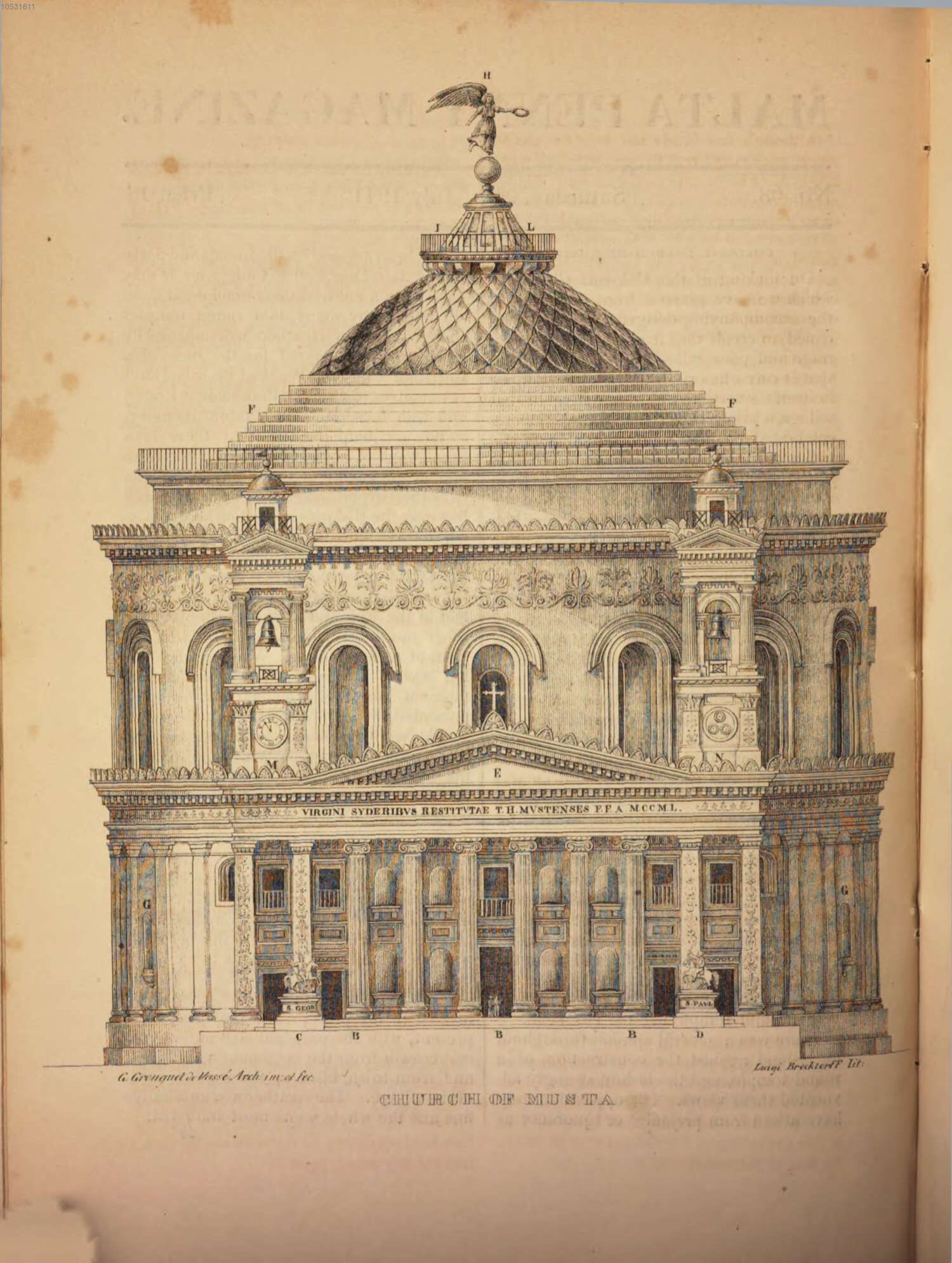
The Rotunda’s dome measures 37.2 metres in diameter internally. It was constructed without scaffolding for the main structure, using a method in which the dome was built around a mound of compacted earth that was gradually removed as the masonry rose, section by section. The work was almost entirely funded by the parishioners of Mosta themselves, who contributed labour, money and material over nearly three decades. Construction began in 1833. The church was consecrated in 1871, fifteen years after Grognet’s death.
What he left behind is an interior of extraordinary, disorienting grandeur. You enter through the portico — six Ionic columns supporting a classical pediment — and then the space opens, circular and vast, ringed by side chapels and pilasters, with the dome soaring above painted in deep blue and gold. The scale is not easily absorbed. The Rotunda can hold a congregation of over ten thousand people. On Santa Marija, it very nearly does.
The afternoon of 9 April 1942
By 1942, Malta had been under almost continuous aerial bombardment for two years. The island’s strategic position in the central Mediterranean made it critical to Allied supply lines to North Africa, and the Axis powers understood this. Between June 1940 and November 1942, Malta endured over three thousand air raids — more bombs per square mile than any other place on Earth during the Second World War. The island was awarded the George Cross by King George VI in April 1942, the only time the decoration has been given to an entire people.
On the morning of 9 April 1942 — a Tuesday in Holy Week — three German Junkers Ju 88 bombers crossed over Mosta during a raid. The Rotunda was full. Wartime Malta had not abandoned its liturgical calendar, and the people of Mosta were gathered inside the church for afternoon devotions, some three hundred of them.
At approximately 4:40 in the afternoon, a bomb pierced the dome. It tore through the ocular opening at the top, struck the interior wall, ricocheted across the stone floor, and came to rest in the nave among the congregation.
It did not detonate.
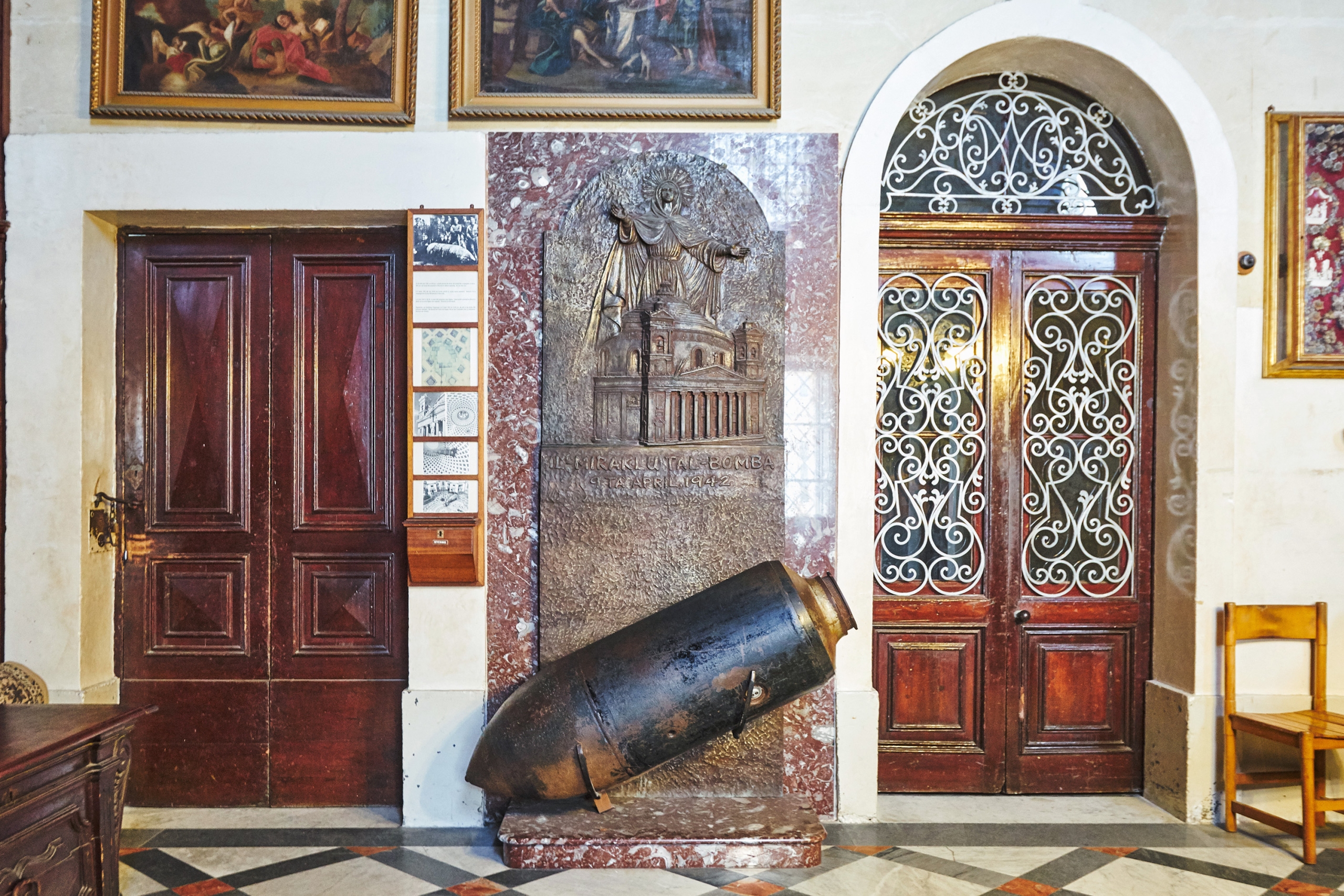
Two further bombs struck the Rotunda’s exterior during the same raid, causing structural damage but no collapse. The bomb in the nave — a 500-kilogram German SC 500 — was later made safe and removed. Of the three hundred people inside the church, not one was killed. Not one was seriously injured.
The story travelled quickly. In a population already enduring extraordinary hardship — the siege had reduced Malta to near-starvation by that spring, and the tanker Ohio would not arrive with its critical fuel cargo until August — the event at Mosta became something to hold onto. The parish has never been reluctant about what it calls the episode: a miracle, pure and simple, of Our Lady of the Assumption, to whose honour the Rotunda had been built and in whose honour the congregation had gathered.
A replica of the bomb is kept in the sacristy today, alongside fragments of shrapnel and documentation of the event. It is one of the most visited objects in Malta — not because it is spectacular in itself, but because of what it did not do.
A church built for this feast
The Rotunda and the feast of the Assumption are inseparable in Mosta’s identity. The church was built in honour of Santa Marija Assunta, and the 15th of August transforms it more completely than any other day of the year.
The exterior of the dome is illuminated. Enormous damask hangings cover the portico columns. The surrounding streets are strung with lights and crowded with people who have come from across the island. The procession of the titular statue — Our Lady of the Assumption, borne on the shoulders of the faithful through the village — departs from the Rotunda and returns to it. And after the procession, the fireworks, launched from the fields outside Mosta, frame the dome in light and smoke against the summer sky.
It is, by any measure, one of the great religious festivals of the Mediterranean. But in Mosta there is always the awareness, underneath the celebration, of that Tuesday in 1942. The feast of the Assumption in this village is also a feast of survival. The Rotunda is full because it was once full in very different circumstances, and the congregation did not die.
Santa Marija: Malta’s greatest feast and the island’s Marian soul
Visiting the Rotunda
The Rotunda is open to visitors throughout the year, with the sacristy and its wartime exhibits accessible daily. The church stands at the centre of Mosta, a short walk from the main square, and is unmissable in every literal sense — the dome is visible from most of the island.
For pilgrims walking the Camino Maltés, the route passes through Mosta as part of the itinerary connecting Rabat to the harbour and onward to Valletta. The Rotunda marks one of the great pauses on that walk: a place where the scale of Maltese faith becomes suddenly, physically undeniable.
The best time to see the interior is early morning, before the heat and the tour groups arrive, when the blue and gold of the dome catches the light from the ocular and the space is still and very quiet. Stand in the centre of the nave, where the bomb came to rest, and look up.
AI Transparency Notice
PilgriMaps uses artificial intelligence tools to assist in the research, drafting and translation of editorial content. All AI-assisted content is reviewed, edited and verified by our editorial team before publication. We contrast information against primary sources, specialist literature and on-the-ground knowledge to ensure accuracy, cultural sensitivity and editorial integrity.
AI is one tool among many in our workflow. The judgement, curation and responsibility for everything published on this platform remain entirely human.
Viator Media S.L. — in compliance with the EU Artificial Intelligence Act (Regulation EU 2024/1689).
This post is also available in: