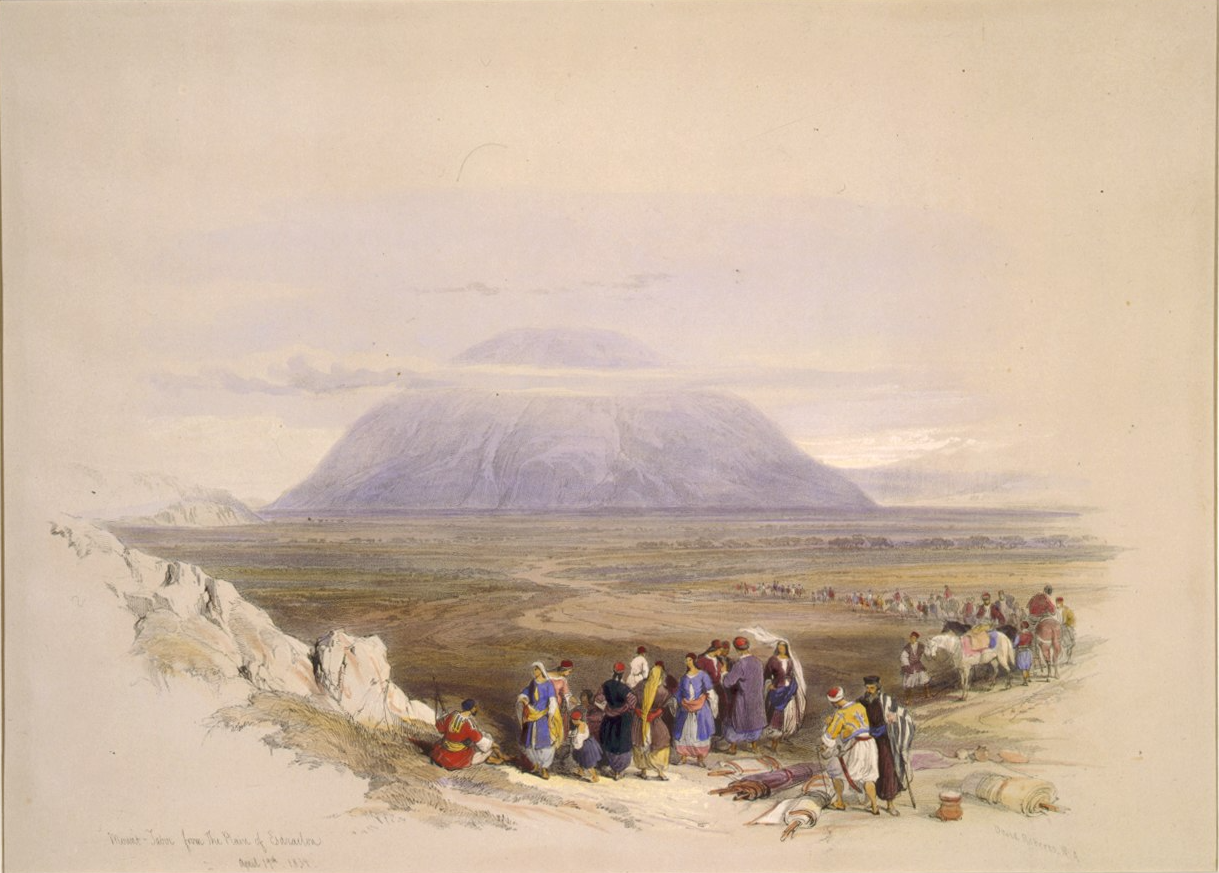
Mount Tabor rises in isolation from the broad plain of Esdraelon in northern Israel, its rounded profile distinct against the horizon. Standing at just 575 meters above sea level, it is unremarkable in height yet singular in presence. Unlike surrounding ridgelines, Tabor is solitary, and this detachment gives it a commanding, almost intentional quality—appearing not as part of a range but as a chosen summit.
Its slopes are covered with oak, lentisk, and thyme. In spring, white lilies and red anemones bloom. The air carries the dry, resinous scent of the Mediterranean scrubland. From the summit, the panorama stretches across Galilee: snow-capped Mount Hermon to the north, Mount Carmel to the west, and the Jordan Valley to the east. It is one of the few places where the region’s biblical topography can be fully grasped—landscape and history layered across the horizon.
At dawn, as fog lifts and shadows retreat, the ascent evokes a quiet clarity. Even for secular visitors, Mount Tabor presents more than a scenic view—it offers a moment of encounter with time, space, and light.
Sacred Histories: From Baal to the Transfiguration
Long before its Christian associations, Tabor was a sacred site for the Canaanites. Archaeological and textual evidence points to Bronze Age worship of Baal, a deity of storms and fertility. This early veneration linked the mountain to sky and seasonal renewal. The Phoenicians carried the cult westward to Rhodes, where a temple to Zeus Atabyrios—deriving its name from “Atabyrion” or Tabor—was erected. Across cultures, the mountain functioned as an axis mundi: a place where heaven and earth converged.
This sacred status endured into Israelite history. The Hebrew prophet Hosea denounced its high places (Hosea 5:1), integrating Tabor into the developing geography of monotheism. In the Hebrew Bible, it appears in the Song of Deborah as the site where Israelite forces assembled before defeating Sisera. The Psalms, too, mention Tabor alongside Hermon, pairing them as symbols of divine grandeur.
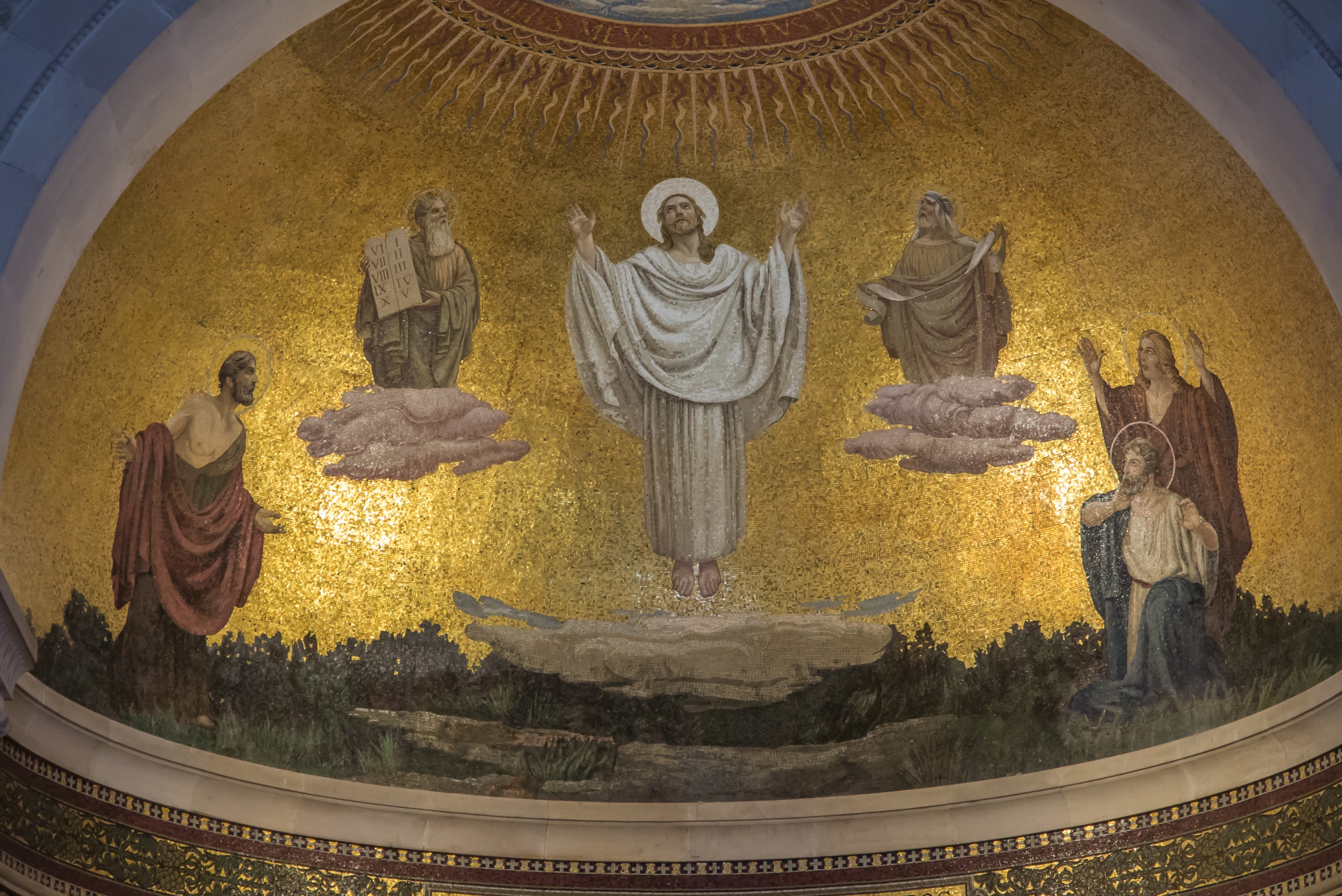
In early Christian tradition, Tabor gained new significance as the site of the Transfiguration. Though the Gospels do not name the mountain explicitly, early theologians such as Origen and Cyril of Jerusalem identified it as the “high mountain” where Jesus, in the presence of Peter, James, and John, is transfigured—shining in radiant light while conversing with Moses and Elijah. A luminous cloud envelops the scene, often interpreted in theological contexts as a manifestation of divine presence.
Thus, the mountain once associated with Baal, lord of the storm, becomes known as the mountain of light. The theme of revelation—from tempest to transfiguration—runs like a thread through three millennia of spiritual history.
Tabor also holds significance in Islamic tradition, known as Jabal al-Tur. Its slopes have long been home to Druze and Muslim communities, coexisting with Christian monastic enclaves. Today, the mountain remains a shared cultural and religious space within the complex mosaic of Galilee.
Conflict, Ruin, and Restoration
Tabor’s prominence made it not only a site of vision but also a site of struggle. During the First Jewish–Roman War (66 CE), historian and military commander Flavius Josephus fortified the summit, but Roman forces captured it after severing its water supply. Ruins from that era still mark the summit’s surface.
In the 4th century, Helena, mother of Emperor Constantine, is said to have commissioned a church atop the remains of earlier shrines. Three chapels were later constructed to represent the three “tents” mentioned in the Gospel account of the Transfiguration. By the 6th century, the anonymous pilgrim from Piacenza already listed the mountain among Christian pilgrimage destinations.
Crusaders later fortified the site and founded a Benedictine monastery. However, following their defeat at Hattin in 1187, the fortress and chapels were destroyed by Saladin’s forces. A brief attempt at reconstruction was again cut short in 1263, when Sultan Baybars razed what remained.
In 1631, Druze emir Fakhr al-Din permitted the Franciscan order to return. Amid ruins and underbrush, they slowly re-established a presence. Their restoration efforts culminated in the early 20th century with the construction of the Basilica of the Transfiguration (1924), designed by Italian architect Antonio Barluzzi. The structure, combining Romanesque and Byzantine elements, features two towers symbolizing Moses and Elijah. Below the altar, the crypt preserves the apse of the earlier Byzantine church. Light filters through the apse’s stained glass in warm, subdued tones—intentionally evoking the mountain’s enduring association with light
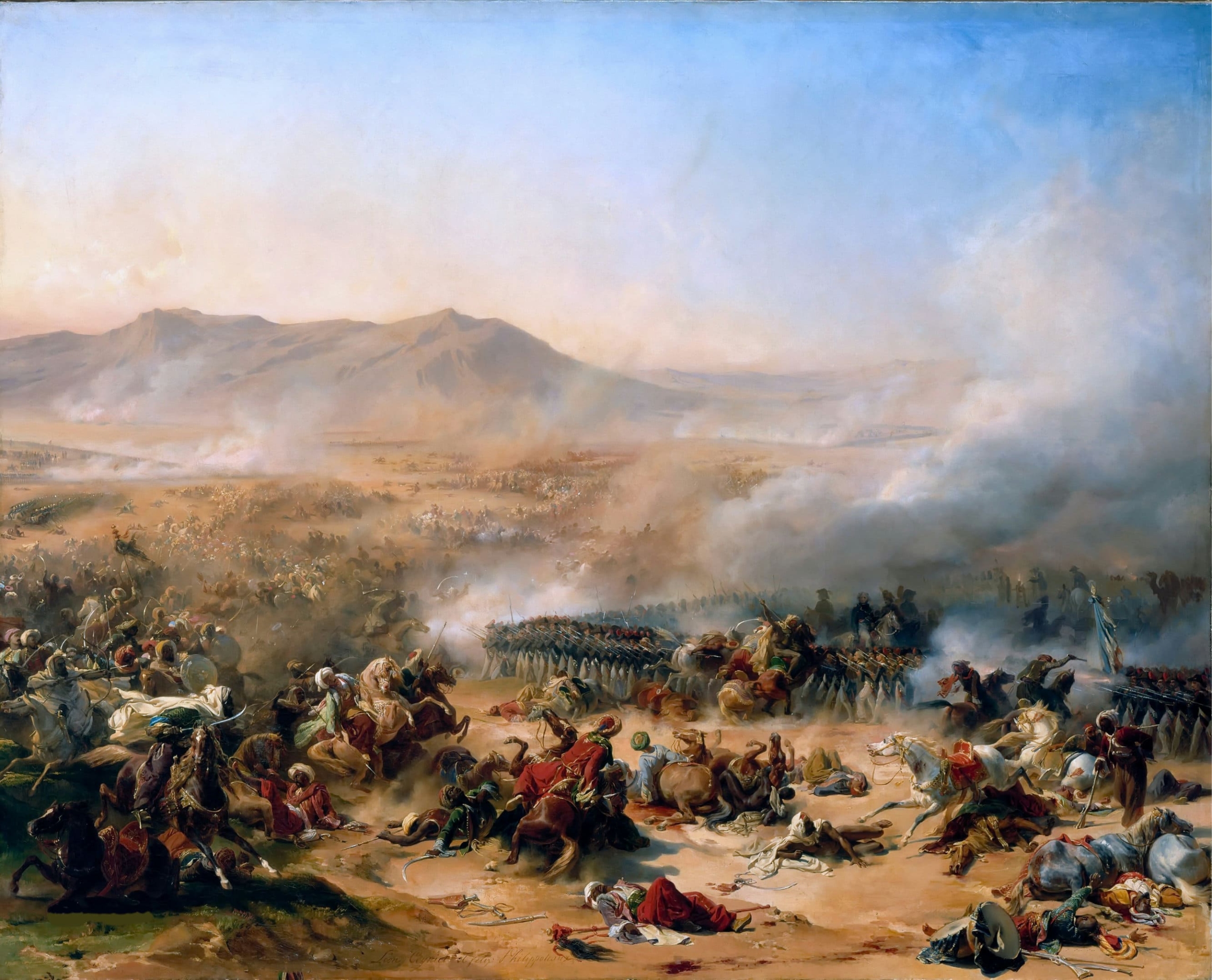
Tabor’s strategic position also drew attention in modern warfare. In 1799, during Napoleon’s Syrian campaign, French troops engaged Ottoman forces on its lower slopes. The French emerged victorious, but the mountain itself remained unchanged—a silent witness to centuries of conflict.
Travelers and Perspectives
Early pilgrimage accounts emphasize Mount Tabor’s spiritual associations. The 6th-century Piacenza pilgrim wrote briefly but evocatively of the three churches atop the mountain, linking them to the Gospel narrative. For such travelers, the mountain was less a viewpoint than a lived encounter with sacred geography.
In 1869, Mark Twain visited Tabor during his journey through the region. His travelogue, The Innocents Abroad, describes the view with characteristic irony and detachment: “The plain of Esdraelon stretched below like a checkerboard; gray ruins lay across the dust. No relics of saints, no sacred bones—only the melancholy of history.” Twain’s ambivalence reflects the tension between reverence and realism—a tension still felt by many visitors today.
Writers such as Chateaubriand and Lamartine responded to the mountain with more Romantic sensitivity, seeing it as a landscape shaped by memory and myth. Each, in their own way, perceived Tabor as more than a geographic landmark. Its meaning, like its form, shifts depending on who ascends it.
Mount Tabor Today
Modern-day visitors encounter a site shaped by centuries of layering—both material and symbolic. Two active monasteries (Franciscan and Eastern Orthodox) maintain a daily rhythm of prayer and hospitality. Paths wind through olive groves, Crusader ruins, and forested lookouts.
Each August 6, the Feast of the Transfiguration draws Christian pilgrims from around the world. Aramaic, Arabic, Italian, Spanish, and Russian mingle in the liturgy. As dawn breaks, light fills the basilica, mirroring the scene it commemorates.
Throughout the rest of the year, Mount Tabor remains quiet but far from dormant. Nearby villages like Daburiyya and Shibli-Umm al-Ghanam are home to mixed communities of Muslims, Jews, and Christians. Local life continues with olive harvests in autumn and, more recently, a summer jazz festival that draws regional and international artists. Music, agriculture, and prayer converge here—not in conflict, but in coexistence.
Ascending Tabor today is less an act of devotion than an invitation to pause. The route from the Wind Gate to the basilica curves through woodlands and clearings. At the top, heat radiates from sunlit stones, and incense hangs in the air. Whether arriving as a pilgrim or a traveler, many share a quiet recognition: “It is good to be here.”
That phrase, attributed to the apostle Peter, endures—not as doctrine, but as observation. On Mount Tabor, presence itself is revelation enough.
The Jesus Trail: four days on the way from Nazareth to Capernaum
AI Transparency Notice
PilgriMaps uses artificial intelligence tools to assist in the research, drafting and translation of editorial content. All AI-assisted content is reviewed, edited and verified by our editorial team before publication. We contrast information against primary sources, specialist literature and on-the-ground knowledge to ensure accuracy, cultural sensitivity and editorial integrity.
AI is one tool among many in our workflow. The judgement, curation and responsibility for everything published on this platform remain entirely human.
Viator Media S.L. — in compliance with the EU Artificial Intelligence Act (Regulation EU 2024/1689).
This post is also available in: