On Jeju Island, a volcanic island south of the Korean Peninsula, a walking trail traces the contours of land and sea with restraint and care. This is not an incidental path. In 2011, Jeju was named one of the New Seven Wonders of Nature, and to walk its perimeter step by step remains one of the most direct ways to understand why.
The route is known as the Jeju Olle Trail. It is neither a conventional trekking circuit nor a purely recreational attraction. The Olle offers a way of moving through the island at human pace, attentive to sound, texture, and encounter, allowing geography and daily life to shape the journey.
Origins of the Olle
The trail’s origins date to 2007, when South Korean journalist Suh Myung-suk returned from walking the Camino de Santiago. Inspired by the social and cultural dimensions of that route, she envisioned a comparable network for her home island—one that would reconnect people with Jeju’s landscapes, villages, and inherited pathways.
She chose the name olle, a word from the local dialect referring to the narrow lane linking a private home to the main road. The term conveys transition: from interior to exterior, from familiar space to open terrain. This idea underpins the trail’s design, which repeatedly moves walkers between shoreline, farmland, forest, and settlement.
From the outset, local volunteers played a central role. Older footpaths were reopened, fishing villages reconnected, and new segments marked with attention to environmental limits. Today, the Jeju Olle Foundation manages the network, coordinates volunteers, and promotes walking as a cultural practice rather than a competitive sport.
The Olle has gained international visibility and maintains a symbolic partnership with the Camino de Santiago. Walkers who complete both routes may request joint certificates, a gesture that acknowledges shared values of slow travel and landscape-based experience, despite their very different histories.
Landscapes along the route
The Jeju Olle extends for approximately 437 kilometers, divided into 21 main routes and several variants. Together, they form a circuit around the island, largely following the coast while periodically turning inland.
Each route has its own character, yet all share a close relationship with the island’s volcanic terrain. Walkers pass black lava cliffs and pale sand beaches, cross citrus orchards and rural fields, and enter dense lava forests known as gotjawal, where porous basalt supports an unusual mix of subtropical and temperate species.
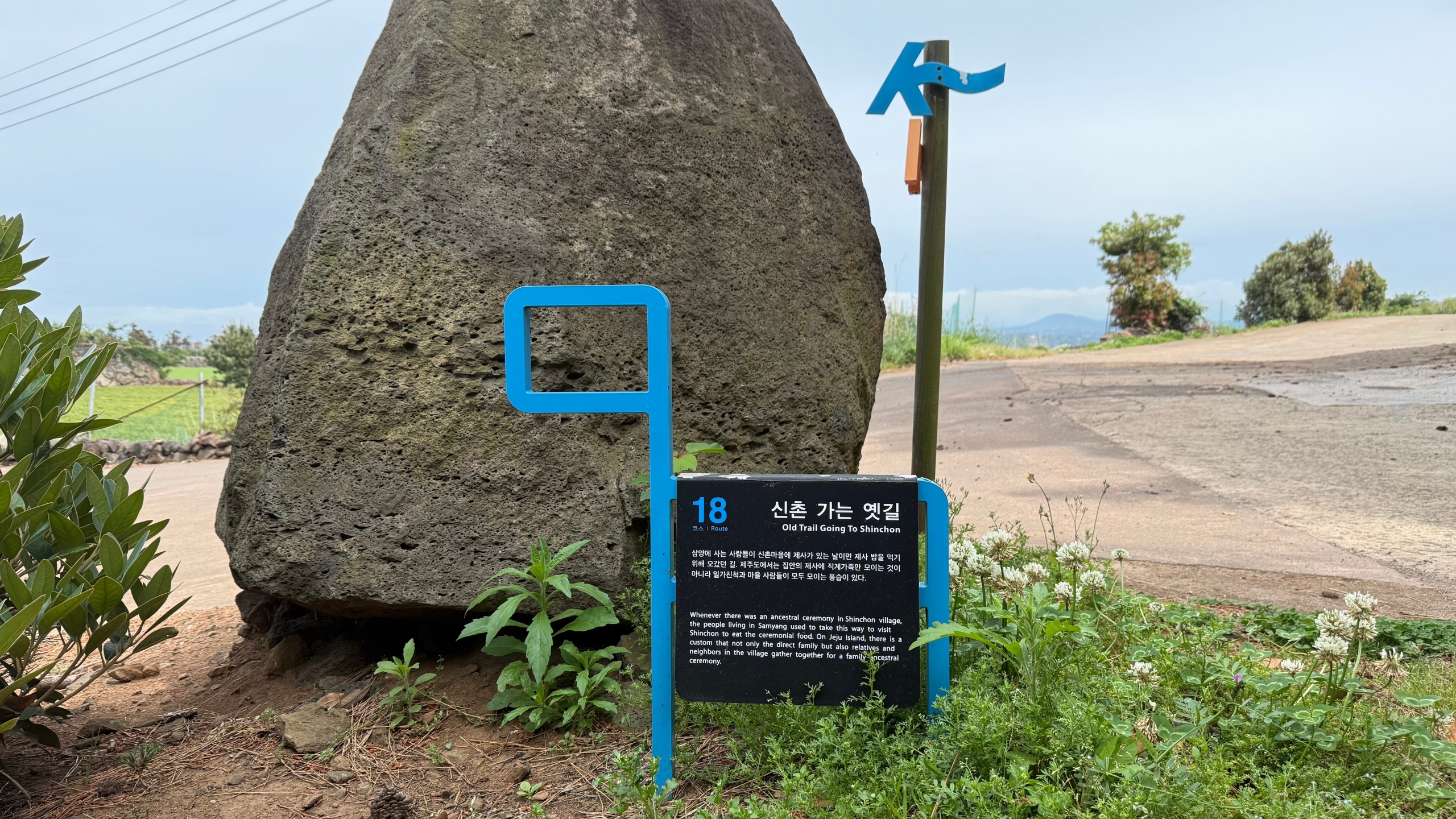
Dominating the interior is Hallasan, the highest peak in South Korea. Although the Olle does not climb its slopes directly, the mountain’s profile remains visible from much of the trail. Surrounding it are numerous oreum, smaller volcanic cones scattered across the island. Local folklore attributes their formation to a giant ancestral figure, embedding narrative meaning into the terrain without separating it from everyday life.
Several sites stand out along the Olle:
- Seongsan Ilchulbong, a coastal volcanic crater and UNESCO-listed site, is known for sunrise views over the sea.
- Sanbangsan, a dome-shaped mountain with a lava cave on its flank, rises abruptly from the lowlands.
- Udo Island, accessible by ferry and incorporated into the Olle network, offers coral beaches, canola fields, and local legends tied to its shape.
- Gotjawal forests form some of the island’s most ecologically distinctive zones, their uneven lava floors creating a cool, shaded environment even in summer.
The sea remains a constant presence—sometimes calm and reflective, sometimes wind-driven and grey. Small satellite islands appear and disappear on the horizon, reinforcing the sense of Jeju as an island shaped by movement and exposure.
Encounters with everyday Jeju
The Olle does not isolate walkers from daily life. Fishing villages and agricultural hamlets lie directly along the route, and brief exchanges with residents are common. Gestures of hospitality—fruit offered from a garden, directions given at a crossroads—form part of the walking experience.
Among the island’s most recognizable figures are the haenyeo, female free divers who harvest seafood without breathing equipment. Their work has been recognized by UNESCO as Intangible Cultural Heritage. Often visible offshore with bright flotation buoys, many continue this physically demanding practice well into later life. Their routines reflect generational knowledge and a pragmatic relationship with the sea, sometimes accompanied by customary gestures seeking safety and favorable conditions.
Small local shrines (dang), stone markers, and offering trees appear along certain sections. The trail passes these sites without emphasis, acknowledging their place in the landscape. The dol hareubang, carved stone figures often described as “stone grandfathers,” stand at village entrances and crossroads, functioning as cultural symbols rather than objects of worship.
Food also anchors the journey. Simple meals—seaweed soups, locally raised black pork, seasonal fruit—are widely available in markets and small restaurants. Eating where residents eat offers insight into agricultural cycles and regional identity.
Practicalities of walking the Olle
The Jeju Olle Trail is designed for accessibility. Most routes range between 15 and 20 kilometers, with difficulty levels from easy to moderate. No technical skills are required, only time, basic fitness, and attentiveness.
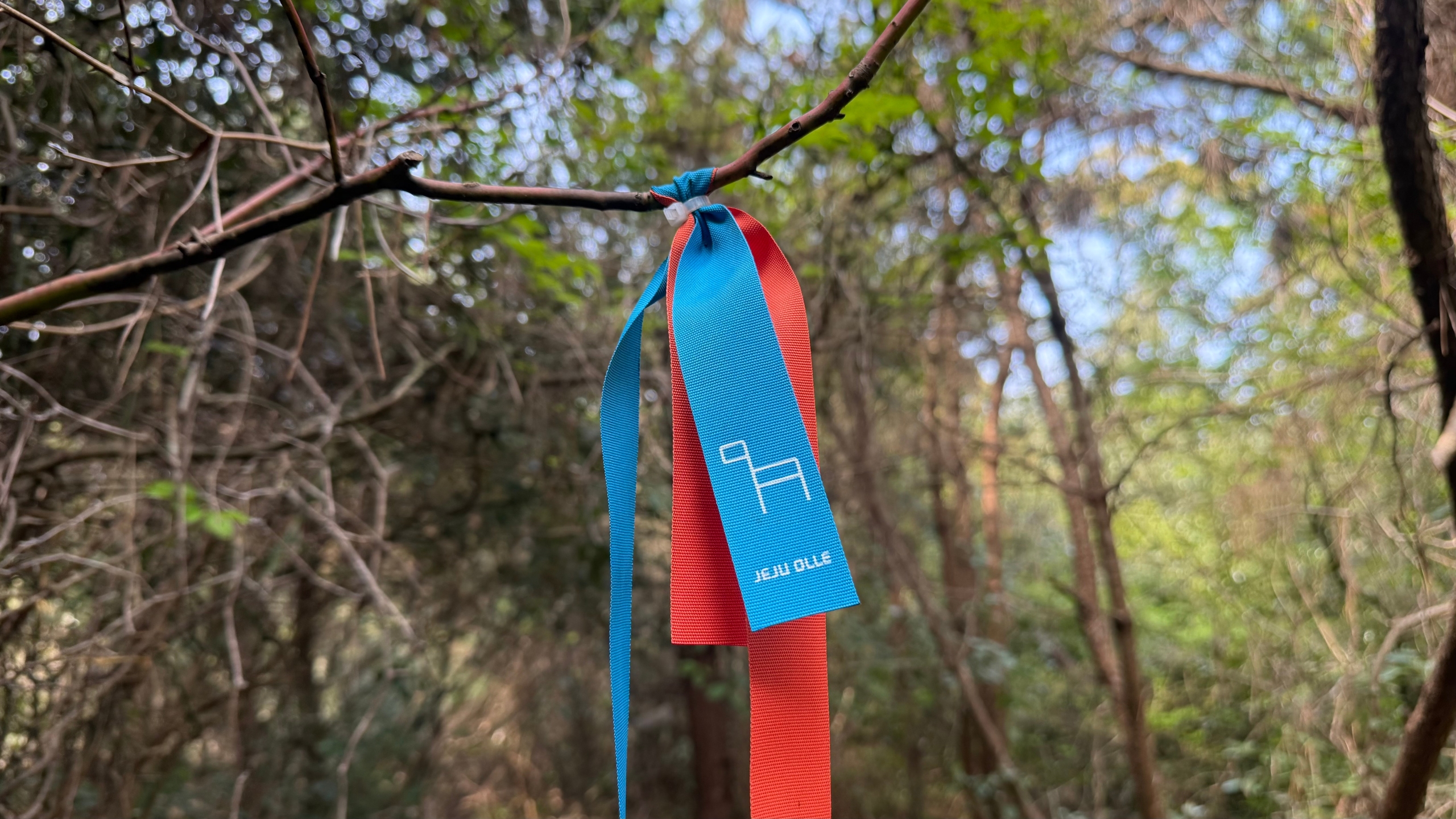
Walkers may complete individual sections or undertake the full circuit over several weeks. The trail accommodates both approaches. Waymarking is clear: blue ribbons indicate one direction, orange the reverse. The ganse, a stylized local pony, appears on signs and posts as the trail’s emblem.
An Olle passport allows walkers to collect stamps at the end of each route. Completing a set number of sections qualifies for a medal and certificate issued by the foundation, serving as a record of time spent rather than a competitive achievement.
Spring (April–May) and autumn (September–October) offer the most stable weather. Summer brings heat and humidity; winter introduces strong coastal winds and fog, creating a quieter atmosphere.
Infrastructure remains modest but effective, with information centers, maps, volunteer support, and regular access to villages for rest and supplies.
Walking with the Island
Walking the Jeju Olle is ultimately a way of inhabiting place differently. The experience is shaped less by spectacle than by accumulation: repeated views of the sea, gradual shifts in terrain, and brief encounters that connect landscape to lived history.
On an island recognized for its natural significance and sustained by everyday cultural practice, the Olle offers a form of movement that prioritizes attention over destination. The path unfolds externally, while another, less visible route takes shape through observation, memory, and pace.
AI Transparency Notice
PilgriMaps uses artificial intelligence tools to assist in the research, drafting and translation of editorial content. All AI-assisted content is reviewed, edited and verified by our editorial team before publication. We contrast information against primary sources, specialist literature and on-the-ground knowledge to ensure accuracy, cultural sensitivity and editorial integrity.
AI is one tool among many in our workflow. The judgement, curation and responsibility for everything published on this platform remain entirely human.
Viator Media S.L. — in compliance with the EU Artificial Intelligence Act (Regulation EU 2024/1689).
This post is also available in: