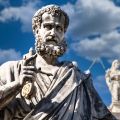
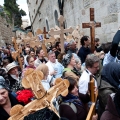
Light falls through the windows of a sober baroque façade on a quiet street in Rabat. Nothing suggests that behind that door lies a journey through nearly two thousand years of history. Within a few steps you move from galleries filled with paintings and ecclesiastical treasures to a grotto linked to Saint Paul, from catacombs cut into the rock to air-raid shelters used during the Second World War.
Few places in Malta condense so many layers of memory into so small a space. And few are so closely tied to a figure who shaped the destiny of the tiny country as Alof de Wignacourt.
His name appears on coastal towers, aqueducts, portraits, and monuments scattered across the archipelago. It also gives its name to one of Malta’s most compelling museums — a place that allows visitors to understand how the island passed from being a military outpost of the Christian Mediterranean to becoming a society with its own distinct identity, deeply marked by the Order of Saint John and by the tradition of Saint Paul’s shipwreck
The Grand Master who left his mark across the Archipelago
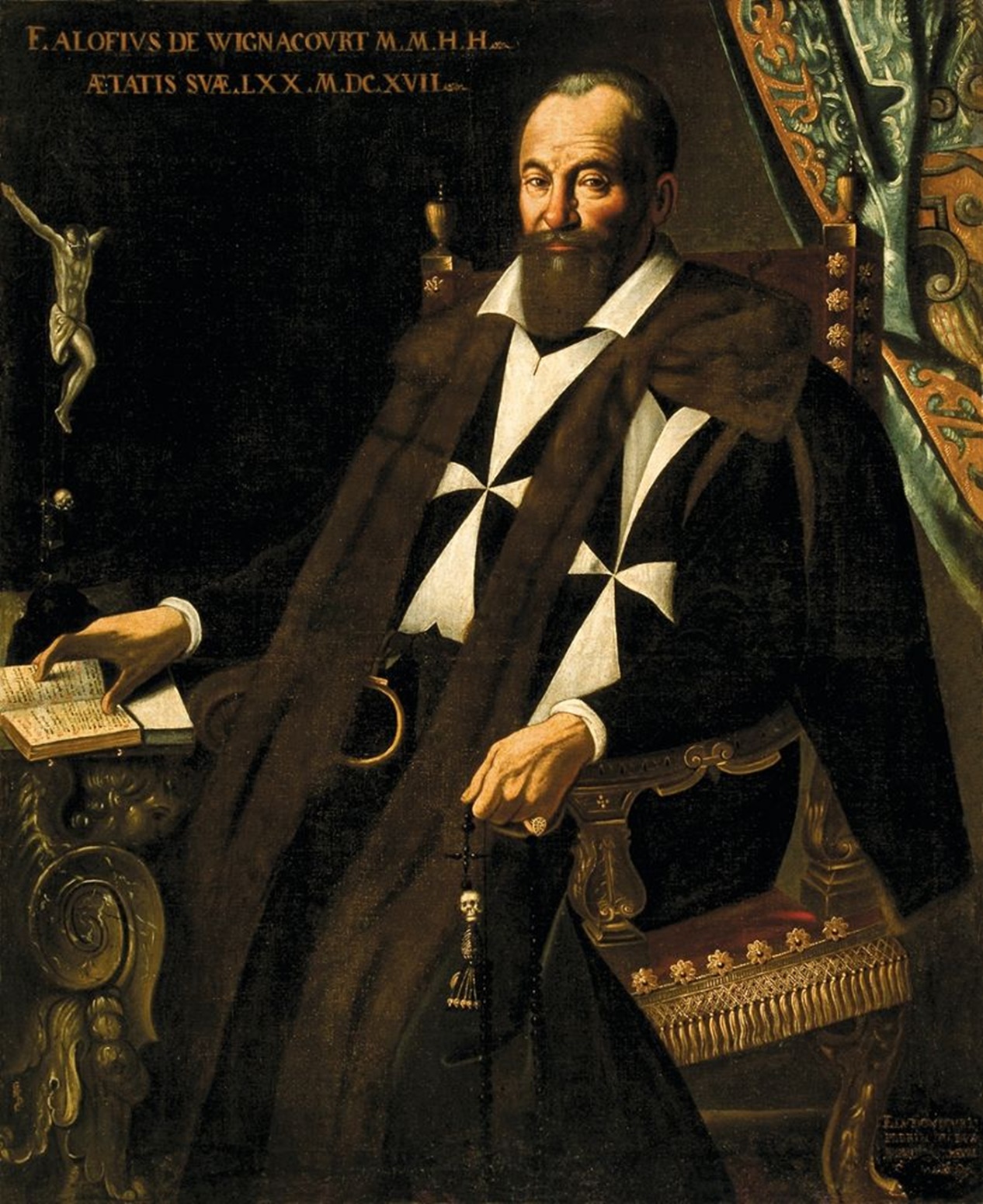
Alof de Wignacourt was born in France in 1547, into a noble family. He joined the Order of Saint John in 1564, barely a year before the Great Siege of Malta, in which he took part. That experience would mark an entire generation of knights: the heroic resistance turned Malta into one of the symbols of Mediterranean Christendom and consolidated the Order’s prestige.
When Wignacourt was elected Grand Master in 1601, Malta was passing through a period of relative stability. The Ottoman threat still existed, but was no longer as pressing as it had been in previous decades. This allowed resources to be directed toward building, defense, and institutional organization — projects that would end up profoundly transforming the island.
Among all the Grand Masters of the Order, Wignacourt occupies a singular position. Historical sources consistently note that he enjoyed an unusual degree of popularity among the Maltese people. He was seen not merely as a foreign ruler, but as someone who made a tangible contribution to the island’s wellbeing.
His most celebrated work is the Wignacourt Aqueduct, an impressive infrastructure that brought water from the elevated inland areas down to Valletta. On an island where fresh water had always been a scarce resource, this construction had an enormous impact on daily life. Some of its arches are still part of the Maltese landscape today.
To this he added a network of coastal fortifications known as the Wignacourt Towers. These structures allowed the coastline to be monitored and enemy incursions to be repelled quickly. Their importance was demonstrated in 1614, when an Ottoman force landed at Marsaxlokk and ransacked part of the southeast of the island. The mobilization of the Order and the Maltese people themselves managed to repel the attack — which would prove to be the last serious Ottoman attempt to conquer Malta.
But Wignacourt’s influence was not limited to defense or public works. During his rule, the tradition linking Malta to Saint Paul’s shipwreck, as narrated in the Acts of the Apostles, gained particular prominence. The Grand Master promoted the institutional prestige of the sites associated with the Apostle and supported the development of the religious complex in Rabat that would eventually become one of the principal centers of Pauline devotion on the island.
His name also became forever associated with one of the most celebrated artists in Western history. When Caravaggio arrived in Malta in 1607, he found in Wignacourt a protector and patron. The painter made several portraits of the Grand Master, as well as his masterpieces The Beheading of Saint John the Baptist and Saint Jerome Writing — considered the summit of baroque Malta.
From Baroque College to Museum
The museum that today bears his name was not originally conceived as a museum. The building forms part of the Pauline complex of Rabat and stands beside the Basilica of Saint Paul, in the surroundings that tradition identifies with the Apostle’s stay on the island.
The history of the site is closely linked to the development of this pilgrimage center. In 1610, the Grotto of Saint Paul was entrusted to the Spanish hermit Friar Juan Beneguas of Córdoba. Under Wignacourt’s rule, the veneration of Saint Paul received strong institutional support.
Over the course of the seventeenth and eighteenth centuries the building was enlarged several times until it reached its current configuration. The present baroque structure was completed in 1749 and served for generations as the residence of the chaplains of the Order of Saint John.
The history of the building mirrors the history of Malta itself. Following the French occupation of 1798, it continued to be used under state administration. During the twentieth century it served many different functions: school, infirmary, social center, and parish offices. Finally, in 1981, it opened its doors as a museum, beginning a new chapter devoted to the conservation and promotion of Malta’s heritage.
A Museum built on layers of History
What distinguishes the Wignacourt Museum from many other European museums is its extraordinary diversity. It is not simply an art collection or a historic building. It is rather a succession of overlapping worlds.
The visit typically begins on the piano nobile, where the main art collection is housed. Here some of the most important figures in Maltese and Mediterranean painting appear, among them Mattia Preti, Antoine Favray, and Francesco Zahra. The galleries also hold liturgical silver, reliquaries, sculptures, historical maps, coins, and rare books that allow visitors to reconstruct the religious and cultural life of baroque Malta.
Among the most striking objects is a copy of the Assertio Septem Sacramentorum — the work written by Henry VIII of England against Martin Luther, before Henry’s own break with Rome. It is one of those objects that remind you how connected Malta was to the great religious debates of Europe.
The collection also holds objects directly related to the Order of Saint John. The most singular is probably the portable altar used on the knights’ galleys. Designed for celebrating Mass at sea, it could be folded shut like a box and contained everything necessary for worship. The museum presents it as the only known example of its kind.
Equally remarkable is the historical replica of the Turin Shroud authenticated in the seventeenth century, along with several reliquaries of considerable artistic quality and a notable collection of portraits connected to the Order.
Descending into underground Malta
The true character of the museum, however, lies below ground. The route leads visitors down to the Grotto of Saint Paul, the spiritual heart of the entire complex. According to Maltese tradition, it was here that the Apostle stayed during his time on the island following the shipwreck described in the Acts of the Apostles. Whatever the historical debates, the grotto has been for centuries one of the most important pilgrimage sites in the archipelago.
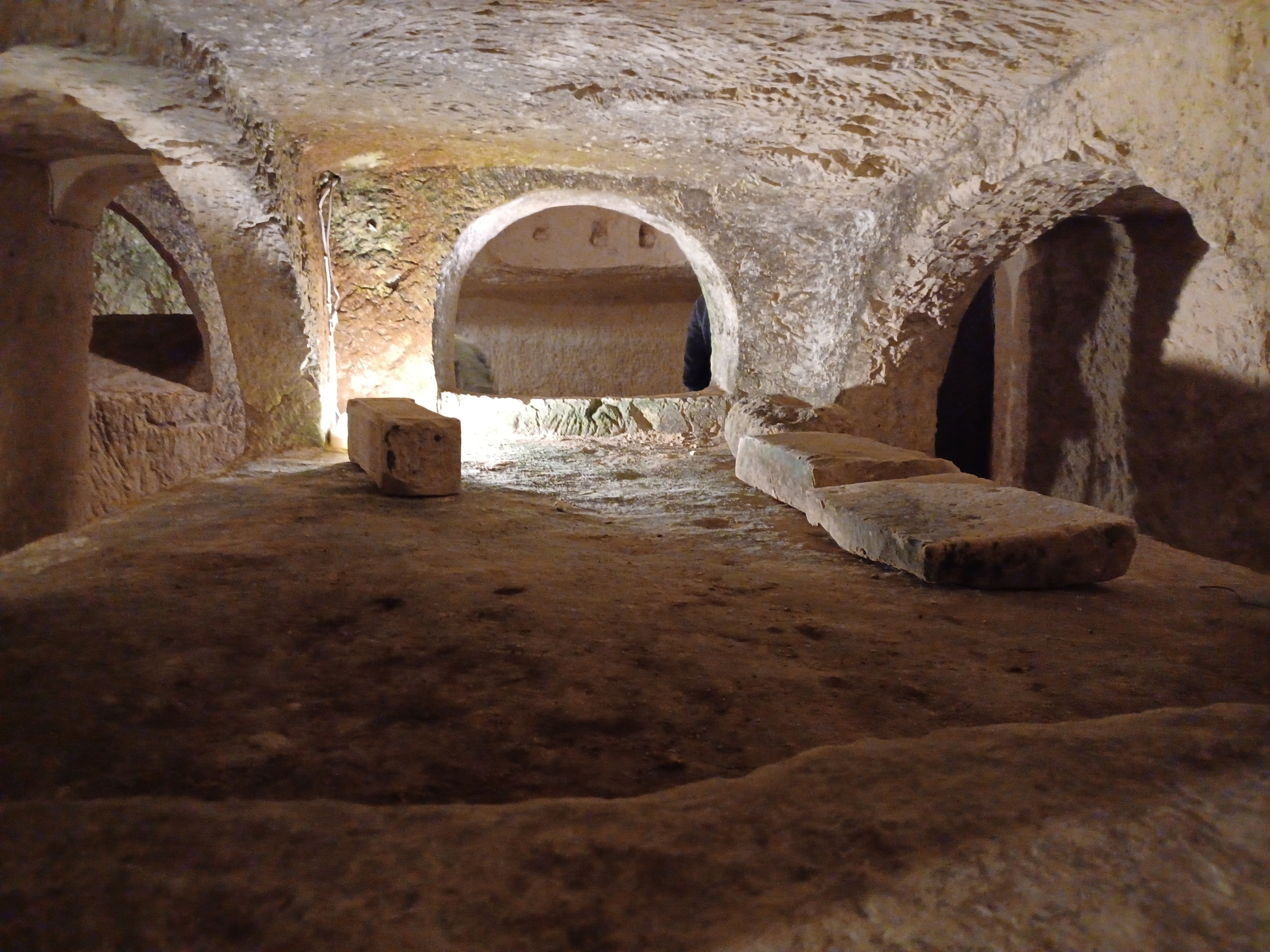
From there, access opens onto an even more ancient world. Hypogea, catacombs, and funerary spaces carved into the rock reveal a history reaching back to antiquity. Some structures preserve stone benches and agape tables used at funeral banquets, offering an exceptional glimpse into the religious practices of Malta’s earliest Christian communities.
The experience is almost archaeological. Visitors do not simply contemplate objects on display; they pass through spaces used for centuries by real people to bury their dead, pray, or gather together.
The final historical layer belongs to the twentieth century. During the Second World War Malta endured the most intense bombing in the entire Mediterranean. The complex preserves a network of air-raid shelters that housed hundreds of people through those difficult years — approximately fifty rock-cut spaces offering protection to around 350 people.
Few visits allow you to move, within a matter of minutes, from late antiquity to the Second World War without leaving the same building.
How to visit the Wignacourt Museum
The museum is located in the historic center of Rabat, beside the Basilica of Saint Paul and just a few minutes from Mdina. This location makes it an ideal visit to combine with a tour of Malta’s ancient capital. It is open daily from 9:30 to 17:00 and offers audio guides in several languages.
Although the institution estimates the visit can be completed in thirty to forty-five minutes, the best approach is to allow between an hour and a half and two hours. Only then is it possible to move through the galleries at a comfortable pace, linger over the main pieces, and explore the underground areas without rushing.
A good itinerary is to begin with the baroque rooms on the upper floor, continue through the historic quarters and the chapel, and leave the Grotto of Saint Paul, the catacombs, and the war shelters for last. In this way, the physical descent underground coincides with a journey into the deepest layers of Maltese history.
Any visit to Malta should include the Wignacourt Museum, for few places do more to illuminate the island’s historical identity. The building brings together several of the great Maltese narratives: the tradition of Saint Paul, the presence of the Knights of Saint John, baroque splendor, early Christian archaeology, and the memory of the Second World War — all of them connected by the figure of Alof de Wignacourt, a Grand Master whose influence remains visible four centuries after his death.
Perhaps that is why the museum is so compelling. It does not tell a single story, but several at once. The story of a French ruler who became a Maltese symbol. The story of an island situated between Europe and the East. And the story of a community that, generation after generation, built its identity upon the traces of those who came before.
AI Transparency Notice
PilgriMaps uses artificial intelligence tools to assist in the research, drafting and translation of editorial content. All AI-assisted content is reviewed, edited and verified by our editorial team before publication. We contrast information against primary sources, specialist literature and on-the-ground knowledge to ensure accuracy, cultural sensitivity and editorial integrity.
AI is one tool among many in our workflow. The judgement, curation and responsibility for everything published on this platform remain entirely human.
Viator Media S.L. — in compliance with the EU Artificial Intelligence Act (Regulation EU 2024/1689).
This post is also available in: