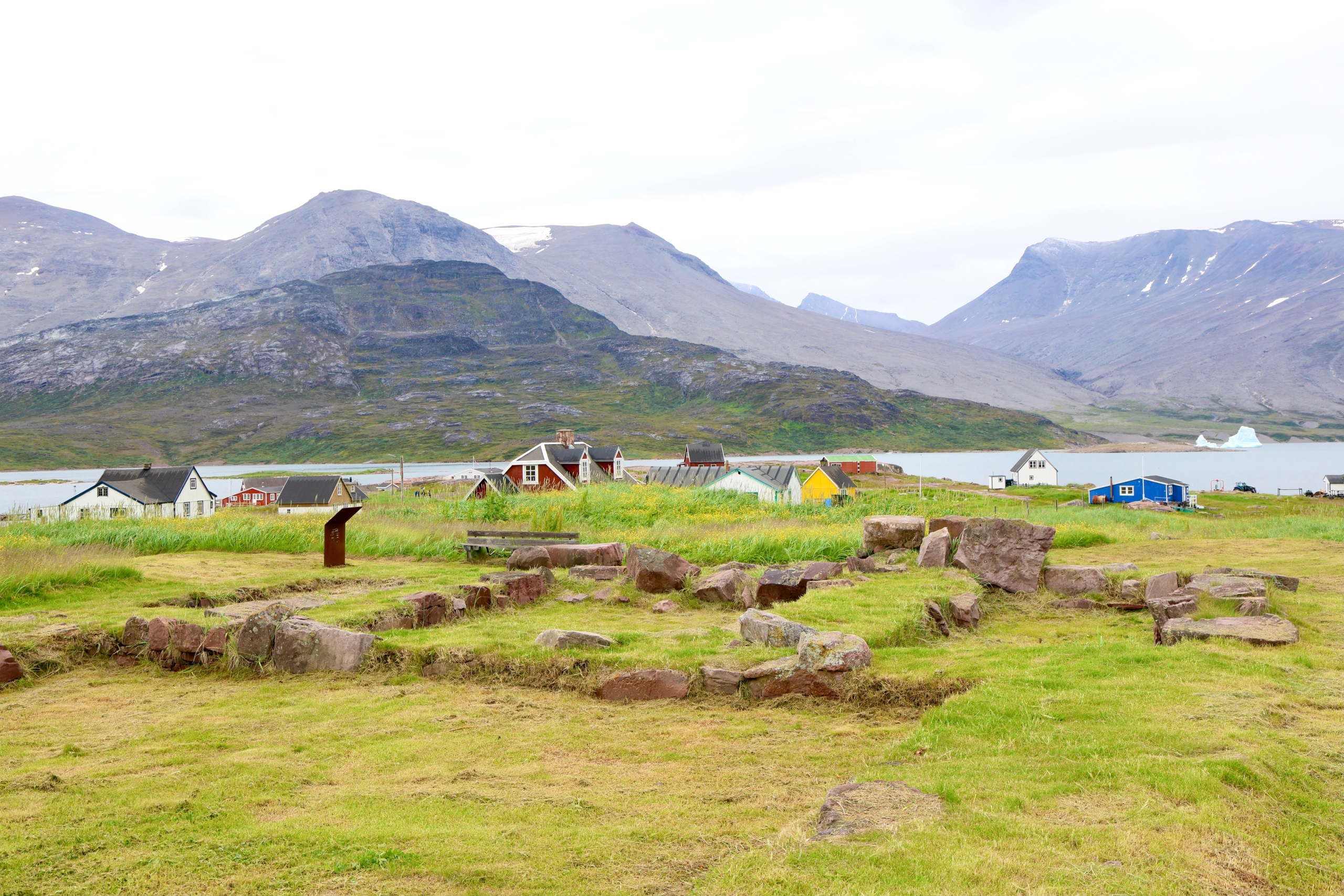
You step onto damp grass that creaks underfoot, as if entering a place that has always existed, though its meaning must be learned rather than assumed. There is no church door to cross, no nave, no bell tower to announce arrival. Only sheep, wind, open meadows, and low stone fragments beneath your boots.
This is where a cathedral once stood: dedicated to Saint Nicholas, traditionally associated with seafarers, in what is now the southern Greenlandic village of Igaliku. For nearly four centuries – between the 12th and 15th centuries – this site was known as Garðar, the ecclesiastical center of medieval Norse Greenland.
What remains is not simply the story of stones. It is the story of a human community that established a symbolic and administrative center thousands of kilometers from the rest of the known world – and how that center functioned simultaneously as a place of ritual life, agriculture, economic exchange, and survival.
The first impression on arrival is paradoxical. In summer, Igaliku resembles a quiet European pasture: green, rolling, almost gentle, with open views over a blue fjord. But lift your gaze toward the surrounding hills and imagine the ice sheet beyond, and the illusion fades. This landscape was never meant to reassure. For centuries, human life here depended on negotiating its unpredictability.
That tension – between brief fertility and permanent severity – frames the entire history of Garðar. Rooting oneself here was always an act of resolve.
Christians at the edge of the known world
Toward the end of the 10th century, Norse settlers from Norway reached Greenland’s southwest coast. The Icelandic sagas – texts blending oral memory and literary construction – describe their gradual adoption of Christianity around the year 1000 CE.
El exilio como camino: La saga de Erik Thorvaldsson y Groenlandia
Jens Erik Carl Rasmussen – Summer Night under the Greenlandic Coast circa 1000Beyond legendary detail, the social logic is clear. In an environment this remote, Christianity functioned as a complete framework of meaning: a ritual calendar, a network of social obligations, and a cultural bridge to Europe. It became not merely an imported belief system, but a structuring force in daily life.Establishing a church in such a place was akin to creating a center of gravity. In 1124, with backing from Sigurd I of Norway, the diocese of Garðar was formally created. Two years later, in 1126, its first bishop, Arnaldur, arrived to establish the episcopal seat. The cathedral dedicated to Saint Nicholas was built soon after, likely with sailors and long-distance travelers in mind – people whose lives depended on the North Atlantic.
A diocese at the end of the world
Garðar was not merely symbolic. Medieval records list up to sixteen bishops appointed to the diocese, though not all reached Greenland or remained there long. One of them, Jón Árnason, traveled to Rome in 1202 to meet Innocent III, then returned to Greenland, where he died in 1209.
Such a journey – at a time when crossing Europe alone could take months – demonstrates how tangible the connection between this Arctic settlement and the center of medieval Europe actually was.
Archaeological research has since identified at least twelve parish churches and four monastic sites across the Norse settlements of Greenland. Even at the margins, a structured ecclesiastical landscape emerged: hierarchies, shared calendars, and local communities participating in practices that aligned them – symbolically and administratively – with distant regions.
The cathedral and daily life
What visitors see today are low stone outlines tracing the floor plan of a cruciform church measuring roughly 27 by 16 meters, built in a Nordic Romanesque style. In a region with scarce timber, constructing a stone cathedral was a statement of long-term intent.
Yet Garðar extended far beyond ritual space. Excavations reveal large ancillary buildings, likely barns or storehouses, capable of holding up to 160 head of cattle. The episcopal estate functioned as a major agricultural unit. In practical terms, sustaining ritual life required producing food, storing hay, managing livestock, and organizing labor.
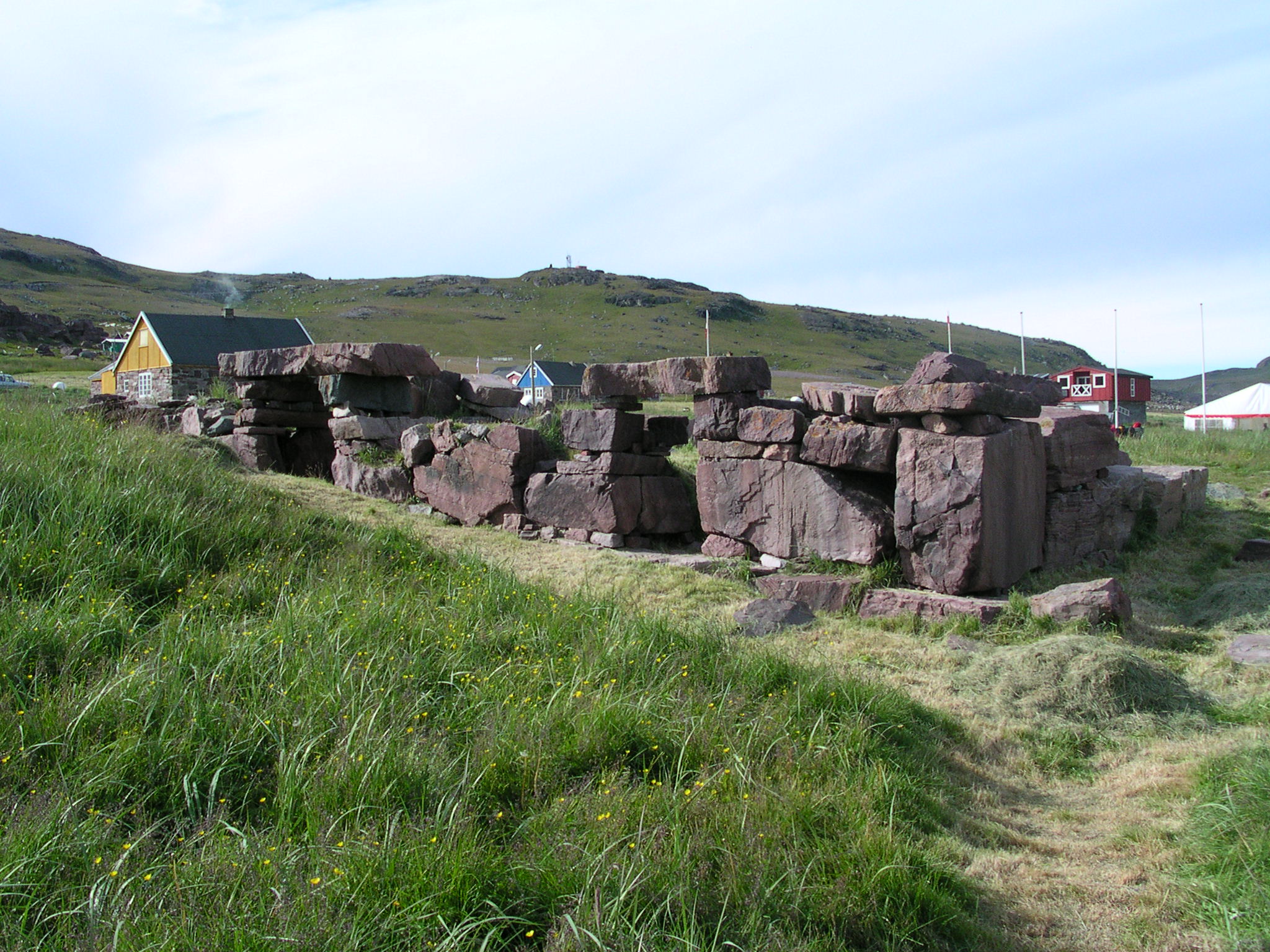
This unfiltered coexistence of spiritual and material activity challenges romantic imagery. Here, communal rites took place alongside farming, trade, and negotiation. Survival was not abstract; it was operational.
Tithes and walrus ivory
The economy of Garðar was shaped by distance. The diocese collected tithes and participated in long-distance trade, particularly in walrus tusks and marine furs, which were sent to Europe not as currency but as valuable commodities. The Church received permission to settle its obligations to Rome in kind, exporting Arctic goods that were then exchanged or sold in Norway.
The image is striking: an episcopal administration sustained by shipments of Arctic ivory crossing dangerous seas. Maintaining this connection was a matter of logistics, endurance, and calculated risk.
Adaptation was constant. A papal letter from 1237 notes that shortages sometimes forced priests to substitute local foods for bread and wine in ritual contexts. This was not anecdotal curiosity, but evidence of how institutional practices shifted under environmental pressure.
The twilight of a connected world
From the 14th century onward, Garðar’s fragile balance began to unravel. Cooling temperatures associated with the Little Ice Age reduced agricultural yields. Europe, affected by the Black Death and internal conflicts, curtailed voyages to the North Atlantic. Communication grew irregular, and isolation deepened.
Some appointed bishops never arrived. One, known as Árni, was presumed dead and replaced while still en route—an administrative symptom of growing disconnection.
At the same time, Inuit groups associated with the Thule cultural tradition expanded southward. European sources describe conflict, but archaeological and comparative evidence suggests a more complex pattern of encounters, exchanges, and tensions typical of overlapping lifeways.
Letters sent to Rome in 1448 and around 1490 describe abandoned churches and communities without clergy or leadership. Ritual life faded not necessarily due to lack of belief, but because the structures sustaining it dissolved. By the mid-15th century, Norse Greenland disappeared quietly from historical records.
Inuit presence, colonization, and memory
After the Norse decline, Greenland remained inhabited by Inuit communities, who likely reused materials from abandoned sites. Life continued according to different rhythms, without replicating Norse-style inland agriculture.
In the 18th century, Danish missionary and colonial initiatives – associated with figures such as Hans Egede – reintroduced European settlement patterns. In 1783, the Norwegian farmer Anders Olsen and his Inuit wife Tuperna established a farm at Igaliku. From this intercultural foundation emerged the modern pastoral economy of southern Greenland.
Today, Igaliku is a small village of painted wooden houses, sheep pastures, a school, and a Lutheran church. It is not an open-air museum. The ruins are not sealed off from daily life; they are part of a living landscape.
Visiting Garðar / Igaliku
Reaching Igaliku requires accepting Greenland’s logic of movement: boats, fjords, and walking paths rather than roads. From Narsarsuaq, travelers cross the fjord by boat to Itilleq, then walk 4–5 km along the historic Kongevejen (“King’s Road”) to the village.
The main ruins outline the cathedral and episcopal complex. There are no soaring walls – only low stone traces. Interpretive panels provide context, but the site’s impact lies in imagining what it represented: a convergence of ritual life, economy, community, and human resilience at a geographic extreme.
Garðar is not only the story of a lost cathedral. It is a record of how people sought continuity and meaning in a remote environment—and how those efforts left subtle marks that remain legible to those willing to walk slowly, observe carefully, and treat silence as a form of archive.
AI Transparency Notice
PilgriMaps uses artificial intelligence tools to assist in the research, drafting and translation of editorial content. All AI-assisted content is reviewed, edited and verified by our editorial team before publication. We contrast information against primary sources, specialist literature and on-the-ground knowledge to ensure accuracy, cultural sensitivity and editorial integrity.
AI is one tool among many in our workflow. The judgement, curation and responsibility for everything published on this platform remain entirely human.
Viator Media S.L. — in compliance with the EU Artificial Intelligence Act (Regulation EU 2024/1689).
This post is also available in: