Pilgrimaps often traces routes shaped by devotion, penance, or aspiration. Less frequently, it follows paths forged by exile. The saga of Erik Thorvaldsson—better known as Erik the Red—belongs to this second category. His life, recorded in medieval Icelandic literature and corroborated in part by archaeology, unfolds as a sequence of enforced departures that collectively map the Norse expansion across the North Atlantic. From western Norway to Iceland, from Iceland to Greenland, Erik’s movements form an unintended itinerary—one shaped not by sacred obligation, but by law, violence, and the promise of survival at the edge of the known world.
A Mythic Account
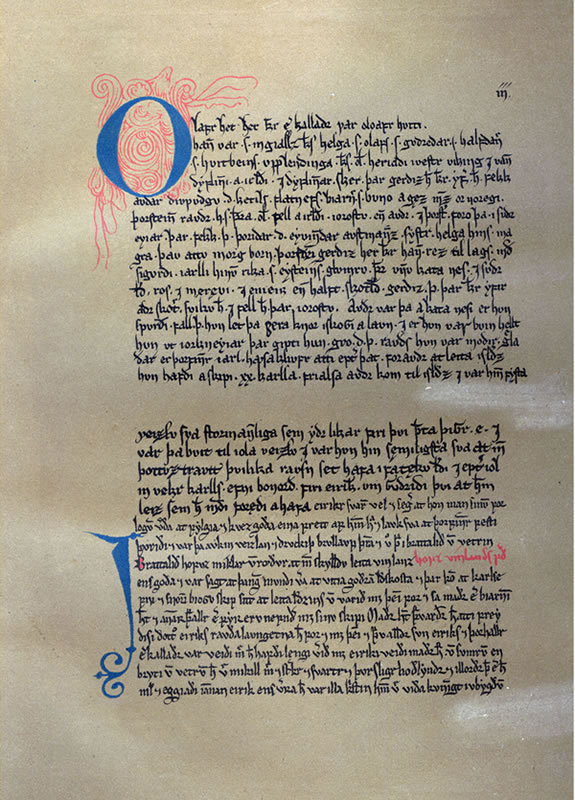
The Saga of Erik the Red (Eiríks saga rauða), composed in Iceland in the thirteenth century, stands as one of the key narrative sources for the Norse expansion across the North Atlantic. Although it bears Erik’s name, the saga extends beyond his biography, recounting the westward voyages of figures such as Thorfinn Karlsefni and Gudrid, as well as the journey of Erik’s son, Leif Erikson, who—according to the text—reached Vinland after being blown off course while sailing from Norway to Greenland. Blending oral tradition with literary composition, the saga frames Erik’s successive exiles as the prelude to a broader geography of exploration that ultimately reached the shores of North America.
Preserved in medieval manuscripts such as the Hauksbók and Skálholtsbók, the saga describes lands unknown to medieval Europe—Greenland, Markland, and Vinland—while also recording encounters, conflicts, and cultural transitions within Norse society. Its historical precision has long been debated, yet archaeological discoveries at L’Anse aux Meadows in Newfoundland have confirmed a brief but real Norse presence in North America around the year 1000, lending material weight to what was once considered a largely legendary account.
Origins in displacement
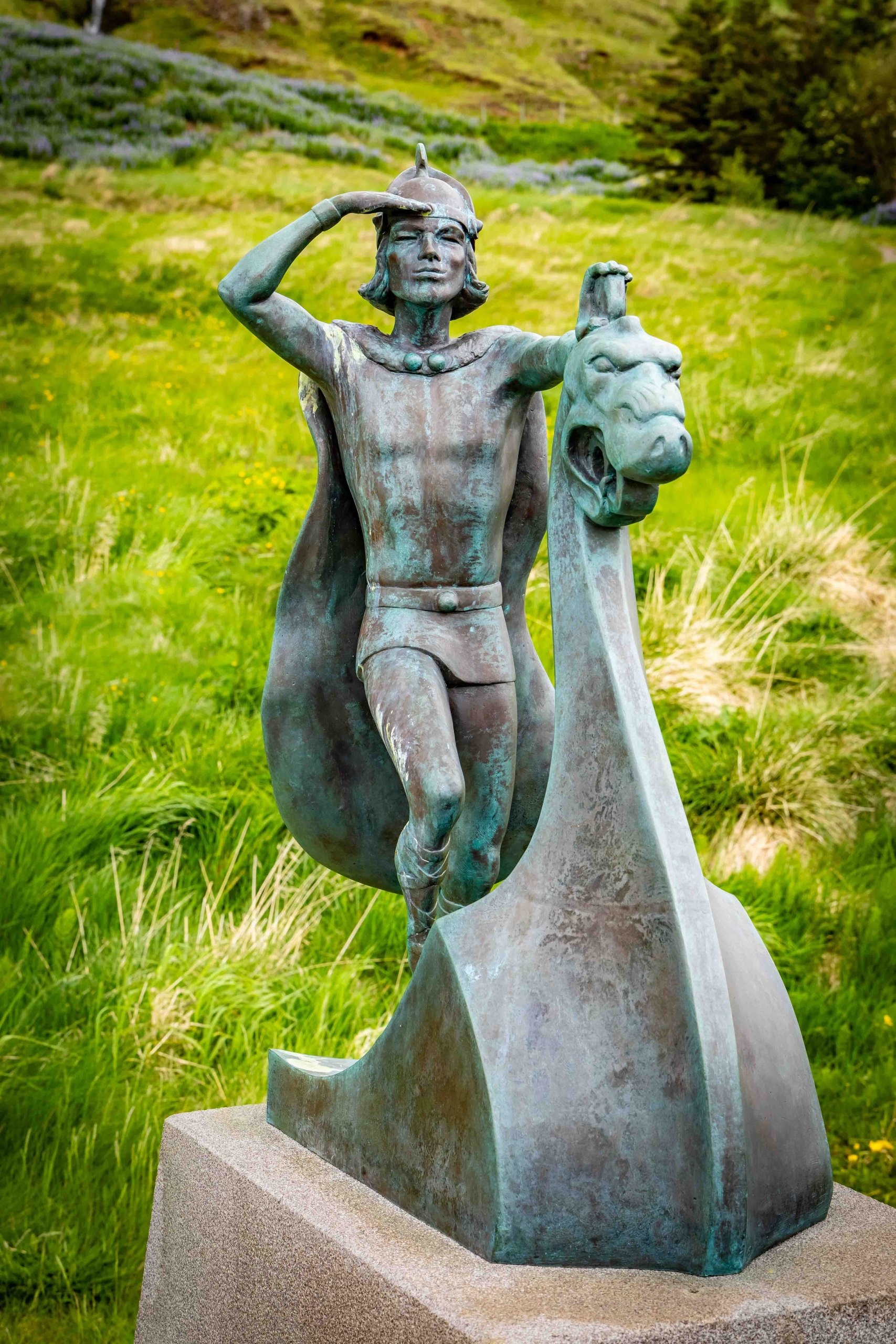
Erik Thorvaldsson was born around 950 CE in Norway. His father, Thorvald Asvaldsson, was exiled for homicide, a punishment that required the family to leave the district. This first expulsion set a pattern: social transgression leading to geographic movement. The family settled in Iceland, then a frontier society itself, only recently settled by Norse migrants navigating fragile legal systems and scarce resources.
Icelandic law allowed for outlawry rather than imprisonment. A person declared full outlaw lost legal protection and could be killed without consequence. Such rulings effectively transformed law into a mechanism of forced travel. Erik, described in the sagas as forceful and quick-tempered, soon followed his father’s path.
The second exile
By the 980s CE, Erik had established a farm in western Iceland. A dispute with neighbors—again involving killings—led to his outlawry for three years. This sentence removed him from society and thus compelled him to imagine a place beyond it. Drawing on rumors of land sighted to the west by earlier sailors, Erik outfitted a ship and sailed into the North Atlantic.
This journey marks a crucial moment in Norse exploration. Unlike earlier accidental sightings, Erik’s voyage was deliberate and sustained. He explored the southwestern coast of Greenland, noting fjords, pastures, and the relative shelter offered by the coastline. When his exile ended, he returned to Iceland with a calculated narrative.
Naming as strategy
Erik called the land Grœnland – Greenland. Medieval sources suggest the name was promotional: a way to attract settlers by emphasizing potential rather than hardship. In this sense, Erik acted less as a conqueror than as a recruiter, reframing exile into opportunity. Around 985 CE, he led a fleet of settlers west. Only about half the ships completed the crossing, underscoring the risk inherent in the route.
The settlers established two main Norse communities, the Eastern and Western Settlements. Erik himself lived at Brattahlíð (modern Qassiarsuk), where archaeological remains confirm a substantial farmstead. These settlements endured for several centuries, integrating pastoral agriculture with hunting and trade.
A route without sanctuaries
From a pilgrim’s perspective, Erik’s trajectory contrasts with later pilgrimage networks. There were no hospices, no waymarkers, no institutional memory to support travelers. Knowledge circulated orally, embedded in sagas that functioned as both history and cautionary tale. The North Atlantic routes Erik traveled—Norway to Iceland, Iceland to Greenland—would later become semi-regular corridors of movement, but during his lifetime they remained precarious passages across open water.
Yet parallels with pilgrimage somehow persist. Exile imposed ritualized movement; the law dictated duration and distance; reintegration depended on return. Erik’s story illustrates how mobility itself shaped Norse identity, turning geography into a moral and social framework.
Legacy through continuation
Erik never reached mainland North America, but his legacy extended there through his son, Leif Erikson. Around 1000 CE, Leif sailed further west and reached Vinland, likely modern Newfoundland. Archaeological evidence at L’Anse aux Meadows confirms a short-lived Norse presence.
These voyages expanded the mental map of the medieval North Atlantic world. While not sustained, they demonstrate a continuity of exploration rooted in earlier acts of displacement. Erik’s enforced journeys created conditions for voluntary ones.
Landscape as archive
Today, Erik the Red’s saga can be traced not through a single linear route, but through a constellation of sites: farm ruins in Iceland, fjords in southern Greenland, and the sea lanes between them. These places function as a dispersed archive, where geography preserves memory more reliably than text.
For modern travelers interested in the cultural history of movement, Erik’s life offers a counterpoint to devotional pilgrimage. His journeys were not undertaken for salvation or enlightenment, but they nonetheless produced enduring cultural landscapes. They remind us that many historic routes emerged from necessity rather than choice, and that exile, like pilgrimage, can reorganize the human relationship to space.
Erik the Red’s saga is a story of boundaries crossed under compulsion. Each exile pushed him further west, transforming punishment into exploration and marginality into settlement. His life illustrates how travel, even when involuntary, can generate routes, communities, and narratives that outlast their origins. The North Atlantic world he helped shape remains a testament to movement as a fundamental human response to conflict, law, and survival.
AI Transparency Notice
PilgriMaps uses artificial intelligence tools to assist in the research, drafting and translation of editorial content. All AI-assisted content is reviewed, edited and verified by our editorial team before publication. We contrast information against primary sources, specialist literature and on-the-ground knowledge to ensure accuracy, cultural sensitivity and editorial integrity.
AI is one tool among many in our workflow. The judgement, curation and responsibility for everything published on this platform remain entirely human.
Viator Media S.L. — in compliance with the EU Artificial Intelligence Act (Regulation EU 2024/1689).
This post is also available in: