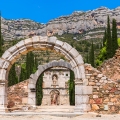
In the early morning, the gates of the Temple of Confucius open to visitors in Qufu, a quiet city in China’s Shandong province. The tour groups have not yet filled the courtyards, and the sound of footsteps echoes between ancient walls, old trees, and stone stelae that carry centuries of history. Behind this apparent calm lies one of the most influential cultural landscapes in Asia.
Qufu is where Confucius was born more than two and a half thousand years ago. But its importance is not limited to that biographical fact. Here a complex system of memory, ritual, and prestige developed that transformed a local teacher into one of the most influential intellectual figures in history. Temple, family residence, and cemetery together form a unique ensemble that allows the visitor to follow the evolution of an idea, a family, and a tradition that would go on to shape the course of China and much of East Asia.
To move through Qufu is not simply to visit ancient monuments. It is an opportunity to understand how a particular vision of education, ethics, and public life managed to cross centuries of political and social change and remain alive today.
Who was Confucius, and why does he still matter?
Confucius was born in 551 BCE in the ancient state of Lu, a territory corresponding roughly to the present-day region of Qufu. He lived during a period of political fragmentation and profound social transformation, an era in which various thinkers were searching for ways to restore order and stability.
Unlike the founders of many religious traditions, Confucius did not present his teachings as divine revelation and did not create an organized religion. His primary concern was human conduct. He argued for the importance of education, the cultivation of virtue, respect for elders, the responsibility of rulers, and the necessity of building a society grounded in harmonious relationships.
His disciples compiled and helped disseminate his teachings. Over time these ideas became integrated into the political structure of the Chinese empire. For centuries, officials who aspired to public office were required to study texts associated with the Confucian tradition and demonstrate their knowledge through rigorous imperial examinations.
The influence of this thought was not confined to China. Korea, Japan, and Vietnam developed educational institutions, administrative models, and intellectual traditions inspired by the Confucian legacy. Even today, many scholars argue that key cultural characteristics of East Asia — from the high value placed on education to certain forms of family organization — cannot be understood without accounting for this inheritance.
In contemporary China, Confucius remains a primary cultural reference. His figure appears in museums, educational programmes, festivals, and cultural centers. Beyond any particular political or ideological interpretation, he continues to represent one of the most recognizable intellectual contributions of Chinese civilization.
And to understand how the teachings of a single teacher came to influence an entire region of the world, there is no better place than Qufu.
Qufu: from personal memory to universal heritage
The importance of Qufu lies in the fact that here one can observe the process by which the memory of a person was gradually transformed into a cultural tradition of continental reach.
The city’s monumental ensemble is formed by three spaces known collectively as the “Three Kongs”: the Temple of Confucius, the Kong Family Mansion, and the Cemetery of Confucius. All three were inscribed together on UNESCO’s World Heritage List in 1994 for their extraordinary historical, artistic, and cultural value.
What is singular about this ensemble is that it does not offer a single perspective on Confucius. Each place tells a different part of the story. Together they form a coherent account of how a tradition is built.
First stop: the Temple of Confucius
The visit typically begins at the Temple of Confucius, the symbolic heart of Qufu and one of China’s great historical monuments.
The first sanctuary was constructed shortly after the philosopher’s death in 478 BCE. Over the centuries it was expanded, partially destroyed, rebuilt, and embellished by successive dynasties. The result is a vast monumental complex bringing together buildings erected between the Jin and Qing periods, thousands of historical stelae, and a remarkable collection of ancient trees.
What strikes the visitor most immediately is the scale. Although dedicated to a teacher rather than an emperor, many of its spaces achieve a monumentality comparable to China’s great palace complexes. The courtyards follow one another in a rigorous axial sequence, leading toward the most important ceremonial halls and creating a carefully calibrated sense of solemnity.
The architecture helps illuminate a fundamental historical phenomenon: the progressive elevation of Confucius from the status of local teacher to moral reference point for generations of rulers and officials. To walk through the temple is to move through centuries of official recognition. Every reconstruction, every inscription, every expansion reflects the interest of successive dynasties in associating their political legitimacy with the values the thinker represented.
For this reason, the temple at Qufu is not only a historical monument. It is also the architectural model that inspired the construction of Confucian temples across China, Korea, Japan, and Vietnam.
Second stop: the Kong Family Mansion
A short distance from the temple stands the Kong Mansion, historic residence of Confucius’s direct descendants.
If the temple represents the public dimension of the Confucian legacy, the mansion reveals its familial and institutional dimension. For centuries, the philosopher’s descendants played a singular role within Chinese society — administering ceremonies, safeguarding documents, managing properties, and maintaining a position of prestige recognized by the state. The residence evolved gradually from a house attached to the temple into a fully aristocratic mansion.
The visit uncovers a complex spatial organization reflecting the hierarchies of traditional Chinese society. Official areas occupy the front of the compound while residential spaces develop toward the interior — an arrangement that expresses not only practical considerations but a particular vision of social order, authority, and etiquette.
One of the most interesting aspects of the visit is discovering how Confucianism was not only a philosophical current but also generated institutions, family structures, and concrete forms of administration. The Kong Mansion is an excellent example of that practical, everyday dimension. It also preserves an important collection of historical objects, portraits, documents, and garments that illuminate the extraordinary continuity of the Kong lineage across the centuries.
Third stop: Kong Lin, the forest of memory
If the temple impresses through monumentality and the mansion through institutional complexity, the Cemetery of Confucius offers an entirely different experience.
Known as Kong Lin, this vast funerary space lies to the north of the city and contains the tomb of Confucius alongside more than one hundred thousand burials belonging to his descendants. It is one of the largest family necropolises in the world.
The arrival is unexpected. Rather than grand ceremonial structures, the visitor finds wooded paths, scattered funerary monuments, and an atmosphere far quieter than the rest of the ensemble. Each tomb represents a generation. Each stele records a name within an extraordinarily extensive genealogy. The ensemble allows one to observe how a family’s memory was preserved across more than two thousand years through ritual, genealogical records, and funerary practice.
Many travelers consider Kong Lin the most moving place in Qufu precisely because of that human dimension. Beyond the figure of the philosopher, the cemetery speaks of the relationship between past and present, of the continuity of family bonds, and of the role memory plays in the construction of collective identity.
A sequence that tells a complete story
The visit to the Three Kongs takes on its full meaning when understood as a narrative sequence. The temple speaks of the teacher and the public recognition of his teachings. The mansion explains how a family converted that legacy into a lasting institution. The cemetery reveals the temporal dimension of that continuity.
Together, the three sites tell an exceptional story: the transformation of an intellectual figure into a cultural tradition capable of crossing dynasties, wars, revolutions, and social upheaval without losing its relevance.
Few places in the world allow one to observe so clearly the process by which an idea becomes heritage.
Beyond Qufu: other landscapes of the Confucian world
Although Qufu is the undisputed center of any Confucian itinerary, other places in China illuminate different facets of the tradition. In Beijing, the Temple of Confucius and the former Imperial College reveal the close relationship between Confucian thought and state administration. In Nanjing, the historic Fuzimiao area and the Imperial Examination Museum open a window onto the educational system that made the study of the classics a path of social advancement.
Further south, in Quzhou, the ancestral temple of the southern branch of the Kong clan — established following migrations during the political upheavals of the Song dynasty — is a reminder that the story of Confucius’s descendants did not unfold exclusively in Shandong.
And in Yunnan province, the great Confucian temple of Jianshui demonstrates how far institutions inspired by this tradition came to be integrated into regions far from China’s historical heartland. Each of these places offers a different perspective. But all of them point, in one way or another, back to the same origin: Qufu.
The best time to visit
Those seeking a quieter experience generally find the best conditions in spring and autumn, particularly on weekdays. The period around late September deserves special mention: cultural events and public ceremonies tied to the traditional anniversary of Confucius’s birth take place during these dates, offering some visitors a rare opportunity to observe the contemporary life of certain rituals — and others a reason to plan their visit for another time.
In any case, the simplest recommendation remains the same: arrive early. The temple courtyards, the mansion’s corridors, and the paths of Kong Lin reveal a completely different atmosphere before the crowds arrive.
A legacy that continues to speak
More than twenty-five centuries after his birth, Confucius continues to generate debate. His ideas have been interpreted, questioned, reformulated, and reclaimed in very different contexts. Yet few people leave Qufu without understanding why his name continues to occupy a central place in Asia’s intellectual history.
The city allows one to observe something deeper than the trajectory of an individual. It allows one to witness the construction of a collective memory. Between ceremonial courtyards and funerary forests, the visitor discovers how a body of teachings transmitted by disciples became a tradition capable of shaping governments, educational systems, and ways of living together across centuries.
Qufu is not only a historical destination. It is a place where one can still sense the long conversation between past and present that has helped define one of the oldest civilizations in the world.
AI Transparency Notice
PilgriMaps uses artificial intelligence tools to assist in the research, drafting and translation of editorial content. All AI-assisted content is reviewed, edited and verified by our editorial team before publication. We contrast information against primary sources, specialist literature and on-the-ground knowledge to ensure accuracy, cultural sensitivity and editorial integrity.
AI is one tool among many in our workflow. The judgement, curation and responsibility for everything published on this platform remain entirely human.
Viator Media S.L. — in compliance with the EU Artificial Intelligence Act (Regulation EU 2024/1689).
This post is also available in: