In the heart of the Buenos Aires plains, just an hour from Argentina’s capital, stands the Basilica of Our Lady of Luján. Its neo-Gothic towers, rising more than one hundred meters, dominate the horizon and can be seen long before entering the city. Within, the sanctuary preserves a small terracotta figure only 38 centimeters tall, which, according to tradition, “remained” by the river in 1630 and gradually became a national emblem. This contrast between the monumental and the miniature defines the site, where popular devotion intersects with history, architecture, and identity.
The Basilica and Its Interior
Construction began in 1890 under the initiative of priest Jorge María Salvaire, designed by architect Ulrico Courtois. The building was inaugurated in 1910 and reached its final form in 1935, when the towers were completed. Inspired by French neo-Gothic models, it extends over one hundred meters in length and features pinnacles, stained-glass windows, and a large rose window illuminating the nave.
At the main altar stands the small terracotta image linked to the “wagon miracle.” Since the early 20th century, its visible face and hands have been complemented by a silver breastplate and a gold crown, the latter sent by Pope Leo XIII. Behind the altar lies the Camarín de la Virgen, a private chamber where ceremonial garments are kept, occasionally open to visitors.
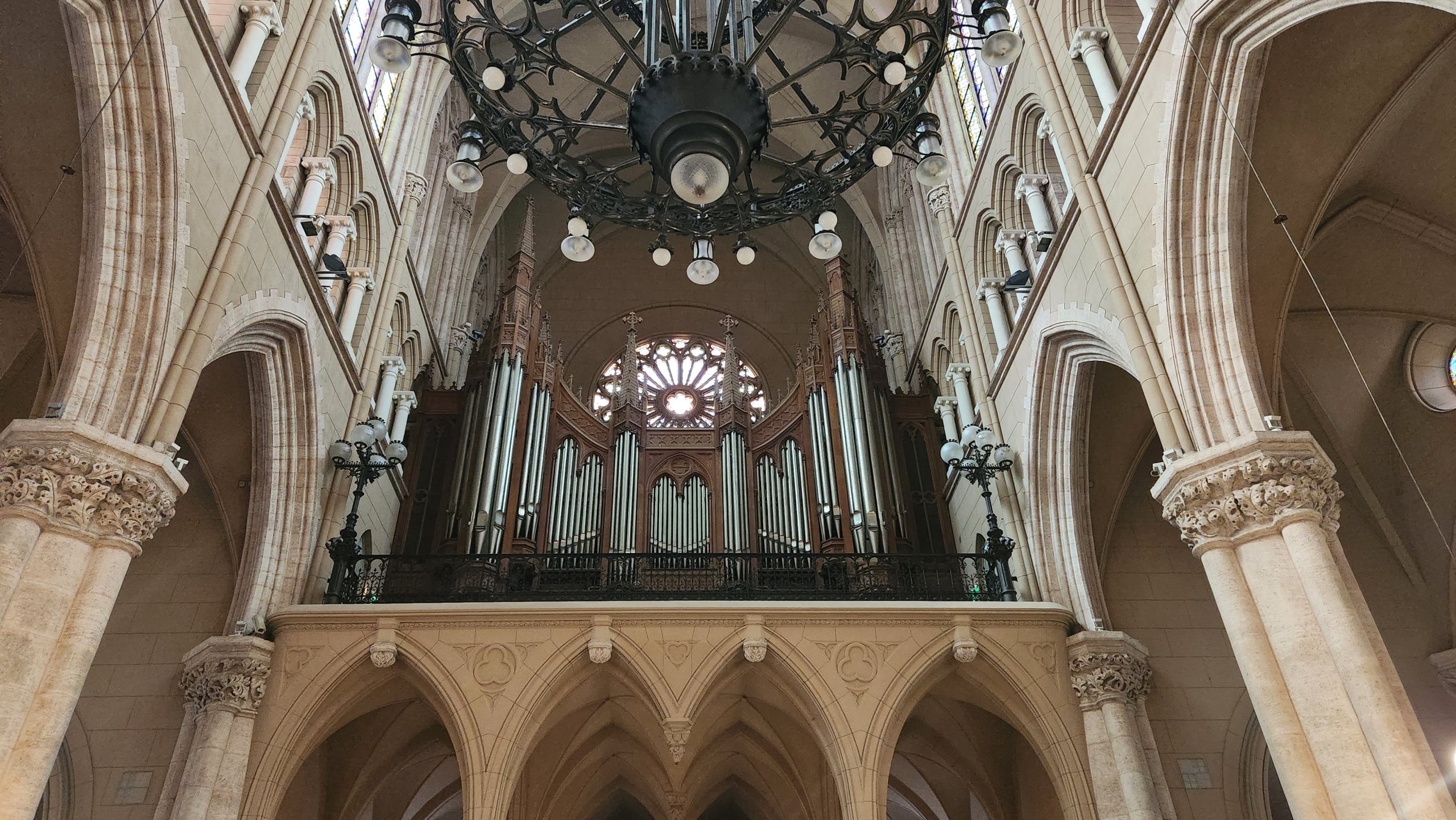
The basilica also houses a monumental Cavaillé-Coll organ with nearly four thousand pipes and a remarkable collection of stained glass that fills the interior with color.
Spaces to Discover
Beneath the temple is a Romanesque-style crypt containing the tombs of chaplains and benefactors, along with a collection of seventy Marian images from around the world. Next to it is the historical museum, which displays the original 1887 crown, the Golden Rose presented in 1982, embroidered cloaks, votive offerings, and documents relating to the sanctuary’s history.
The visit can also lead upward. A staircase system allows access to balconies overlooking Belgrano Square and the city. Higher still, at 65 meters, a viewing platform offers panoramic 360-degree views of the surrounding pampas.
Outside, the square serves as the main gathering place for pilgrims, with open-air celebrations and stalls selling candles and souvenirs. Nearby, the Negro Manuel Historical Walk recalls the 17th-century origins of the devotion with a small chapel evoking the first oratory, dedicated to the memory of the image’s earliest custodian.
The Life of the Sanctuary
The sanctuary remains open daily from 7:00 a.m. to 8:00 p.m., with free admission. Masses are held throughout the day, and at 6:00 p.m. a communal rosary takes place. Confessions and petitions are also available.
Certain dates transform the city into a center of large-scale gatherings. May 8, the patronal feast, attracts tens of thousands. In October, the annual youth pilgrimage on foot from Buenos Aires fills the roads, while in September gaucho groups arrive on horseback. December 8, the feast of the Immaculate Conception, also draws vast crowds. Visitors who arrive on these occasions will find a vibrant, collective celebration, while on ordinary days the atmosphere is quieter and contemplative.

Getting There and Practical Information
Reaching Luján from Buenos Aires is straightforward. By car, the journey takes about an hour along the Western Highway. Bus line 57 connects several points in the capital with Luján’s terminal, a short walk from the basilica. The train is slower, requiring a transfer at Moreno on the Sarmiento line, with a total travel time of about three hours.
The city offers guided tours every day, covering the crypt, museum, and tower access. Around the main square there are hotels, inns, and restaurants, and nearby stands the Enrique Udaondo Museum Complex, displaying colonial documents, historic carriages, and religious art. The best times to visit are autumn and spring, when the weather is mild and the crowds are smaller.
Where the Small Becomes Monumental
A journey to Luján offers insight into Argentina’s cultural heart. Here, national history, collective memory, and monumental architecture converge around a small terracotta figure, only a few centimeters tall, that has endured for nearly four centuries. From this modest origin grew one of the continent’s most enduring devotions—an emblem of how what is seemingly minor can shape something vast.
AI Transparency Notice
PilgriMaps uses artificial intelligence tools to assist in the research, drafting and translation of editorial content. All AI-assisted content is reviewed, edited and verified by our editorial team before publication. We contrast information against primary sources, specialist literature and on-the-ground knowledge to ensure accuracy, cultural sensitivity and editorial integrity.
AI is one tool among many in our workflow. The judgement, curation and responsibility for everything published on this platform remain entirely human.
Viator Media S.L. — in compliance with the EU Artificial Intelligence Act (Regulation EU 2024/1689).
This post is also available in: