Churches, hills, paths, and spaces of welcome form the map of Medjugorje. More than a destination to be covered quickly, this small village in Herzegovina invites an unhurried experience marked by hospitality, silence, and the desire to return to what is essential.
Since the reported apparitions of 1981 that gave rise to its worldwide reach, Medjugorje has received millions of visitors. For many, the journey is a pilgrimage: they come seeking prayer, reconciliation, interior rest, or a renewed relationship with faith. Others are drawn by curiosity about one of the most singular religious phenomena in contemporary Europe.
The Catholic Church’s position helps to situate that experience from the outset. The Vatican has recognized the pastoral value of Medjugorje and authorized devotion associated with the site, while the process of official discernment regarding the alleged apparitions remains open — no definitive declaration on their supernatural character has been issued. In practice, this invites visitors to focus on what defines the village’s daily life: the Eucharist, the rosary, confession, adoration, silence, and encounter with other pilgrims. Whatever one’s starting point, that is where the experience is most likely to be found.
In either case, the best way to approach the place is to set aside haste and accept that much of what it offers is not found in any monument, but in the rhythm of the visit itself. Medjugorje reveals itself best when walked without hurry.
The Parish of Saint James: the heart of Medjugorje
The best place to begin is the parish church of Saint James the Apostle. Its two towers are the village’s visual landmark and, above all, the center of an intense communal life. Here Masses are celebrated, moments of prayer organized, confessions heard, and groups from many countries received.
The parish functions as more than a place of worship. It is a space of arrival and orientation. Around it one perceives the diversity of those who visit Medjugorje: families, young people, religious, elderly, parish groups, and travelers drawn by curiosity. Some sit in silence; others speak with emotion after a celebration; others wait patiently to go to confession or join in the rosary.
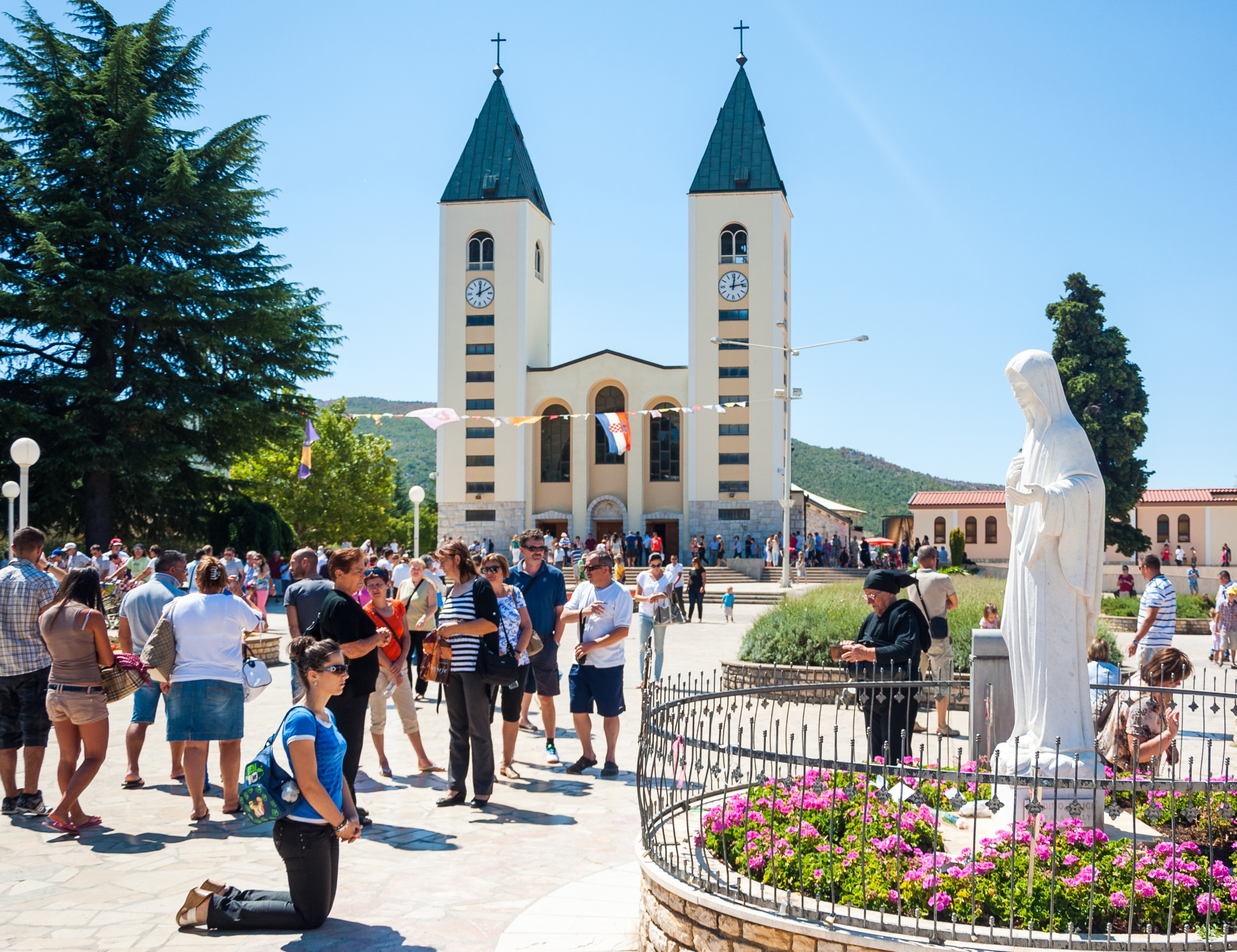
Beside the church, the outdoor altar reveals the scale the site has acquired. It was designed to accommodate large gatherings of pilgrims and fills particularly during international celebrations, feast days, and youth encounters. Yet even when the crowds are large, the atmosphere retains a peculiar combination of intensity and recollection. Medjugorje is not a sanctuary of grand solemn ceremonies in marble and half-light — it is a village that has adapted itself to welcome those who arrive from far away.
It is worth devoting the first day to this center. Before ascending the hills, attending a celebration and sitting for a while in the parish’s surroundings offers a gradual entry into the village’s rhythm. Many people arrive carrying profound personal reasons: some are living through grief, illness, family crisis, or a period of uncertainty. Others are marking a reconciliation or a change of life. That awareness calls for the most attentive kind of respect.
Podbrdo: the hill of the first accounts
Podbrdo hill lies a short distance from the village center. It is the site associated with the testimonies of the six young people who, in June 1981, reported seeing a female figure they identified as the Virgin Mary. Since then the path has become one of Medjugorje’s most recognized routes.
The ascent is not long, but the terrain demands attention. The stones are uneven, slopes appear without warning, and in summer the heat can be intense. It is neither an urban walk nor a technical mountain route — it is a climb that calls for firm footwear, water, and a willingness to advance slowly.
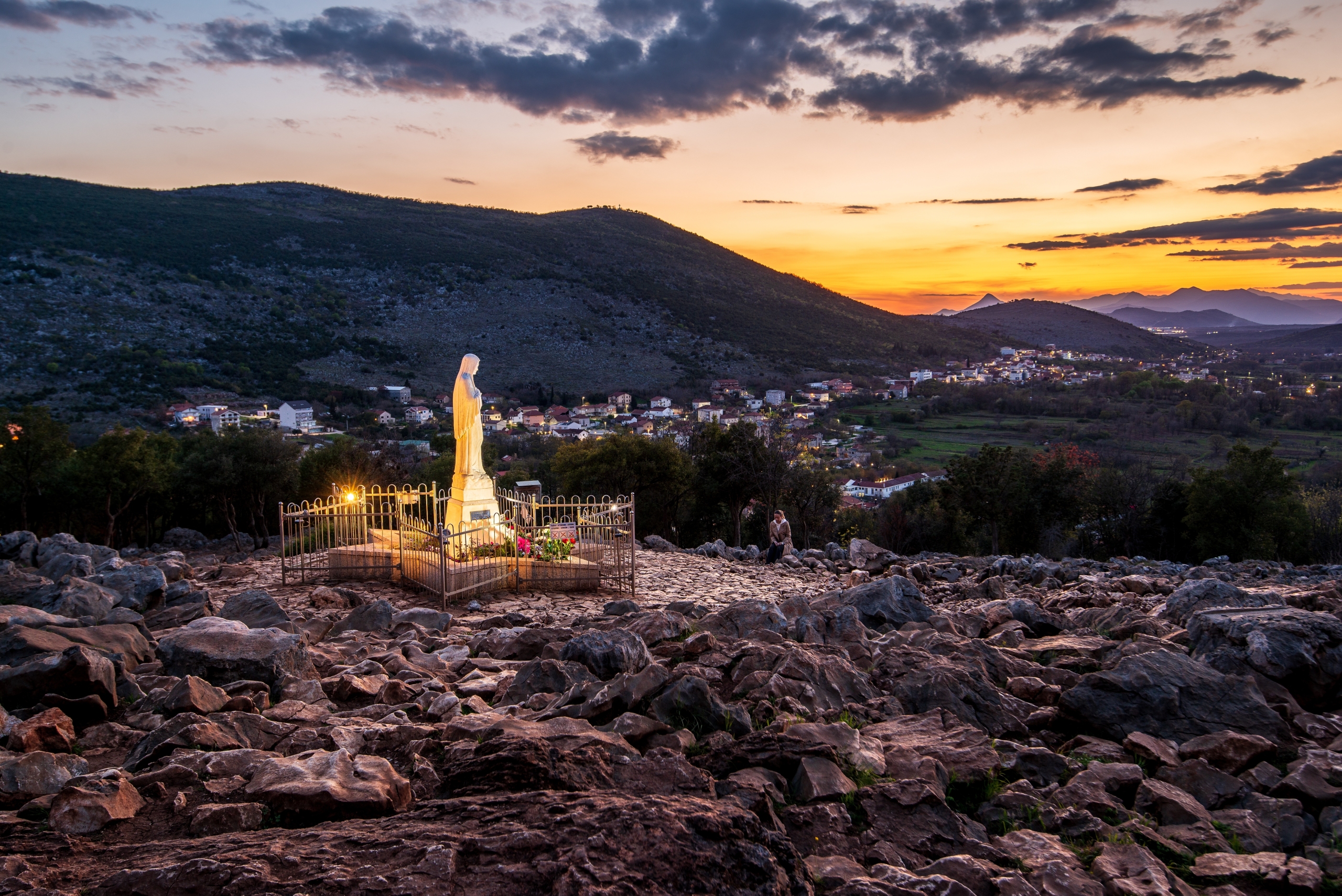
That pace is part of the experience. Along the way one passes pilgrims praying quietly, groups pausing at the stations of the rosary, and individuals ascending alone. Some carry a specific intention; others are not seeking an answer but a moment of stillness. At certain points the landscape opens toward the valley, allowing one to read the geography of this part of Bosnia and Herzegovina: stone, sparse vegetation, scattered fields, and villages settled among the hills.
For first-time visitors, Podbrdo offers a simple key: the point is not to reach a spectacular summit but to accept a physical and mental pause. The stone underfoot demands that one watch where one steps; the silence, when it comes, invites one to look inward.
Križevac: the mountain of the Cross
Križevac offers a different experience. The hill is crowned by a large cross erected in 1934 — decades before the reported events that brought Medjugorje to worldwide attention. That earlier history matters, because it is a reminder that the religious tradition of this area did not begin in 1981. The village already had its own practices, devotions, and ways of living faith.
The ascent of Križevac is more demanding than Podbrdo. The route is typically associated with the Stations of the Cross and requires more time, greater stamina, and sensible preparation. It need not be approached as a test — it can be walked slowly, with rests, or only partially completed. The experience is not measured by speed or distance covered.
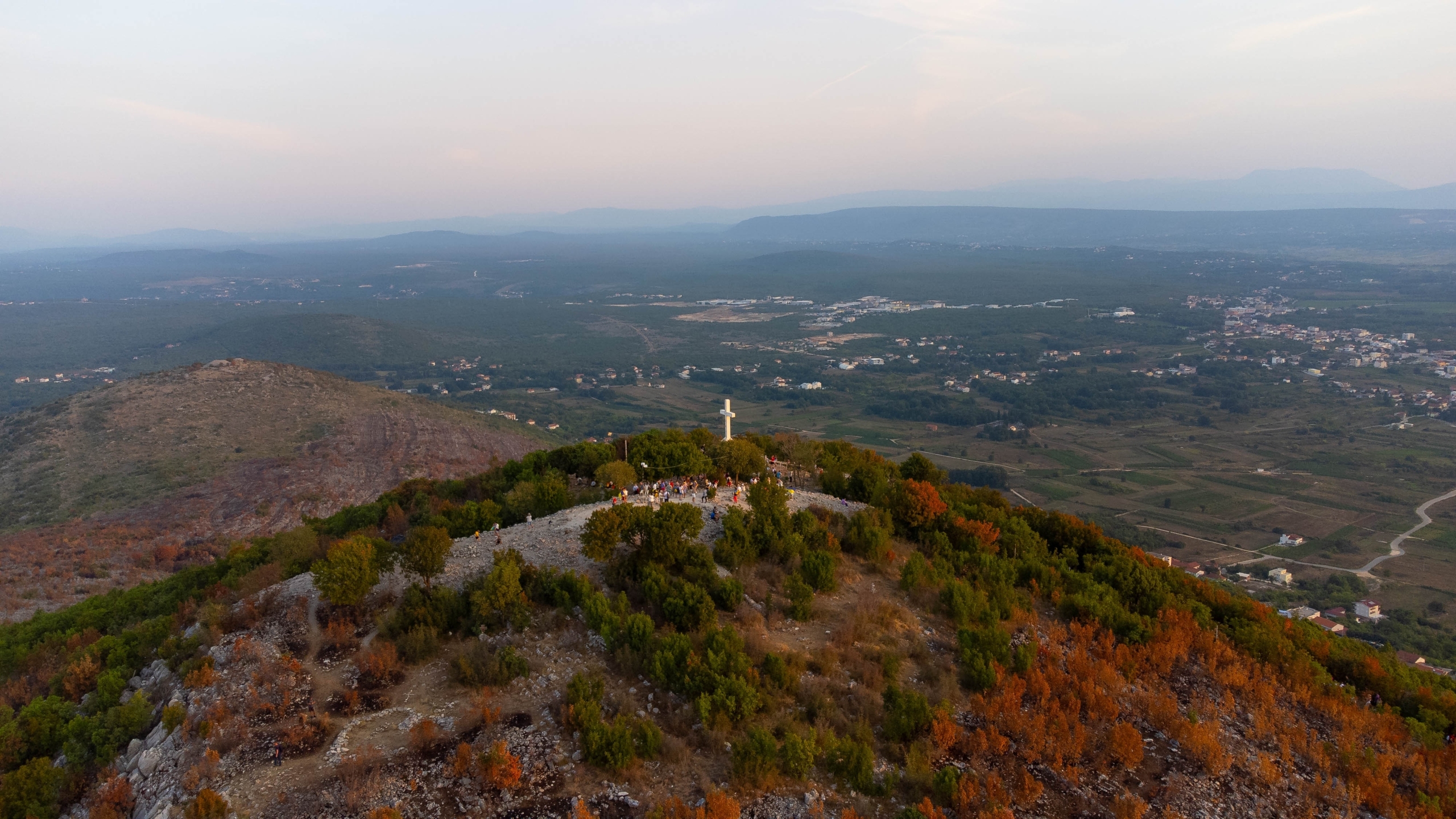
From the top, the landscape opens into a broad panorama of Herzegovina. For some pilgrims that view becomes a moment of prayer; for others, an occasion to understand the relationship between the village and its surroundings. Medjugorje is not a sanctuary isolated from its territory. Its hills, its climate, its paths, and the memory of its people are part of its identity.
Podbrdo and Križevac do not compete with each other. The first is associated with the initial reported accounts; the second speaks of an older local history and a spirituality centered on the cross. Which to choose depends on available time, physical condition, and the meaning each visitor wishes to give the journey.
A village prepared to welcome
Beyond the church and the hills, Medjugorje has developed a network of spaces designed for hospitality. The adoration chapel offers a place of silence for those who wish to pause without joining a collective activity. The Domus Pacis retreat house receives individuals and groups seeking days of reflection. The Village of the Mother and the Cenacolo community speak, in turn, of the social and pastoral dimension that has grown up around the sanctuary.
These places help one understand that Medjugorje is not only a setting for pilgrimage but a small infrastructure of welcome. Accommodation, food, guides, information services, retreat spaces, and community programmes support the arrival of visitors throughout the year. That activity has transformed the local economy — and consolidated a culture of hospitality that is itself part of the experience.
A reasonable itinerary can be organized over two days. The first is best devoted to the parish of Saint James and its immediate surroundings: arriving, getting one’s bearings, attending a celebration, and walking through the village allows a gradual entry into its rhythm. It is also a good moment to discover the spaces of prayer and to let the experience take shape without an overly loaded agenda.
The second day can be reserved for one of the hills. Those with little walking experience or limited time may choose Podbrdo. Those seeking a longer route and feeling prepared may choose Križevac. Attempting both ascents in a few hours risks turning the visit into a race and losing what is essential.
The religious programme varies according to the time of year and major gatherings. Before traveling, it is worth consulting official celebration schedules, peak periods, and weather conditions. In summer, early morning or late afternoon are generally the most suitable times to walk. In winter, the terrain and temperature call for greater caution.
How to get there: planning the journey with care
Medjugorje has no airport of its own. The closest is Mostar, though its flight connections can be limited; many pilgrims therefore arrive through Split, Dubrovnik, or Sarajevo and complete the journey by road. Depending on the point of departure and the type of trip, the most comfortable options are usually a transfer booked in advance, a rental car, or a bus with a connection in Mostar or a nearby city.
Those arriving from Croatia should allow for the border crossing into Bosnia and Herzegovina, carry the required documentation, and leave sufficient margin for possible delays. For groups, it can be especially practical to coordinate transport with accommodation or through a pilgrimage agency; independent travelers will appreciate confirming schedules, exact arrival point, and return arrangements before booking flights.
One final piece of advice is simple: do not plan too tight an arrival. Beginning the journey without urgency is itself a good way to enter the rhythm of Medjugorje.
A few attitudes help one move through it well: respecting moments of prayer, avoiding intrusive photographs during celebrations or confessions, preserving silence in spaces intended for recollection, and distinguishing between the parish’s official activities and private initiatives.
Medjugorje is best understood when one accepts that not everything needs to be explained immediately. The village offers paths, celebrations, and concrete places — but their meaning depends, in large part, on the disposition with which each person walks them. At the end of the day, when pilgrims return from the hills and the lights come on around the church, the most lasting impression is rarely that of having visited an extraordinary destination. It is that of having found a place where it is still possible to walk without hurry, to keep silence, and to return to what is essential.
AI Transparency Notice
PilgriMaps uses artificial intelligence tools to assist in the research, drafting and translation of editorial content. All AI-assisted content is reviewed, edited and verified by our editorial team before publication. We contrast information against primary sources, specialist literature and on-the-ground knowledge to ensure accuracy, cultural sensitivity and editorial integrity.
AI is one tool among many in our workflow. The judgement, curation and responsibility for everything published on this platform remain entirely human.
Viator Media S.L. — in compliance with the EU Artificial Intelligence Act (Regulation EU 2024/1689).
This post is also available in: