Since 1981, this small village in Herzegovina has become one of the great international centers of Marian pilgrimage. The Catholic Church has recognized the pastoral value of the experience and its spiritual fruits, while keeping open the question of the supernatural character of the alleged apparitions.
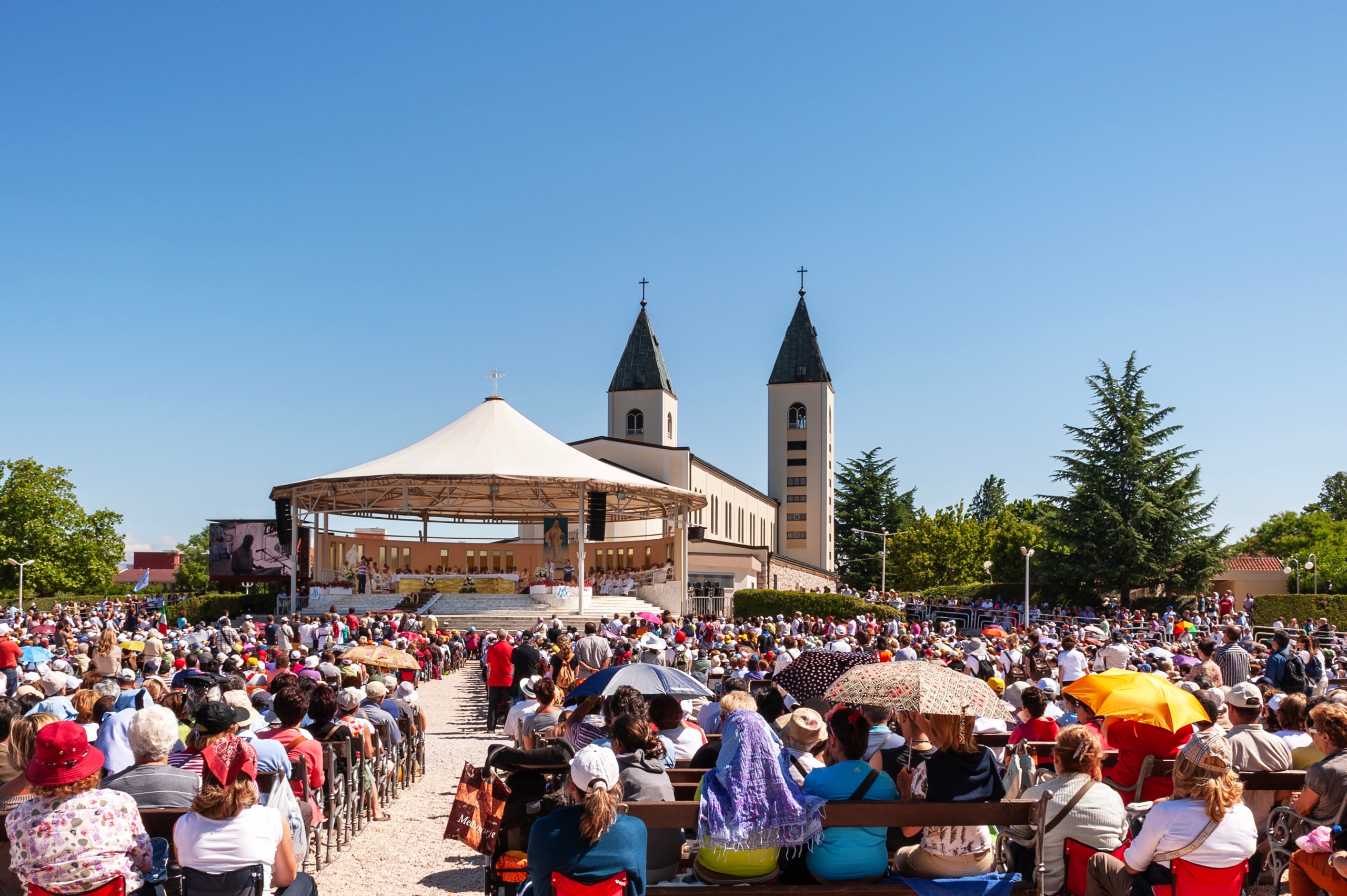
As evening falls, Medjugorje seems to recover for a few moments the scale of any village in Herzegovina: quiet streets, low houses, nearby mountains, and a soft light over the fields. But one need only approach the parish church of Saint James the Apostle to sense that this is not an ordinary place. Voices are heard in numerous languages; groups pray the rosary; families wait to take part in the Eucharist; pilgrims return from the stone hills surrounding the village.
For four decades, Medjugorje has drawn people from across the world — believers and, at times, non-believers. For many, the journey answers an intimate search: to recover a life of prayer, to seek clarity before an important decision, to be reconciled with one’s own history, or to find a moment of silence in the midst of an accelerated life.
A singular reported phenomenon
The accounts of Medjugorje center on six young parishioners: Ivanka Ivanković-Elez, Mirjana Dragićević-Soldo, Vicka Ivanković-Mijatović, Ivan Dragićević, Marija Pavlović-Lunetti, and Jakov Čolo. According to their own testimony, they reported seeing a female figure in the first days of June 1981, whom they identified as the Virgin Mary.
More than four decades later, the phenomenon continues to form part of the life of Medjugorje: some of the alleged visionaries continue to claim daily apparitions, while others associate theirs with annual or periodic encounters. This continuity helps explain why Medjugorje does not belong only to the memory of an initial event, but remains for many pilgrims a living spiritual experience centered on peace, prayer, and conversion.
The history of Medjugorje unfolds in a complex context. In 1981, the village was part of communist Yugoslavia and situated in a region with an intense Catholic tradition, but also one marked by historical tensions between diocesan authorities and the Franciscans who served many parishes in Herzegovina. Those circumstances shaped the initial reception of the accounts and help explain why the Church’s discernment process has been lengthy, careful, and at times intensive.
To reduce Medjugorje to a controversy, however, would be to miss what happens there every day. Its identity has been built around a simple, recognizable, and profoundly human spirituality: peace, prayer, reconciliation, conversion, fasting, forgiveness, and hope. The most characteristic title of the local devotion — “Queen of Peace” — summarizes one of its central intuitions: peace is not merely the absence of war, but a task that begins in the conscience, is cultivated in the family, and is expressed in relationship with others.
Returning to what is essential
The messages attributed to Medjugorje have insisted, from their beginnings, on the need for prayer and reconciliation. “Peace. Peace. Peace. Be reconciled,” read one of the first texts recorded by local tradition. Beyond the specific formulation of any individual message, the body of the tradition proposes a spirituality that does not seek to complicate religious life but to bring it to its most basic practices: to stop, to pray, to forgive, to care for others, to participate in communal life, and to recover trust.
The Dicastery for the Doctrine of the Faith — the Vatican body responsible for examining such phenomena — has noted that many pilgrims come to Medjugorje to renew their faith rather than to witness extraordinary events. Its 2024 Note La Reina de la Paz mentions conversions, a return to sacramental practice, family reconciliations, vocations, and a more intense prayer life among the fruits associated with the place. It also notes the presence of young people, married couples, those distant from religious practice, and visitors from other Christian traditions and even other religions.
The daily life of Medjugorje reflects that orientation. The center is not a reserved room or the pursuit of novelties, but the parish: Mass, Eucharistic adoration, confessions, the rosary, retreats, and community gatherings. The hills of Podbrdo and Križevac form part of the experience, but the heart of the place remains communal. Some ascend in silence; others pray in company; others pause before the landscape; others return to the village without having found a concrete answer, but with the sense of having recovered a more human rhythm.
A discernment that accompanies
The position of the Catholic Church on Medjugorje requires precise explanation. It is neither an approval of the alleged apparitions as a supernatural fact, nor a dismissal of the spiritual experience that has grown around the place.
In 1991, the Declaration of Zadar affirmed that, on the basis of investigations conducted to that point, it was not possible to declare the events to be supernatural apparitions or revelations. At the same time, it called for ensuring proper pastoral care for those traveling to Medjugorje. That formulation left the historical and theological question open while recognizing from the outset that pilgrims needed accompaniment, formation, and sacramental life.
Over the following years, Rome took gradual steps toward a clearer pastoral presence. In 2019, the organization of official pilgrimages was authorized — without that gesture being interpreted as a certification of the supernatural nature of the events. The most significant development came in September 2024, when the Dicastery for the Doctrine of the Faith published the Note La Reina de la Paz and granted a nihil obstat to the spiritual experience associated with Medjugorje.
The Latin expression may sound technical, but its meaning is accessible. A nihil obstat indicates that no serious doctrinal or pastoral obstacles have been identified to prevent the prudent promotion of a spiritual experience. It allows Church leaders to accompany the faithful with greater clarity and acknowledges that, within a given phenomenon, positive signs of spiritual life may be recognized. It does not render the alleged apparitions an obligatory belief for Catholics, nor does it constitute a declaration that their origin is supernatural.
This distinction is not intended to dampen devotion, but to situate it in its proper perspective. The Church does not ask anyone to believe in the alleged apparitions in order to visit Medjugorje. What it recognizes is that many people find there a proposal of prayer, conversion, and fraternity that can be lived legitimately and fruitfully.
Fruits as the criterion
The 2024 Vatican Note is particularly significant because it places its emphasis on fruits. It speaks of people who have returned to religious practice, of reconciliations between spouses, of vocations to the priesthood, consecrated life, and marriage, of prayer groups that have emerged in numerous countries, and of initiatives to help vulnerable people. It also describes Medjugorje as a space of sincere recollection, capable of helping many visitors to move through personal crises and to recover hope.
That emphasis carries an important consequence: the center of Medjugorje should not be the figure of the alleged visionaries or the expectation of new messages. The Dicastery itself indicates that the alleged visionaries should not be considered “central mediators” of the phenomenon. Attention is to be directed instead toward the life of prayer, the Eucharist, listening to the Word, adoration, and concrete love for others.

This is an orientation that coincides with the experience of many pilgrims. Those who come to Medjugorje tend to discover that the place invites less toward curiosity than toward interiority. The question is not so much what extraordinary event might be witnessed, but what might change in one’s own way of living: how to be reconciled, how to care for relationships, how to move through grief, how to recover an abandoned spiritual practice, or how to serve those who suffer with greater attentiveness.
The Church’s prudence extends also to the messages attributed to Our Lady. The 2024 Note evaluates much of that corpus positively as edifying material, but asks that one always speak of “alleged messages” and notes that certain expressions require careful interpretation. This is not an invitation to permanent suspicion, but a call to read from the whole — avoiding the absolutizing of isolated phrases and maintaining the Gospel and communal life as the primary reference.
A village and a proposal of hope
Medjugorje is also a social phenomenon. The arrival of pilgrims has transformed the local economy, generating accommodation, transport services, retreat spaces, and networks of welcome. But to read the place only in terms of religious tourism would be insufficient. Its strength lies in having offered, for more than four decades, a language of peace and reconciliation in a region marked by historical wounds, national conflicts, and the memory of war.
In that context, the “Queen of Peace” is not only a devotional title. It is an image that speaks of a shared aspiration: the possibility of rebuilding life from forgiveness, prayer, and care for others. The proposal of Medjugorje can be lived in very different ways — from an intense religious pilgrimage to a culturally attentive visit to local history. But in every case it preserves a simple invitation: to slow down, to listen more deeply, and to return to what is essential.
The Church has not issued a definitive response on the supernatural character of the alleged apparitions. It has recognized, through the nihil obstat of 2024, that the spiritual experience of Medjugorje can be welcomed and pastorally accompanied. That precision, far from diminishing the place, allows its singularity to be better understood.
Medjugorje remains an open question for history and theology. But for those who pilgrim there, it tends to be, before anything else, an experience of encounter — with a living tradition, with an international community, and above all with the possibility that peace begins in the interior of each person.
AI Transparency Notice
PilgriMaps uses artificial intelligence tools to assist in the research, drafting and translation of editorial content. All AI-assisted content is reviewed, edited and verified by our editorial team before publication. We contrast information against primary sources, specialist literature and on-the-ground knowledge to ensure accuracy, cultural sensitivity and editorial integrity.
AI is one tool among many in our workflow. The judgement, curation and responsibility for everything published on this platform remain entirely human.
Viator Media S.L. — in compliance with the EU Artificial Intelligence Act (Regulation EU 2024/1689).
This post is also available in: