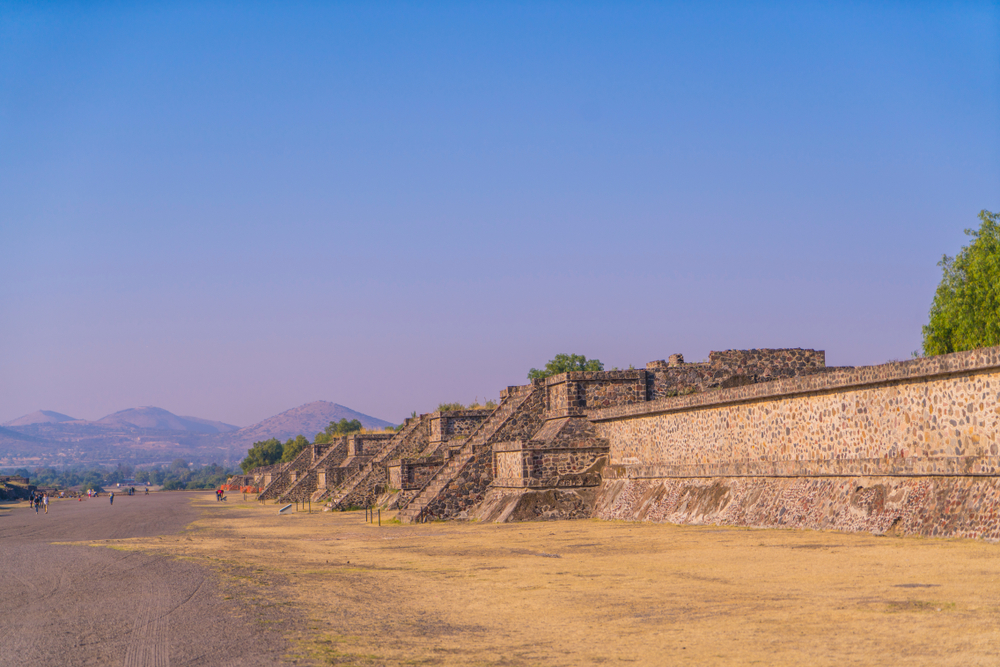
Stretching more than two kilometers through the heart of ancient Teotihuacan, the Calzada de los Muertos—or Avenue of the Dead—defines one of the most enigmatic urban landscapes of the pre-Columbian world. Aligned roughly north-south and flanked by stepped platforms, temples, and vast plazas, the avenue connects two monumental foci: the Pyramid of the Moon at its northern terminus and the Pyramid of the Sun to the east of its midpoint.
Today, the avenue’s scale and architectural order make it one of the most visited archaeological sites in the Americas. Yet in antiquity, this linear space may have served a more complex function—not merely as infrastructure for political spectacle, but as a processional route shaped by ritual practice. Though Teotihuacan left no written record of its beliefs, evidence increasingly suggests that the Calzada de los Muertos was a ceremonial corridor, traversed by pilgrims, processions, and cosmological performances that expressed the city’s sacred geometry.
Naming and Misinterpretation
The name Calzada de los Muertos—“Avenue of the Dead”—was coined by the Aztecs when they encountered the abandoned city centuries after its fall. Mistaking the mounds and platforms along the avenue for tombs, they believed it to be a necropolis. In reality, Teotihuacan’s dead were buried not along the avenue, but beneath apartment compounds and ritual precincts. The name persists, but it obscures the space’s original function.
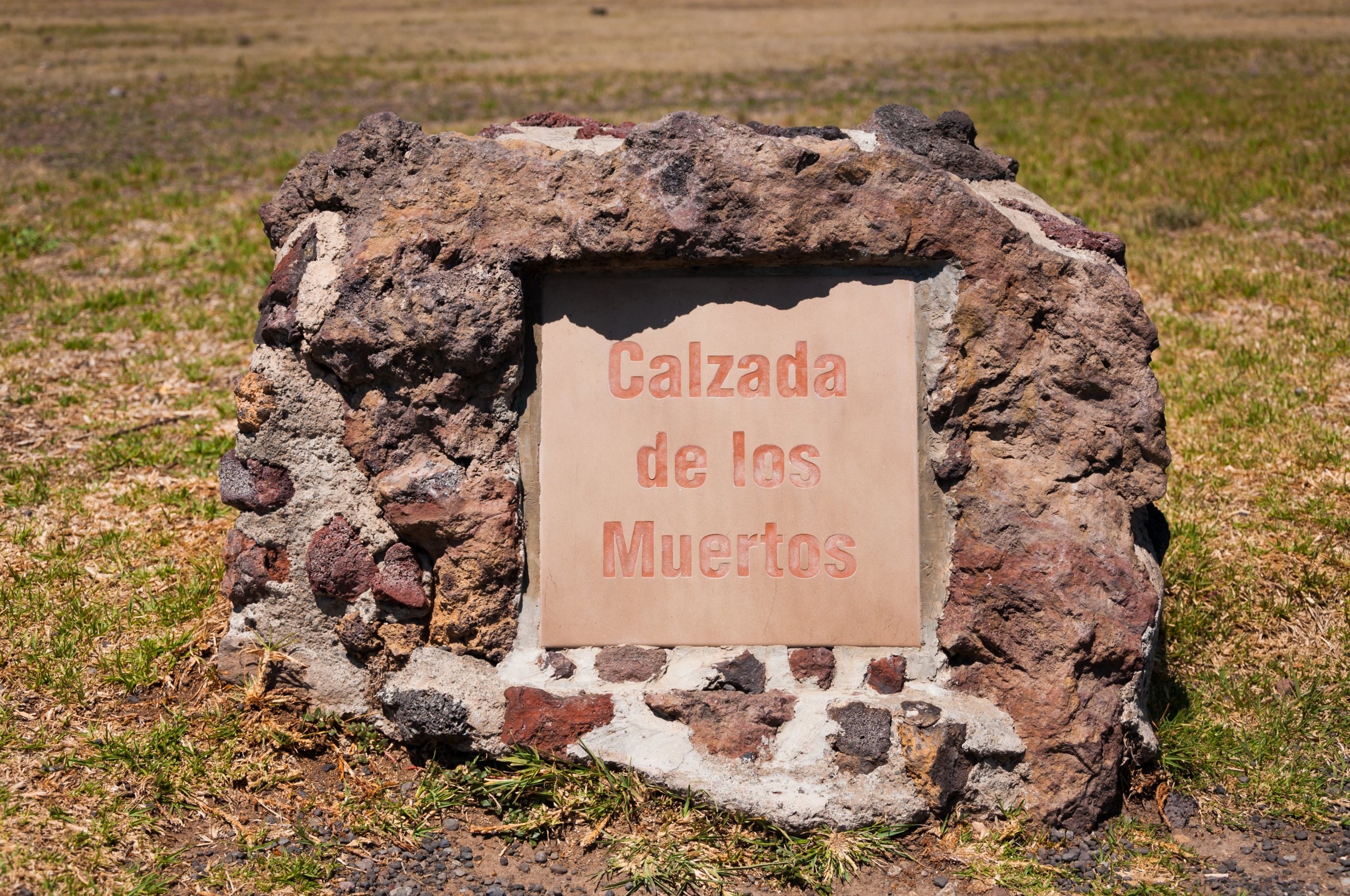
Contemporary archaeology interprets the avenue not as a cemetery, but as a ritual axis: a carefully planned route for movement, alignment, and public ceremony. Its scale suggests collective participation, and its orientation—15.5 degrees east of true north—mirrors solar and calendrical patterns observed elsewhere in Mesoamerican ritual planning.
Procession as Sacred Performance
The avenue begins (or ends) at the Pyramid of the Moon, situated at the base of the Cerro Gordo mountain. This northern sector forms a visual and symbolic climax, framed by the natural topography. Scholars interpret this as a sacred landscape, where built and natural forms co-articulate cosmological order.
Archaeological studies of the Pyramid of the Moon and its surrounding plaza show signs of ritual deposition, including human and animal offerings, precious materials, and evidence of ceremonial staging. The broad plaza in front of the pyramid was likely used for gatherings and ritual drama, possibly involving large groups moving along the avenue toward this northern axis.
In this context, the Calzada functioned not merely as a road, but as a ritual conduit, through which individuals moved in coordinated sequence—participating in spatially anchored acts of devotion, renewal, or spectacle. Such movements may have marked calendrical festivals, rites of passage, or imperial ceremonies. The avenue created a structured path for sacred choreography.
Pilgrimage or Political Theater?
The notion of pilgrimage in Teotihuacan must be approached carefully. Unlike in later Mesoamerican civilizations such as the Aztec or Maya, where written sources describe specific journeys to sacred sites, Teotihuacan left no textual archive. Nevertheless, the scale of its monuments and the archaeological evidence of foreign presence—including offerings of materials from Oaxaca, the Gulf Coast, and the Maya region—suggest that Teotihuacan drew visitors from across Mesoamerica.
Whether these visitors were pilgrims in a religious sense, emissaries of political alliances, or trade envoys is difficult to determine. However, the presence of ritual caches and regionally distinct artifacts along the avenue indicates that travel to Teotihuacan involved acts of cultural and possibly spiritual significance. The city’s monumental core was not just an administrative center but a theatrical landscape of power and cosmology, and the Calzada was its ceremonial backbone.
If not pilgrimage in the formalized, cyclical sense known from later traditions, it was likely something functionally close: intentional journeys to a sacred urban center, involving ritual participation and offerings, embedded within a broader spiritual worldview.
Urban Planning and Sacred Geography
One of the most compelling arguments for the avenue’s ritual function lies in its integration with Teotihuacan’s urban design. The city’s layout was not utilitarian but symbolic. The orientation of buildings, sightlines, and plazas appears to encode cosmological principles—especially solar cycles and the cardinal directions.
The Avenue of the Dead does not run strictly north-south but is offset by 15.5 degrees, possibly aligning with the setting of the Pleiades or calendrical events tied to agriculture and renewal. Such deviations were deliberate, embedding the sacred into the geometry of daily life.
Moreover, the avenue was not a flat space—it included ramps, stepped elevations, and wide plazas that structured how people moved, gathered, and perceived the city’s architecture. These spatial rhythms suggest the avenue was experienced ritually, not simply walked. The act of traversing it would have been immersive—ceremonial rather than practical.
A Route That Endures
Teotihuacan collapsed around 550 CE, and the Avenue of the Dead fell into disuse. Yet its monumental presence endured, reinterpreted by later civilizations. For the Aztecs, it was a sacred place of origin. They believed the gods had been born there, and they pilgrimaged to Teotihuacan as part of their own religious-political identity. In this way, the avenue acquired a second life—not as a functioning road, but as a mythologized memory of sacred movement.
Today, visitors walk the same route, flanked by the same stones. Though modern tourism has replaced ancient ritual, the avenue still stages a kind of processional experience—one in which space and meaning unfold step by step. The term pilgrimage may not apply in the formal religious sense, but the act of movement through a charged landscape remains.
Sacred Movement in an Urban Frame
The Calzada de los Muertos stands as one of the clearest examples of sacred urbanism in ancient Mesoamerica. Its length, orientation, and integration with ritual architecture suggest it was more than infrastructure—it was a medium through which sacred experience was enacted, structured, and witnessed.
Whether traversed by elite priests, visiting emissaries, or common participants in seasonal rites, the avenue facilitated a form of ritual movement that parallels the dynamics of pilgrimage: intentional travel, embodied devotion, and the transformation of space through participation. Though its meanings have shifted, the Avenue of the Dead continues to carry traces of those who walked it with purpose—marking time, memory, and belief into the landscape.
AI Transparency Notice
PilgriMaps uses artificial intelligence tools to assist in the research, drafting and translation of editorial content. All AI-assisted content is reviewed, edited and verified by our editorial team before publication. We contrast information against primary sources, specialist literature and on-the-ground knowledge to ensure accuracy, cultural sensitivity and editorial integrity.
AI is one tool among many in our workflow. The judgement, curation and responsibility for everything published on this platform remain entirely human.
Viator Media S.L. — in compliance with the EU Artificial Intelligence Act (Regulation EU 2024/1689).
This post is also available in: