In China, the mountains were never geography alone. They were the places where the cosmos made itself available to human understanding — and where human beings, by the act of climbing, made themselves available to the cosmos.
There is a moment on the ascent of Mount Hua — Huashan, the western peak, the one with the vertiginous plank walkways bolted into sheer cliff face — when the path narrows to the width of a single body and the drop on both sides becomes absolute. Pilgrims have been climbing this mountain for two thousand years. At that moment, every one of them has faced the same choice: continue, or turn back. The mountain does not negotiate. It simply presents the question.
That quality of unambiguous demand is, perhaps, the point.
Five mountains, one cosmos
The Wu Yue — the Five Sacred Mountains — are not a random collection of impressive peaks. They are a cosmological system mapped onto the landscape of China: Taishan in the east, Huashan in the west, Hengshan Bei in the north, Hengshan Nan in the south, and Songshan at the center. Together they mark the cardinal directions and the axis of the world. To climb one of them is to locate oneself within an order that is simultaneously geographical, moral, and cosmic.
The system predates any single religious tradition. By the time Confucianism, Daoism, and Buddhism had each developed their own relationship to the mountains, the mountains had already been sacred for centuries. What happened over time was not competition but layering: temples, monasteries, and academies were built on the same slopes, sometimes within sight of each other, each tradition finding in the peaks what its own framework led it to seek. The mountains did not belong to any one tradition because they preceded all of them. They were, in the oldest Chinese understanding, simply where Heaven and Earth came closest together.
Taishan: the mountain of emperors and ordinary people
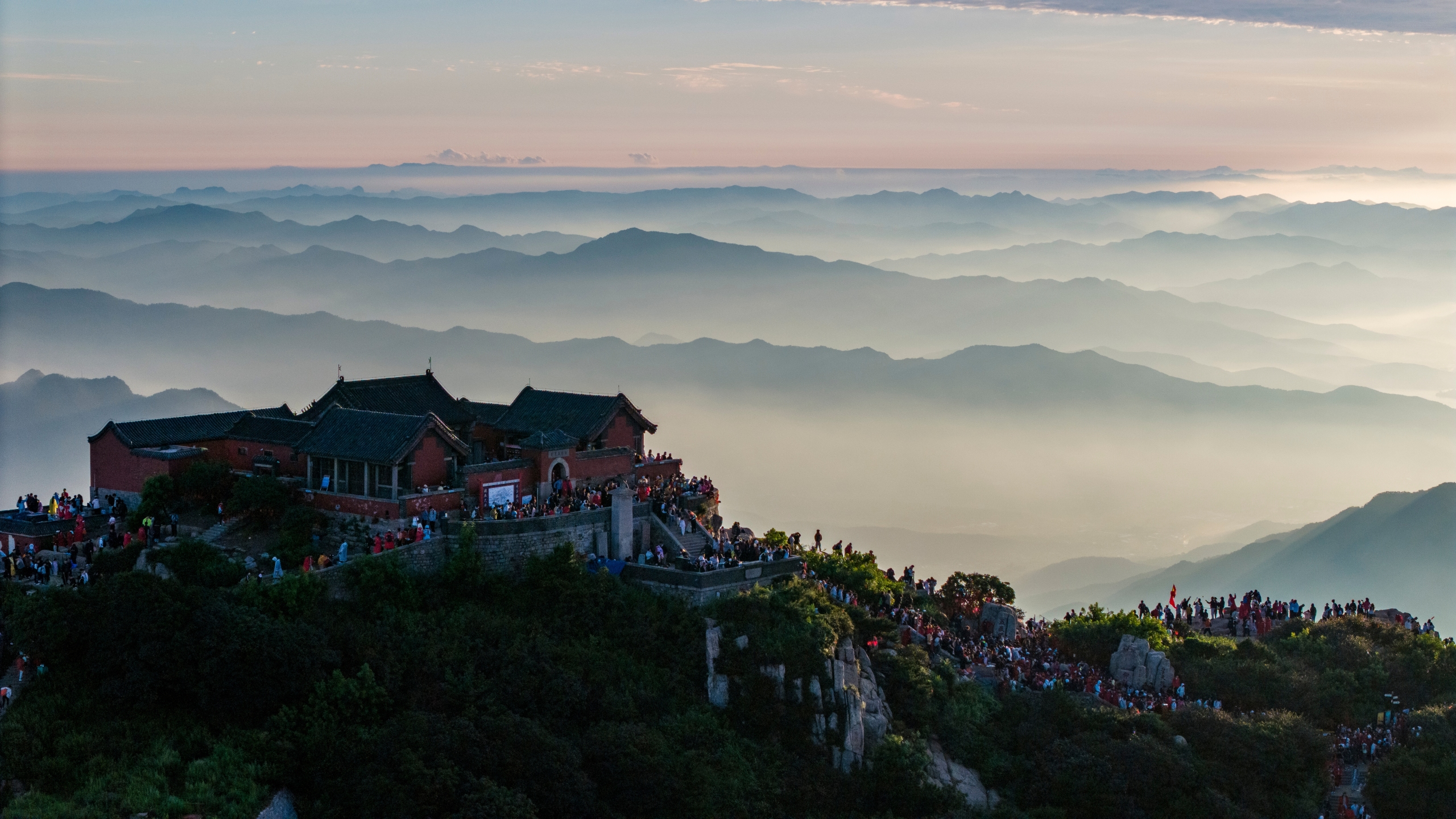
Of the five, Taishan is the most visited and the most historically freighted. For more than two millennia, Chinese emperors performed the fengshan sacrifices here — elaborate rituals of cosmic legitimation conducted at the summit, by which the emperor reported to Heaven on the state of the realm and received, in return, a renewed mandate to rule. The list of emperors who climbed Taishan reads like a condensed history of China.
But alongside the imperial processions, ordinary people climbed too — and still do, in numbers that make Taishan one of the most-visited pilgrimage sites in the world. Many begin the ascent at midnight to reach the summit at dawn. The goal is to watch the sun rise over the eastern plain, an act that carries, in the Chinese tradition, connotations of renewal, clarity, and moral recommitment that no theological explanation quite exhausts.
The 6,293 steps are lined with inscriptions carved into the rock face by scholars, poets, and emperors across the centuries. Climbing Taishan is climbing through layers of human aspiration deposited over three thousand years. The mountain is, among other things, an archive.
Songshan: the mountain at the center
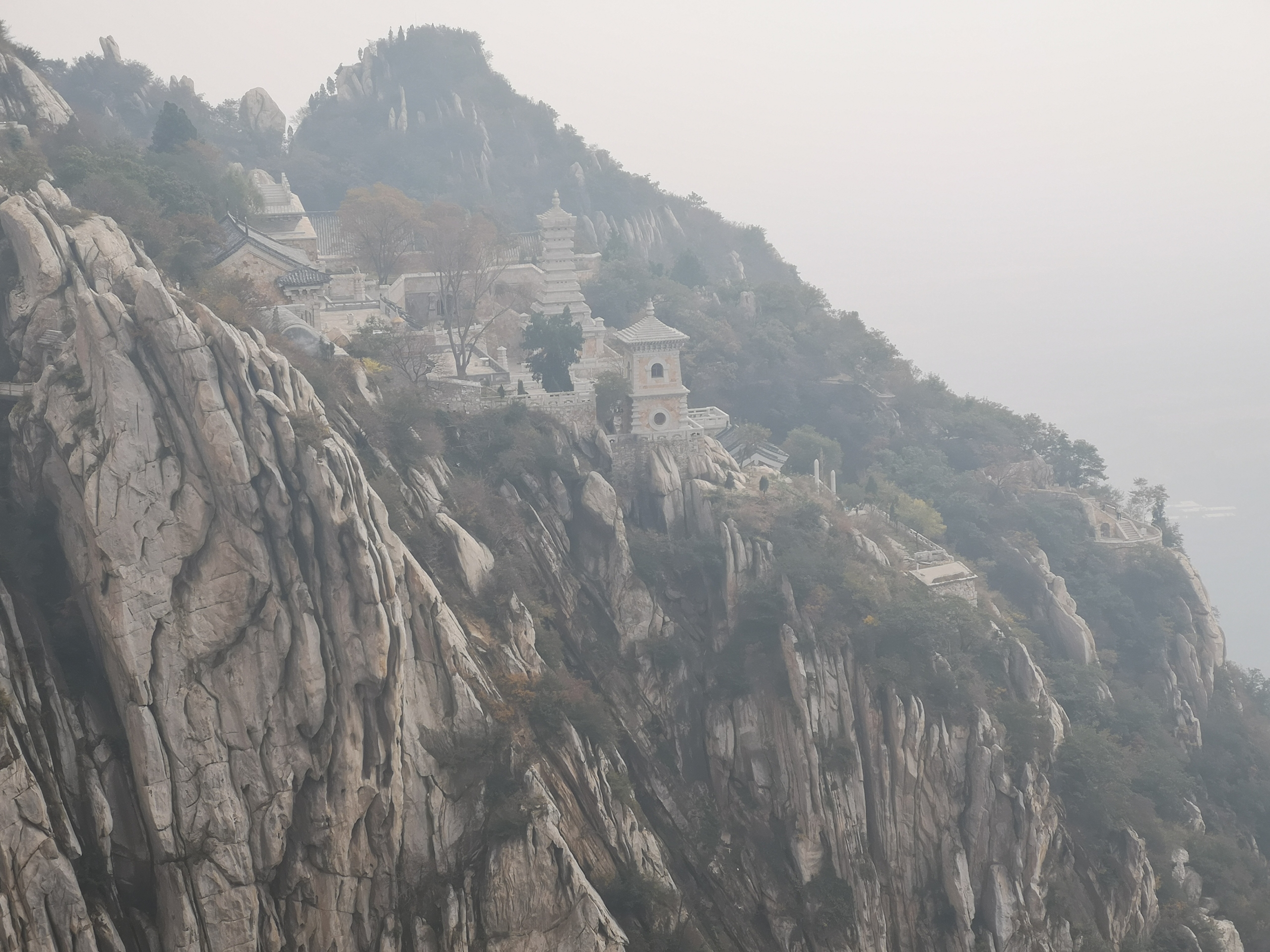
Songshan, the central peak in Henan province, is the mountain that holds the middle of the system together — and it shows in the density of what has accumulated there. The Shaolin Monastery sits on its slopes, making Songshan simultaneously a site of Chan Buddhist practice, martial arts tradition, and Daoist cultivation. The Zhongyue Temple at its base is one of the oldest continuously active religious sites in China.
But Songshan’s significance in the pilgrimage imagination has less to do with any specific institution than with its position. The center, in Chinese cosmological thinking, is not a passive midpoint. It is the place of integration — where the four directions meet and where, consequently, the self that has been dispersed across relationships and obligations can momentarily cohere. To climb the central mountain is to seek, however briefly, a vantage point from which the whole becomes visible.
Huashan: the mountain of extremity
Mount Huashan: Between Vertigo and Pilgrimage on the Trail of Death
If Taishan is the mountain of history and Songshan is the mountain of integration, Huashan is the mountain of pure demand. Its five peaks are connected by paths that have tested pilgrims for centuries — including the South Peak plank walk, a series of wooden boards fixed to a vertical rock face by iron chains, traversable only in single file, with nothing below for several hundred meters. It is not a route for the indifferent.
Huashan has been associated primarily with Daoism, and there is something in the mountain’s character that fits: the Daoist tradition’s insistence that the path reveals itself only to those who are genuinely willing to follow it, regardless of where it leads. But the pilgrims who climb Huashan come from every tradition and no tradition. What they share is the willingness to put themselves in a situation where distraction is structurally impossible.
That enforced attention is, arguably, what all five mountains offer in their different registers. The climb removes the ordinary conditions under which the self can avoid itself.
What the mountains ask
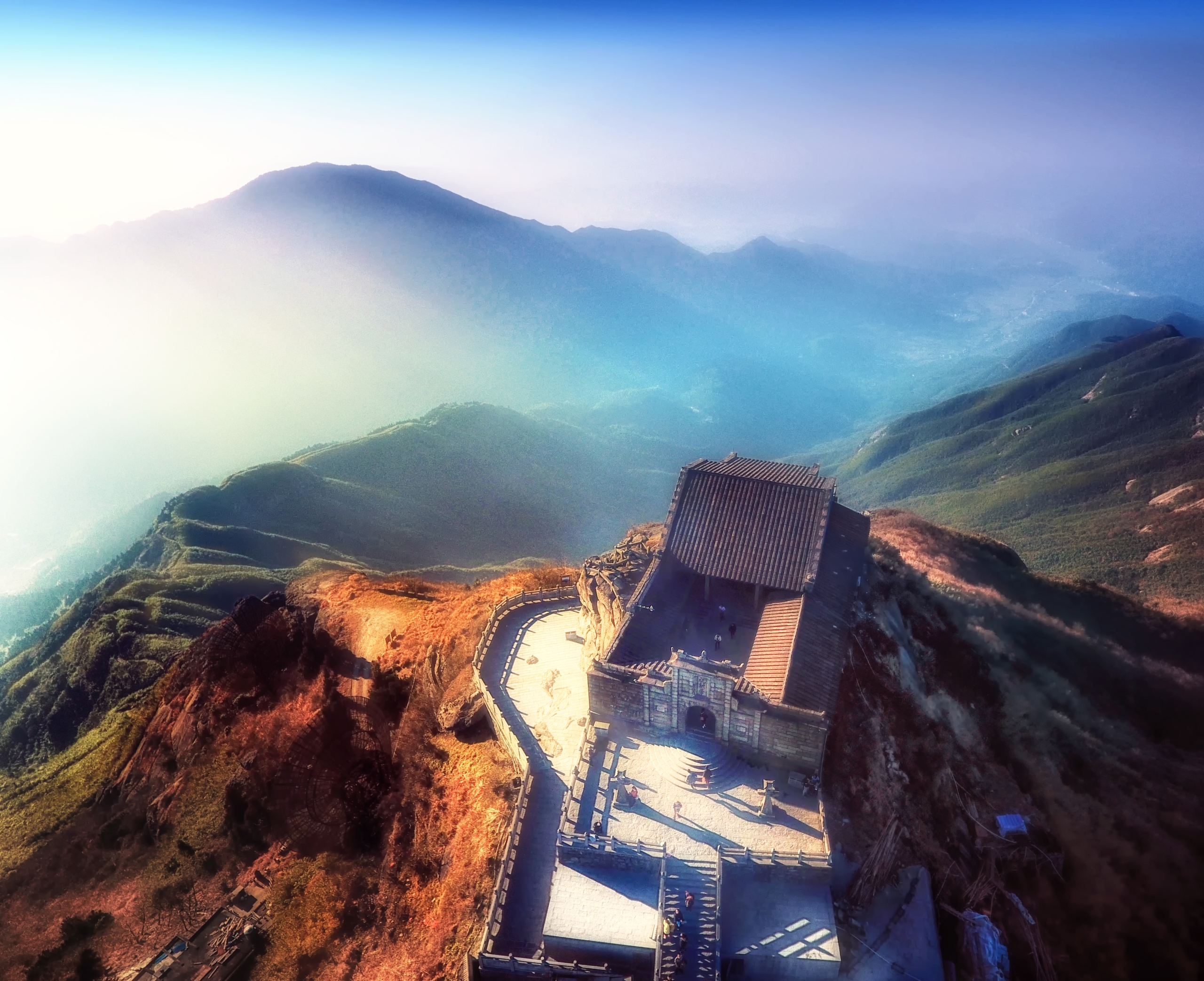
The pilgrim tradition at the Five Sacred Mountains does not fit neatly into any single religious category, which may be precisely why it has survived every change of dynasty, ideology, and official policy that China has undergone. During the Cultural Revolution, the temples were damaged or closed. The pilgrims kept coming.
What they are seeking is not easy to name. The Daoist would say alignment with the natural order. The Buddhist would speak of the dissolution of attachment. The Confucian would point to the clarification of moral intention that comes from sustained physical effort in a place of elemental seriousness. The contemporary visitor without any particular religious framework might simply say: I needed to be somewhere that made ordinary concerns feel appropriately small.
All of these are true. None of them is complete. The mountains have been absorbing human seeking for three thousand years without resolving it into a single answer, which suggests the seeking may be more important than any conclusion it reaches.
Confucius stood at the summit of Taishan and said the world below seemed small. He did not say what to do about that. He left the descent, and everything it implied, to the climber.
Further reading: Edouard Chavannes, Le T’ai chan: Essai de monographie d’un culte chinois (1910); Robert Hymes, Way and Byway: Taoism, Local Religion, and Models of Divinity in Sung and Post-Sung China (2002); Kenneth Pomeranz, “Sacred Sites and the Construction of Chinese History,” in Pilgrims and Sacred Sites in China, ed. Susan Naquin and Chün-fang Yü (1992).
AI Transparency Notice
PilgriMaps uses artificial intelligence tools to assist in the research, drafting and translation of editorial content. All AI-assisted content is reviewed, edited and verified by our editorial team before publication. We contrast information against primary sources, specialist literature and on-the-ground knowledge to ensure accuracy, cultural sensitivity and editorial integrity.
AI is one tool among many in our workflow. The judgement, curation and responsibility for everything published on this platform remain entirely human.
Viator Media S.L. — in compliance with the EU Artificial Intelligence Act (Regulation EU 2024/1689).
This post is also available in: