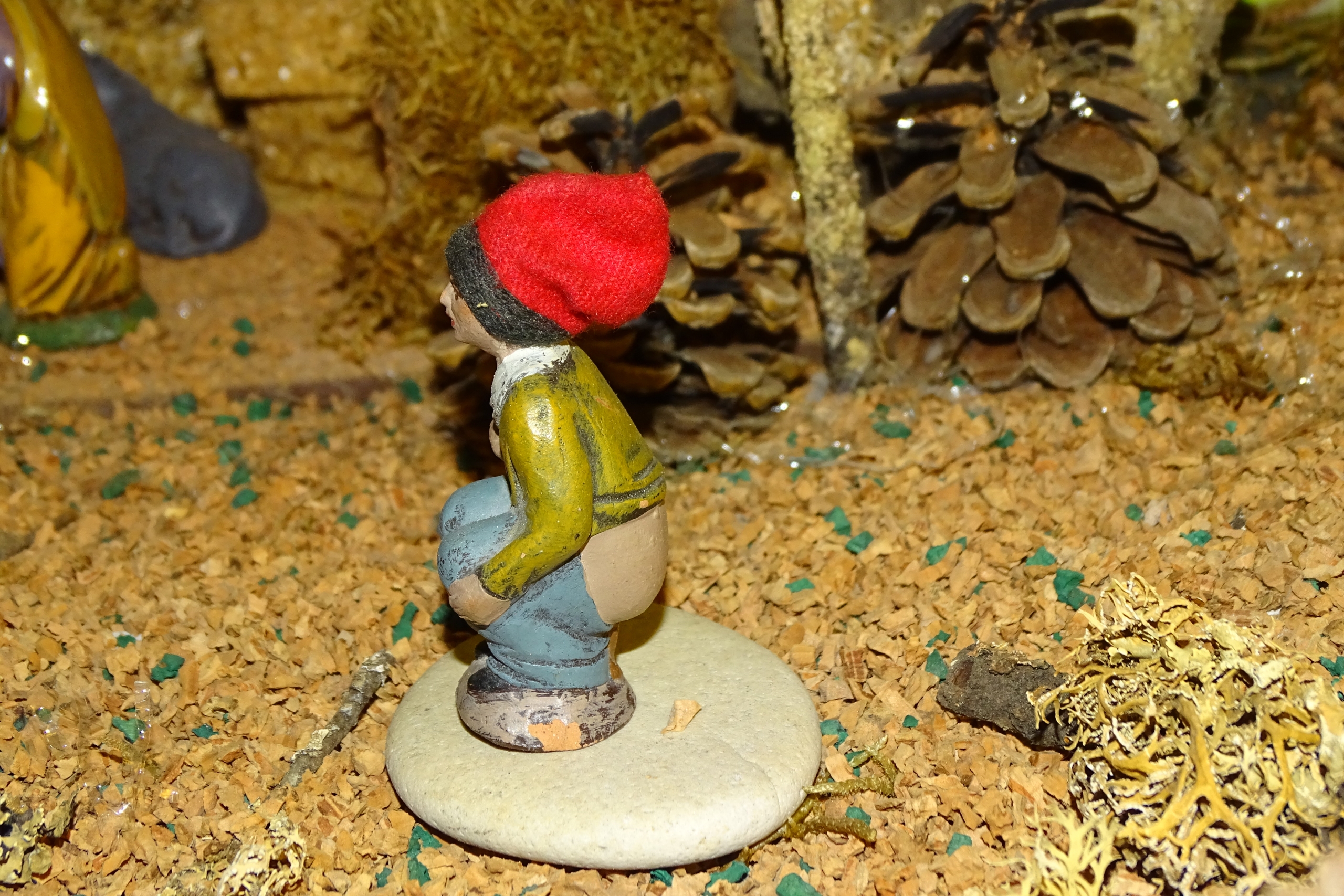
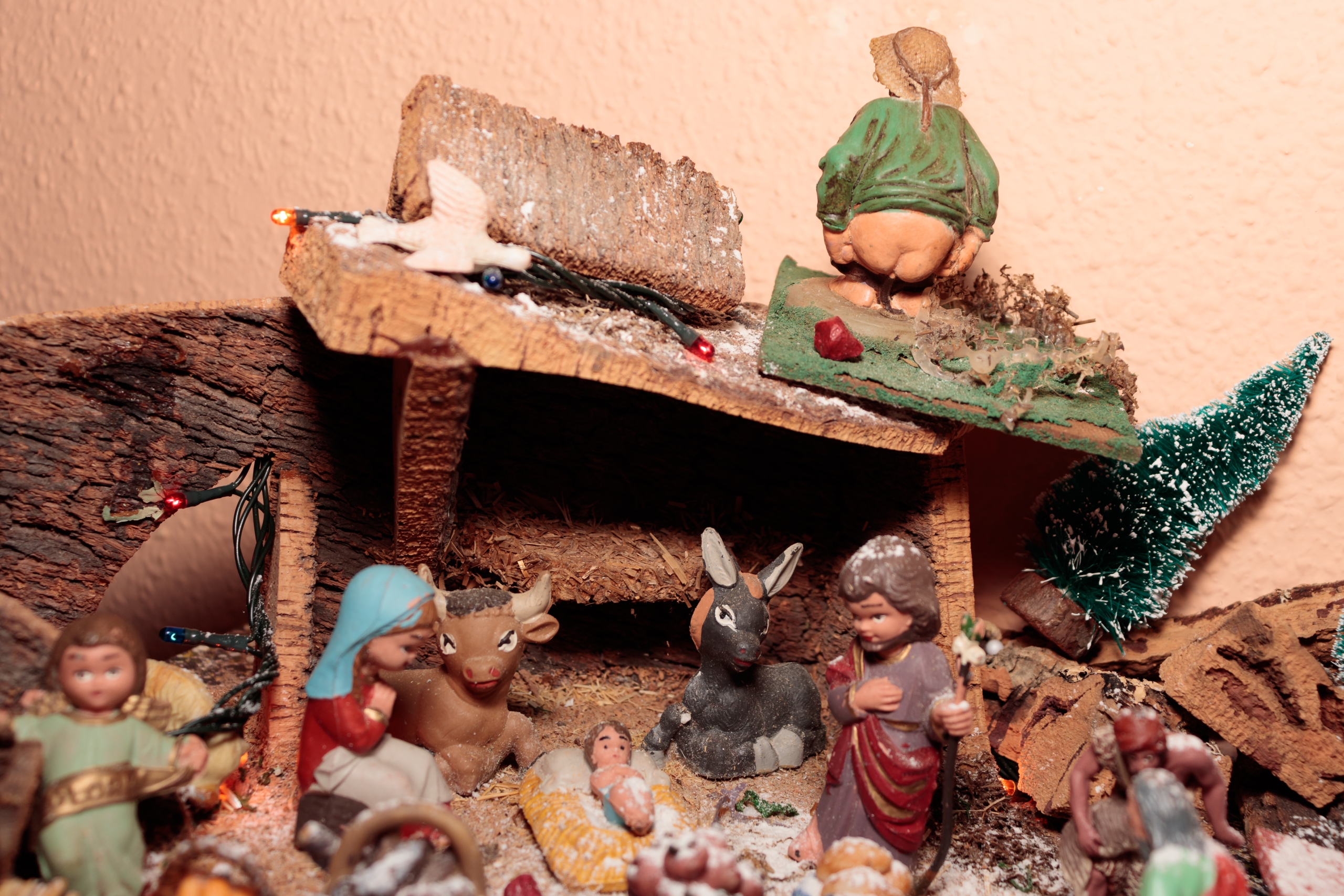
In the quiet light of a Catalan Christmas, amid the moss and miniature shepherds of a pessebre – the traditional Nativity scene – there is a figure that startles first-time viewers. Behind the stable or under a tree, a small peasant crouches with his trousers down, caught in the most unceremonious of human acts.
He is the caganer – literally, “the defecator.” To outsiders, the figure may appear irreverent, even shocking. Yet in Catalonia, the caganer has endured for centuries as a necessary presence, part of the landscape of birth, fertility, and renewal.
Origins of a paradox
The caganer appears in records as early as the 18th century, emerging in rural Catalonia when Nativity scenes began to include local characters – farmers, woodcutters, washerwomen, and shepherds – set against a miniature Mediterranean countryside. This peasant figure, usually dressed in the red cap (barretina) of Catalan tradition, was not created to mock the Nativity but to complete it. He represented the earth itself: ordinary, cyclical, and fertile.
In popular interpretation, his act fertilizes the ground where new life will grow, ensuring abundance for the coming year. Like the ox and the donkey beside the manger, he links the divine event to the natural world. The birth of Christ may mark a moment of transcendence, but the caganer anchors it in the soil of human reality.
The human among the divine
The inclusion of such a figure in a sacred scene embodies a distinctly Mediterranean understanding of life and the body – one that does not isolate the physical from the spiritual. Catalan tradition, shaped by centuries of agrarian rhythm, has long treated bodily functions as part of nature’s order rather than taboo.
In this sense, the caganer becomes a philosophical gesture as much as a comic one. While the Holy Family embodies the miracle of incarnation – divinity taking human form – the caganer reminds viewers that humanity itself is inseparable from the physical processes that sustain life. The juxtaposition is deliberate: at one end of the pessebre, the infant Christ represents divine descent into flesh; at the other, the crouched peasant embodies the body’s return to the earth. Between the two lies the continuum of existence.
This tension – between the sublime and the elemental – defines the Catalan nativity. The caganer is not a violation of reverence but a completion of it. By acknowledging what is base, the scene becomes whole.
Humor and equality
Part of the caganer’s endurance lies in its humor. It brings laughter to a tableau that otherwise emphasizes solemn wonder. That laughter carries a trace of equality. In recent decades, caganers have appeared in the likeness of politicians, athletes, and pop icons – from Catalan presidents to global celebrities – all rendered in the same undignified posture.
This democratic impulse speaks to a core of Catalan folk sensibility: the leveling power of humor before the universal realities of nature. Everyone, whether saint or statesman, shares the same human vulnerabilities. To “caganerize” a public figure is to remind them – and us – of that common ground.
Nature and the supernatural
In theological terms, the caganer represents a daring coexistence of opposites: the ungovernable forces of nature and the transcendent mystery of the Incarnation. The one acts according to biological necessity; the other, by divine will. Both, however, lie beyond human control.
This parallel is subtle but profound. The caganer’s act is involuntary, cyclical, part of the rhythm of life that humans can neither halt nor abolish. The Incarnation, too, stands as an event outside human agency – an intervention in the natural order that redefines it. Each signifies a force larger than the individual: one organic, one cosmic. In this juxtaposition, the pessebre becomes a meditation on the limits of human mastery.
Where nature insists on its continuity, the divine interrupts it. Yet both movements – birth and decay, incarnation and excretion – belong to the same reality of existence. The caganer makes this truth visible, gently, absurdly, and without apology.

Continuity in clay
In Catalonia today, artisans in towns such as Torroella de Montgrí and Olot still model the caganer by hand in terracotta. Workshops produce figures both traditional and satirical, and every December, markets fill with hundreds of variations: classic peasants beside caricatures of world leaders, all waiting to take their place among shepherds and kings.
Families debate where to place the caganer – hidden behind a tree, near the stable, or humorously in full view. Children delight in finding him each year, a game that blends reverence with play. In this way, the caganer continues to function as cultural continuity: an annual reminder that the sacred and the earthly coexist not as opposites, but as partners in the story of life.
The philosophy of the hidden figure
To stand before a Catalan pessebre is to see the entire cycle of being represented in miniature. The angels hover in song, the Magi advance from afar, the shepherds bring offerings, and there, discreetly in the background, a small man honors the same creation by returning to it what it gave.
The caganer holds no malice. His presence affirms that nature’s processes – birth, growth, decay – exist alongside miracle. Both speak of realities beyond human command. The divine enters the world through matter; matter, in turn, continues its eternal work.
In that paradox lies the quiet wisdom of Catalonia’s Christmas: the recognition that life’s most physical and most transcendent moments are not opposed, but intertwined. The stable and the soil belong to the same mystery.
AI Transparency Notice
PilgriMaps uses artificial intelligence tools to assist in the research, drafting and translation of editorial content. All AI-assisted content is reviewed, edited and verified by our editorial team before publication. We contrast information against primary sources, specialist literature and on-the-ground knowledge to ensure accuracy, cultural sensitivity and editorial integrity.
AI is one tool among many in our workflow. The judgement, curation and responsibility for everything published on this platform remain entirely human.
Viator Media S.L. — in compliance with the EU Artificial Intelligence Act (Regulation EU 2024/1689).
This post is also available in: