In 2024, a new long-distance walking route emerged in Canada with a distinctive name and an intentional meaning: Kapoah. Conceived not simply as an itinerary but as a cultural gesture, the route frames walking as a practice of reconciliation—between cultures, historical narratives, and spiritual traditions—within the geographic heart of the American continent.
The name Kapoah is neither a tourism label nor a symbolic acronym. It is a linguistic convergence of two Indigenous words meaning “path”: kapatakan from the Innu language and oahah from the Wendat language. This choice functions as a statement rather than an ornament. Naming the route in the languages of the peoples who first inhabited these lands signals historical recognition and cultural continuity. Contemporary walkers do not begin from an empty point; they move through layered territories shaped by earlier passages.
A project rooted in memory and continuity
Kapoah did not arise in isolation. Its contemporary form is closely tied to the 350th anniversary of the Archdiocese of Quebec, founded in the 17th century and among the oldest Catholic dioceses in North America. In 2024, within this commemorative framework, local organizers promoted a long-distance pilgrimage route that would connect landscape, history, and walking practice without requiring transatlantic travel.
While the European Camino de Santiago provided a conceptual reference, the project’s primary ambition was regional: to articulate a route that reflects the cultural plurality of Quebec and Canada, including Indigenous nations, French colonial heritage, and contemporary spiritual life. Initiated by Abbé François Jacques and collaborators, Kapoah was officially launched in May 2024, when a first group of walkers completed the full route to the Holy Door of the Notre-Dame de Québec Basilica-Cathedral, establishing the foundation of an annual tradition.
Three histories beneath the footsteps
What distinguishes Kapoah from many walking routes is its layered narrative. The path is intentionally framed as a dialogue among three historical and cultural legacies that continue to shape the region.
Indigenous routes: Before the map
Walking Kapoah means following corridors of movement that long predate colonial cartography. Many segments trace valleys, riverbanks, and passes historically used by Innu, Wendat, and other First Nations. Regional toponymy preserves these narratives: names such as Saguenay, Métabetchouan, and Ouiatchouan refer to living languages rooted in long-standing relationships between people and land.
Here, landscape operates as a participant rather than a backdrop. The Saguenay Fjord, the forests of Charlevoix, and the banks of the St. Lawrence River are not framed as scenic views but as sites of meaning shaped by generations of use and interpretation. By adopting Indigenous terminology and acknowledging these trajectories, Kapoah situates pilgrimage as a practice with deep precedents in the Americas, rather than an exclusively European tradition.
The French colonial layer: New France in motion
Overlaying Indigenous geographies is the material legacy of New France. From the 17th century onward, French settlers established villages, parishes, and road networks along the St. Lawrence corridor and its hinterlands. Many of these settlements remain active today, preserving architectural forms and communal memory.
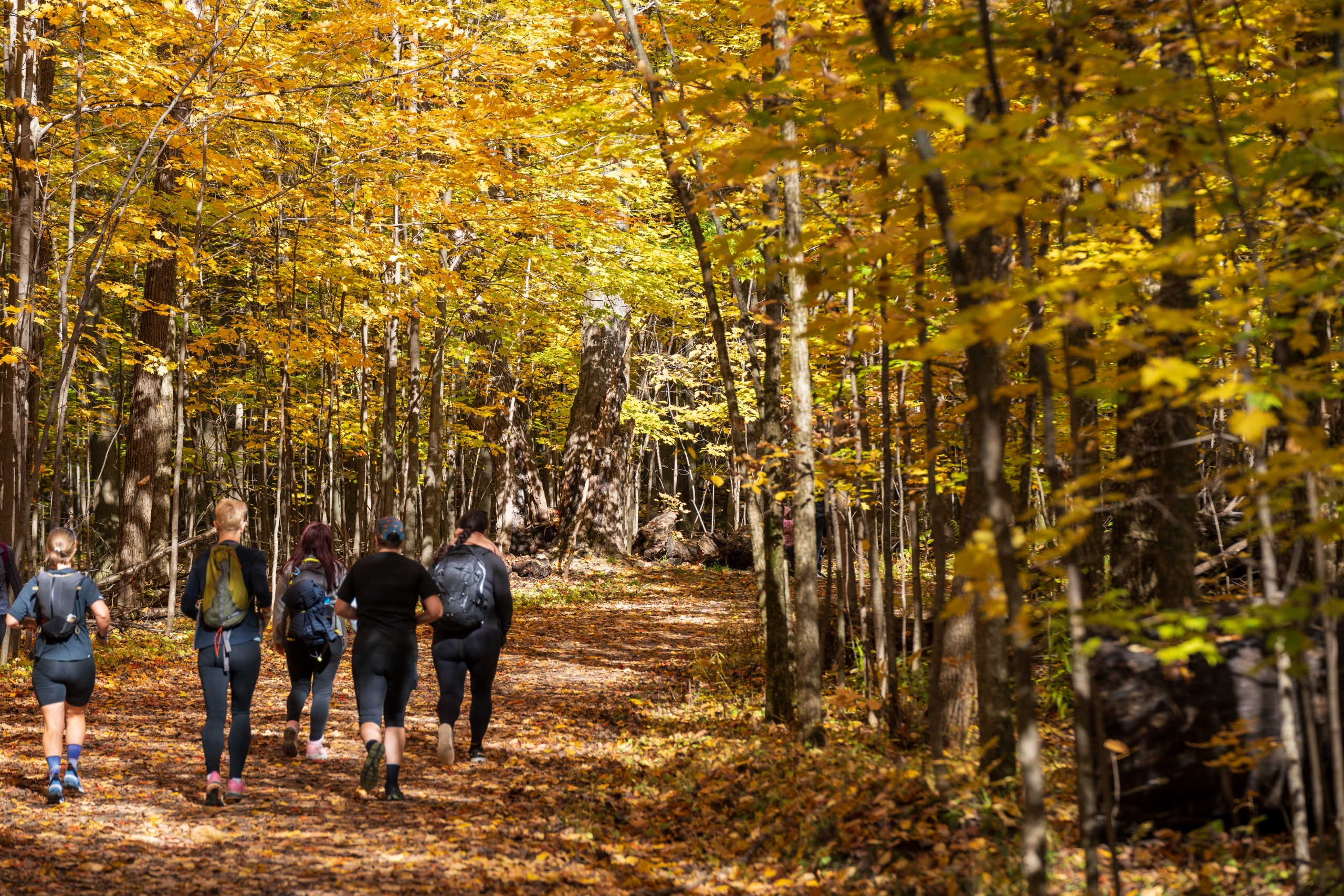
Walkers encounter rural churches, stone farmhouses, mills, and linear roads such as the historic Chemin du Roy, once structured under the seigneurial system. These routes connected ports, parishes, and marketplaces, forming an infrastructure where religious, economic, and administrative life intersected. Kapoah integrates these traces without abstraction, allowing walkers to move through inhabited landscapes where history remains embedded in daily life.
Catholic landmarks: Thresholds and symbols
The Catholic dimension of Kapoah is explicit but not prescriptive. Churches, sanctuaries, and monasteries structure the route, culminating at the Holy Door of the Notre-Dame de Québec Basilica-Cathedral—the only Holy Door located outside Europe. As a symbolic threshold, it anchors the route within a broader ritual geography.
Along the way, walkers may encounter established practices associated with pilgrimage routes: credential booklets stamped at key locations, communal gatherings in churches, and arrival ceremonies. The route also passes the burial site of François de Laval, a foundational historical figure in Canadian Catholic history. These elements provide continuity with established pilgrimage traditions while remaining open to diverse motivations for walking.
The route: From fjord to threshold
Kapoah is conceived as a network rather than a single fixed line. Its full length approaches 500 kilometers, typically walked over four weeks, though shorter segments allow for partial experiences.
- Sentier Notre-Dame Kapatakan (267 km)
Beginning at the Ermitage Saint-Antoine in Lac-Bouchette, this segment follows forested terrain toward Rivière-Éternité, skirting the Saguenay Fjord. It concludes near the statue of Notre-Dame-du-Saguenay at Cap Trinité, combining demanding terrain with strong historical associations.
- Sentier de traverse Le Fjord–Charlevoix (130 km)
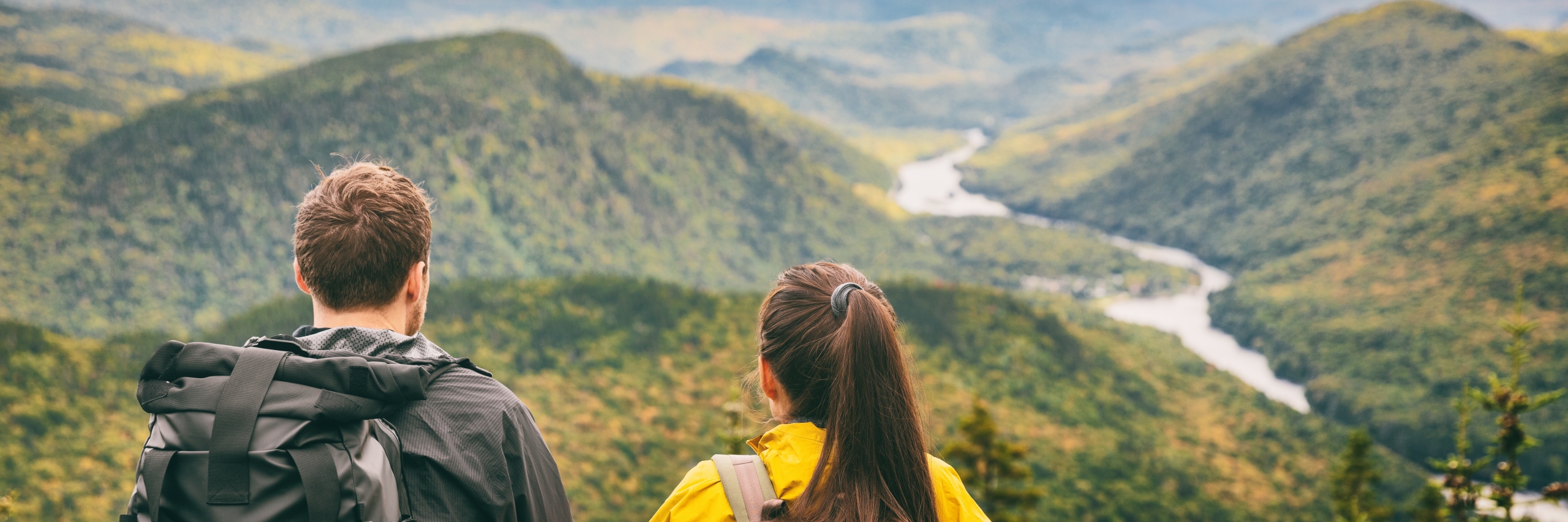
This mountainous connector crosses remote forests and valleys, requiring solid physical preparation. Shelters and backcountry paths dominate, emphasizing sustained engagement with Quebec’s interior landscapes.
- Sentier Notre-Dame de Québec (205 km)
From La Malbaie to Quebec City, this segment highlights built heritage. Walkers pass through Baie-Saint-Paul and the Côte-de-Beaupré, encountering historic churches, the Basilica of Sainte-Anne-de-Beaupré, Montmorency Falls, and the approach to Old Quebec.
Walking today: Profiles and practices
Participants range widely in age, background, and motivation. Accommodation remains modest – parish halls, rural hostels, campgrounds, and monasteries – supporting a rhythm shaped more by walking than by infrastructure. Informal encounters with residents, shared meals, and evening conversations contribute to a sense of collective experience without formal programming.
Reconciliation by design
Beyond religious affiliation, Kapoah presents itself as a symbolic response to Canada’s complex historical legacy. By foregrounding Indigenous languages, acknowledging colonial layers, and framing walking as an act of listening, the route offers an ethical and cultural proposition: reconciliation as movement rather than declaration.
The arrival at the Holy Door marks not an endpoint but a transition. Crossing it closes one journey and opens another—toward a broader understanding of land, memory, and coexistence.
Kapoah does not seek to replicate older pilgrimage routes. Its relevance lies in its specificity: a North American path shaped by Indigenous presence, colonial history, and contemporary reflection. It remains open to anyone willing to walk, observe, and engage—step by step—with the layered ground beneath their feet.
AI Transparency Notice
PilgriMaps uses artificial intelligence tools to assist in the research, drafting and translation of editorial content. All AI-assisted content is reviewed, edited and verified by our editorial team before publication. We contrast information against primary sources, specialist literature and on-the-ground knowledge to ensure accuracy, cultural sensitivity and editorial integrity.
AI is one tool among many in our workflow. The judgement, curation and responsibility for everything published on this platform remain entirely human.
Viator Media S.L. — in compliance with the EU Artificial Intelligence Act (Regulation EU 2024/1689).
This post is also available in: