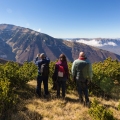
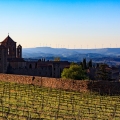
A coffin advances slowly, surrounded by thousands. This is not an ordinary burial but a return. In the summer of 1374, a procession moved across the roads of Östergötland toward Vadstena. Inside the casket were the remains of Bridget of Sweden, brought from Rome after seven months of travel across Europe. Farmers, clergy, and onlookers accompanied the cortege. Miracles were reported. Tears were shed. Hymns were sung. The scene functioned less as a pious episode than as a collective act to ensure that a life would not dissolve into distance.
That final stretch—from the Swedish coast to the monastery she envisioned—forms today the symbolic core of Birgittaleden, the route linking Söderköping and Vadstena. It did not originate as a tourism product but as memory set in motion. To walk it is, in a sense, to accompany that return.
Seven months North
Bridget died in Rome in 1373, after years of intense activity in a city that was both spiritual center and political arena. Her body was placed in the convent of San Lorenzo in Panisperna while plans for its transfer were arranged. Medieval logistics required practical measures: to facilitate long-distance transport, bones and soft tissue were separated, in keeping with contemporary custom. Some relics remained in Rome; the rest began the journey north.
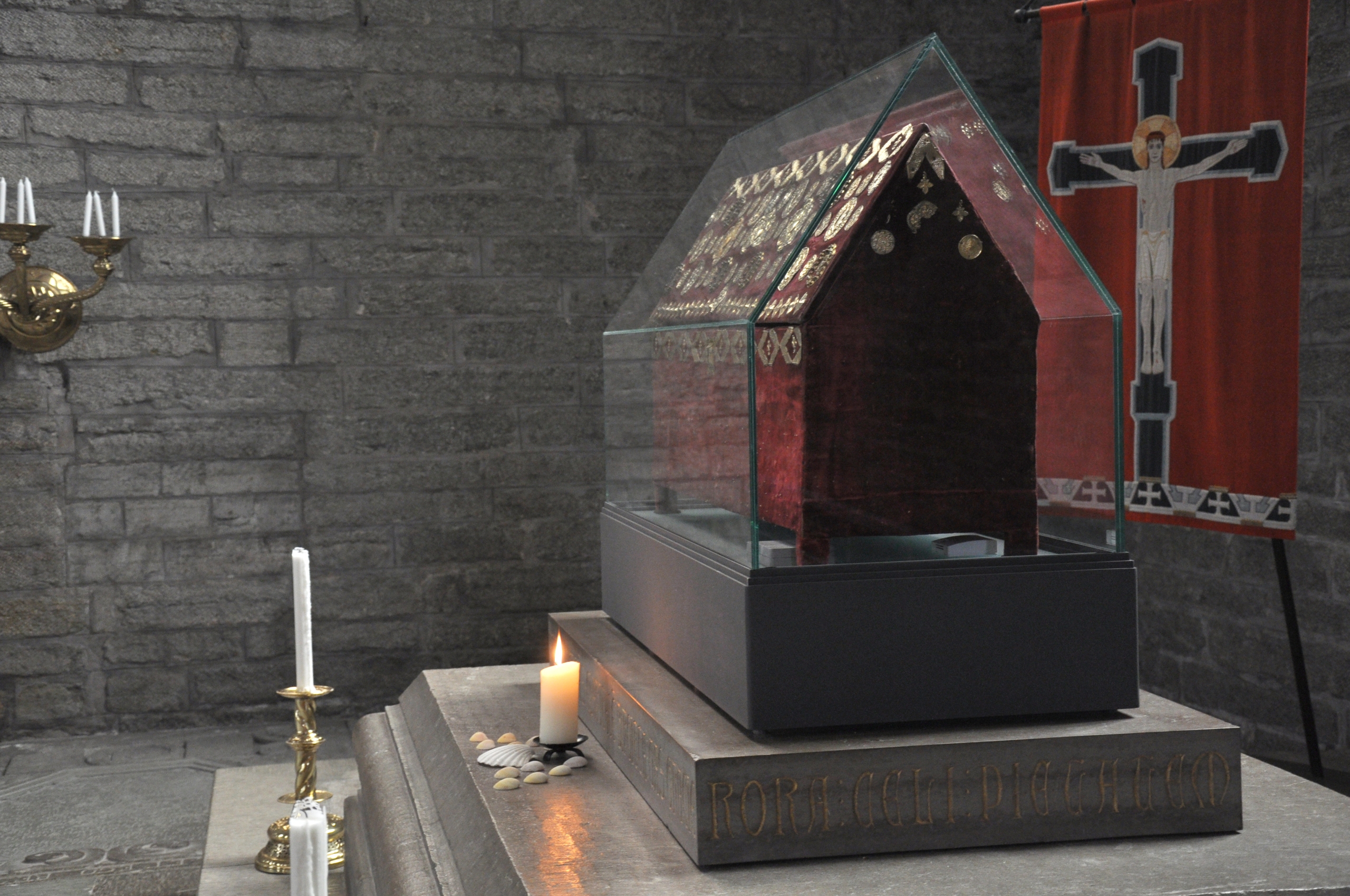
The principal figure behind the return was her daughter Catherine (Katarina), accompanied by a small retinue. They crossed the Alps, traversed Germanic and Scandinavian territories, and eventually reached the Baltic. After disembarking in Söderköping, the final stage began: a land procession to Vadstena. This was not merely a funerary transfer; it was a public affirmation of legacy.
In medieval Europe, relics served as more than physical remains. They functioned as focal points of communal identity. The arrival in Vadstena transformed the monastery into a site of tangible presence, not solely of memory. Years later, in 1391, Bridget would be canonized. The decisive gesture, however, had already taken place: the body had returned north.
Life and work of a European woman
To reduce Bridget to the label of “Swedish saint” diminishes her scope. Born in 1303 into an influential family, she received an education unusual for women of her time. She was wife and mother of eight children. After becoming a widow, she intensified a life marked by visionary experiences recorded in texts known as the Revelationes, widely circulated in fourteenth-century Europe.
She addressed kings and popes, intervened in debates concerning the return of the papacy to Rome during the Avignon period, and advocated moral reform within the Church. In 1371 she undertook pilgrimage to Jerusalem, a demanding undertaking even for younger travelers, and returned in fragile health. She died two years later.
Her legacy extended beyond writing. She promoted the foundation of a religious order—the Order of the Most Holy Savior—whose center was to be established in Vadstena. The community, composed of both men and women under a shared rule, reflected an organizational model unusual for its time. When the relics arrived in 1374, the site was already a project; from that moment it became a sanctuary as well.
Bridget’s life unfolded across linguistic and political borders. She traveled, wrote, negotiated, and debated on a continental scale. This transnational dimension helps explain why her memory continues to resonate with walkers of varied backgrounds.
St Birgitta Ways: A contemporary network
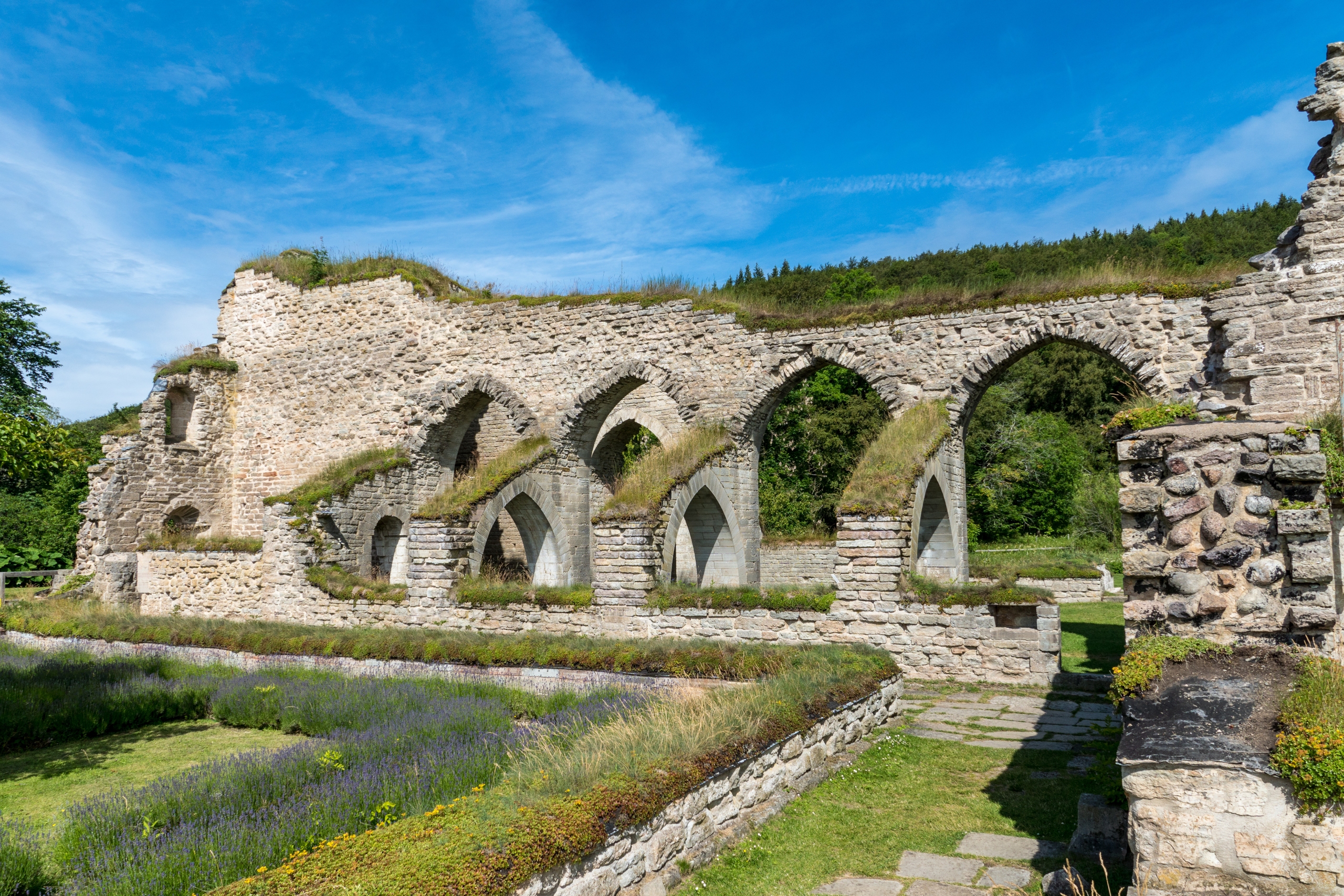
Birgittaleden forms part of the broader St Birgitta Ways, a structured network of pilgrimage routes centered on Vadstena. The initiative goes beyond trail marking. It provides digital maps, stage suggestions, “pilgrim-friendly” accommodations, a pilgrim passport, and a final certificate. Medieval tradition is translated into practical infrastructure.
Several routes converge on Vadstena:
- Linköping–Vadstena (72 km, 4 days), beginning at Linköping Cathedral and including stretches along the Göta Canal.
- Vårdnäs–Vadstena (122 km, 6 days), through oak landscapes.
- Jönköping–Vadstena (134 km, 7–8 days), skirting Lake Vättern.
- Hamburg–Maribo–Lund–Vadstena (776 km, around 35 days), an international corridor linking Germany, Denmark, and Sweden.
Within this network, Birgittaleden stands out for its direct connection to the historical translation of 1374. It retraces, step by step, that foundational episode.
Walking Birgittaleden today
Distance and stages
The route between Söderköping and Vadstena measures roughly 130 kilometers. It is typically divided into six or seven stages, with daily distances ranging from 13 to 21 km—about four to eight hours of walking. Much of the path overlaps with the Östgötaleden trail, ensuring clear signage and maintenance.
A common stage outline includes:
- Söderköping → Gårdeby
- Gårdeby → Askeby
- Askeby → Linghem → Linköping
- Linköping → Vreta Kloster
- Vreta Kloster → Borensberg
- Borensberg → Motala
- Motala → Vadstena
This is not an alpine or extreme route. The landscape is open and agricultural, dotted with rural churches and small towns. The experience rests in continuity rather than spectacle.
Departure and arrival
The traditional starting point is St. Laurentii Church in Söderköping. From there, the path moves inland toward Linköping, which functions as an urban and logistical hinge. Those with limited time may begin in Linköping and complete the walk in four days.
Arrival in Vadstena carries symbolic density. The former monastery—now partly museum and cultural site—and the abbey church mark the physical end. As with most pilgrimages, however, the conclusion does not close the experience; it reframes it.
Maps and orientation
St Birgitta Ways provides detailed digital maps. Nonetheless, relying exclusively on a mobile phone is unwise. Downloading offline tracks, carrying an external battery, and keeping a physical map or basic orientation skills remain prudent practices. Infrastructure is solid, but weather and detours can alter plans.
Accommodation and services
The network includes partner accommodations designed for pilgrims, from hostels to parish houses. During the Scandinavian summer, advance booking is advisable. Sweden is organized yet expansive; distances between services may be greater than expected.
Passport and Certificate
The pilgrim passport allows for the collection of stamps at churches and designated points. After completing a minimum distance toward Vadstena—around 100 km—a final certificate may be requested. Beyond documentation, it serves as a contemporary ritual of closure.
Rhythm and preparation
Walking 15 to 20 kilometers per day requires no heroism but does demand preparation: tested footwear, a light backpack, hydration, and attentiveness to the body. Pilgrimage is not competition. It is cadence.
Walking behind relics
Why follow today a route born from the transfer of a medieval coffin? Perhaps because the original scene contains something widely recognizable: a community choosing to accompany one of its own to the end. To walk Birgittaleden is to renew that gesture without needing to share all the convictions of 1374.
Östergötland’s fields and open horizons encourage reflection without dramatics. There are no towering peaks to impose silence; quiet emerges from repetition of step after step. Each day adds distance and reduces noise.
When walkers enter Vadstena and stand before the former monastery, they may recall that initial procession. The coffin advanced so that a life would not remain scattered. Today people walk for different reasons—grief, search, curiosity, the need for pause—yet the mechanism is similar: moving the body to order the mind.
Birgittaleden does not promise answers. It offers something more restrained and perhaps more durable: a route shaped by history. At times, tracing the path of a fourteenth-century return becomes a distinctly contemporary way to begin anew.
AI Transparency Notice
PilgriMaps uses artificial intelligence tools to assist in the research, drafting and translation of editorial content. All AI-assisted content is reviewed, edited and verified by our editorial team before publication. We contrast information against primary sources, specialist literature and on-the-ground knowledge to ensure accuracy, cultural sensitivity and editorial integrity.
AI is one tool among many in our workflow. The judgement, curation and responsibility for everything published on this platform remain entirely human.
Viator Media S.L. — in compliance with the EU Artificial Intelligence Act (Regulation EU 2024/1689).
This post is also available in: