If a universal pilgrim passport existed today, with boxes for Compostela, Rome, Jerusalem, and the great northern shrines, it would likely need extra pages to contain all the stamps collected by Bridget of Sweden.
In the fourteenth century, when travel meant exposure to uncertain seas, unsafe roads, and diseases without remedy, this Swedish noblewoman crossed Europe from one end to the other. She did so more than once, and not as a matter of passing devotional curiosity. For her, spirituality was articulated through movement. The road formed part of the vocation.
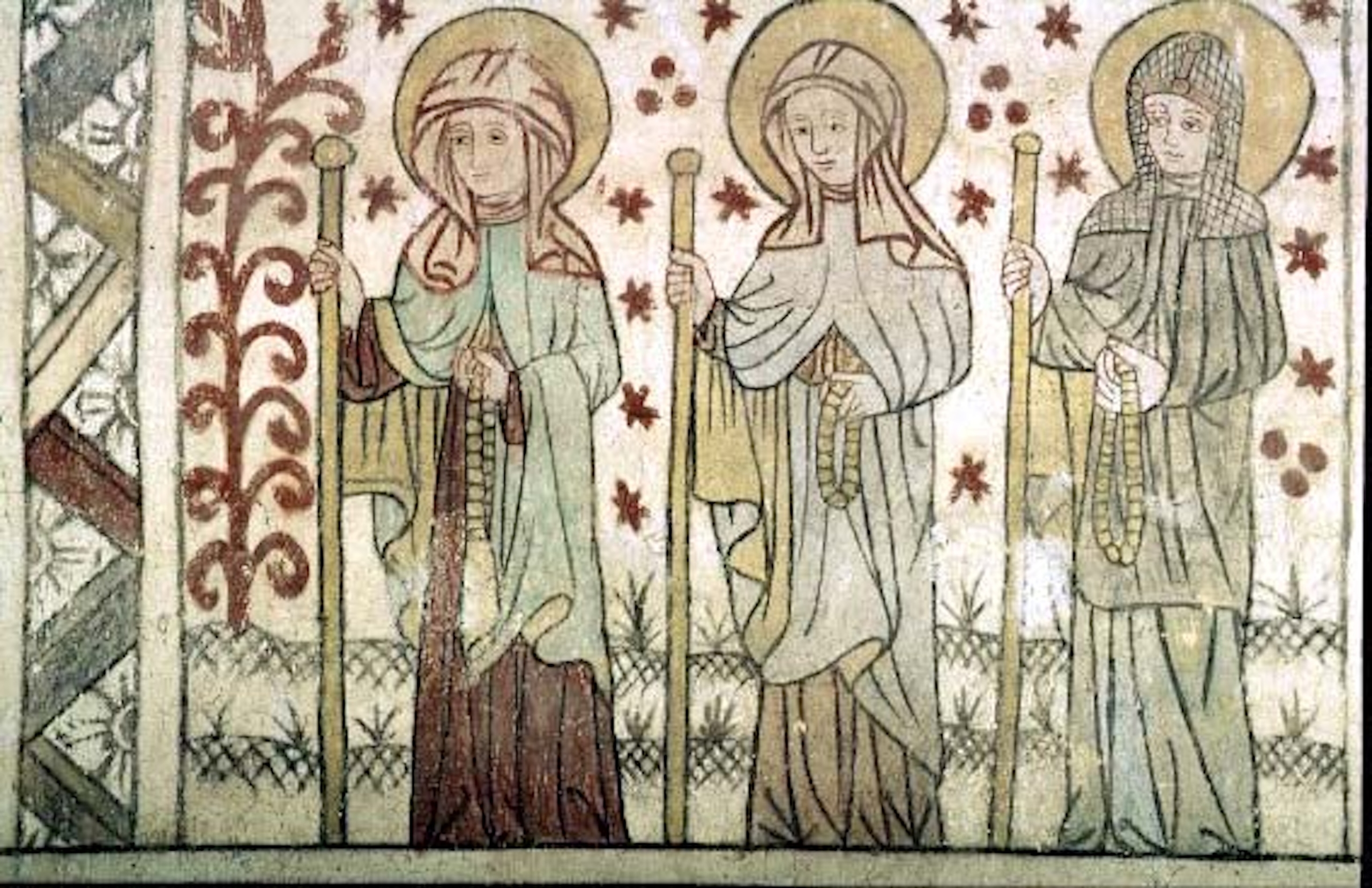
Born in 1303 into the Swedish aristocracy, Bridget lived first as wife, mother of eight children, and court figure before emerging as a mystic, reformer, and founder. Her biography is often read through the lens of her visions and political influence. Viewed cartographically, however, another dimension appears. Bridget was a systematic pilgrim. She traversed the four principal axes of medieval Latin Christendom and, after her death, did so once again through the transfer of her remains.
Northward: Nidaros cathedral and the shrine of Olaf
Bridget’s first documented pilgrimage dates to around 1330 or 1332. She was still married and traveled with her husband, Ulf Gudmarsson. Their destination was Nidaros – present-day Trondheim – where the shrine of King Olaf II of Norway had become the principal pilgrimage center of Scandinavia.
The journey was neither short nor comfortable. It required maritime crossings and overland routes through rugged territory. Among the Scandinavian nobility, however, such journeys formed part of established religious culture. At this stage, Bridget appears not as a prophetic reformer but as a laywoman participating in the devotional practices of her milieu. Yet a defining trait was already visible: a willingness to travel far in search of sacred space.
In her later Revelationes, although she does not describe this journey in detail, she articulates a principle that illuminates her understanding of pilgrimage: “The soul that seeks God should not fear the long road, for with each step it draws nearer to its true homeland.” The phrase reads less as travel narrative than as existential orientation. Walking meant directing one’s life toward an ultimate horizon.
Westward: Cathedral of Santiago de Compostela
Between 1341 and 1342, Bridget and her husband undertook the pilgrimage to Santiago de Compostela. The date coincided with the Holy Year of 1342, adding a jubilee dimension to the journey. From Sweden, the route likely combined sea passages toward northern Germany or Flanders with extended overland travel across France before joining the Camino Francés.
In fourteenth-century Europe, pilgrimage to Santiago entailed crossing kingdoms, languages, and legal systems. It exposed travelers to danger and to the dense spiritual culture of a mobile Christendom. For Bridget, the journey marked a turning point. On the return, her husband fell gravely ill. Though he recovered temporarily, he entered the Cistercian monastery of Alvastra in 1344 and died that same year.
Widowhood altered the trajectory of Bridget’s life. Her visionary experiences intensified, and her prophetic vocation took clearer shape. Compostela functioned as a threshold between the Swedish noblewoman and the figure who would later address rulers and church leaders with striking authority. In a later reflection, she wrote: “Many travel to see lands and cities, but blessed is the one who travels to reform the soul.” In biographical perspective, Santiago initiated precisely such an interior process.
One Path, Many Ways to Santiago: Historic Trails and Contemporary Networks
Toward the Center: Rome and the public mission
In 1349, on the occasion of the Jubilee of 1350, Bridget traveled to Rome. Europe had recently endured the Black Death, and the papacy was then based in Avignon. Rome itself faced political and economic decline. Bridget arrived as a pilgrim but remained for the rest of her life, apart from her journey to Jerusalem. She died there in 1373.
Rome became her spiritual base and the stage for sustained public engagement. From the city she urged the papacy to return from Avignon and criticized ecclesiastical abuses with notable directness. Her visions circulated widely in late medieval Europe through the Revelationes. In 1370 she obtained approval for the Order of the Most Holy Savior, later known as the Bridgettine Order, whose principal monastery was established at Vadstena Abbey.
In one vision concerning the pilgrim Church on earth, she records these words attributed to Christ: “I am the way by which those who desire life must walk.” The metaphor of the path resonates strongly in her Roman years. The city functioned less as a terminus than as a site of discernment and intervention. If Compostela marked personal rupture, Rome consolidated mission.
Eastward: Jerusalem and the geography of origins
Between 1371 and 1373, already elderly, Bridget undertook pilgrimage to Jerusalem accompanied by her daughter Catherine. The region was under Mamluk rule. The journey was lengthy, expensive, and hazardous. For Bridget, however, arrival at the sites associated with the life of Jesus represented a necessary culmination.
In Jerusalem she visited the Church of the Holy Sepulchre and other locations linked to the Passion. There she received some of her most influential revelations, including a vision of the Nativity in which the child lies on the ground radiating light. This image reshaped European Nativity iconography in subsequent centuries.
In a revelation associated with the Holy Land, she reflects: “Here, where my feet have touched the earth, I learned how great was the cost of the world’s redemption.” The formulation conveys a consciousness of inhabiting terrain where memory and meaning converge.
She returned to Rome in 1373 and died on 23 July of that year. Symbolically, she had reached the outer limits of medieval Christian geography.
The final journey
Her story did not conclude with death. In 1373 her body was transported from Rome across Central Europe to Sweden, arriving at Vadstena in 1374. The translation of her remains strengthened the monastery there as a northern spiritual center. In time, this posthumous route would inspire the modern St. Bridget’s Way in Sweden, tracing locations associated with her memory.
In one reflection on earthly life as transit, she wrote: “The human being is a pilgrim on this earth and should not fasten the heart to what passes.” The statement acquires particular resonance in light of the continued movement of her remains.
Walking as identity
Chronologically, her itinerary forms a clear sequence: Nidaros around 1330 or 1332; Santiago between 1341 and 1342; settlement in Rome in 1349; Jerusalem between 1371 and 1373; death in Rome in July 1373; translation to Vadstena in 1374. Geographically, she traversed north, west, center, and east. Pilgrimage structured her adult life.
In the fourteenth century, infrastructure did not facilitate long-distance travel. Reliable maps were scarce; medical care was limited; dangers were real. That a widowed noblewoman and mother undertook such extensive journeys indicates unusual determination.
Bridget did not travel as social convention. She traveled because she understood faith as displacement and search. Her influence cannot be explained solely by her visions or political interventions. It can also be traced in her footsteps.
In an era when thousands again walk toward historic sanctuaries, her biography offers a historical precedent. The road, in her case, was not accessory to spiritual life. It defined it.
AI Transparency Notice
PilgriMaps uses artificial intelligence tools to assist in the research, drafting and translation of editorial content. All AI-assisted content is reviewed, edited and verified by our editorial team before publication. We contrast information against primary sources, specialist literature and on-the-ground knowledge to ensure accuracy, cultural sensitivity and editorial integrity.
AI is one tool among many in our workflow. The judgement, curation and responsibility for everything published on this platform remain entirely human.
Viator Media S.L. — in compliance with the EU Artificial Intelligence Act (Regulation EU 2024/1689).
This post is also available in: