Just north of the bustling city of Varanasi, in India’s state of Uttar Pradesh, lies Sarnath—a tranquil archaeological zone that once marked the beginning of one of the most influential philosophical traditions in world history. Here, in the 5th century BCE, Siddhartha Gautama, newly awakened after his enlightenment beneath the Bodhi tree at Bodh Gaya, delivered his first sermon to five ascetics who had once been his companions in austerity.
This event, known in Buddhist tradition as the Dhammacakkappavattana Sutta, the “Setting in Motion of the Wheel of the Law (Dharma),” established the foundation of the Buddha’s teaching and symbolically set the Dharma Wheel in motion.
The Site of Sarnath
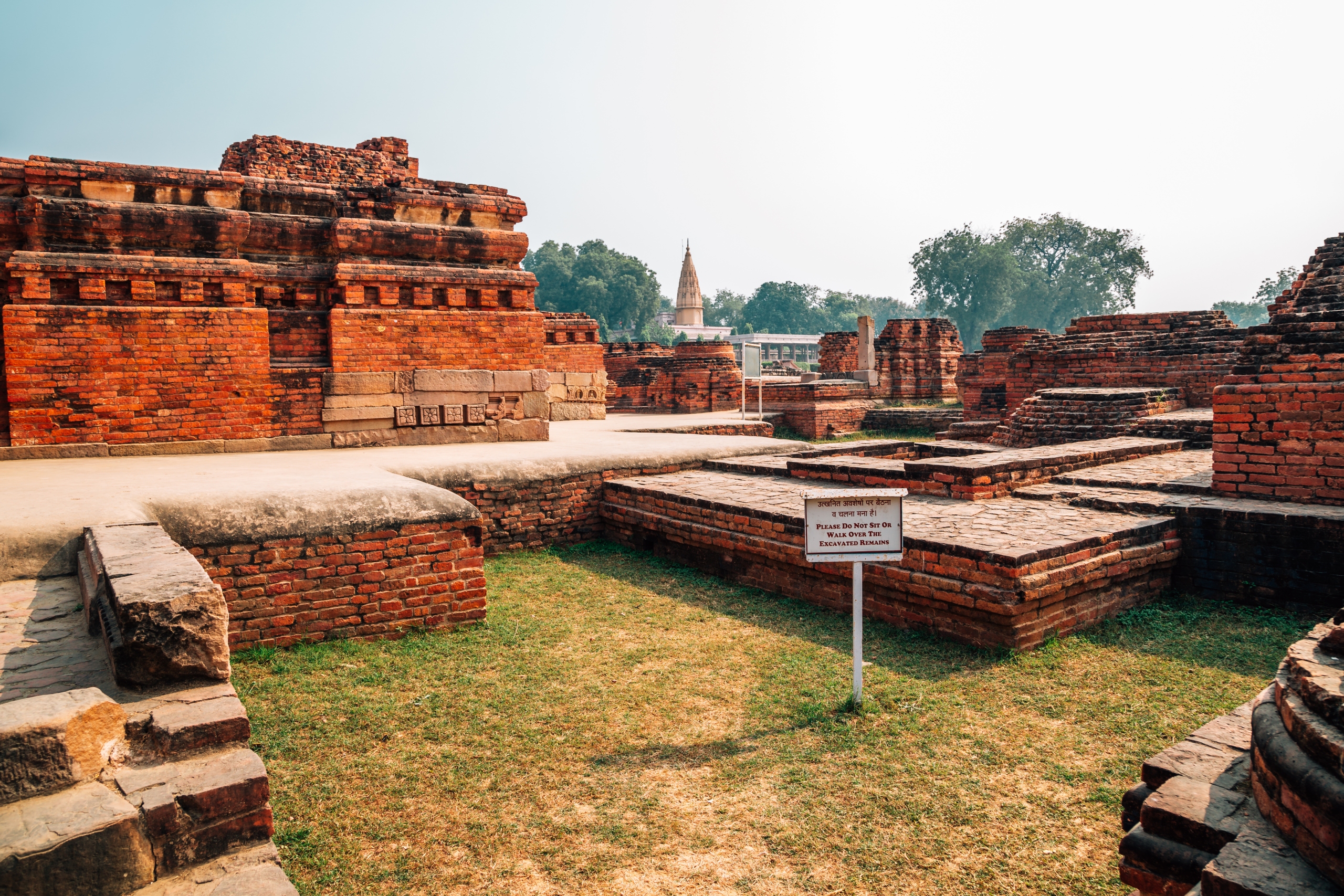
In the Buddha’s time, Sarnath was known as Isipatana, “the place where sages (rishis) landed,” a monastic grove associated with ancient seers. Today, the archaeological site is a serene complex of ruins, stupas, and monastic foundations surrounded by parks and museums. The most prominent monument is the Dhamekh Stupa, a cylindrical brick-and-stone structure about 34 meters high and 28 meters in diameter. Its lower drum, carved with floral and geometric patterns, dates to the Gupta period (4th–6th centuries CE), though its core may preserve an earlier Mauryan structure.
Nearby stand the remains of the Dharmarajika Stupa, attributed to Emperor Ashoka (3rd century BCE), who commemorated the sites of the Buddha’s life with stone pillars and stupas. One such Ashokan pillar still stands in fragments at Sarnath, its shaft now protected in the adjacent museum. The original lion capital—four lions seated back-to-back atop a circular abacus of wheels and animals—was adopted as the national emblem of India in 1950, a testament to Sarnath’s enduring symbolism.
The Sermon: Setting the Wheel in Motion
The Buddha’s first sermon to his five disciples, preserved in Pali, Sanskrit, and later translations, outlines the central framework of Buddhist thought. Its setting is modest—five mendicants in a deer park—but its scope is vast, establishing the Middle Way, the Four Noble Truths, and the Noble Eightfold Path.
Rejecting both extreme self-indulgence and self-mortification, the Buddha taught that liberation arises from a balanced path between these two. This Middle Way became the ethical and contemplative backbone of his teaching, marking a distinct departure from the ritual orthodoxy and ascetic movements of his time.
The sermon then proceeds to the Four Noble Truths: The truth of suffering (dukkha) — that existence, conditioned by craving and impermanence, entails forms of unsatisfactoriness; the truth of the origin of suffering — that craving (tanha), born of attachment and ignorance, perpetuates the cycle of rebirth; the truth of the cessation of suffering — that liberation (nirvana) becomes possible when craving is extinguished; the truth of the path leading to cessation — the Noble Eightfold Path, comprising right view, right intention, right speech, right action, right livelihood, right effort, right mindfulness, and right concentration.
In this first discourse, the Buddha described the Dharma not as a divine revelation but as a discovery—a timeless truth accessible through insight and ethical cultivation. His five listeners, moved by the clarity of this exposition, are said to have attained the first stages of awakening, forming the nucleus of the early Buddhist community (sangha).
Historical layers and archaeological memory
Over centuries, Sarnath evolved into a flourishing monastic and scholarly center, particularly under the Mauryas, Kushans, and Guptas. Chinese pilgrims such as Faxian (5th century CE) and Xuanzang (7th century CE) described a city with numerous monasteries, stupas, and thousands of resident monks studying various schools of Buddhist philosophy.
The site’s decline began after the 12th century CE, when northern India experienced waves of political upheaval and monastic institutions were abandoned or destroyed. Sarnath’s rediscovery came through 19th-century excavations led by British archaeologists such as Alexander Cunningham, who uncovered the Dhamekh Stupa, monastic ruins, and inscriptions confirming the site’s identification as ancient Isipatana.
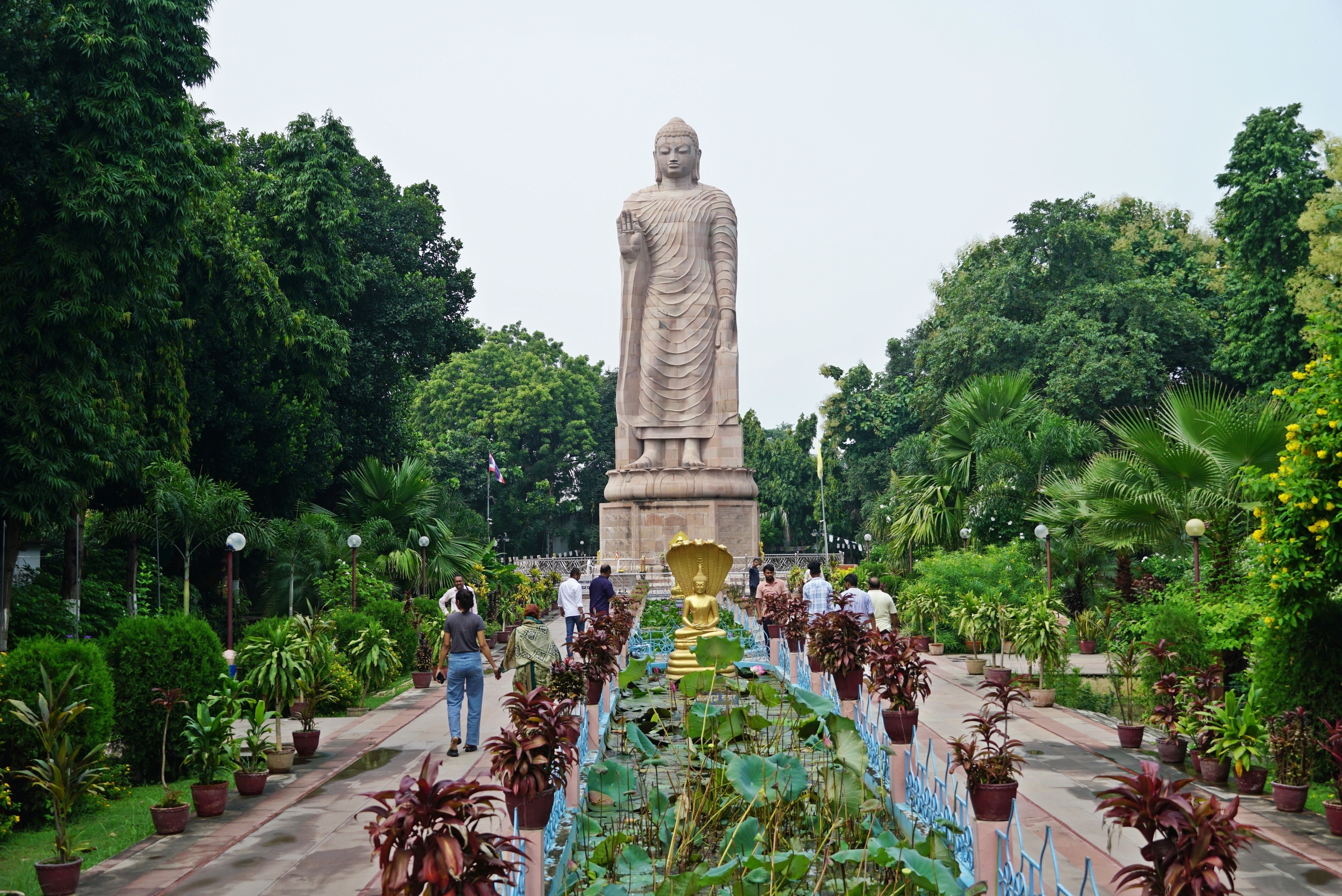
Today, Sarnath is both an archaeological park and a site of living pilgrimage. Visitors encounter monks in saffron and maroon robes circumambulating the stupas, school groups visiting the Sarnath Museum, and international pilgrims meditating beneath trees descended from the original Bodhi lineage. Yet the atmosphere remains subdued, a deliberate contrast to the sensory intensity of nearby Varanasi.
The continuing legacy
The first sermon at Sarnath represents a moment of articulation rather than revelation—a reasoned teaching on human suffering and the possibility of its resolution. Its enduring influence lies in its precision and universality: an analysis of the mind and of ethical behavior that transcends sectarian boundaries.
For modern travelers, Sarnath offers both historical depth and contemplative quiet. The physical traces—the stupa foundations, Ashokan pillar, and museum artifacts—anchor a memory of inquiry that began twenty-five centuries ago. Whether one approaches it as a site of faith, philosophy, or world heritage, Sarnath stands as the place where the “wheel of understanding” began to turn, and where reflection on suffering and freedom first found its form.
AI Transparency Notice
PilgriMaps uses artificial intelligence tools to assist in the research, drafting and translation of editorial content. All AI-assisted content is reviewed, edited and verified by our editorial team before publication. We contrast information against primary sources, specialist literature and on-the-ground knowledge to ensure accuracy, cultural sensitivity and editorial integrity.
AI is one tool among many in our workflow. The judgement, curation and responsibility for everything published on this platform remain entirely human.
Viator Media S.L. — in compliance with the EU Artificial Intelligence Act (Regulation EU 2024/1689).
This post is also available in: