In northern Luzon, in the province of Pangasinan, the town of Manaoag rises quietly amid rice fields, tobacco farms, and low limestone hills. At its heart stands the Minor Basilica of Our Lady of the Rosary of Manaoag, a major pilgrimage site in the Philippines. Unlike the long-distance trails of Europe or Japan, the pilgrimage to Manaoag is not shaped by terrain or seasonal route. It is defined by repetition, return, and proximity to an image believed to intercede in times of peril and need.
This site reflects a form of Filipino religiosity that blends local narrative, Spanish colonial history, and enduring popular devotion. It remains secularly significant today, not only as a religious site but also as a lens through which one can understand the social and cultural patterns of mobility and community in the archipelago.
Origins and narratives
The name “Manaoag” derives from the local Pangasinan word mantaoag, meaning “to call.” Oral tradition recounts that in the early 17th century, a local man heard a mysterious female voice calling to him from a tree. There, he is said to have seen an apparition of the Virgin Mary, holding the child Jesus and a rosary. A church was later built on the site, and the town grew around it.
The image housed in the basilica today—Our Lady of the Rosary of Manaoag—is a carved ivory statue brought from Spain, believed to date to the early colonial period. It was formally enthroned in the late 17th century. While the narrative resembles Marian apparition accounts in other parts of the world, the Manaoag tradition is less about revelation and more about proximity—about the Virgin’s enduring presence in the lives of devotees, especially in times of conflict and illness.
A site of movement and return
Unlike remote pilgrimage destinations, Manaoag is accessible by paved road and integrated into the broader transportation networks of Luzon. Pilgrims often arrive by jeepney, bus, or private vehicle—many traveling from Metro Manila and neighboring provinces. The influx is especially intense on weekends, Marian feast days, and during Lent.
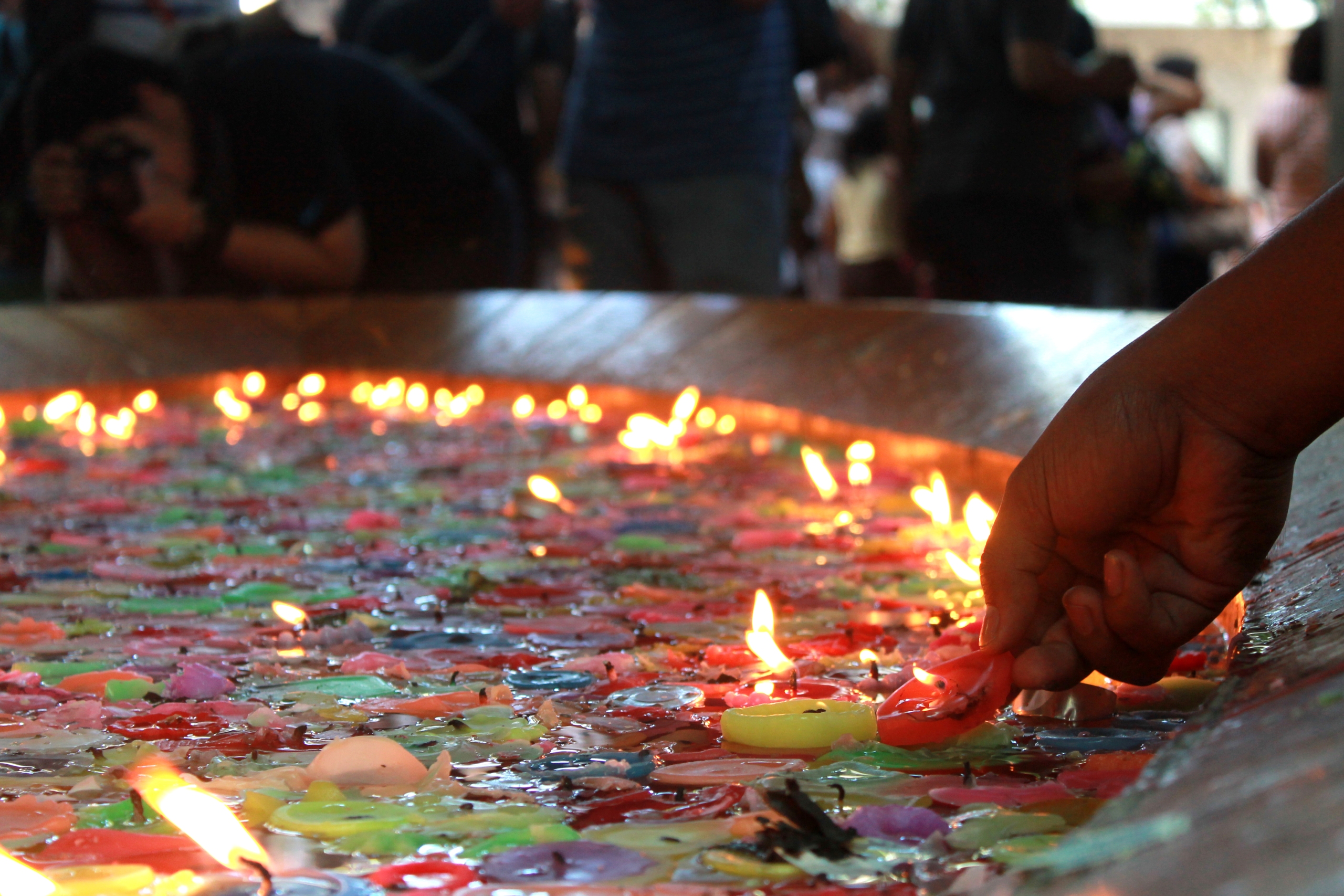
The church offers multiple Masses daily, blessing rituals, candle-lighting areas, and a space to touch the base of the statue. Pilgrims bring photographs, medical records, school exam results, letters, and bottles of holy water. Local vendors sell rosaries, oils, and candles in colors coded to specific petitions: red for love, yellow for health, blue for peace.
The basilica’s courtyard is marked by small shrines, stations of the cross, and processional routes. Yet there is no required circuit; movement through the site is open, informal, and deeply personal. This distinguishes Manaoag from more structured pilgrimage routes abroad. Here, the spiritual geography is centered not on walking a path, but on arriving, encountering, and returning home changed.
Historical layers
The image of Our Lady of Manaoag survived fires, earthquakes, and wartime destruction. During World War II, a bomb fell through the church roof but failed to detonate—a story often cited as a sign of divine protection. The devotion was officially recognized by the Vatican in 1925 with a canonical coronation of the statue. In 2015, the church was declared a minor basilica by Pope Francis.
This official recognition reflects both the scale of the devotion and its entrenchment in Filipino Catholic identity. However, the basilica is more than a religious site. It is a social institution, an economic hub for local vendors, and a psychological refuge for thousands who seek comfort in an uncertain world. It is also a staging point for diasporic Filipinos returning to reconnect with their homeland and their faith.
Pilgrimage in the Philippine context
Manaoag belongs to a uniquely Philippine tradition of pilgrimage that is less about distance and more about presence. Unlike Santiago de Compostela or Mount Kailash, where the journey is defined by endurance or elevation, sites like Manaoag are centers of devotional density. They are part of an archipelagic model of pilgrimage, where movement is shaped by islands, roads, and ritual repetition rather than linear treks.
In this sense, Manaoag is part of a wider pattern that includes Quiapo Church in Manila, the shrine of Our Lady of Peñafrancia in Naga, and the Santo Niño in Cebu. These sites form a network of local sacred centers, each reflecting distinct regional traditions but united by a common devotional rhythm.
Continuity and challenge
The enduring popularity of Manaoag has invited both reflection and scrutiny. The commercialization of the site—visible in the rows of souvenir stalls and the steady economy around religious items—raises questions about the interface between commerce and faith. Yet these same stalls sustain local livelihoods and provide pilgrims with tangible expressions of their devotion.
At the same time, the site continues to evolve. The digital age has introduced livestreamed Masses, online petitions, and virtual blessings, expanding the reach of the shrine while raising new questions about what pilgrimage means in a digitally connected world.
AI Transparency Notice
PilgriMaps uses artificial intelligence tools to assist in the research, drafting and translation of editorial content. All AI-assisted content is reviewed, edited and verified by our editorial team before publication. We contrast information against primary sources, specialist literature and on-the-ground knowledge to ensure accuracy, cultural sensitivity and editorial integrity.
AI is one tool among many in our workflow. The judgement, curation and responsibility for everything published on this platform remain entirely human.
Viator Media S.L. — in compliance with the EU Artificial Intelligence Act (Regulation EU 2024/1689).
This post is also available in: