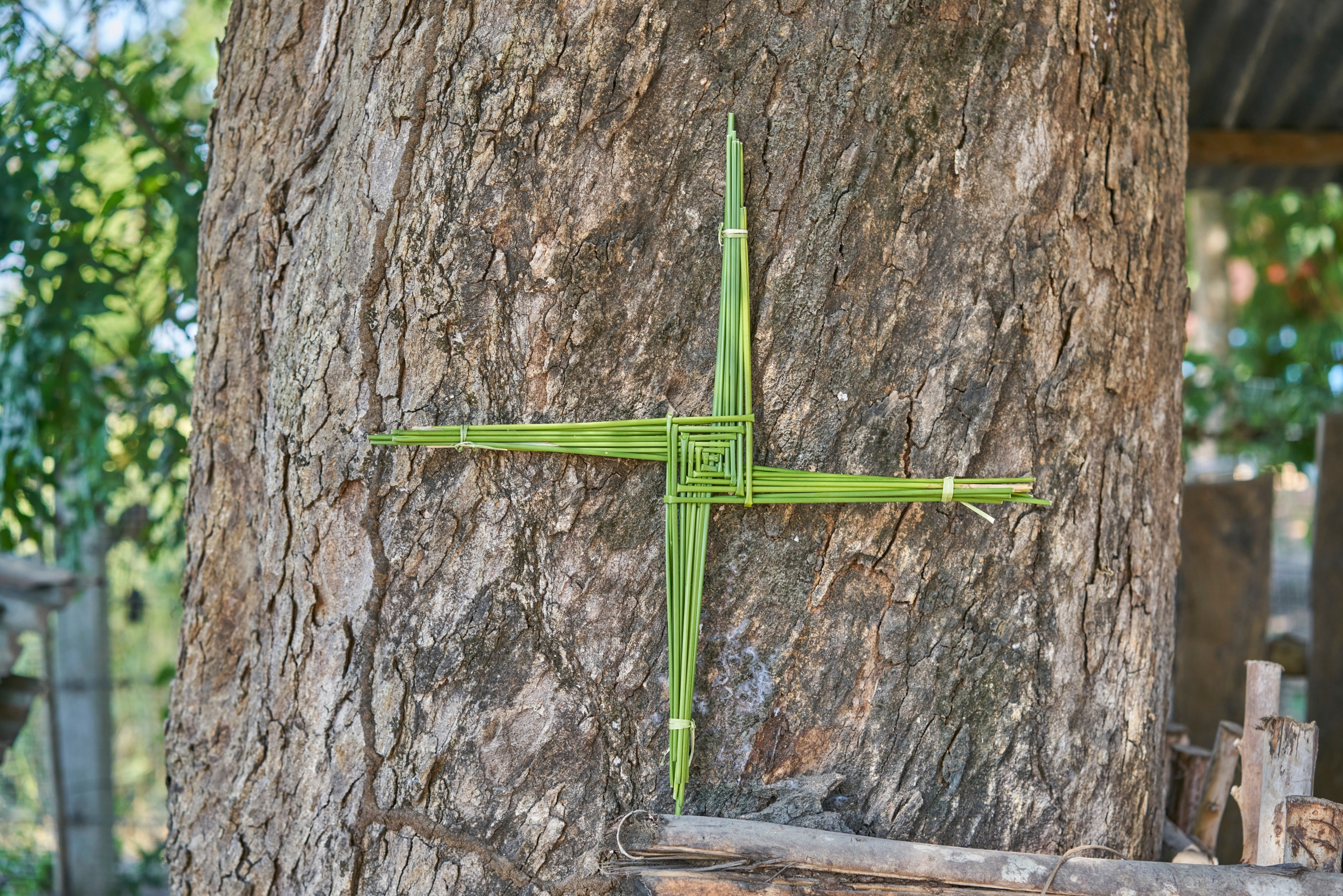
At dawn on 1 February, in many Irish homes someone steps into the fields to gather rushes. With them, a small cross is woven and placed above the doorway to protect the household during the year. The tradition is simple, almost domestic, yet remarkably ancient: it reaches back more than fifteen centuries and is associated with a woman whose memory continues to shape Ireland’s spiritual landscape.
That woman is Brigid of Kildare.
Alongside Saint Patrick and Saint Columba, Brigid belongs to the trio of figures who shaped the early centuries of Christianity in Ireland. Her monastery at Kildare became one of the most influential spiritual centers of early medieval Ireland, a place of prayer, hospitality, and learning that for centuries drew pilgrims from across the island.
Today her memory inspires a contemporary pilgrimage: St Brigid’s Way, a route of roughly 110 kilometers linking the sanctuary associated with her birth in Faughart with the monastic town of Kildare.
The itinerary is modern, yet the landscape it crosses is deeply ancient. Along the path appear royal hills where Ireland’s kings were crowned, sacred wells venerated for centuries, and places connected with early Christian missionaries.
Walking this route means, in a sense, tracing Ireland’s spiritual history.
Brigid of Kildare and the origins of Irish Christianity
Ireland at the time of Brigid’s birth, around the middle of the fifth century CE, was undergoing a profound religious transformation. Christian preaching was beginning to take root in a society still structured around Gaelic clans and long-established traditions.
Irish Christianity developed a distinctive form. Instead of organizing itself primarily around urban dioceses, as in continental Europe, it grew through rural monasteries that functioned as spiritual, cultural, and economic centers.
It was within this context that Brigid emerged.
The main sources for her life come from medieval hagiographic texts. The most important is the Vita Sanctae Brigidae, written in the seventh century by the monk Cogitosus, which describes the exceptional prestige of the monastery of Kildare and the central role of its founder in the religious life of the island.
According to this tradition, Brigid was born in Faughart, in what is now County Louth, around the year 451 CE. Her father is described as a Gaelic nobleman named Dubhthach, while her mother, Brocca, was a Christian woman held in servitude.
These accounts emphasize a defining aspect of Brigid’s character: radical generosity. Many stories describe how she distributed food among the poor with such abundance that her family worried about the household’s resources.
Eventually she chose a religious life and, toward the end of the fifth century, founded a monastery in Kildare.
The monastery of Kildare and its historical significance
The monastery established by Brigid in Kildare quickly gained extraordinary importance. The community had a distinctive structure: it functioned as a double monastery, where monks and nuns lived within the same religious complex under the authority of an abbess. This organizational model, relatively common in early Celtic Christianity, reflects the prominent roles that some women held in the spiritual life of Ireland at the time.
Cogitosus describes Kildare as a leading religious center visited by pilgrims, clerics, and travelers. The monastery was connected to a major church, agricultural lands, and a community devoted both to spiritual life and to hospitality.
The historian Lisa Bitel, a specialist in early Irish Christianity, has noted that Brigid’s figure quickly became one of the island’s most important religious symbols, comparable in popularity to Saint Patrick.
For centuries the monastery of Kildare retained considerable prestige within Irish ecclesiastical life.
Wells, fire, and hospitality: symbols of Brigid’s spiritual legacy
Three symbols frequently associated with Brigid help explain her enduring cultural influence.
- The fire of Kildare
One of the most widely known traditions linked to Brigid is the perpetual flame of Kildare. Medieval sources describe a fire maintained by women religious in her honor, representing constant prayer and watchfulness. The twelfth-century chronicler Gerald of Wales mentioned this practice, noting that the flame was guarded by a female community.
The tradition disappeared during the Protestant Reformation but was revived in the twentieth century by the spiritual center Solas Bhríde, founded in Kildare by the Brigidine Sisters.
- Sacred wells
St Brigid’s Well is among the oldest pilgrimage sites associated with her memory. Sacred wells form part of a deeply rooted Irish tradition in which water is regarded as a place of healing and prayer. Many of these sites continue to receive visitors who practice forms of popular devotion.
- Hospitality
Hospitality also appears as a central theme in the stories surrounding Brigid. Numerous narratives describe how she offered food, shelter, and protection to travelers and those seeking assistance. These accounts reflect the social role of Irish monasteries, which often functioned as centers of refuge for pilgrims and wayfarers.
Christian tradition and Celtic reinterpretations
Brigid’s figure has generated considerable historiographical debate. Medieval sources clearly present her as a fifth-century Christian abbess and founder of a major monastic center. Beginning in the nineteenth century, however, some scholars noted parallels between the saint and a Celtic divinity named Brigid, associated with fire, poetry, and fertility.
The shared name and the celebration of her feast on 1 February—the date of the ancient agricultural festival of Imbolc—encouraged this interpretation.
Today most historians consider the relationship between the two figures to be complex. As the medievalist Lisa Bitel has explained, certain symbolic elements within Ireland’s religious landscape may have been reinterpreted within a Christian framework, yet there is no direct evidence that the historical Brigid represents a simple continuation of a Celtic goddess.
This symbolic ambiguity may partly explain why Brigid’s figure continues to hold remarkable cultural vitality in contemporary Ireland.
The modern birth of St Brigid’s Way
St Brigid’s Way is a recent initiative aimed at reviving pilgrimage traditions connected with the saint. The idea began to take shape in 2012 during the St Brigid’s festival in Faughart. There, researchers and spiritual guides Karen Ward and Dolores Whelan attended a lecture by the researcher Anthony Murphy on possible alignments among ancient sacred sites associated with Brigid.
Inspired by this perspective, Ward and Whelan began exploring the landscape on foot between Faughart and Kildare, seeking to identify a pilgrimage route connecting historical sites and symbolic landscapes related to Brigid’s memory.
In 2013 they organized the first full pilgrimage between the two locations, a nine-day walk that laid the foundation for the present itinerary. The project developed through collaboration with several cultural and spiritual networks linked to Brigid’s legacy, including the Solas Bhríde center managed by the Brigidine Sisters, which since the late twentieth century has promoted renewed attention to the saint’s historical and cultural heritage.
Over time the route was incorporated into the National Pilgrim Path Network of Ireland, which brings together the country’s principal pilgrimage routes.
The route: from Faughart to Ireland’s monastic heart
St Brigid’s Way covers roughly 110 kilometers and is usually divided into nine stages. The journey begins at the sanctuary of Faughart, where several places of devotion associated with Brigid can be found, including a sacred well and a contemporary shrine.
From there the path descends toward Dundalk, crossing open meadows and old rural routes. The route continues to Ardee, one of the historic towns of County Louth, before turning toward Knockbridge, where tradition places a monument linked to the mythological hero Cúchulainn.
The trail then enters County Meath, passing through some of Ireland’s most symbolically significant landscapes. One of these is the Hill of Slane, associated with the tradition that Saint Patrick lit the Paschal fire there, symbolizing the arrival of Christianity on the island. Nearby lies the Hill of Tara, one of Ireland’s most important archaeological complexes. For centuries it served as the coronation site of the High Kings of Ireland and as a symbolic center of Gaelic authority.
From Tara the route continues westward across landscapes of bogland, forests, and agricultural fields, including natural areas such as Donadea Forest Park and Coolree Bog. The final stage passes through the Curragh of Kildare, a wide plain associated with several traditions connected to Brigid. According to medieval accounts, the King of Leinster granted this land to her after her cloak miraculously spread to cover the entire territory.
The pilgrimage concludes at St Brigid’s Cathedral, near the ancient pilgrimage well and the Solas Bhríde spiritual center.
Walking in Brigid’s footsteps
Although St Brigid’s Way is a recent creation, its route crosses some of the most ancient and symbolically rich landscapes in Ireland. For many pilgrims it offers an opportunity to rediscover the life of a woman who played a decisive role in the origins of Irish Christianity. For others it provides a way to explore a landscape where history, legend, and spiritual traditions continue to intersect.
Perhaps that is why this contemporary pilgrimage resonates so strongly: it allows travelers to walk through an Ireland where the past has not vanished, but remains present in every hill, every well, and every path leading toward Kildare.
AI Transparency Notice
PilgriMaps uses artificial intelligence tools to assist in the research, drafting and translation of editorial content. All AI-assisted content is reviewed, edited and verified by our editorial team before publication. We contrast information against primary sources, specialist literature and on-the-ground knowledge to ensure accuracy, cultural sensitivity and editorial integrity.
AI is one tool among many in our workflow. The judgement, curation and responsibility for everything published on this platform remain entirely human.
Viator Media S.L. — in compliance with the EU Artificial Intelligence Act (Regulation EU 2024/1689).
This post is also available in: