Every serious pilgrim knows the three daily rites. The stamp on the credential, the hot shower (when there is one, and when the water doesn’t run out precisely as you’ve got shampoo in your hair), and the bed — ideally some distance from the German gentleman who snores like a tractor on an uphill gradient.
Then there is a fourth, which the official guides say little about and pilgrims a great deal. It arrives around four in the afternoon, it has a white head or the colour of rubies, and it lands on the wooden table of a village bar with a sound worth more than any applause. The end-of-stage beer. Or a good glass of wine.
Call it a weakness if you like. The veterans call it tradition.
The mechanism is simple and infallible. At seven in the morning, in the dark and the cold, beer does not so much as cross your mind. You are thinking about coffee, about a croissant, about where you put the second sock. At ten, on the first climb, you are thinking only about breathing.
But toward midday, under the sun of the mesetas, when the landscape is a sea of wheat without a tree and without a scrap of shade all the way to the horizon, something happens. An image takes shape in the mind. A tall glass, misted over, droplets sliding slowly down it as in an advertisement from the 1980s.
From that moment, every step has a purpose. The bell tower in the distance becomes the promise of a square. The square becomes the promise of a bar. The bar becomes the promise of that glass. Some pilgrims have covered the final eight kilometres of the hardest stage on the Camino Francés guided solely by the vision of an ice-cold caña. And they arrived smiling.
The pilgrim’s beer has its own protocol, observed with an almost monastic seriousness.
First: you drink it afterwards. Never during. Anyone who drinks halfway through a stage soon discovers that the remaining kilometres become curiously longer and the path slightly more undulating than the map indicated.
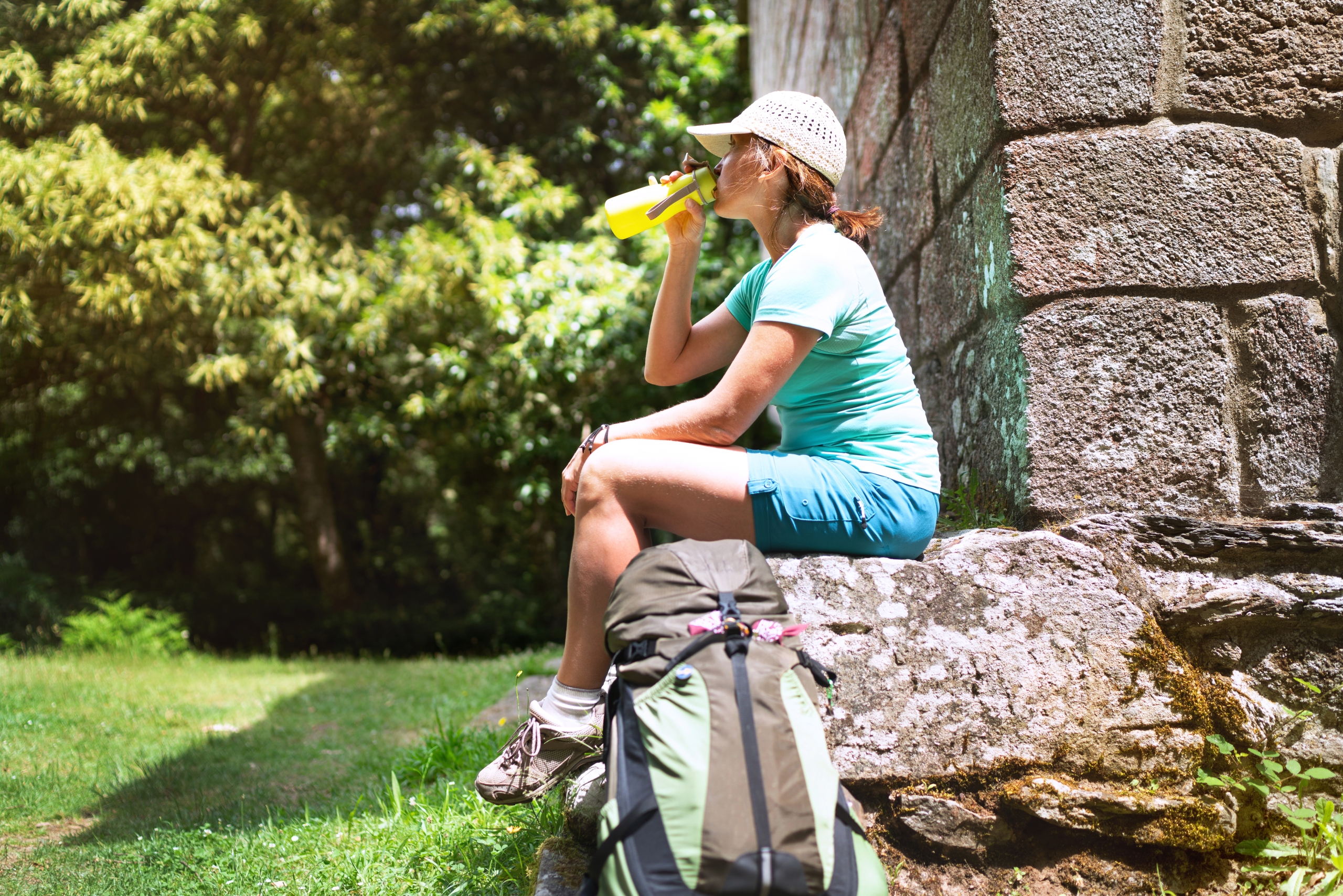
Second: you drink it with your boots off. There exists a moment of pure ecstasy that no poet has ever really managed to describe, and it is the one in which you slide your boots off under the table, wiggle toes liberated after seven hours of imprisonment, and raise the glass to your lips. There, ladies and gentlemen, you touch heaven.
Third: you drink it in company. Alone it is an aperitif. With three or four others — the Australian you met in Burgos, the pair of retired Frenchwomen who walk faster than everybody, the lad from Bologna who has been complaining about blisters since day one — it becomes a ceremony. You toast the stage completed, the climbs survived, the feet that are still carrying you.
There is, moreover, a stretch of the Camino de Santiago where the concept of reward reaches mystical heights. It is the Rioja. Here the vineyards accompany the path for kilometres, the bunches of grapes watch you from the rows with a conspiratorial air, and every village seems to have more wineries than inhabitants.
Near Estella, in Navarre, there is even a wine fountain, offered to pilgrims by a local bodega. A fountain. Of wine. Free. Anyone seeing it for the first time usually reacts like a child outside the chocolate factory, then remembers there are still twenty kilometres to go and takes a single sip with the wisdom of an abbot.
In the Rioja, the end-of-stage copa de vino becomes almost a cultural obligation. You sit down in a small square of golden stone, the waiter brings you a crianza and a little plate of olives or chorizo, and you understand that Spain has invented a form of civilisation the rest of the world still struggles to grasp: pleasure as a reward that is owed to you, without guilt.
Beyond the irony, there is something profound in that glass. The camino is effort, renunciation, dawn alarms and bunk beds. It is right — indeed necessary — that every day should also have its moment of joy. The end-of-stage reward teaches something we often forget in everyday life: the finish line should be celebrated.
How many times, at home, do we finish a difficult piece of work and move straight on to the next, without stopping for a moment? The pilgrim, by contrast, stops. Sits down. Watches the sunset over the fields, tastes the local wine, listens to the chatter of the bar, greets the old man of the village who has been playing cards at the same table for fifty years. He enjoys what is good and beautiful around him, with the satisfaction of someone who earned it at walking pace.
And then there is the discovery of flavours. In Navarre the fresh rosé, in the Rioja the full-bodied reds, in Castile the craft beers that turn up in the most unlikely villages, in Galicia the albariño that tastes of sea and rain. Every region tells its own story through its glass, too, and the attentive pilgrim tastes it with the curiosity of an anthropologist and the palate of a gourmet.
A note of wisdom, before anybody accuses us of incitement. The reward works because it is singular. One beer, one copa, savoured slowly. The second is already another story, and the half past six alarm, together with the twenty-five kilometres of the following day, can be implacable judges. The experienced pilgrim alternates the glass with litres of water, eats something and goes to bed early. The inexperienced pilgrim finds this out the next morning, on the first climb, in a silence heavy with regret.
In Santiago, on the last day, after the embrace of the apostle and the tears in the Plaza del Obradoiro, almost everyone ends up in the same place: a crowded bar in the old town, with the companions of weeks on the road, raising a glass one final time. It is the sweetest glass of the whole journey, because it tastes of arrival, of friendship and of nostalgia.
Some, back home, keep the habit. They finish a heavy day’s work, take off their shoes, pour themselves a glass of good wine, and for a moment they are back at that wooden table, in the square of a village whose name they may well have forgotten.
Because in the end the camino teaches this too: life is made of stages, and each one deserves its toast. ¡Salud y buen camino!
AI Transparency Notice
PilgriMaps uses artificial intelligence tools to assist in the research, drafting and translation of editorial content. All AI-assisted content is reviewed, edited and verified by our editorial team before publication. We contrast information against primary sources, specialist literature and on-the-ground knowledge to ensure accuracy, cultural sensitivity and editorial integrity.
AI is one tool among many in our workflow. The judgement, curation and responsibility for everything published on this platform remain entirely human.
Viator Media S.L. — in compliance with the EU Artificial Intelligence Act (Regulation EU 2024/1689).
This post is also available in: