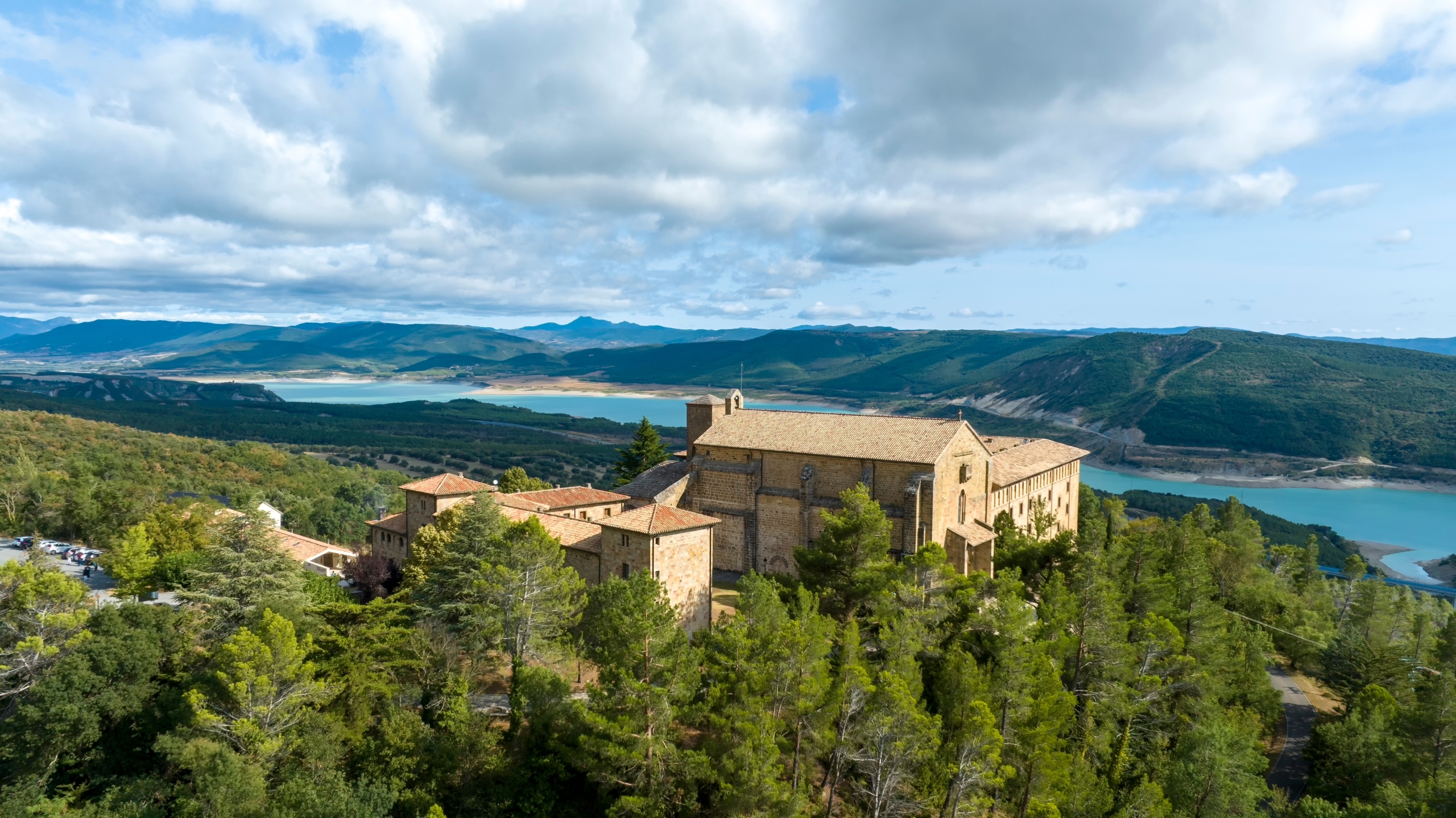
Between Navarre and Huesca, beside the Yesa Reservoir, stands San Salvador de Leyre, a Romanesque monastery surrounded by forests and wrapped in legend. The Aragonese Camino to Santiago passes nearby, and many Navarrese kings are buried there. From one of its walls, a small path leads into the woods toward a modest spring. Depending on the season, it may have barely any water at all.
Nothing seems to announce that this humble place holds one of the most remarkable legends of the Camino de Santiago, a story that reaches back more than a thousand years.
Tradition tells of an abbot of Leyre named Virila, who was troubled by a difficult question: he was trying to understand what eternity could truly mean. How could a thousand years pass like an instant? How could one conceive of something with neither beginning nor end?
One morning — or one afternoon, depending on the version — he left the monastery and went walking in the mountains. Perhaps he was seeking silence. Most likely, he hoped that meditating in the forest would give him an answer he had not found in books. He reached the spring we have mentioned, and while he remained there, he heard a bird singing.
The song was so extraordinarily beautiful that Virila became absorbed in listening. When the bird stopped singing, the abbot began his return. He believed he had been away only a few hours.
But as he approached Leyre, he began to sense that something did not fit. The monastery looked different. Its buildings had changed. When he knocked at the door, an unknown monk came out to receive him.
Virila did not know him either. “I am the abbot of this monastery,” he must have explained. No one had ever heard of him.
The astonishment grew until the monks decided to consult their old documents. There, lost among the names of vanished generations, they found the memory of an abbot named Virila who had left the monastery one day and never returned. Three hundred years had passed.
The question that had led him into the forest had found its answer: if the song of a simple bird could suspend the perception of time for three centuries, eternity could lie entirely beyond human measurement.
Not everything is legend
The most interesting part of the story is that this abbot did exist. A document dated to the year 928, related to Bishop Galindo of Pamplona, mentions among its witnesses an abbot named Verila, or Virila. The available documentation places him within the monastic world of Leyre during the first half of the tenth century.
We do not know much more with certainty, but he must have had a reputation for holiness, since he was venerated in the monastery almost from the time of his death, and wonderful stories about him began to spread. In fact, the story traveled throughout Europe and can be found, with variations, in other places, such as the well-known version associated with the Monastery of Armenteira in Pontevedra.
This does not mean that someone simply copied the story and replaced the protagonist’s name with Virila. The circulation of medieval legends was far more complex. Tales traveled with preachers, pilgrims, monks, merchants, and manuscripts; they changed as they moved from one territory to another and eventually took root in specific places.
At Leyre, something especially interesting happened: the story became attached to an abbot who had actually existed. Even more interestingly, the spring associated with the marvelous event can still be visited.
The spring where legend became landscape
There is no archaeological or documentary evidence that allows us to say that the historical Virila sat precisely beside the spring that bears his name today. What can be said is perhaps more interesting: for generations, this corner of the mountains has been identified as the setting of the legend.
The relationship between story and landscape became so intense that it survived even one of Leyre’s most difficult periods.
In the nineteenth century, the confiscations of Church property led to the disappearance of the monastic community. The monastery was abandoned, and for decades its buildings suffered serious deterioration. Yet a study devoted to Virila recalls that local people continued to tell the abbot’s story and to search among trees and rocks for the spring associated with his prodigious disappearance.
Today, those who arrive at the spring find a small sculpture of Virila and a reference to the bird. Navarra Tourism describes it with almost perfect honesty: it is little more than a place among rocks and trees. Only forest, stone, water, and silence — the same minimal materials from which the legend was built.
A path within the path
For those walking this part of Navarre in the footsteps of the Camino, the short walk takes on another meaning as well.
The Aragonese Camino to Santiago comes from the Somport Pass, descends toward Jaca, and then follows the natural corridor of the Aragón River before entering Navarre. The route continues through the area of Yesa and Sangüesa before heading toward Puente la Reina, where it meets the great route coming from Roncesvalles.
Leyre is closely linked to the Camino de Santiago, but in reality it was there long before. The first secure historical reference to the monastery dates from 848, when Eulogius of Córdoba passed through the area. Three years later, he recalled that stay in a letter to Bishop Wiliesindo of Pamplona.
Eulogius mentions a community governed by an abbot named Fortún and expresses admiration for its library. When Virila appears in the documentary record eighty years later, Leyre was already an established monastic center.
In the centuries that followed, its history became closely tied to the kingdom of Pamplona. Today the complex preserves some of the most important examples of Romanesque art in Spain: the crypt, the eastern end of the church, and the spectacular Porta Speciosa. In its pantheon there is a casket containing the remains of the ancient Navarrese kings, so it can be considered a royal pantheon.
The strange measure of time
There is a deeper reason why the legend of Virila seems to fit so naturally within the universe of the Camino de Santiago. It speaks of time, and those who walk the Camino experience time taking on another dimension. In everyday life, the day is measured in hours and minutes. On the Camino, however, much older measures return: sunrise, the kilometers still ahead, the next village, a spring, the fatigue of the body, an unexpected conversation.
Virila takes that experience to a fantastic extreme. He leaves Leyre trying to understand eternity intellectually and, according to the legend, ends up understanding it when he stops measuring time.
That is why the small trail to the spring can be understood as a kind of path within the Camino. The walk takes up only a fraction of a day, but on a tiny scale it reproduces one of the essential gestures of every pilgrimage: leaving a place and returning transformed by what was found along the way.
More than a thousand years after Abbot Virila, travelers still leave the monastery for a few moments to enter the forest and look for a small spring.
Some will come drawn by the story, others by the landscape, and others simply because they have seen a trail and want to know where it leads. When they arrive, they will find rocks, trees, and perhaps a little water. With luck, they will also hear a bird.
It is best, then, not to look at the watch right away. Just in case.
AI Transparency Notice
PilgriMaps uses artificial intelligence tools to assist in the research, drafting and translation of editorial content. All AI-assisted content is reviewed, edited and verified by our editorial team before publication. We contrast information against primary sources, specialist literature and on-the-ground knowledge to ensure accuracy, cultural sensitivity and editorial integrity.
AI is one tool among many in our workflow. The judgement, curation and responsibility for everything published on this platform remain entirely human.
Viator Media S.L. — in compliance with the EU Artificial Intelligence Act (Regulation EU 2024/1689).
This post is also available in: