Ghana’s Spiritual Life According to H.E. Ben Batabe Assorow, Ambassador to the Holy See
In May 1980, John Paul II landed in Accra as a “pilgrim of peace,” in the year the Catholic Church in Ghana was celebrating the centenary of its evangelising mission. Forty-five years later, that visit continues to shape the way Ghana tells its own story: a country where churches and mosques share the same city block, where funerals bring families of different faiths together around the same grief, and where the memory of ancestors remains a common language even for those who no longer recognise it as religion.
We spoke with H.E. Ben Batabe Assorow, Ambassador of Ghana to the Holy See, who in November 2025 presented his Letters of Credence to Pope Leo XIV, continuing a diplomatic line that took root in 1975 — the year relations between Accra and the Vatican began — and which since 2013 has been consolidated in a resident mission in Rome. A diplomat and also a witness to a layered spirituality, Ambassador Assorow guides Pilgrimaps through an itinerary that crosses Accra, the Volta Region and Ashanti, between Marian grottos, cathedrals and the still-living memory of the passage of a Pope who came, in his own words, not as the world’s religious leader but as a pilgrim.
- PilgriMaps: John Paul II’s visit to Ghana in 1980 is still vividly remembered today. What does that memory mean now, four decades on — is it preserved through story, through liturgy, through place?
Saint John Paul II’s visit to Ghana in May 1980 remains an important moment in the history of the Catholic Church in Ghana. What makes the visit particularly significant is that it coincided with the centenary celebration of the Catholic Church’s evangelizing mission in Ghana. He came not simply as a world religious leader, but, in his own words, as a pilgrim of peace.
The memory of his visit survives in several ways. For the older generation who witnessed the visit, it is a living story. They remember the crowds, the excitement and the extraordinary experience of seeing the Holy Father on Ghanaian soil. For younger generations, the memory has been inherited through photographs, Church history, family stories and Catholic institutions and places associated with his name.
His visit took him to the big cities of Accra and Kumasi. In Accra, he celebrated Mass at Independence Square and met the Catholic community, representatives of other Christian traditions and Muslim leaders. In Kumasi, his encounter with catechists was particularly significant because catechists played an indispensable role in the early evangelization of Ghana.
So, more than four decades later, the memory is not merely nostalgia. It represents a moment when the universal Church visibly encountered the local Church in Ghana. It also reminds us that Ghanaian Catholicism is simultaneously deeply African and fully part of the worldwide Catholic communion.
The hillside where the Asantehene and the Virgin met: Buoho Grotto
One significant monument mounted in his memory is the erection of a brass statue on the premises of the National Catholic Secretariat, the administrative arm of the Ghana Catholic Bishops’ Conference.
- PilgriMaps: Which pilgrimage site in Ghana carries, in your view, the deepest layer of history — and what should a visitor know before arriving, so that the place is not merely beautiful to look at, but actually means something?
There are several places one could mention, but I would draw attention to St. Mary’s Sanctuary at Buoho, popularly known as the Buoho Grotto, in the Ashanti Region.
Its significance goes beyond the physical beauty and serenity of the environment. The sanctuary dates to the earlier period of the development of Catholicism in Ghana and has become a place where generations of Catholics have gone for prayer, Marian devotion, retreats and pilgrimage.
But I would also strongly recommend the Our Lady of Lourdes Grotto at Kpando-Agbenoxoe in the Volta Region. It has developed into an important centre of Marian spirituality, with pilgrims coming for Mass, confession, Eucharistic adoration, the Rosary and the Stations of the Cross.
A visitor should therefore resist approaching these places merely as tourist attractions. A shrine is best understood by becoming quiet enough to observe what people are doing there. Watch the mother praying silently for her family. Observe the young person kneeling before the Blessed Sacrament. Walk the Stations of the Cross. Sit quietly beneath the trees.
The architecture and landscape may attract you, but it is the accumulated prayer of generations that gives a sacred place its real meaning.
- PilgriMaps: Is there a shrine or sacred place in Ghana that holds personal significance for you — somewhere you return to, or think of, beyond its official value?
For me, what makes a sacred place meaningful is not necessarily its size or popularity but the encounters that happen there.
I am particularly drawn to Marian grottos because they create a certain atmosphere of silence that can sometimes be difficult to find in everyday life. Places such as Kpando-Agbenoxoe remind me that pilgrimage is fundamentally an interior journey. You may travel many kilometres to arrive at a shrine, but the most important distance is often the distance between your mind and your heart.
The architecture and landscape may attract you, but it is the accumulated prayer of generations that gives a sacred place its real meaning.
There is something powerful about seeing people arrive carrying different burdens — family difficulties, gratitude, grief, uncertainty or simply a desire to encounter God. At a shrine, those individual stories become part of one community of prayer.
That, for me, is what gives such places significance beyond their official designation.
- PilgriMaps: In what way does Ghanaian Catholic liturgy — with its music, its rhythm, its sense of community — shape a pilgrim’s experience differently from a cathedral in Rome or a grotto in Lourdes?
A pilgrim attending Mass in Ghana quickly discovers that worship engages the whole person.
There is music, rhythm, movement, colour and a very strong sense of community. Drums and other traditional instruments can accompany the liturgy, and singing is rarely something performed by a choir while everyone else listens. The congregation thus participates, ensuring that there is full, active, and conscious participation by all.
In many Ghanaian communities, when we sing, the body naturally becomes involved. When we celebrate, we celebrate together. When we mourn, we mourn together. This gives Ghanaian Catholic spirituality a distinctive communal character.
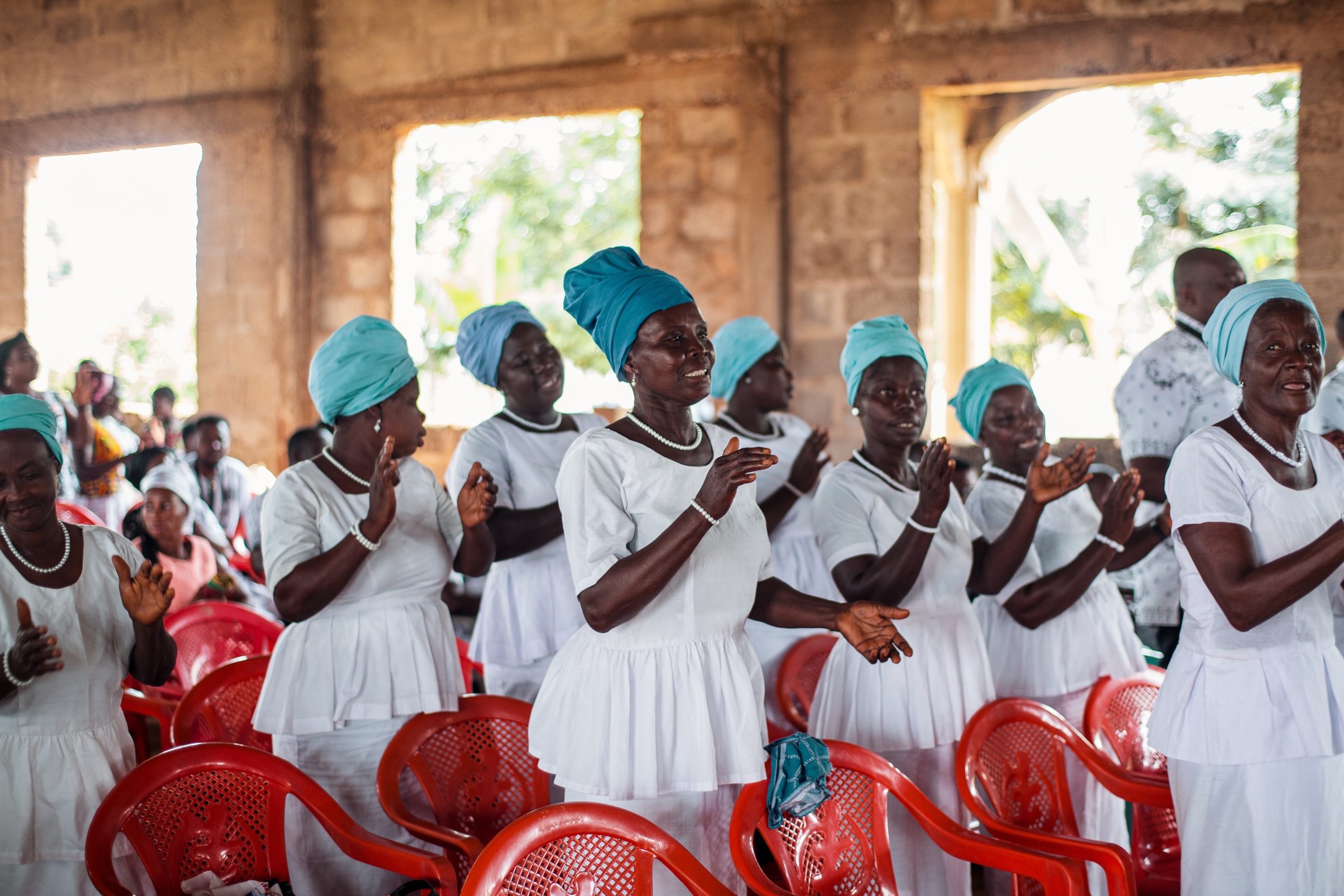
A cathedral or a basilica in Rome can give the pilgrim a profound sense of history and universality. Lourdes can offer extraordinary silence and Marian devotion. Ghana offers something complementary: an experience of faith expressed through the vitality of an African community.
This does not make the Catholic faith in Ghana less universal. On the contrary, it demonstrates something beautiful about Catholicism: the same Eucharist can be celebrated in Rome, Lourdes, Accra or a small Ghanaian village while allowing each culture to bring its authentic gifts into worship.
- PilgriMaps: Ghana is often described as a place where faiths coexist in unusually harmonious ways. Are there sacred spaces — Catholic, Muslim, Akan — that are physically close to one another, or that overlap in ritual life?
One of the remarkable features of Ghana is that religious difference does not necessarily mean social distance.
Ghana has generally developed a culture in which religious conviction and neighbourliness can exist together.
A church and a mosque may serve people living in the same neighbourhood. Christians and Muslims work together, attend the same schools, belong to the same extended families and participate in one another’s important social occasions.
The overlap becomes particularly visible during funerals, festivals and community events. A Muslim may attend the funeral of a Christian neighbour, and a Christian may support a Muslim family during bereavement. Traditional authorities may preside over communal ceremonies attended by Christians and Muslims alike.
This coexistence does not mean that theological differences disappear. They remain. But Ghana has generally developed a culture in which religious conviction and neighbourliness can exist together.
Interestingly, during Saint John Paul II’s 1980 visit, he deliberately met Muslim leaders in Accra and spoke about Christians and Muslims living as neighbours in mutual respect. That remains an important vision for Ghana today.
- PilgriMaps: Before the arrival of Christianity and Islam, Ghana already had its sacred groves, its ancestral shrines, its seasonal festivals. Which of these traditions continue to mark daily life today, regardless of declared religious affiliation?
Traditional spirituality remains deeply embedded in Ghanaian cultural life, sometimes in ways people do not immediately identify as religious.
Our understanding of family, ancestors, chieftaincy, funerals, marriage, naming ceremonies, festivals and even our relationship with land carries elements inherited from traditional Ghanaian worldviews.
Festivals are particularly important. Across Ghana, festivals connect communities to migration stories, harvests, ancestors, traditional leadership and particular historical events. Even Christians and Muslims who do not participate in traditional worship may identify strongly with the cultural heritage represented by these festivals.
Respect for ancestors is another example. For many Ghanaians, remembering those who came before us is fundamental to understanding who we are. Christianity has naturally transformed how Christians understand the spiritual dimension of this relationship, but the importance of ancestry and communal memory remains.
There is also the traditional understanding that land is more than an economic commodity. Land carries history, identity and responsibility.
The pilgrim gradually discovers that Christianity is itself a pilgrimage. We are people on a journey.
So although Ghana is overwhelmingly Christian and Muslim today, the older religious imagination has not simply disappeared. In many respects, it continues to provide part of the cultural vocabulary through which Ghanaians understand community, belonging and the sacred.
- PilgriMaps: Have you ever witnessed moments — a festival, a funeral rite, a harvest celebration — in which Ghanaians of different faiths found themselves in the same space, honouring the same land? What did it reveal to you?
This is perhaps most visible during Ghanaian funerals and traditional festivals.
At a funeral, you may find Catholics, Protestants, Pentecostals, Muslims and people who identify strongly with traditional religion sitting together. They may pray differently, but they have come for the same reason: to accompany a family and honour the life of someone who belonged to their community.
Traditional festivals provide another powerful example. A festival may have origins connected to ancestral or traditional religious practices, yet today the celebration can bring together an entire town regardless of religious affiliation.
What this reveals to me is that Ghanaian identity has a layer deeper than individual religious affiliation. We understand ourselves as belonging to families, communities and a land with a shared history.
It does not erase our religious differences. Rather, it gives us a common space in which those differences can coexist.
Perhaps that is one of Ghana’s quiet lessons to the world: you do not have to believe exactly as your neighbour believes to recognise your neighbour as belonging to you.
- PilgriMaps: In many pilgrimage cultures, the physical act of walking or travelling toward a sacred place matters as much as the destination itself. Does that hold true in Ghanaian tradition? How does that journey typically present itself?
Absolutely. The journey itself can become a form of prayer. Catholic pilgrimages in Ghana often involve groups travelling together from parishes, dioceses, youth movements or religious associations. The journey may begin very early in the morning or even overnight. People pray the Rosary, sing hymns, share food and listen to spiritual reflections along the way.
At the pilgrimage site itself, there may also be physical movement — processions, walking the Stations of the Cross, Rosary processions or moving prayerfully from one devotional point to another.
Walking is particularly meaningful because pilgrimage should cost us something. There is tiredness, heat, dust, waiting and inconvenience. These become part of the spiritual experience.
The pilgrim gradually discovers that Christianity is itself a pilgrimage. We are people on a journey. Therefore, arriving at the shrine is important, but what happens to you on the road may be equally important.
- PilgriMaps: How is this layered religious identity — Catholic, Muslim, traditional — transmitted to Ghanaian children? Through story, through ritual, through family, or through something else entirely?
I would say it is transmitted through all of these, but especially through family and community participation. A Ghanaian child learns culture not primarily from a textbook but by being present.
You attend funerals. You travel home for festivals. You listen when grandparents speak. You learn greetings and proverbs. You observe how elders are treated. You attend church or mosque with your parents. You learn the stories of your hometown and eventually discover why certain customs exist.
For Catholic children, formation also takes place through the parish, Sunday Mass, catechism, Catholic schools, youth groups, altar service and other associations.
If you come to Ghana looking only for sacred buildings, you will miss interesting places. If you come prepared to encounter people, you will begin to understand Ghana’s spirituality
But the interesting thing is that these identities are not always kept in separate compartments. A Catholic child may also grow up knowing the traditional history of his or her clan. A Muslim child may participate culturally in a traditional festival without compromising Islamic identity.
Ghanaian identity therefore develops through layers: family, faith, ethnicity, language, community and nation. Storytelling remains especially important because stories carry values. When an elder tells you where your people came from, the story is also telling you who you are.
- PilgriMaps: If a PilgriMaps reader had exactly one week to experience the full spiritual texture of Ghana — Catholic, Muslim and ancestral — where would you send them first, and why there specifically?
I would tell them not to spend the entire week moving from monument to monument. Ghana’s spiritual character is found as much in its people as in its buildings.
I would begin in Accra, because Accra introduces you immediately to contemporary Ghana’s religious diversity. Visit the Holy Spirit Cathedral and experience Catholic life in the capital. Encounter the Muslim community and observe how mosques and churches exist within the life of the same city. Remember also that Independence Square was the setting for Saint John Paul II’s great Eucharistic celebration during his 1980 visit.
From Accra, I would travel to the Volta Region and Kpando-Agbenoxoe, where the Marian grotto provides a very different atmosphere — quiet, prayerful and contemplative. Spend time there rather than merely taking photographs.
I would then travel toward Kumasi in the Ashanti Region. Kumasi is indispensable because it opens the visitor to the relationship between Christianity and one of Ghana’s most influential traditional cultures. Visit a Catholic community, experience the traditional institutions of Asante society and, if possible, visit the Buoho Grotto.
But I would reserve part of the journey for something that cannot always be placed on a tourist itinerary: a Ghanaian community experience. Attend Mass on Sunday. Sit with a family. Visit a traditional authority where appropriate. If there is a festival, observe it respectfully. Eat with people. Listen to their stories.
Because if you come to Ghana looking only for sacred buildings, you will miss interesting places. If you come prepared to encounter people, you will begin to understand Ghana’s spirituality.
The spiritual texture of Ghana is ultimately found in the meeting of faith, community, memory, hospitality and the land itself. That is the Ghana I would want a pilgrim to encounter.
AI Transparency Notice
PilgriMaps uses artificial intelligence tools to assist in the research, drafting and translation of editorial content. All AI-assisted content is reviewed, edited and verified by our editorial team before publication. We contrast information against primary sources, specialist literature and on-the-ground knowledge to ensure accuracy, cultural sensitivity and editorial integrity.
AI is one tool among many in our workflow. The judgement, curation and responsibility for everything published on this platform remain entirely human.
Viator Media S.L. — in compliance with the EU Artificial Intelligence Act (Regulation EU 2024/1689).
This post is also available in: