


The heat is stifling, but beneath the tree-lined avenue at Al-Muharraq there is shade and a little breeze. To enter the ancient Church of the Virgin Mary you must remove your shoes, as is the Coptic custom, and pass alongside the gallery of holy icons. The church is usually busy with visitors, above all families with children, who dash about and greet foreign visitors with laughter.
There, hanging from the iconostasis, a beautiful curtain conceals the very heart of Al-Muharraq, the ancient Qusqam: the altar raised over the small house that tradition holds was the home of the Holy Family for more than half a year. And here, according to that same religious memory, Joseph received the news that they could begin the journey home.
That is why Al-Muharraq might be described as a second Bethlehem: it preserves the memory of a family turned foreign, who are said to have found here, for a time, a home. And that memory has profoundly transformed the place.
From Five Verses to Twenty-Five Milestones: How Egypt’s Holy Family Trail Was Born
The Place Where the Flight Stops
The tradition preserved by the monastery holds that the Holy Family remained here for 185 days — approximately six months. Some contemporary ecclesiastical sources offer slight variations in the exact figure, a detail that suggests reading these numbers as part of a transmitted tradition rather than a historically documented chronology.
But it is precisely that long stay attributed to Qusqam that explains its singularity. Al-Muharraq is not remembered simply as a place through which Jesus, Mary and Joseph passed. It is remembered as a place where they lived.
The ancient Coptic tradition reinforced that identification over the centuries. Texts such as the so-called Vision of Theophilus — attributed to Patriarch Theophilus of Alexandria though composed in a later period — helped to present Qusqam as a holy mountain and as a privileged station on the Flight into Egypt.
Al-Muharraq therefore represents the symbolic culmination of the journey, even if it is not literally its final stop. The Coptic narrative continues afterwards to Drunka, near Assiut, before beginning the return northward.
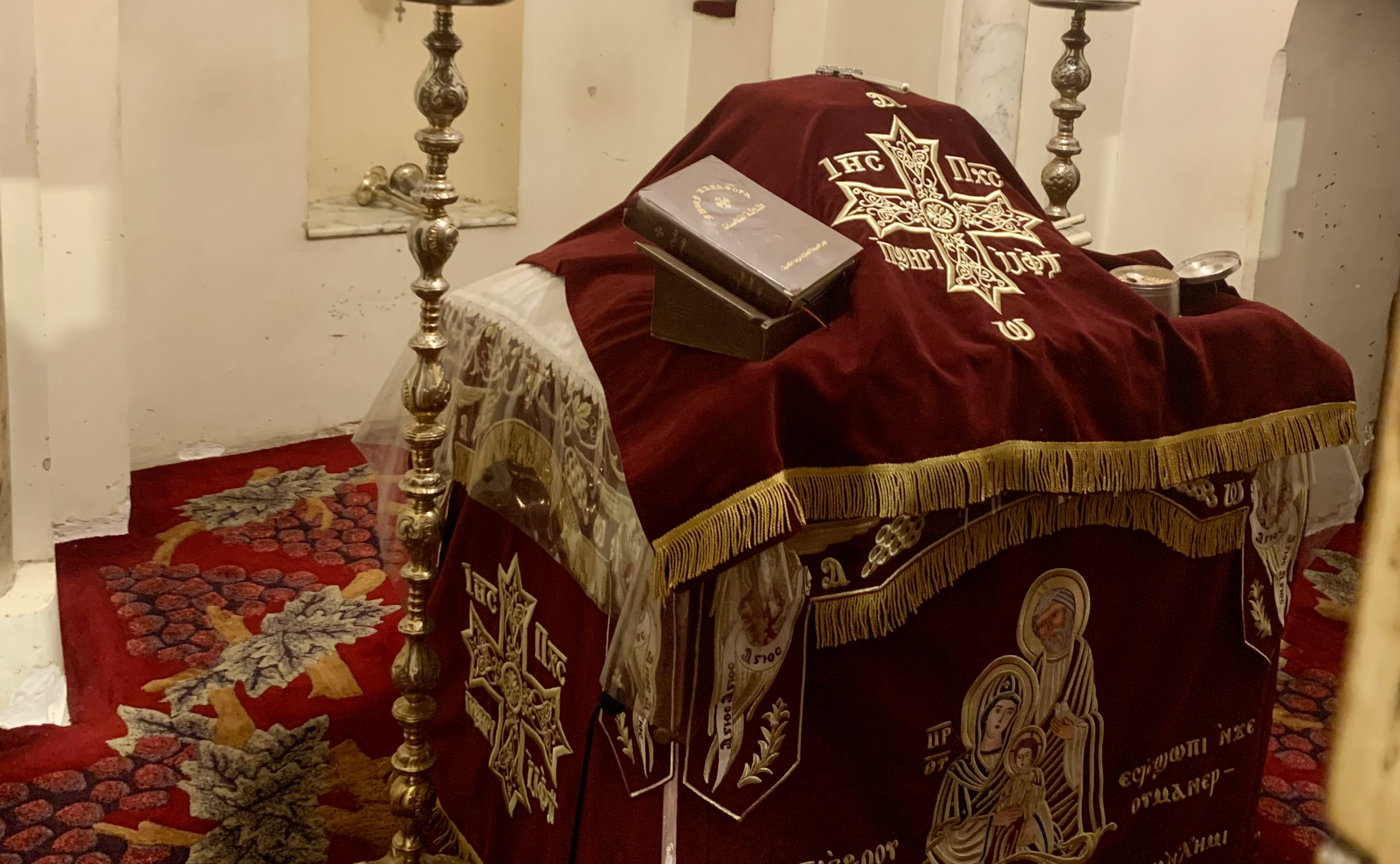
Far More Than a Monastery
To call Al-Muharraq simply a “monastery” might lead one to imagine a small cenobitic community lost in the desert. The reality is very different. Deir al-Muharraq is today an enormous spiritual complex, one of the great centres of the Coptic Church in Upper Egypt. Within its walls stand buildings raised across many centuries, several churches, spaces devoted to religious formation, quarters for the monastic community and extensive areas prepared to receive pilgrims and visitors.
Its heart remains the small ancient Church of the Virgin, linked by tradition to the Holy Family’s stay. But around it a whole universe has grown. The ancient tower recalls the times when monastic communities needed to protect themselves. The great church rebuilt at the end of the 19th century speaks of a period of expansion. The Church of the Virgin raised in 1964 responds already to the need to accommodate far larger celebrations. To this must be added the educational tradition of the place, begun with a monastic school in 1932 and later developed into a theological college, along with the preservation of manuscripts, icons and a long culture of religious transmission.
You do not, therefore, visit an isolated monument. You enter a small spiritual city built around a memory. And that difference is felt immediately. Al-Muharraq is not organised as a museum in which the past has been separated from the present. The churches are still in use, the liturgy forms part of daily life, and pilgrims do not arrive solely to admire architecture. For many of them, the journey ends here, in one of the most significant places in the entire tradition of the Holy Family in Egypt.
A Visit to Be Made Slowly
Perhaps that is why Al-Muharraq deserves an unhurried visit. An hour and a half allows you to see its principal spaces, but setting aside half a day or a full day changes the experience completely. The best approach is to begin with the ancient Church of the Virgin. Its dimensions and its austerity are surprising precisely because they contrast with the enormous importance tradition grants to the place.
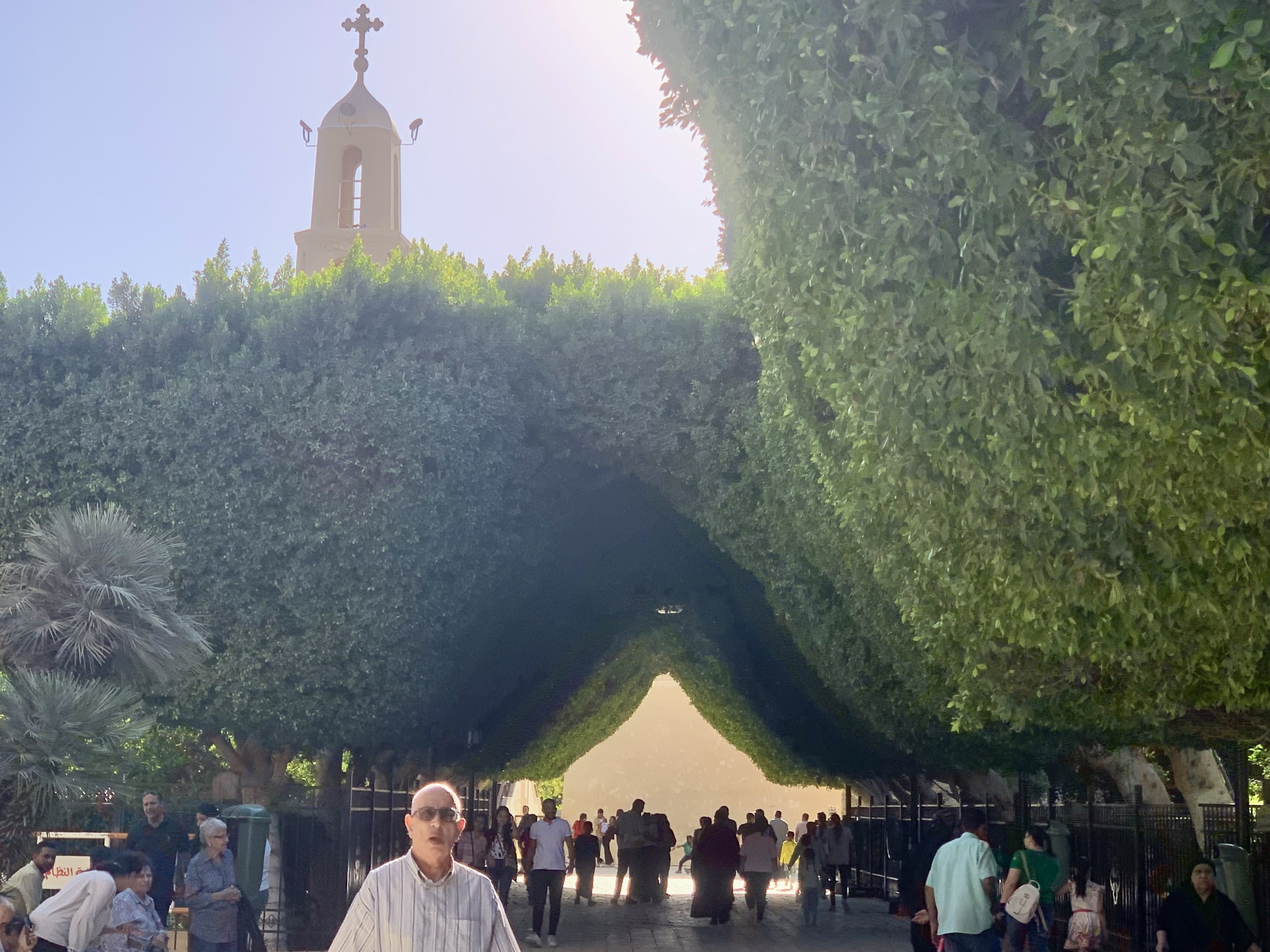
Afterwards it is worth approaching the old tower and continuing toward the churches built in later periods. The route allows you to pass, practically on foot, from late antiquity and the Middle Ages to the 19th and 20th centuries.
But the interest does not lie only in the buildings. You should also observe the people who arrive, the movement around the churches and the relationship between pilgrims and the resident community. Al-Muharraq continues to perform the function for which it grew over centuries: to receive, to celebrate and to transmit a memory.
That also explains why the visitor must adapt to the place, and not the other way round. Opening times can vary according to the religious calendar, the fasts or the great celebrations. There is no uniform annual tourist schedule comparable to that of a museum, so it is advisable to check access conditions shortly before travelling there.
Nor should it be forgotten that you are entering an active religious space. Dressing modestly, keeping silence during services and asking before taking extensive photographs or carrying out professional work are all part of the visit.
How to Get There
Al-Muharraq stands on Mount Qusqam, approximately 12 kilometres west of Al-Qusiya, in the governorate of Assiut.
For those travelling from Cairo, one of the most comfortable options is to take the railway that runs south along the Nile valley and complete the journey by road. Assiut and Al-Qusiya are the most practical bases for visiting the complex, especially if you have a car and driver.
Those with a full day available can combine the visit with Drunka, near Assiut, another of the great places associated with the southern phase of the Holy Family tradition.
Even so, it is worth resisting the temptation to accumulate sites. Al-Muharraq works better when it is given enough time to understand what you are seeing.
The Second Bethlehem
And perhaps it is at the end of the visit that the expression “second Bethlehem” acquires its full meaning. Not because of the monumentality. Precisely for the opposite reason.
At the centre of that enormous spiritual complex there remains a small church bound to the memory of a family who, according to Coptic tradition, reached Qusqam after a long journey and stayed there for months. Around it grew, later, churches, fortifications, schools, spaces for pilgrimage and a community that remains alive.
There are places that preserve an episode from the past. Al-Muharraq preserves the consequences of having remembered it for centuries. The visitor can walk from a small mudbrick church to far more recent buildings and observe how a story passed down generation after generation has ended by creating an entire landscape.
That is why coming here is worthwhile even for those who do not travel the whole Route of the Holy Family. In few places in Egypt is it so visible how a religious tradition can shape architecture, community life, pilgrimage and territory.
Al-Muharraq is not simply a point on an itinerary. It is the place where the journey becomes a stay, and where, even today, memory continues to be inhabited.
This content comes to you in collaboration with Egyptian Tourism Authority
Egypt’s Holy Family Trail: A spiritual journey, heritage and renewal
AI Transparency Notice
PilgriMaps uses artificial intelligence tools to assist in the research, drafting and translation of editorial content. All AI-assisted content is reviewed, edited and verified by our editorial team before publication. We contrast information against primary sources, specialist literature and on-the-ground knowledge to ensure accuracy, cultural sensitivity and editorial integrity.
AI is one tool among many in our workflow. The judgement, curation and responsibility for everything published on this platform remain entirely human.
Viator Media S.L. — in compliance with the EU Artificial Intelligence Act (Regulation EU 2024/1689).
This post is also available in:


