The crypt smells of damp stone. Two lamps cast amber light on the brickwork. Below, the murmur of an ancient well echoes softly. A modest altar occupies what tradition holds was once a humble chamber – the “beneath” of Abu Serga, or Saint Sergius, a church in Old Cairo. Here, according to Coptic memory, a child named Jesus once slept while his family sought refuge in Egypt.
The power of this place lies not only in what it represents but in what it invites: a question that still resonates today. How did five verses in the Gospel of Matthew become an official itinerary with twenty-five destinations across Egypt? The answer unfolds slowly, shaped by devotion, oral tradition, and the Coptic Church’s long memory—transforming scattered recollections into a sacred topography.
A Brief Text, an Expansive Story
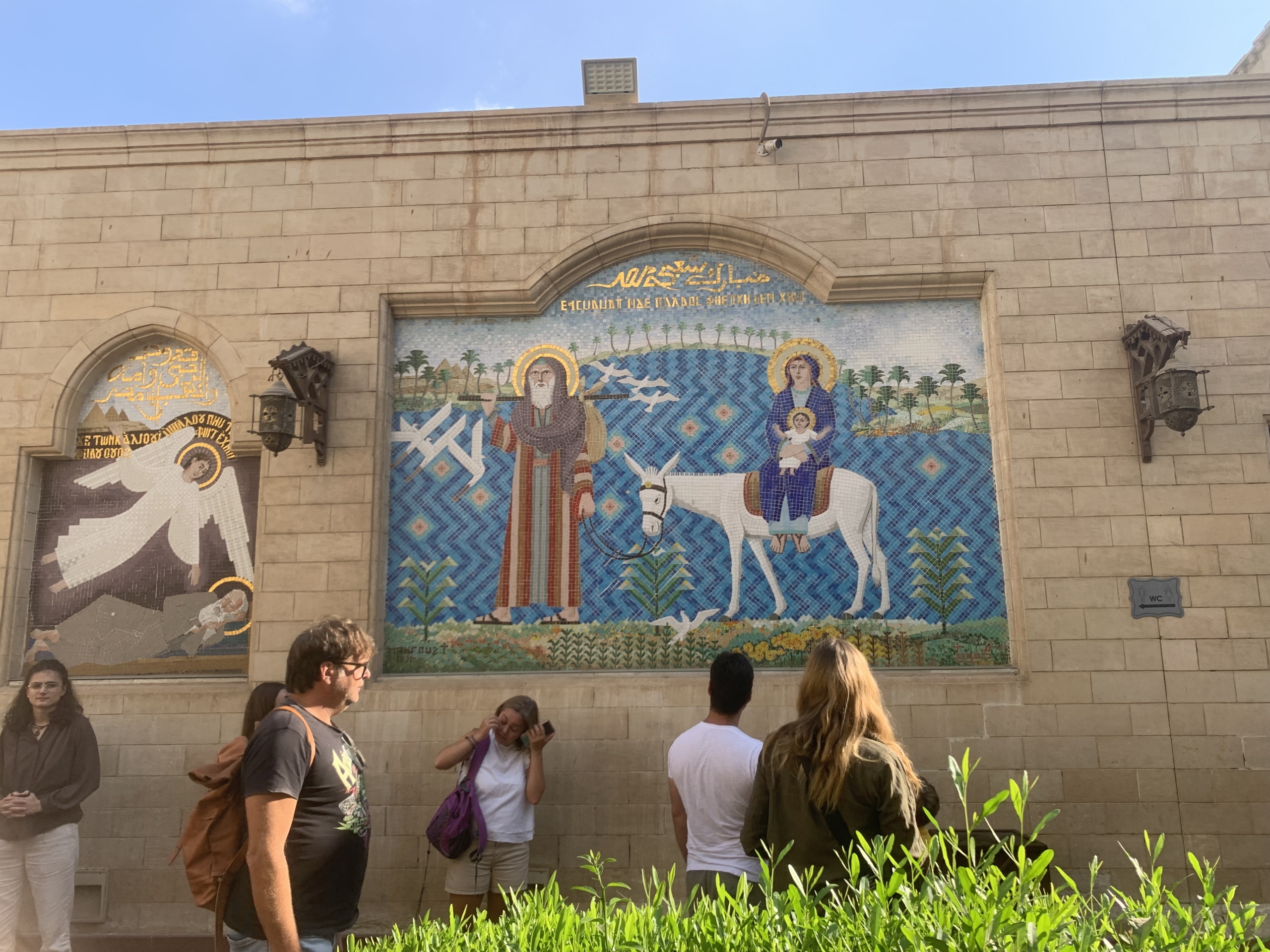
The Gospel of Matthew recounts the Flight into Egypt in just a few lines. An angel appears to Joseph in a dream, warning him to flee. The family departs by night and remains in Egypt until the death of Herod. Another dream signals their return. No locations are mentioned, no distances, no dates. The passage is not a travelogue but a theological framing of a prophecy: “Out of Egypt I called my son” (Matthew 2:15).
That silence, paradoxically, created space. Early believers began to imagine what had been left unsaid. The canonical verses formed a narrative core, which later generations surrounded with concentric rings of tradition. The vision of Theophilus, Patriarch of Alexandria in the late 4th century, the writings of early monastic chroniclers, and a body of poetic apocryphal texts gradually filled in the blanks – offering details that were never meant as history but functioned as symbolic elaboration.
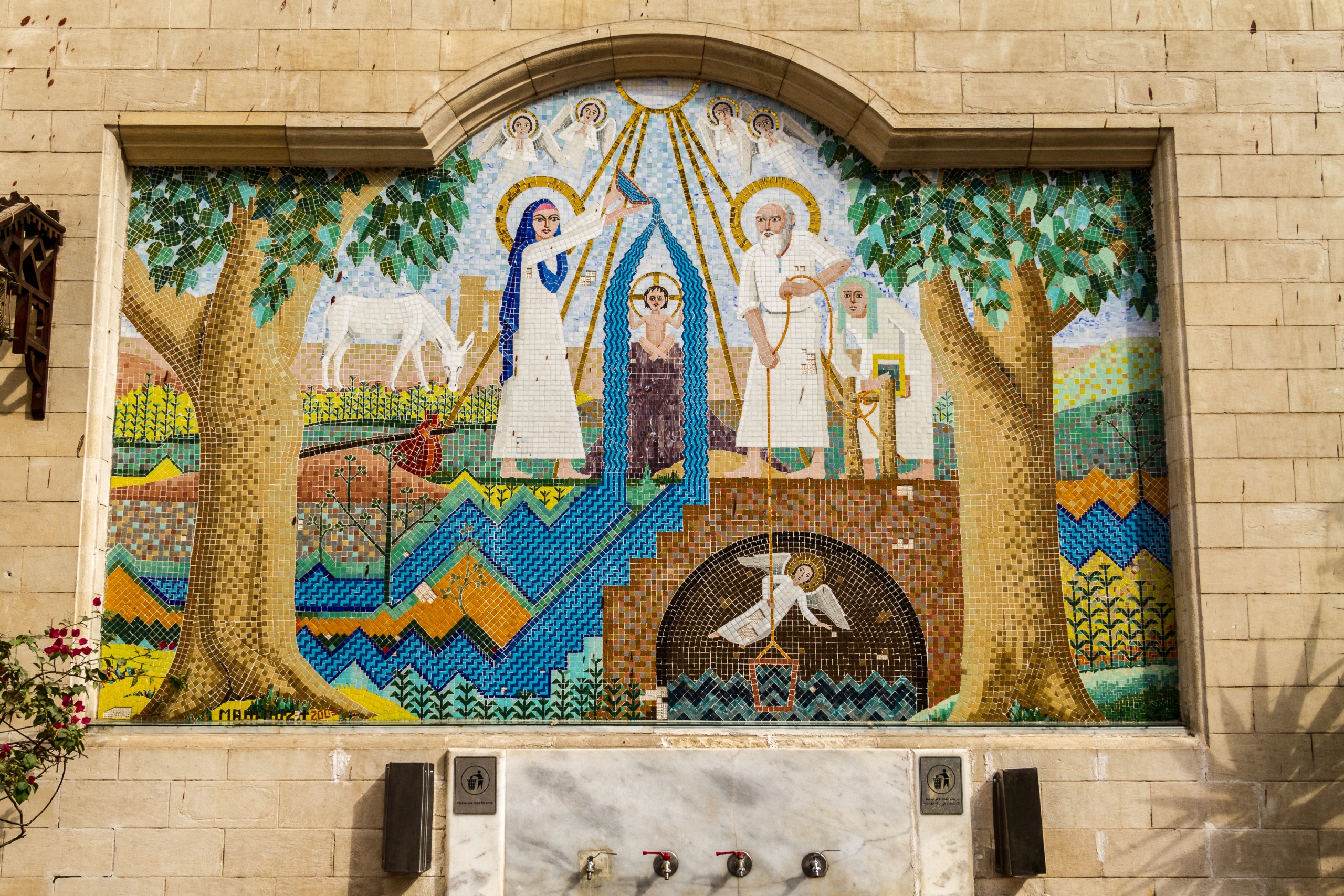
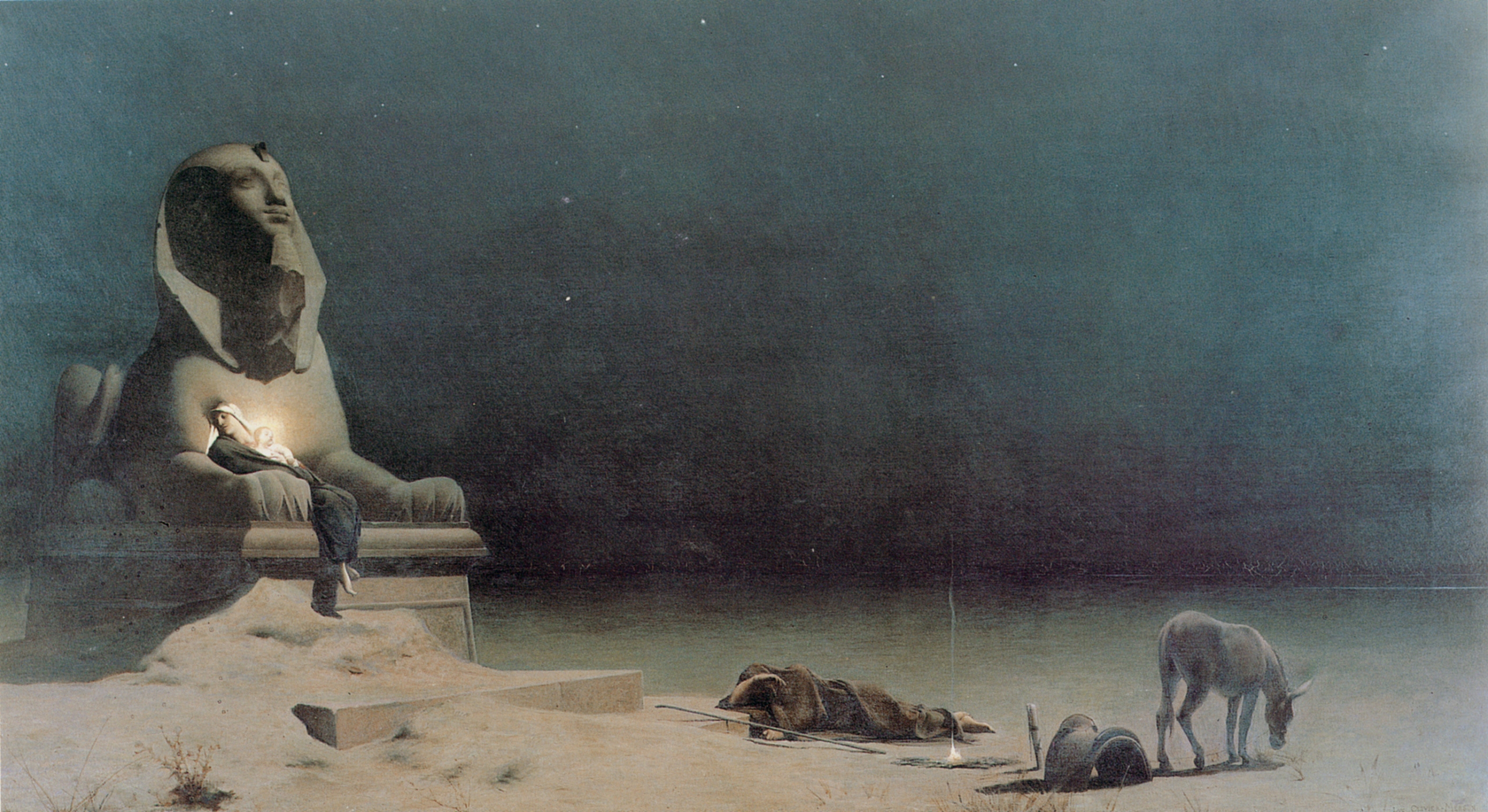
One such text, the Gospel of Pseudo-Matthew, tells of idols that fell to the ground when the family entered an Egyptian town (Pseudo-Matthew, 23), or of a palm tree that bent to offer its fruit while a spring emerged at its base to quench their thirst (Pseudo-Matthew, 20). The Arabic Infancy Gospel adds mentions of wild animals walking peacefully beside the child and water springing from desert sand (Arabic Infancy Gospel, chs. 10–11).
These texts were not itineraries but lessons. Water represented providence. Shade meant protection. Bread recalled the everyday tasks of a mother in exile. Over time, these teachings became attached to specific places—wells, trees, caves—until the landscape itself bore the imprint of sacred memory. And over those places, churches rose.
Theophilus of Alexandria and the First Spiritual Map
Within Coptic tradition, the pivotal figure is Theophilus of Alexandria. Moved by a desire to preserve the memory of the Holy Family’s journey, he is said to have prayed for divine revelation. In a dream, the Virgin Mary appeared to him and disclosed each stop along their flight.
This narrative—neither a map in the modern sense nor a historical chronicle—functioned as a kind of spiritual cartography. It unified disparate traditions into a coherent whole. Communities began to consecrate the memory in stone: sanctifying wells, marking sacred trees, and turning caves into crypts. Churches were built over each location, many of which remain active today.
With Theophilus’s vision, the Flight into Egypt ceased to be an abstract passage in Scripture. It became a tangible path—stretching from Sinai to the Delta, from Cairo to Upper Egypt. For Coptic Christians, it confirmed that their land had not only sheltered the Holy Family, but had itself become part of sacred geography.
Egypt, Reimagined
Over time, these traditions were reread through the lens of prophecy. Isaiah 19 offered a striking framework: “The Lord enters Egypt, and the idols tremble.” For Copts, this line explained why so many legends describe statues falling as the child entered a town. Later in the same chapter, the prophet speaks of “an altar to the Lord in the heart of Egypt,” which Coptic tradition links to the Monastery of Al-Muharraq—built atop a rock said to have been the family’s longest resting place.
The line “Blessed be Egypt, my people” became the theological anchor. In Christian memory, Egypt—once the setting of bondage in the Hebrew Bible—was reinterpreted as a land of refuge, the country that gave shelter to a persecuted family and, by doing so, participated in the story of salvation.
Memory Becomes Stone
This devotion helped Egyptian Christianity flourish for centuries. In Wadi el-Natrun, where tradition holds that a spring rose at the child’s command, Coptic monasticism took root as early as the 4th century. In Al-Muharraq, the sojourn of the family turned the altar into what believers called a “Second Bethlehem.” In Matariya, a sycamore tree and a well became enduring symbols of maternal rest and divine provision. And in the 20th century, the Marian apparitions at Zeitoun drew thousands of pilgrims, renewing attention to the ancient route.
Each site became more than a point on a map. It became a marker of protection, sustenance, expectation, and hope—an itinerary of human experience rendered in stone, water, and ritual.

From Local Cult to National Itinerary
For centuries, the Route of the Holy Family remained a primarily Coptic devotion, relatively unknown beyond Egypt’s Christian communities. That changed in the 21st century. Through cooperation between the Coptic Church and the Egyptian government, many of the sites have been restored and made accessible. In 2017, Pope Francis blessed an icon of the Flight and lent his support to the route’s recognition as a formal pilgrimage path.
Today, the route is a convergence of heritage, faith, and cultural tourism. For secular travelers, it offers a journey through architecture, archaeology, and history. For pilgrims, it is a path etched with meaning: a refugee family moving through a foreign land, transforming Egypt into sacred ground.
A Map Woven Over Sixteen Centuries
The Route of the Holy Family was not born of modern infrastructure or ecclesiastical decree. It emerged from a long memory—woven through centuries of vision, devotion, and storytelling. Egypt turned an episode of flight into a geography of presence: wells to quench thirst, trees to offer shade, caves to hide from danger, and altars to mark safety found.
To walk the route today is to join that layered memory. But before setting out, it is worth listening to the story itself: how five verses grew into twenty-five stops through the memory of Theophilus, the voice of apocrypha, and the imagination of a people who shaped their landscape into sacred narrative.
This content is brought to you in partnership with Synergy and the Egyptian Tourism Authority (ETA)
AI Transparency Notice
PilgriMaps uses artificial intelligence tools to assist in the research, drafting and translation of editorial content. All AI-assisted content is reviewed, edited and verified by our editorial team before publication. We contrast information against primary sources, specialist literature and on-the-ground knowledge to ensure accuracy, cultural sensitivity and editorial integrity.
AI is one tool among many in our workflow. The judgement, curation and responsibility for everything published on this platform remain entirely human.
Viator Media S.L. — in compliance with the EU Artificial Intelligence Act (Regulation EU 2024/1689).
This post is also available in: