On a mountain in southern India, hundreds of pilgrims climb a steep path carrying wooden crosses on their shoulders. Some walk barefoot, others pause to pray at the Stations of the Cross, while voices repeat an invocation in Malayalam: Ponnum Kurishu Muthappo, Ponmala Kayattom. It is a call to Muthappan, the affectionate name by which the Christians of this region know St Thomas, one of the twelve apostles of Jesus.
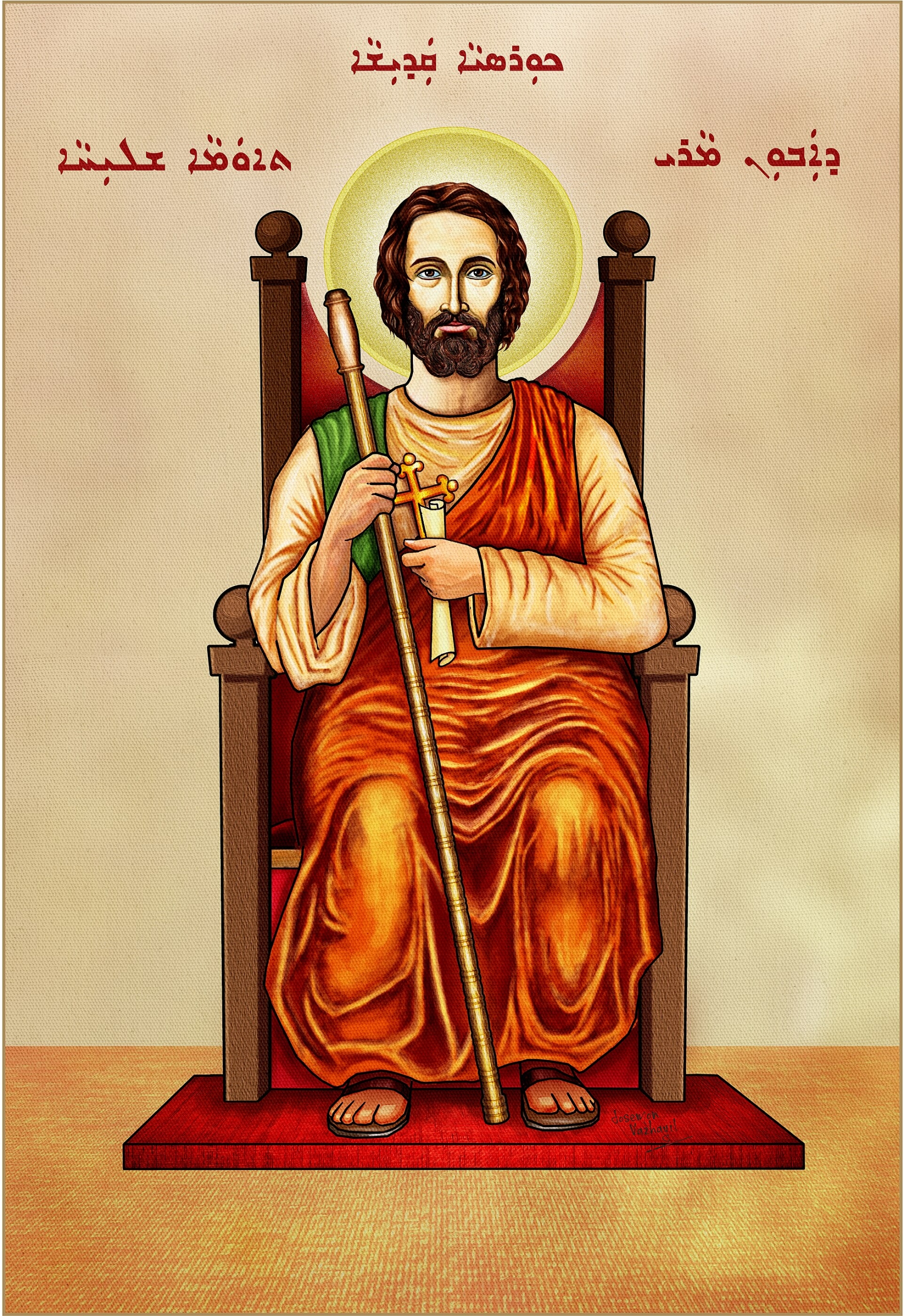
We are at Malayattoor, in the Indian state of Kerala, far from Jerusalem and from the settings where we usually place the origins of Christianity. Yet for the pilgrims climbing this mountain, St Thomas is far more than a biblical figure. He is the spiritual father of a community whose history reaches back, according to a tradition almost two thousand years old, to the arrival of the apostle himself on the shores of India.
This memory has given rise to a pilgrimage geography that extends across much of the south of the country. Churches founded, according to tradition, by St Thomas; mountains where he is said to have sought refuge and prayer; and a basilica raised over the place where his burial is venerated.
There is no single road linking all these sites, as there is with the great Jacobean routes of Europe. But there are three itineraries that allow one to follow the apostle’s traces: the seven and a half churches of Kerala, the mountain pilgrimage to Malayattoor, and the shrines of Chennai, on the eastern coast, where tradition places his final days.
An Apostle on the Spice Routes
According to the tradition of the St Thomas Christians, the apostle arrived in India in the year 52, landing in the vicinity of Muziris, an important trading port on the Malabar coast, generally identified with the region of present-day Kodungallur.
The arrival of a traveller from the Near East in this remote territory may seem surprising to a Western reader, but it was by no means impossible. Long before European expansion, the coasts of India were connected with Arabia, Persia, Egypt and the Mediterranean by an extensive network of maritime routes. Ships used the monsoon winds to carry spices, precious stones, textiles and other goods. With them travelled people, languages, ideas and beliefs.
It is in that world of exchange that tradition places the arrival of Thomas, who is said to have begun preaching among the local population and the communities connected with maritime trade. He would then have founded several Christian communities in Kerala before travelling to the eastern coast of the peninsula, where he is said to have died a martyr around the year 72.
The story of his journey is recorded in the Acts of Thomas, an apocryphal text probably composed in the third century, which combines historical memory, religious narrative and legendary episodes. Although it is not possible to verify every detail of the apostle’s personal presence in India, we do know that Christian communities existed in the south of the country from late antiquity, many centuries before the arrival of the Portuguese.
And this brings us to one of the most interesting particularities in the history of Indian Christianity.
When Portuguese navigators reached Kerala at the end of the fifteenth century, they found Christian communities that had been practising their faith for centuries and that maintained close religious and cultural ties with the Churches of Persia and Mesopotamia. Those Christians, known as Nasranis or St Thomas Christians, preserved liturgical traditions in Syriac and an identity deeply rooted in Indian culture.
Over time, and especially following the ecclesiastical divisions of the seventeenth century, different Churches emerged as heirs to that tradition. Among them are the Syro-Malabar Catholic Church and the Syro-Malankara Catholic Church, both in full communion with Rome, though with liturgical traditions distinct from the Latin one.
But not all St Thomas Christians are Catholic. There are also communities such as the Malankara Orthodox Church and the Jacobite Syrian Orthodox Church, which are not in communion with the Pope, as well as the Mar Thoma Church, of Reformed tradition. All share, in different ways, the memory of origins bound to the apostle.
The Seven and a Half Churches: Following the Apostle’s Traces in Kerala
The first of these routes covers the places where, according to tradition, St Thomas founded the first Christian communities in India. They are known as the Ezhara Pallikal, literally the “seven and a half churches,” a name that has survived for centuries and that still identifies some of the most important sites of Kerala’s Christian heritage.
The route can begin at Kodungallur, near the site of the ancient port of Muziris. There, at Azhikode, stands the Marthoma Pontifical Shrine, dedicated to the memory of the apostle’s arrival.
From there the traveller can continue to Palayur, where tradition recalls the first conversions, and to Kottakkavu, in North Paravur, another of the oldest communities of local Christianity. In these places, apostolic memory is preserved among churches, ancient crosses and accounts of the first celebrations and baptisms.
Further south lies Kokkamangalam, near the waters of Lake Vembanad, in a region of canals, coconut plantations and small settlements historically connected by inland navigation. The landscape helps us understand that many of those Christian settlements grew up alongside the trade routes that structured the Malabar coast.
The itinerary continues toward Niranam, where an important church of the Malankara Orthodox tradition is preserved, and Nilakkal, in a mountainous region of the interior. Kollam, one of the great historic ports of southern Kerala, constitutes another of the seven traditional foundations. Although the original church is said to have disappeared, the city preserves a long Christian memory interwoven with its commercial history.
Finally there is Thiruvithamcode, now situated in the neighbouring state of Tamil Nadu, near the former region of Travancore. Its church, known as Arappally or “half church,” explains the peculiar name of this route. According to local tradition, Thomas established there a community of lesser standing than the other seven.
Today these places can be visited over a circuit of several days, mainly by road. Kochi makes a good gateway to the region, although the distribution of the shrines requires planning the journeys carefully. This is a historical and religious route, not a continuous walking path with waymarking and official stages.
To prepare the visit, the Kerala tourism office provides information on the seven and a half churches of St Thomas, their traditions and their principal points of interest.
Malayattoor: the Pilgrimage to St Thomas’s Mountain
Unlike the circuit of the seven and a half churches, Malayattoor preserves a pilgrimage road in the fullest sense, walked each year by numerous faithful, especially during Lent and the Easter celebrations.
The shrine stands on a mountain in Ernakulam district known as Kurisumudi, the “mountain of the cross.” According to tradition, St Thomas withdrew there to pray during his travels through southern India. Popular memory speaks of an apparition of the Virgin Mary and of a golden cross discovered centuries later by hunters.
At the summit, marks on the rock traditionally regarded as the apostle’s footprints are venerated, along with a spring associated with his prayers. These elements form part of a devotion that has made the place one of the great centres of Christian pilgrimage in India.
The path begins at the foot of the mountain and climbs for some three kilometres to reach the shrine. Along the way are the fourteen Stations of the Cross, where pilgrims stop to pray. Many carry wooden crosses on their shoulders, some of considerable size and weight. Others carry stones or objects that symbolise their worries, promises or petitions.
The most important moment of the year comes with Puthunjayar, the Sunday after Easter, when the great feast of Malayattoor is celebrated. The pilgrimage then draws thousands of people, though the mountain receives visitors throughout the year and especially during the weeks of Lent. It is a celebration deeply rooted in the religious life of Kerala, in which people from other religious traditions also take part.
Malayattoor lies relatively close to Kochi international airport and to Angamaly railway station, so it can be visited as an excursion from that area. For details of the celebrations and access, it is worth consulting Kerala Tourism’s official information on Malayattoor.
Chennai: the Places of Martyrdom and the Tomb of St Thomas
The third route takes us to Chennai, the former Madras, on India’s eastern coast. There, Christian tradition places the final years of St Thomas’s life and his martyrdom, generally dated to around the year 72.
The places connected with this stage of his life form an itinerary that can be completed in a single day, combining urban journeys with visits on foot.
The first is Little Mount, a small hill preserving a cave in which, according to tradition, the apostle took refuge to escape his persecutors. The shrine also includes a spring considered miraculous and various marks on the rock attributed to Thomas’s presence.
From there the route continues to St Thomas Mount, a hill overlooking part of Chennai, which tradition identifies as the scene of the martyrdom. The shrine is reached by a historic granite stairway, built in the eighteenth century thanks to the patronage of the Armenian merchant Petrus Uscan.
At the summit stands the church of Our Lady of Expectation, raised during the Portuguese period. One of its most important features is an ancient stone cross bearing an inscription in Pahlavi, a language used in Persia. Although it does not date from the apostle’s time, it constitutes a particularly interesting testimony to the historical links between Indian Christianity and the Christian communities of the East.
The visit culminates at Mylapore, one of Chennai’s historic neighbourhoods, where the Basilica of San Thome stands over the traditional burial place of the apostle.
The present church, in neo-Gothic style, was built at the end of the nineteenth century on the site of an earlier Portuguese church. Within it is the tomb chapel, one of the most venerated places for the St Thomas Christians.
Tradition holds that the apostle’s remains were transferred centuries later to Edessa, in Mesopotamia, and subsequently reached Ortona, in Italy, where the principal relics are preserved. Chennai nevertheless remains the place associated with his original burial and an important pilgrimage destination.
Between Little Mount, St Thomas Mount and San Thome Basilica one can follow a sequence that summarises the final episodes of Thomas’s life according to local tradition: his refuge, his martyrdom and his burial.
There is no official, continuous walking route connecting the three shrines, but their relative proximity within Chennai makes it possible to organise a religious and cultural itinerary in a single day.
To prepare the visit, the pages of the Little Mount Shrine and of San Thome Basilica offer information on the places of worship and the celebrations.
Three Routes for Discovering a Thousand-Year Tradition
The roads of St Thomas offer very different experiences, which can be travelled independently or combined into a single journey through southern India.
The seven and a half churches form a circuit of religious and historical heritage requiring several days, and allow the visitor to encounter some of the oldest Christian communities in the country. Malayattoor, for its part, offers a genuine pilgrimage on foot, concentrated in the ascent of a mountain and especially bound to the Easter celebrations. Finally, Chennai offers an urban itinerary through the places where tradition locates the apostle’s martyrdom and burial.
Anyone wishing to see all three groups of sites can organise a journey of roughly a week, using Kochi as the gateway to Kerala and continuing afterwards to Chennai. It is worth bearing in mind the great distances between the shrines, the tropical climate and the calendars of the various religious communities.
There is no common credential certifying that one has travelled the roads of St Thomas, nor a single itinerary with established stages. Each shrine maintains its own traditions and celebrations, within a religious geography that has taken shape over many centuries.
Beyond the accounts of the apostle’s life, these routes allow the discovery of a dimension of Christianity still little known to many Western travellers. The history of the St Thomas communities forms part of the history of India, of its ancient commercial exchanges and of its cultural relations with the Near East.
Nearly two thousand years after the arrival that tradition remembers, his memory remains present in the liturgies of Kerala, in the crosses pilgrims carry to Malayattoor, and in the venerated tomb at Mylapore. These are places that continue to bring together the faithful of different Churches, and that show the extent to which the figure of the apostle has become part of the religious and cultural identity of southern India.
AI Transparency Notice
PilgriMaps uses artificial intelligence tools to assist in the research, drafting and translation of editorial content. All AI-assisted content is reviewed, edited and verified by our editorial team before publication. We contrast information against primary sources, specialist literature and on-the-ground knowledge to ensure accuracy, cultural sensitivity and editorial integrity.
AI is one tool among many in our workflow. The judgement, curation and responsibility for everything published on this platform remain entirely human.
Viator Media S.L. — in compliance with the EU Artificial Intelligence Act (Regulation EU 2024/1689).
This post is also available in: