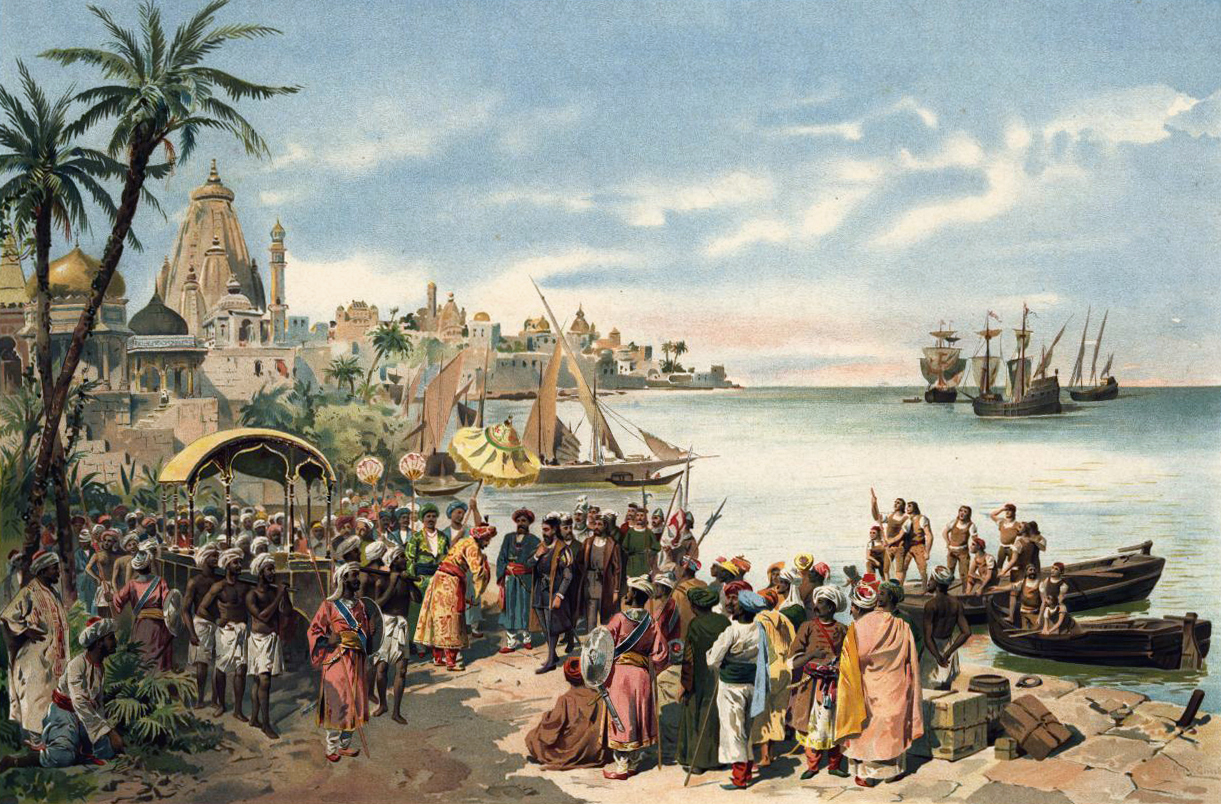
In 1498, Vasco da Gama reached the Malabar coast with instructions to find Christians and spices. He found both, and was substantially more prepared for the spices.
The Christians were a problem. Not because there were too few of them, but because there were rather a lot, they had been there since roughly the year 52, they had never heard of the Pope in any way that affected their Sunday mornings, and they answered to a patriarch in Mesopotamia. They did not need converting. They needed, from the Portuguese point of view, explaining.
It took the Latin Church a century to work out what to do about this, and the solution it eventually arrived at went so badly that the resulting schism is still visible in Kerala’s church signage today.
The Community That Was Already There
The Saint Thomas Christians — Nasrani, Syrian Christians, Mar Thoma Nasrani — trace their foundation to the Apostle Thomas, who by tradition landed at Muziris on the Kerala coast in AD 52 and founded seven and a half churches before being martyred at Mylapore, on the other side of the subcontinent.
You may take the tradition or leave it. What is not in dispute is that there was an organised, literate, socially prominent Christian community on the Malabar coast for well over a thousand years before any European arrived, in communion with the Church of the East from around 300 until 1599, worshipping in Syriac, using the Holy Qurbana of Addai and Mari.
They had royal charters. The king of Venad granted privileges to the Christians of Kollam in 849; the Tharisapalli copper plates date from 892. Marco Polo reported them. A Dominican friar turned up in 1323 and noted them. They were, in other words, thoroughly documented and entirely unsurprising to everybody in the region except the men who had just arrived by sea.
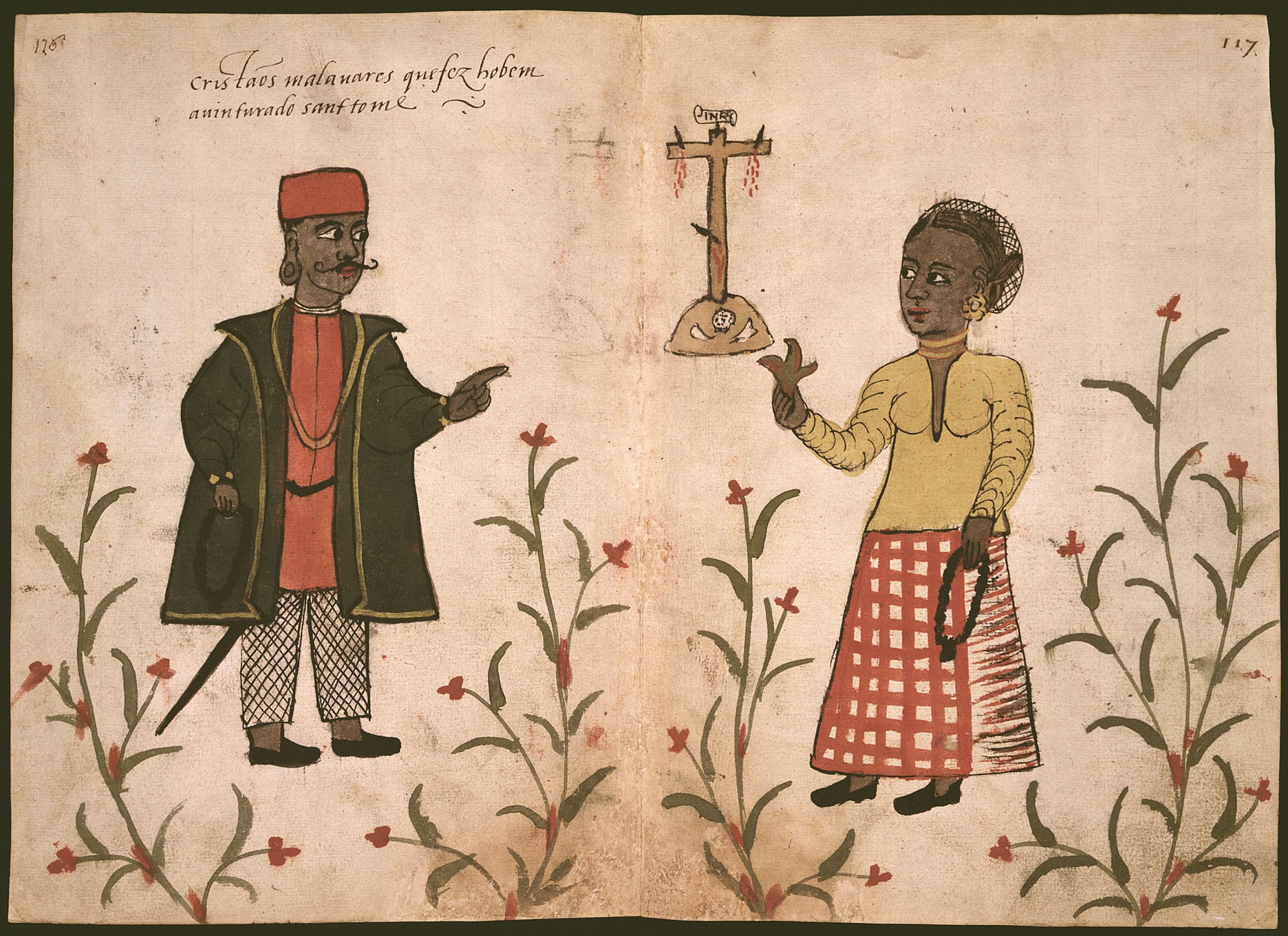
Anonymous 16th century Portuguese illustration contained within the Códice Casanatense, depicting a couple of Saint Thomas Christians of the Malabar Coast in India.
The Heresy Catalogue
The Portuguese response was not immediately hostile. It was, at first, confused, and the confusion is where the comedy lives.
Here was a Christianity with no Latin, no Roman vestments, married clergy, a liturgy nobody in Lisbon could read, a bishop appointed from Mesopotamia, and social customs shaped by fifteen centuries of Indian life. It was self-evidently Christian. It was also self-evidently not doing any of it the way Coimbra did.
So the missionaries went through the catalogue. European theology had an extensive filing system of heresies, developed over centuries of arguing with people much closer to home — Arians, Monophysites, Donatists, the whole apparatus — and the assumption was that any deviation must correspond to an entry.
They settled on Nestorianism: the error of holding two persons in Christ rather than two natures. The Indians were suspected of being heretics by the Portuguese missionaries, and the charge stuck, being both technically available and conveniently associated with the Church of the East.
Whether the Nasrani of sixteenth-century Malabar held anything resembling a Nestorian Christology is a question theologians still argue about. What is clear is that a diagnosis was made, and that a community which had been quietly celebrating the Eucharist since the Roman Empire was informed by recent arrivals that it had been doing so incorrectly.
Diamper
The reckoning came in June 1599.
Aleixo de Menezes, Archbishop of Goa, convened a synod — not at Angamaly, the headquarters of the local diocese, but at Diamper, near the Portuguese stronghold at Kochi. It opened on 20 June and ran to the 26th.
The synod formally placed the Saint Thomas Christians under the Latin Archdiocese of Goa, removed the patriarch of the Church of the East from jurisdiction, imposed Portuguese bishops, the Latin liturgy, Roman vestments and clerical celibacy, and extended the Goa Inquisition’s reach to Cochin. The customs and Syriac books of the local Christians were condemned. Passages of the Qurbana of Addai and Mari were declared “impious, sacrilegious and resulting from Nestorian heresy.” Books were burned.
That last detail deserves a moment. The Anaphora of Addai and Mari is among the oldest eucharistic prayers in continuous use anywhere in Christendom, older than most of what the Portuguese brought with them. In 2001, the Holy See formally recognised its validity.
Four hundred and two years later. Not the fastest correction in the history of the Church, but not the slowest either.

The Rope
The Nasrani took fifty-four years to answer. The immediate trigger was the disappearance of Ahatallah, a bishop from the East who arrived claiming patriarchal authority over India. A Jesuit alerted the Portuguese, who put him on a ship for Cochin and Goa. Thomas Christians heard the ship had docked at Cochin and came to meet him. They were told it had already sailed. They never saw him again, and rumours spread that the Portuguese had drowned him in Cochin harbour or burned him for heresy. (Later archival work suggests he was sent onward to Lisbon and died at Paris in 1654, which is less dramatic and was not available to anyone in Kerala at the time.)
On 3 January 1653, the community gathered at a stone cross at Mattancherry. There were far more people than could touch the cross itself, so they tied ropes to it and held the ropes, and swore they would never again submit to the Portuguese Jesuits.
The cross is said to have bent under the weight. Hence the name: Koonan Kurishu Satyam, the Oath of the Bent Cross. Out of a community of perhaps two hundred thousand, almost all took the oath. The Padroado supremacy imposed at Diamper broke in an afternoon. Some later returned to Rome — the Syro-Malabar Church — and some did not, and the division is permanent.
What Got Built
Here is where the story turns, and where it stops being funny and becomes rather beautiful. Both sides built shrines. The result is one of the densest and strangest pilgrimage landscapes anywhere in the Christian world, where sites founded in the first century sit within a few hours’ drive of sites founded by the people who came to correct them.
The Ezharappallikal, the seven and a half churches of Thomas: Kodungallur, Palayur, Kottakavu at North Paravur, Kokkamangalam, Niranam, Nilackal and Kollam, with Thiruvithamcode as the half. Whatever their actual foundation dates, these are the oldest continuously venerated Christian sites in Asia.
Palayur has what is effectively a Kerala camino: the Mahatheerthadanam, a thirty-kilometre pilgrimage on foot from Thrissur to the church, held annually in Lent.
Azhikode, near Kodungallur, where the Mar Thoma Pontifical Shrine on the Periyar holds a relic of the apostle’s arm bone.
Malayattoor, where pilgrims climb 609 metres to Kurisumudi, the Hill of the Cross, to a shrine at the top marking where tradition says Thomas prayed. It was raised to archdiocesan status in 1998 and is now an international pilgrimage station. A hill climbed on foot with a cross at the summit: the pattern is instantly familiar to anyone who has walked to a Mediterranean hilltop sanctuary, and it developed entirely independently.
San Thome Basilica at Mylapore in Chennai, over the apostle’s tomb, with St Thomas Mount and Little Mount nearby.
And then, from the other direction:
The Basilica of Bom Jesus in Old Goa, holding the body of Francis Xavier, exposed publicly roughly every ten years and drawing enormous crowds.
St Francis Church in Kochi, where Vasco da Gama was buried in 1524 — until his remains were taken back to Portugal fourteen years later, leaving an empty grave that people still queue to see.
The Joke and the Point
The joke is real: an expedition sails halfway round the world to bring Christianity to India and is met at the shore by Christians whose church is older than the nation the expedition sailed from.
The point underneath it is less comfortable, and it is about what happens when you arrive somewhere convinced you already know what you are going to find. The Portuguese were not stupid men. They were men with a complete system, and a complete system has a slot for everything, and anything that will not fit a slot must be filed as error.
What they could not process was the possibility that Christianity had gone east as early as it went west, and had spent fifteen centuries becoming Indian in the same way their own had spent fifteen centuries becoming Iberian, and that neither outcome was a deviation from the other.
The pilgrims who climb Kurisumudi barefoot, and the pilgrims who file past Xavier’s body in Goa, are in the end doing the same thing. It only took a burned library, a bent cross and four hundred years to establish it.
AI Transparency Notice
PilgriMaps uses artificial intelligence tools to assist in the research, drafting and translation of editorial content. All AI-assisted content is reviewed, edited and verified by our editorial team before publication. We contrast information against primary sources, specialist literature and on-the-ground knowledge to ensure accuracy, cultural sensitivity and editorial integrity.
AI is one tool among many in our workflow. The judgement, curation and responsibility for everything published on this platform remain entirely human.
Viator Media S.L. — in compliance with the EU Artificial Intelligence Act (Regulation EU 2024/1689).
This post is also available in: