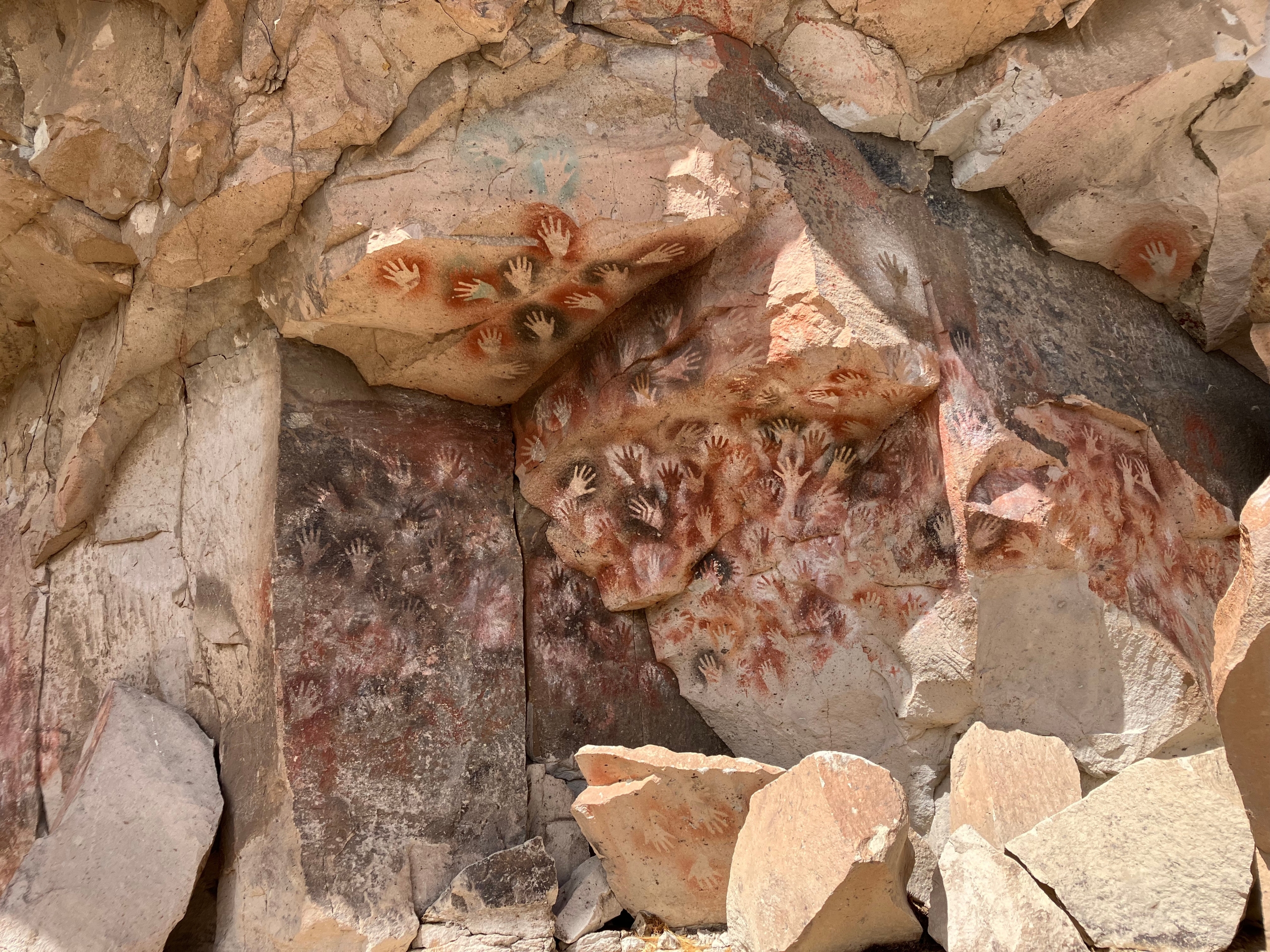
There is a gesture that requires no language to understand. You place your hand against a rock wall, spread the fingers, and blow pigment around it. When you lift your hand away, the shape that remains is not a painting of a hand. It is the absence where a hand was. A negative. Proof that someone stood exactly here.
In a canyon in southern Patagonia, more than eight hundred of these marks cover the rock. They were made in waves across roughly eight thousand years, by people who had no way of knowing that anyone would still be looking.
What is there
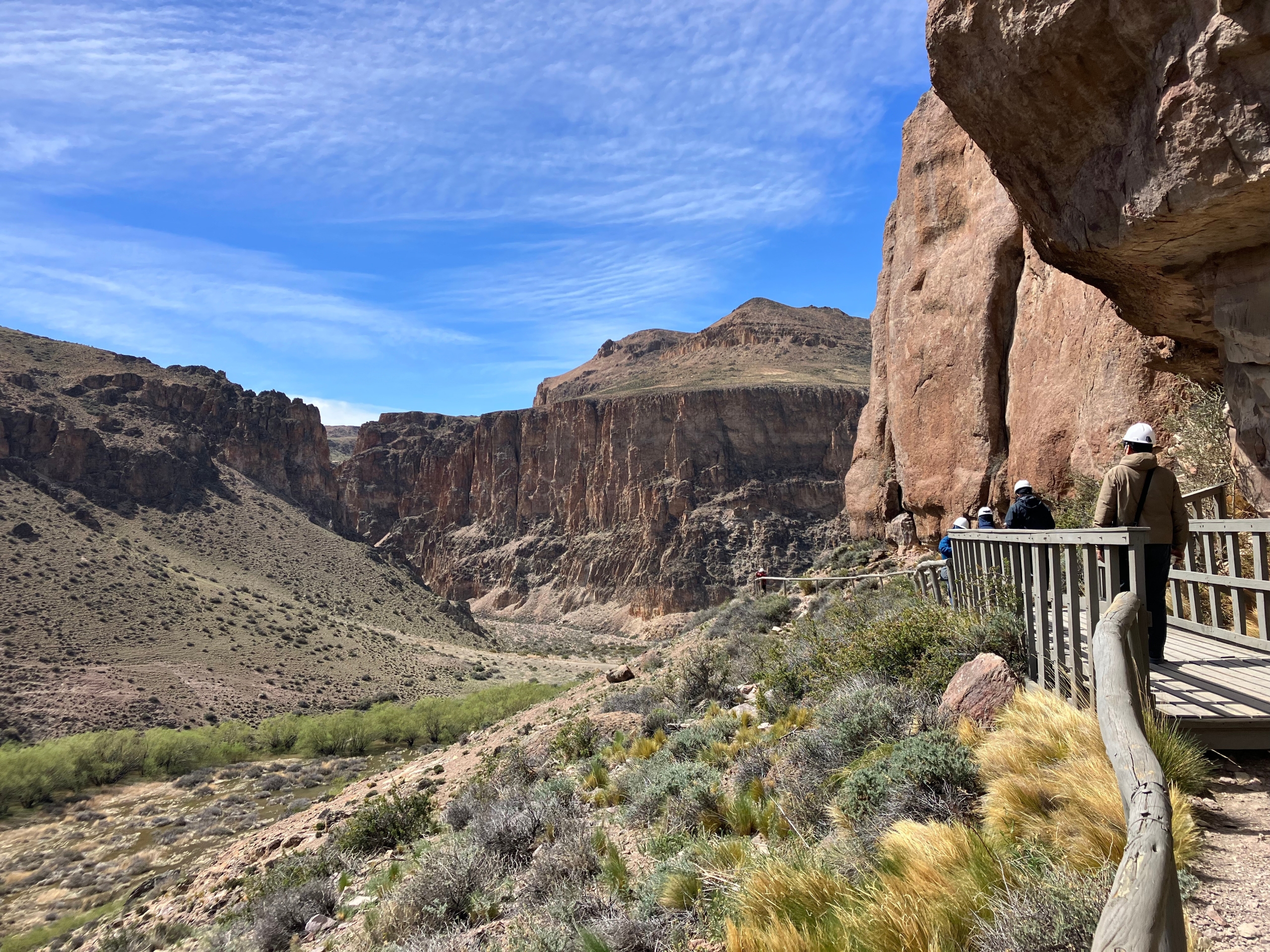
Cueva de las Manos lies at the base of a stepped cliff in the Río Pinturas canyon, in the upper Deseado basin, about 163 kilometres south of the town of Perito Moreno in Santa Cruz Province, Argentina. UNESCO inscribed it in 1999 under criterion (iii), as exceptional testimony to a vanished cultural tradition. The protected area covers 600 hectares with a buffer zone of more than 2,300.
The stencils are in black, white, red and ochre. Around them are painted guanacos, rheas, pumas, hunting scenes, and geometric designs whose meaning nobody has established. The hunting scenes are unusually dynamic — animals driven, encircled, brought down — and they were made by people who depended entirely on those animals.
The dating comes from an unexpected source. Bone pipes were found at the site, used to spray pigment against the wall. Radiocarbon dating of those pipes, together with stratigraphy and direct dating of the art, places the earliest work at around 7300 BC and the latest at around AD 700. The most substantial research was carried out by the Argentine archaeologist Carlos Gradin and his team from 1964 onward.
Eight thousand years is not a moment. It is longer than the entire span from the first Egyptian dynasty to now. Whatever was happening in this canyon, it was happening across a stretch of time that dwarfs most of what we call history.
One detail is worth sitting with. The great majority of the stencils are left hands, which suggests people holding the pipe in the right hand and pressing the left against the stone. Thousands of years apart, across dozens of generations, the same practical arrangement of a body doing a thing.
Why call this a pilgrimage
A reasonable objection: this is an archaeological site, not a shrine. Nobody has ever walked here in devotion to anything, and we have no idea what — if anything — the people who made these marks believed.
That objection holds, and the honest answer is that what we are describing is a contemporary proposal rather than an inherited tradition. There is no codified pilgrimage to Cueva de las Manos, and this article is not inventing one.
But consider what pilgrimage actually consists of, stripped of any particular creed. You travel a considerable distance, usually with difficulty, to stand in a specific place where something happened that bears on who you are.
By that description, the canyon of the Río Pinturas qualifies almost too well. What happened here is the emergence of the behaviour that makes us what we are: the decision to leave a mark that means I was here and that will outlast the person who made it. Every subsequent act of that kind descends from this one. The pilgrim’s credencial stamped in a parish sacristy, the ex-voto hung beside an altar at Ta’ Pinu, the graffito scratched into plaster in a third-century Syrian house-church by a man asking to be remembered — all of it is the same gesture, refined and complicated, but not different in kind.
We have written before about walking toward the oldest church in the world. This is older by seven thousand years, and it is not a church, and it may be the more fundamental destination.
The approach
What makes this work as a walk rather than a site visit is the canyon itself.
The classic approach descends from the rim near the Hostería Cueva de las Manos, drops through the ravine to the Río Pinturas at the bottom, crosses the river, and climbs the far side to reach the cave. The full route runs roughly six kilometres with about 430 metres of elevation gain, and takes two and a half to three hours. It is rated hard, and the rating is fair.
There is a shorter option of around 2.6 kilometres from the Portal Cañadón Pinturas, the gateway into Parque Patagonia Argentina, reached in about fifty minutes on paved Ruta 40 south from Perito Moreno. That version takes an hour to an hour and a half and is graded moderate. And you can simply drive most of the way, along an hour of gravel road.
The longer walk is the one worth doing, for a reason that is not sentimental. You descend into the canyon, lose sight of everything above it, cross water at the bottom, and climb back up to reach the art. The landscape stages an arrival. You do not come upon the hands; you work your way to them, and the last stretch is upward.
Along the way there are guanacos and rheas — the same animals painted on the walls you are walking toward. That is not a curated experience. It is simply what still lives there.
A longer route
The canyon holds more than one site. Beyond Cueva de las Manos are the Charcamata rock shelter and Cueva Grande, and the estancias Cueva de las Manos (formerly Los Toldos) and Casa de Piedra offer lodging and full-day archaeological expeditions combining vehicle transfer with walking over rough ground.
That opens a real possibility: not a single visit but a multi-day itinerary through the Pinturas canyon system, staying at the estancias, walking between shelters, with the Museo de Arqueología Carlos Gradin in Perito Moreno as either a starting briefing or a closing synthesis.
Such a route does not currently exist as a waymarked whole. The components all do. What is missing is the connective work — stages defined, distances measured, sites registered, accommodation mapped — which is precisely the work that turned a scatter of Maltese chapels into the Camino Maltés and a set of Ibizan parishes into something a visitor can plan around.
Practical Notes
The site is visited in guided groups of around twenty, with an interpretation centre at the access point. It sits within both Perito Moreno National Park and Cueva de las Manos Provincial Park.
Getting there requires commitment. From Río Gallegos it is Ruta 40 north through Gobernador Gregores; from Perito Moreno town it is Ruta 43 west and then gravel. Patagonian weather is unforgiving and the roads are ripio — loose gravel — for significant stretches. A suitable vehicle matters.
The season runs broadly from October to April. Patagonian wind is a constant rather than an event.
The thing itself
Stand in front of the panel and what strikes you is not antiquity. It is scale of a different kind — not the eight thousand years, but the size of the hands.
They are small. Many appear to belong to adolescents. Somebody’s children stood at this wall, put a hand to the cold rock, and blew pigment through a bird bone until the shape appeared.
Nothing about that is remote. The interval is enormous and the gesture is not. You could do it today with a mouthful of ochre and no instruction from anyone, and you would understand immediately why they did.
That is what a pilgrimage to human origins would actually mean: not travelling to see something strange, but travelling a long way to discover that it is not strange at all.
AI Transparency Notice
PilgriMaps uses artificial intelligence tools to assist in the research, drafting and translation of editorial content. All AI-assisted content is reviewed, edited and verified by our editorial team before publication. We contrast information against primary sources, specialist literature and on-the-ground knowledge to ensure accuracy, cultural sensitivity and editorial integrity.
AI is one tool among many in our workflow. The judgement, curation and responsibility for everything published on this platform remain entirely human.
Viator Media S.L. — in compliance with the EU Artificial Intelligence Act (Regulation EU 2024/1689).
This post is also available in: