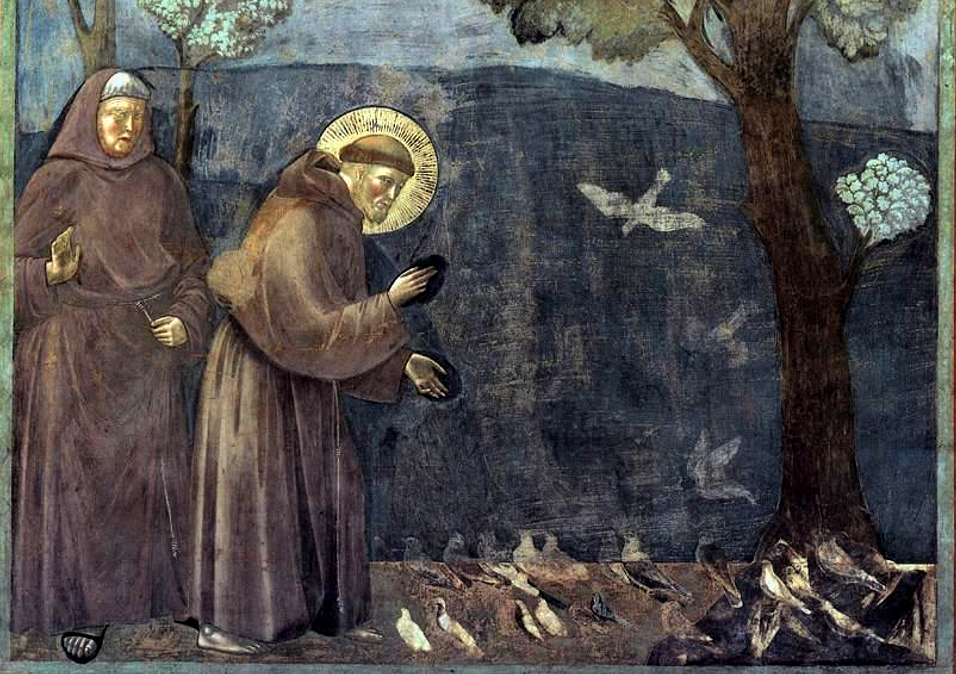
The Canticle of the Creatures was made to be heard. Francis of Assisi set the sun, the moon, the stars, the wind, the water, the fire and the earth into its verses and turned them into a praise of simple, powerful beauty, built on rhythm and repetition. The saint himself is said to have taught the song to his companions so that they could perform it and carry it with them along the roads.
That music, however, has not reached us in any recognisable form. Codex 338 of Assisi, which preserves the oldest known copy of the poem, transmits the text but not a melody that can be securely identified as the one Francis composed. What remains is the cadence of the words, and the knowledge that in their origin those words had voice and sound.
Perhaps that is why it is so easy to imagine the Canticle being born in the open air, facing a luminous dawn, during a walk through the fields of Umbria. But the medieval sources tell a very different story. The beauty of the poem arose in one of the most difficult moments of its author’s life.
A man who could not look at the light
Around 1225, Francis was gravely ill in his eyes. The accounts handed down by the Franciscan tradition describe a condition that made it difficult for him to bear daylight, and even the glare of fire. We do not know with medical precision what he suffered from, but we do know that the eye problem profoundly shaped the last years of his life and took him from place to place in search of relief and treatment.
One of the most striking scenes is set at San Damiano, on the outskirts of Assisi. There, according to the Speculum perfectionis, Francis was lodged in a humble construction of reed matting. The account dwells on his suffering: the illness, the insomnia, one particularly hard night, even the mice that tormented him in that precarious shelter.
It is precisely in that context that he decides to compose a new praise.
The contrast changes the reading of the poem entirely. Francis sings to the sun when light is painful to him. He celebrates fire when he can barely endure its glare. He speaks of water, of wind and of earth while his own body grows ever more fragile.
The Canticle does not emerge, then, from an untroubled contemplation of nature. It emerges from an experience of vulnerability. And that circumstance is perhaps one of the keys to its extraordinary force: the beauty it proposes does not deny suffering, but appears in the midst of it.
According to tradition, Francis wanted that new praise to serve for his own consolation, for that of his companions, and also for anyone who might hear it. He did not imagine a poem shut away in private. He wanted it to circulate. His companions were to sing it and then address those who had stopped to listen. The sources use a suggestive expression for them: ioculatores Domini, “jongleurs of the Lord.”
The song had been born in a dark room, but it was meant to go out into the world.
We know when. But where?
The authorship of the Canticle is one of the firmest elements of its history. Codex 338, dated to around the middle of the thirteenth century, transmits it within the body of Francis’s writings, and contemporary critical editions consider it an authentic work.
There is also reasonable agreement on its date: the most prudent formulation places it around 1225, though the sources do not allow a specific day or month to be fixed with absolute certainty. More interesting is the question of place.
Two settings are particularly connected with that period: San Damiano, beside Assisi, and La Foresta, in the Valle Santa of Rieti. Their reasons for belonging to the history of the Canticle are different, but not necessarily incompatible.
Perhaps the problem arises precisely when we imagine the composition of a medieval work as we would imagine the writing of a book today: an author seated at a desk, beginning the text and finishing it in the same place. The Canticle belonged to a culture of orality, memory and song. Moreover, the Franciscan tradition itself presents the poem as a work connected to different moments in the last months of Francis’s life.
That allows us to see San Damiano and La Foresta not so much as two rivals claiming the same scene, but as two places bound to a single process.
San Damiano: Where the praise is born
San Damiano is the strongest candidate for the birth of the Canticle for a simple reason: the medieval sources that expressly narrate Francis’s decision to compose that new praise set the scene there.
It is the place of the illness and of the difficult night, but also of the transformation of that experience into words. There would have arisen the core in which the sun, the moon and the stars appear, along with the wind, the water, the fire and the earth.
Tradition then speaks of other moments. Francis is said to have added a stanza dedicated to those who forgive and who bear illness and tribulation, connected to a conflict between the bishop and the podestà of Assisi. And, close to his death in 1226, he is said to have incorporated the verses addressed to “sister bodily death.”
Specialists debate how far we should imagine these stages as neatly separate additions. Some recent analyses point out that the metrical and thematic construction of the poem shows a notable unity. But that discussion does not eliminate a suggestive possibility: the Canticle may have accompanied Francis over a period of his life rather than being confined to a single moment of writing.
And it is there that the second setting appears.
La Foresta: the landscape of the same year
In 1225 Francis also travelled toward the region of Rieti because of his eye disease. A medieval source recounts that he stayed for a time in a church called San Fabiano, situated near the city and served by a secular priest.
The account is surprisingly concrete. Beside the house where he was lodged there was a small vineyard. Francis’s presence attracted numerous visitors, who went into it, ate the grapes and damaged the harvest. The priest feared he would be left without wine, but Francis assured him he would obtain an abundant yield. The story ends by affirming that this is what happened.
Local tradition identifies that church of San Fabiano with the present sanctuary of Santa Maria della Foresta, about five kilometres from Rieti. The site lies in a small hollow, among oak and chestnut woods, crossed by the Acqua Marina stream and linked for centuries to the memory of that vineyard.
It is easy to understand why La Foresta came to be associated with the Canticle. Not only because the landscape seems to speak almost naturally with its verses — water, earth, vegetation — but because it belongs to the same biographical itinerary of Francis in 1225: the same sick man, the same affliction of the eyes, the same period in which the poem was born or began to circulate.
From the Rieti area, Francis would go on toward Fonte Colombo, where he was to receive treatment for his eyes.
The tradition of La Foresta holds that he may have written, reworked or made known some part of the Canticle there. The surviving medieval sources do not go so far as to state this expressly, so the sanctuary cannot be presented as the indisputable place where the work was composed. But its candidacy has another kind of force: it places us physically inside the world Francis travelled while that song formed part of his life.
San Damiano preserves the scene of the praise’s birth. La Foresta preserves the landscape and the itinerary of that same year.
From one place to another
Perhaps, then, the question is not only “where did Francis write the Canticle?” but “through which places did he pass while the Canticle was becoming the work we know?”
San Damiano allows us to imagine the paradoxical moment when a man unable to bear light begins to praise the sun. La Foresta introduces us to another episode of that same fragility: an invalid lodged near a vineyard, crossing the region of Rieti before submitting to a painful eye treatment.
And both places allow us to understand that the Canticle was not written from outside nature, like someone contemplating a landscape, but from inside a concrete physical experience made of darkness, water, earth, illness, travel and fraternity.
Eight centuries later, that geography can still be walked. San Damiano is an inseparable part of the Franciscan landscape of Assisi. La Foresta and Fonte Colombo belong to the sanctuaries of the Valle Santa of Rieti and are built into the itineraries and roads that follow Francis’s traces through Umbria and Lazio.
The melody Francis is said to have composed for the Canticle was lost. We do not know exactly how it sounded when his first companions began to sing it. The roads, by contrast, remain.
And perhaps that is one of the most beautiful ways to approach the poem today: to walk through the places of that sick man who could barely look at the light and who, precisely then, found words to call the sun brother, the water sister, and the earth mother.
AI Transparency Notice
PilgriMaps uses artificial intelligence tools to assist in the research, drafting and translation of editorial content. All AI-assisted content is reviewed, edited and verified by our editorial team before publication. We contrast information against primary sources, specialist literature and on-the-ground knowledge to ensure accuracy, cultural sensitivity and editorial integrity.
AI is one tool among many in our workflow. The judgement, curation and responsibility for everything published on this platform remain entirely human.
Viator Media S.L. — in compliance with the EU Artificial Intelligence Act (Regulation EU 2024/1689).
This post is also available in: