In October 1838, at a gathering near Tauranga on Te Ika-a-Māui, the fish of Māui, a young man stood up in front of two peoples who were preparing to go to war and asked them not to.
He was about thirty-three. His father, Te Waharoa, paramount chief of Ngāti Hauā, had died the month before, and he had inherited a position built substantially on warfare. He had fought himself — a reprisal raid near Te Awamutu in 1825, campaigns against Te Arawa in the 1830s. He knew exactly what he was asking people to give up.
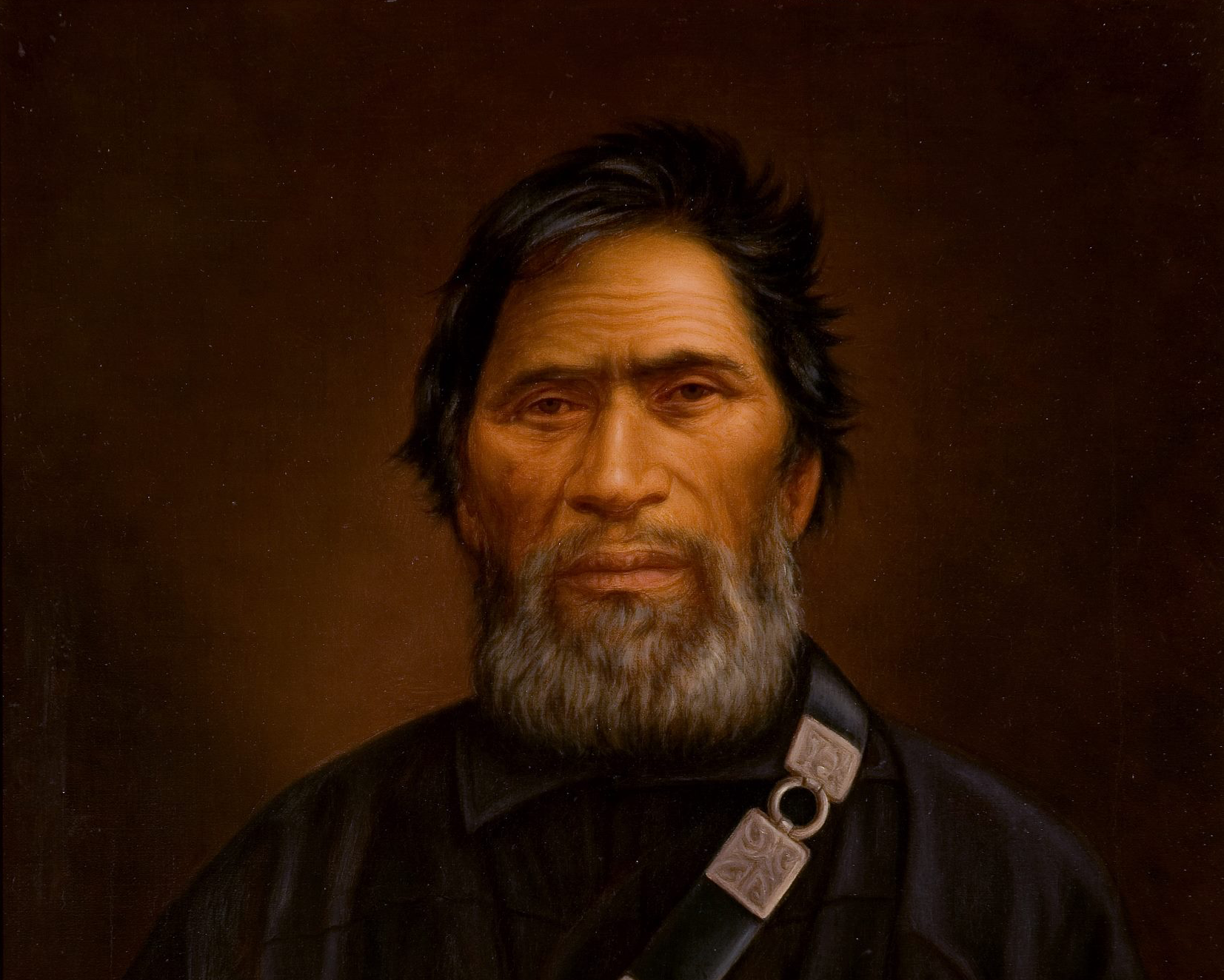
He held a Bible while he spoke. He had learned to read only a few years earlier. He was not yet baptised; that came the following June, when he took the name Wiremu Tāmihana — William Thompson. Pākehā (the Maori name for English men) would later call him the Kingmaker. Ngāti Hauā and Waikato-Tainui remember something more particular: a man who spent almost thirty years trying to build the conditions in which his people and the settlers could occupy the same islands without destroying each other, and who was destroyed for it.
Te Tāpiri: a village built as an argument
That same year, 1838, Tāmihana began building a new kāinga at Te Tāpiri. The settlement had rules. Residents were expected to live by the Ten Commandments. Within a year around three hundred people were living there, and the church was said to hold a thousand.
What makes Te Tāpiri interesting is that it was not a mission station. Tāmihana was not a convert managed by a missionary — he practised Christian belief within a Māori framework, on his own authority, in a community he governed himself. He taught in the school there. He established farming among Ngāti Hauā communities and traded the surplus to Pākehā settlers in Auckland.
He was building an argument in the form of a village: that Māori could take what was useful from the new world arriving on their coasts without dissolving into it. That literacy, agriculture, law and trade could be Māori institutions rather than instruments of absorption.
In 1844 he approached Bishop Selwyn asking for a doctor, because his people were dying at a rate he could not stop. The request tells you what the 1840s were like in the Waikato, and what he understood himself to be up against.
Peria
Then he did it again, larger. In 1846, Tāmihana founded Peria, a new Christian settlement whose name came from Berea, the biblical city mentioned in the Acts of the Apostles (17:10). It would become a busy and prosperous kāinga with a post office, a school and a wheat mill, governed by a rūnanga — a council.
Peria lies approximately six kilometres from Matamata, a small New Zealand town known around the world as the gateway to Hobbiton, the fictional village brought to life by Peter Jackson in The Lord of the Rings and The Hobbit films. The famous movie set stands on a nearby farm, about fifteen minutes by car from the town centre. While visitors travel to the surrounding countryside to discover Tolkien’s imaginary world, few may realise that, just outside Matamata, Wiremu Tāmihana built a very different kind of village — one intended to demonstrate that Māori traditions, Christian faith and a changing society could coexist.
Read the list of Peria’s institutions slowly, because it is not what most people picture when they imagine a Māori settlement in the 1850s. A functioning local government. A postal service. Industrial milling. A school.
John Gorst, the Waikato Civil Commissioner — a Crown official whose job was in large part to undermine Māori political authority — was impressed with the rule of law among Ngāti Hauā, which he attributed to “the character and personal influence of Wiremu Tāmihana and the chiefs by whom he is… surrounded and supported.”
That is a remarkable thing to find in the file of a man sent to dismantle your movement. Peria was the fullest expression of Tāmihana’s thesis, and it is the reason he is properly understood as a builder. Not of roads. Of places where people came together, exchanged, learned, and settled disputes without weapons.

The King
By the late 1850s, land sales were fragmenting Māori authority across the island, and Tāmihana took a leading role in the formation of the Kīngitanga, the King Movement, and the election of Pōtatau Te Wherowhero as the first Māori King.
When Te Wherowhero was confirmed in May 1859, it was Tāmihana who placed a Bible over his head. That gesture earned him the name the Pākehā gave him. His intention was explicit and has been consistently misrepresented ever since. Tāmihana intended that the Māori King would be in alliance with Queen Victoria, not in opposition to her. As he put it: just as the nations of Europe had their own sovereigns, Māori too should be able to choose one.
He became the movement’s diplomat and publicist, and founded a Māori-language newspaper for it, Te Hokioi. Gorst responded by launching a rival paper, Te Pihoihoi Mokemoke, to ridicule the King Movement — which gives you the flavour of the period: two printing presses in the Waikato, arguing.
In March 1861 Tāmihana travelled to Taranaki and brokered a truce with Donald McLean, the Native Secretary. He was, at that point, the most effective peacemaker in the country.
The road
And here the two kinds of building meet. While Tāmihana was constructing villages, the Crown was constructing something else. New roads from Auckland to Mangatāwhiri — the Great South Road — and inland from Raglan were built to facilitate the movement of troops and supplies in the event of war. In 1862 Governor Grey established a supply corps for the troops working on the road and ordered steamers to supplement the system.
This was infrastructure with one purpose. James Belich has described Grey’s public peace policy as indirect preparation for a war to remove the King Movement. The road was the preparation made visible, advancing a few miles at a time toward the Mangatāwhiri, the boundary the Kīngitanga had set.
On 9 July 1863, Grey issued an ultimatum to all Māori living between Auckland and the Waikato: swear allegiance to the Queen and surrender their arms, or be deemed in rebellion. On 12 July, British troops crossed the Mangatāwhiri Stream. The invasion of the Waikato had begun, and it came down the road.
What followed
Throughout the invasion Tāmihana attempted to negotiate with government forces, to little effect. There were other voices in the Kīngitanga. Rewi Maniapoto argued for resistance; Tāmihana argued for negotiation. The invasion made the argument academic. Rangiriri, Rangiaowhia, Ōrākau — the names of the Waikato campaign are known to every schoolchild in Aotearoa now, and they were not known to many for a very long time.
The fighting ended when the Waikato tribes withdrew into Ngāti Maniapoto territory, which became known as the King Country. Behind them, the Crown confiscated the land. Peria was deserted after Tāmihana’s surrender.
He died on 27 December 1866, aged around sixty-one. In 1867 the settler Josiah Firth called a meeting at Peria and unveiled an obelisk in his memory — a monument on the site of a town that no longer existed.
In 1995 the Crown conceded that the 1863 invasion and confiscation were wrongful and apologised. Waikato-Tainui accepted a settlement of cash and land worth around $171 million — approximately one percent of the value of what had been taken. Queen Elizabeth II signed the bill personally.
His legacy is not confined to history books or monuments. Today, Wiremu Tāmihana’s life has become the focus of pilgrimages through the Waikato, bringing together Christian leaders and Māori elders to revisit the places where he pursued his vision of peace and coexistence.
Organised by Pilgrimages Aotearoa, these journeys follow his story through Waharoa, Matamata and Peria, with Archbishop Sir David Moxon and elders of Ngāti Hauā sharing accounts of his life, his Christian faith and the wars that transformed his homeland. Travelling mainly by vehicle, with stops at significant historical sites and memorials, the pilgrimages offer an opportunity to confront a difficult shared past and reflect on the relationship between Māori and Pākehā today. A further pilgrimage is planned for 2027.
Encounter and its conditions
There is a temptation, writing from Europe about a figure like this, to reach for the vocabulary of pilgrimage: paths of encounter, roads that bring peoples together, walking as reconciliation. It is a vocabulary this publication uses often and believes in. It does not fit the story of the roads built to invade the Waikato, and the reason is worth stating.
Roads are not neutral. A road is built by someone, toward something, for a purpose. The Camino Francés grew out of hospitals and bridges built to help travellers survive a journey they had chosen. The Great South Road was built so that artillery could reach the Waikato in good order. Both are infrastructure; they are not the same kind of thing, and the difference is the intention of whoever laid the metal.
What Tāmihana understood — and what his villages were arguments for — is that genuine encounter requires conditions. A school. A council that settles disputes. A mill, a post office, a market. Somewhere for two peoples to meet on terms neither one dictates. He built those places twice, from nothing, and they worked. Gorst said so in a report to a government that was already planning to destroy them.
Evelyn Stokes, whose Wiremu Tamihana: Rangatira remains the fullest account of his life and draws heavily on his own letters, described him as a peacemaker labelled a rebel. That is the whole tragedy in five words. The New Zealand Herald, marking its own anniversary, named him New Zealander of the Year for 1863 — the year the army invaded his homeland.
Tāmihana’s son, Tupu Atanatiu Taingakawa Te Waharoa, carried the role of kingmaker into the twentieth century. The Kīngitanga endures. Ngāti Hauā are still at Matamata. The obelisk still stands at Peria.
Castle Hill Rocks: A pilgrimage through New Zealand’s cinematic and mythic landscapes
AI Transparency Notice
PilgriMaps uses artificial intelligence tools to assist in the research, drafting and translation of editorial content. All AI-assisted content is reviewed, edited and verified by our editorial team before publication. We contrast information against primary sources, specialist literature and on-the-ground knowledge to ensure accuracy, cultural sensitivity and editorial integrity.
AI is one tool among many in our workflow. The judgement, curation and responsibility for everything published on this platform remain entirely human.
Viator Media S.L. — in compliance with the EU Artificial Intelligence Act (Regulation EU 2024/1689).
This post is also available in: