In the lush Kedu Plain of Central Java, rising above rice fields and volcanoes, stands Borobudur—a colossal stone mandala built more than a millennium ago. Often described as the world’s largest Buddhist monument, Borobudur is not a temple in the conventional sense. It is a walkable cosmogram, a mountain of meaning carved from volcanic stone, designed to be circled, ascended, and contemplated.
Though long buried under volcanic ash and forest, Borobudur has reemerged as both a national symbol and an international site of pilgrimage. Its design encodes Mahāyāna Buddhist philosophy, cosmic geography, and meditative practice. To walk its paths is to enter a world where stone and story, movement and mindfulness, are inseparable.
Origins and Purpose: A Monument to the Path
Borobudur was constructed in the 8th and 9th centuries CE under the Śailendra dynasty, during a period when Java was a flourishing crossroads of Buddhist, Hindu, and local animist traditions. Unlike many religious structures of its time, Borobudur was not built for housing monks or conducting ritual liturgies, but for pilgrimage and instruction.
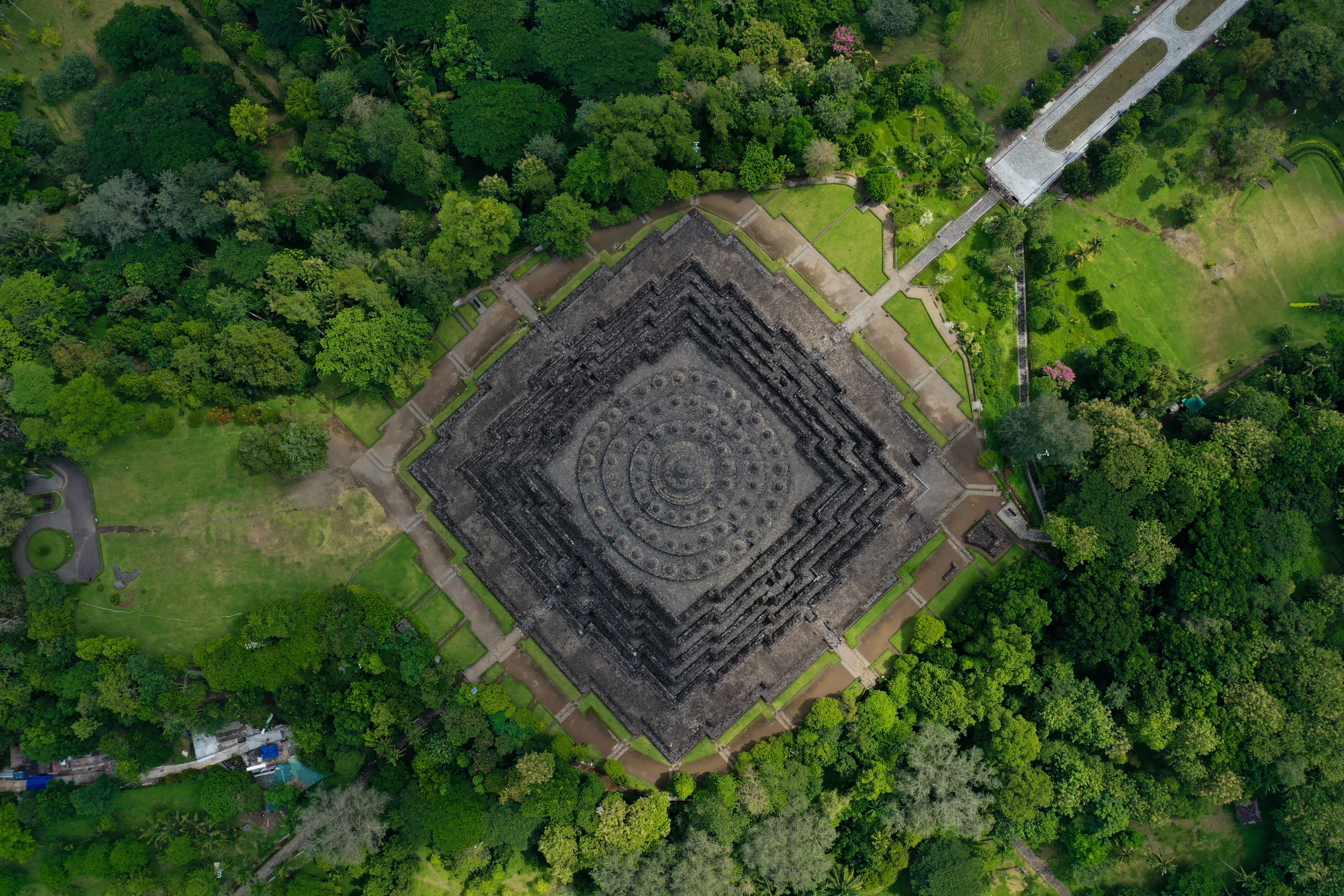
The structure takes the form of a stepped pyramid, blending Gupta-era Indian stupa forms with indigenous Javanese terracing and megalithic traditions. From its square base to its circular summit, Borobudur reflects the conceptual structure of the Buddhist universe—a diagram of samsāra (cyclical existence) and the path toward liberation.
At its core, Borobudur is an architectural embodiment of the bodhisattva path. It offers pilgrims a spatial experience of progression—from the world of desire and illusion, through the disciplined practices of form, to the formless realm of awakening.
The Journey Up: Pilgrimage as Ascension
Pilgrimage at Borobudur is an act of circumambulation and ascent. Traditionally, visitors enter from the eastern staircase and begin a clockwise walk around each level, slowly moving upward.
The monument is composed of three main zones:
- Kamadhatu (the realm of desire): Represented by the hidden base, this level symbolizes attachment and sensory indulgence. Its reliefs were covered soon after construction, possibly for structural or symbolic reasons.
- Rupadhatu (the realm of form): This middle section consists of four square terraces adorned with more than 1,300 bas-relief panels, depicting Jātaka tales, the Lalitavistara (the life of the Buddha), and scenes from daily life. Here, the pilgrim is invited to reflect on ethical conduct, causality, and discipline.
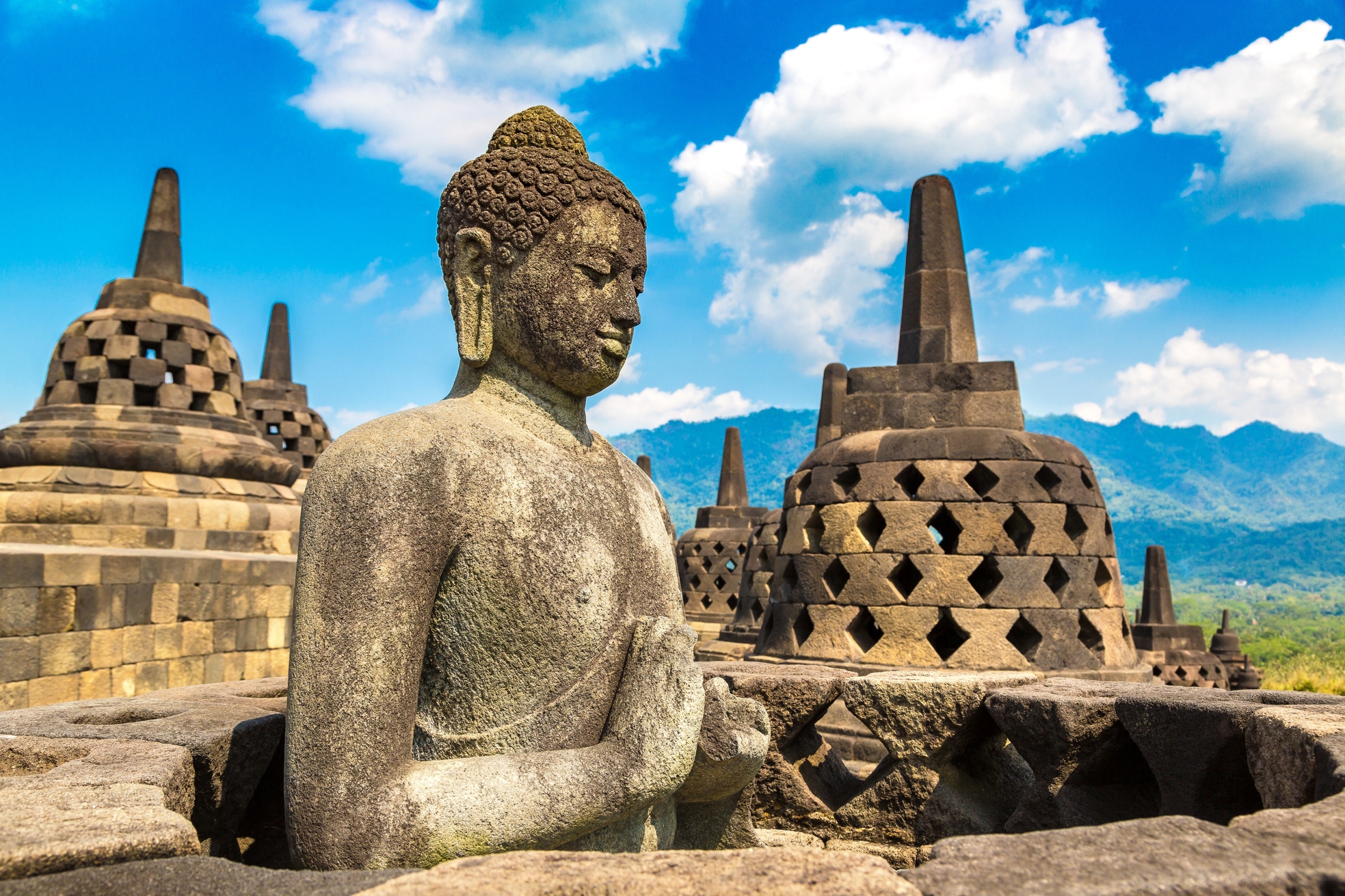
- Arupadhatu (the formless realm): The uppermost levels are composed of three circular terraces, each encircled by bell-shaped stupas containing seated Buddha statues. These forms are open and uncluttered, evoking emptiness and transcendence.
At the summit sits a large central stupa—plain, silent, and closed—interpreted by some as representing the inexpressible or the ultimate reality beyond form.
A Monument Without Inscriptions
One of Borobudur’s enigmas is its absence of dedicatory inscriptions or internal chambers. Unlike other South and Southeast Asian shrines, there is no known relic housed inside. Its purpose appears to be entirely symbolic and experiential, reinforcing the idea that the act of walking—physically and mentally—is the ritual.
This lack of conventional sanctity enhances Borobudur’s status as a pilgrimage of movement, where the sacred is not enclosed but embodied in space and action.
Rediscovery and Reinvention
Abandoned around the 14th century as Java shifted toward Islam and political centers moved east, Borobudur lay forgotten beneath volcanic ash and jungle for centuries. It was rediscovered in the early 19th century by Dutch colonial officials and later excavated and restored in phases.
In the 20th century, Borobudur became a secular icon of Indonesian heritage, included in schoolbooks, banknotes, and state ideology. In 1991, it was inscribed as a UNESCO World Heritage Site, attracting both Buddhist pilgrims and international tourists.
While most Javanese today do not identify as Buddhist, the site has seen revived ritual significance, especially during Vesak (Waisak), the annual celebration of the Buddha’s birth, enlightenment, and death. Pilgrims from Thailand, Myanmar, Sri Lanka, and beyond now gather for candlelit processions and meditative walks around the monument.
Practical Pilgrimage: Visiting Borobudur Today
Borobudur is located in Magelang, Central Java, about 40 kilometers from Yogyakarta, a major cultural hub with air and rail connections. The site is open year-round, though access to the upper levels may be restricted depending on preservation efforts.
Highlights include:
- Museum Karmawibhangga: Exhibiting the hidden base reliefs and early photographs of Borobudur’s restoration.
- Mendut and Pawon Temples: Two nearby temples historically linked to Borobudur’s ritual landscape.
- Vesak Festival: Held on the full moon in May, drawing thousands for a unified, multilingual expression of Buddhist unity.
Visitors should dress modestly and approach the monument with respect, especially during ritual events. Local guides trained in archaeology and religious studies can offer deeper insight into the monument’s symbolism and stories.
A Living Mandala
For modern pilgrims—religious or not—Borobudur offers a rare opportunity to walk a philosophy. Each level invites contemplation, each relief speaks across time. The site asks for presence, patience, and perspective.
As an act of pilgrimage, Borobudur is not about reaching a shrine. It is about ascending through meaning—an encounter with emptiness, not as void, but as clarity, spaciousness, and interconnection.
AI Transparency Notice
PilgriMaps uses artificial intelligence tools to assist in the research, drafting and translation of editorial content. All AI-assisted content is reviewed, edited and verified by our editorial team before publication. We contrast information against primary sources, specialist literature and on-the-ground knowledge to ensure accuracy, cultural sensitivity and editorial integrity.
AI is one tool among many in our workflow. The judgement, curation and responsibility for everything published on this platform remain entirely human.
Viator Media S.L. — in compliance with the EU Artificial Intelligence Act (Regulation EU 2024/1689).
This post is also available in: