The Cammino della Pace (Way of Peace) stretches over 300 kilometers from L’Aquila, a city often reshaped by earthquakes, to the Sanctuary of San Michele on Mount Gargano. It weaves through mountain villages, forests, and quiet plains. Yet beneath this calm surface lies a landscape marked by the violent ruptures of the 20th century.
In Abruzzo, seismic scars are visible in stone churches and rebuilt villages. But there are others, less evident: the traces of battles that turned the region into a theatre of war during the winter of 1943.
The Sangro Front
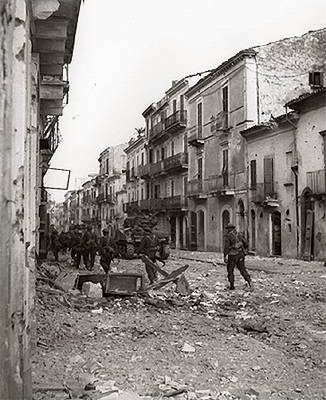
After Italy’s armistice in September 1943, the country split between German-occupied zones and the advancing Allies. The Wehrmacht fortified the Gustav Line to halt the Allied push toward Rome. In response, British General Bernard Montgomery was tasked with mounting an offensive in eastern Italy, both to breach this defensive barrier and to divert German forces from the impending landings at Anzio.
The Sangro River became a central obstacle. November rains swelled its waters, turning the area into a flooded quagmire. Under continuous shelling, Allied engineers constructed Bailey bridges while infantry units—British, Indian, New Zealander, and Canadian—advanced through deep mud and cold rain.
On 27 November 1943, the offensive began with a bombardment by nearly 700 guns. Coastal divisions moved on Fossacesia and San Vito Chietino; Indian brigades fought for Mozzagrogna; New Zealand troops advanced toward Castel Frentano. German defenders—infantry and elite paratroopers—counterattacked repeatedly. While military records label this a “minor battle,” veterans described unrelenting days of fear, mud, and exhaustion.
Tactical Victory, Strategic Debate
By 4 December, the Allies had forced a German withdrawal to the Moro River, gaining roughly 10 kilometers. The objective of engaging German troops was met. Yet, questions lingered. Critics of Montgomery’s strategy noted the decision to launch a frontal assault in poor terrain and weather. While not a deliberate bloodletting, it was a calculated risk—one that cost thousands of lives.
Only two weeks later, the town of Ortona saw one of the fiercest urban battles of the Italian campaign. From 20–28 December, Canadian troops fought house by house against German paratroopers. Tunnels, booby traps, and constant shelling devastated the historic center. The Battle of Ortona earned the region its grim moniker: “the Italian Stalingrad.”
Civilian Suffering
Beyond the front lines, civilians paid a steep price. German troops, implementing scorched-earth policies, razed villages and massacred inhabitants. In Pietransieri, on 21 November 1943, 125 civilians—men, women, and children—were executed. Similar atrocities followed in Lettopalena and Gessopalena, where entire communities were dynamited, and survivors took refuge in caves, enduring the winter in hunger and cold.
By the time liberation arrived, many villages had been reduced to rubble. Survivors returned to ruins. Stories from that winter—of families destroyed, of children hiding in freezing shelters—still echo in the region.
A Path of Memory
Today, the Cammino della Pace crosses these same landscapes. It passes Allied cemeteries, monuments to the partisan Brigata Maiella, and abandoned villages. Each site marks the enduring legacy of 1943.
Nature has reclaimed much of the terrain, but traces remain: reconstructed hamlets, silent graveyards, memorial plaques. Walking this route becomes an act of remembrance—for soldiers killed by orders made in distant headquarters, and for civilians caught in the war’s path.
The Cammino della Pace serves not as a romantic symbol, but as a reminder: peace is not static. It demands vigilance. Those who walk these valleys encounter more than scenery; they engage with a history written in mud, blood, and resilience.
AI Transparency Notice
PilgriMaps uses artificial intelligence tools to assist in the research, drafting and translation of editorial content. All AI-assisted content is reviewed, edited and verified by our editorial team before publication. We contrast information against primary sources, specialist literature and on-the-ground knowledge to ensure accuracy, cultural sensitivity and editorial integrity.
AI is one tool among many in our workflow. The judgement, curation and responsibility for everything published on this platform remain entirely human.
Viator Media S.L. — in compliance with the EU Artificial Intelligence Act (Regulation EU 2024/1689).
This post is also available in: