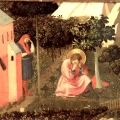
A woman walks alone across northern Spain. She carries a pack, moves at a pace that answers to no timetable, and learns to measure time differently: by the distance to the next village, by the tiredness in her legs, by an unexpected conversation with a stranger. This almost anecdotal image takes place between 2004 and 2005, on the Camino Francés.
The woman is Kim Nam Hee, a South Korean writer virtually unknown outside her country. She did not arrive on the Camino de Santiago as the representative of a tourism institution or as a specialist in European history. She arrived as a pilgrim. In 2006 she published an account of her experience as part of a collection of travel journals under the title A Woman’s Journey Alone.
What happened next was nothing short of revolutionary.
The numbers help measure the scale of the change. In 2004, the Pilgrim’s Office registered just 18 pilgrims from South Korea. Fifteen years later, in 2019, that figure had reached 8,224. The book sold, according to international sources, more than 50,000 copies — and has not, to date, been translated into other languages.
A catalyst
That leap cannot be attributed mechanically to a single book. It would be a simplification to make Kim Nam Hee the sole cause of a collective transformation. But various Galician, Jacobean, and journalistic sources consistently identify her book as one of the great catalysts of the Korean surge — a genuine cultural phenomenon.
The story has something paradoxical about it. The Camino de Santiago — a network of medieval routes crossing Spain toward Compostela — might have seemed remote to a Korean readership: geographically distant, culturally foreign, and tied to a religious tradition largely unfamiliar. And yet, within a few years, it had become a byword for interior journey, physical endurance, vital pause, and human encounter. Kim Nam Hee does not explain that phenomenon on her own, but she occupies a decisive place at its origin.
The key is that Kim Nam Hee did not present the Camino as a catalogue of monuments or a checklist of stages to complete. She presented it as a place where something can change. In later interviews, the author described how the Camino had made her more open, braver, and more generous. She also spoke of the stories of other pilgrims and of what the route seemed to whisper to her as she walked. The language is revealing: not that of a tourist visiting a destination, but of someone who listens while moving forward.
For many Korean readers, that voice offered an emotional translation of the Camino. The route ceased to be a difficult-to-decipher European tradition and became something recognizable: a solo crossing, a physical trial, an interval from ordinary life — something that connected essentially with Korean values and with the interior life.
From book to cultural galaxy
The popularity of the Camino did not remain within the world of books. In 2013, Kim Nam Hee took part in a Korean television programme centered on the experience of several pilgrims. Other audiovisual formats followed, including Shall We Walk Together, broadcast by JTBC in 2018 and featuring the musical group g.o.d. The Compostela route had become a recognizable setting within Korean popular culture.
This is not to say that all those programmes depended directly on Kim Nam Hee’s book. What they show, rather, is that the Camino had already acquired a stable place in the collective imagination. What began as an intimate narrative could now become a reality show, a variety programme, digital content, a university discussion, and a travel aspiration.
The phenomenon has left its mark within Korea itself. Some national hiking trails are now presented as Korean equivalents of the Camino de Santiago. The Jeju Olle Trail is frequently compared to the Spanish route, while the Dongseo Trail has at times been promoted with similar rhetoric. The comparison reveals that what travels from Galicia is not only an international destination. What travels is an idea: that walking for days can be a way of knowing a territory, but also of rebuilding one’s relationship with oneself and with others.
In recent years the Korean publishing market has confirmed that expansion. Since Kim Nam Hee, memoirs, practical guides, accounts of encounters, and poetic reflections on the Camino have all appeared. This is a sign of cultural maturity. The Camino no longer depends on a single voice or a single type of reader. There are those who seek logistical information, those who want to read stories of friendship, and those who find in the route a language for speaking about grief, uncertainty, exhaustion, or hope.
A society that needed to walk
The terrain, moreover, was fertile. South Korea is an urban, highly connected society marked by a strong culture of performance and achievement. In that context, the Camino could offer a different kind of time — not empty time, but slow time. Walking for weeks means renouncing, at least temporarily, the speed of daily life, the obsession with efficiency, and the obligation for every hour to carry visible utility.
Several studies of Korean travelers have identified precisely these dimensions: slowness, recollection, meditation, spirituality, friendship, and physical pain. The pilgrimage emerges as a complex experience in which the body matters as much as the mind. The kilometers are not a metaphor — they weigh on the feet, on the knees, and on the decision to continue each morning. But that exhaustion can acquire a different meaning when shared with other walkers, or when it becomes a tangible measure of one’s own effort.
This is why the Camino has found in Korea a resonance that goes well beyond tourism. For some, it is a journey of transition between stages of life. For others, a pause after a period of intense study or work. For many, it is a way of proving to themselves that it is still possible to keep moving without knowing exactly what awaits at the end of the day.
Perhaps this is why the influence of Kim Nam Hee remains so visible. Not because she explained everything the Camino means, but because she found a way to make it feel close. Her account did not promise automatic transformation or offer the route as an answer to every problem. It showed, instead, a woman moving forward alone — with doubt, fear, and tiredness — until she discovered that walking can also be a way of opening up.
Before the statistics, the television programmes, and the Korean trails that aspire to resemble Santiago, there was a pilgrim who came home and wrote about what she had lived. Thousands of Korean readers found in those pages something more than a story about Spain. They found the possibility of beginning their own camino.
AI Transparency Notice
PilgriMaps uses artificial intelligence tools to assist in the research, drafting and translation of editorial content. All AI-assisted content is reviewed, edited and verified by our editorial team before publication. We contrast information against primary sources, specialist literature and on-the-ground knowledge to ensure accuracy, cultural sensitivity and editorial integrity.
AI is one tool among many in our workflow. The judgement, curation and responsibility for everything published on this platform remain entirely human.
Viator Media S.L. — in compliance with the EU Artificial Intelligence Act (Regulation EU 2024/1689).
This post is also available in: