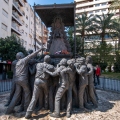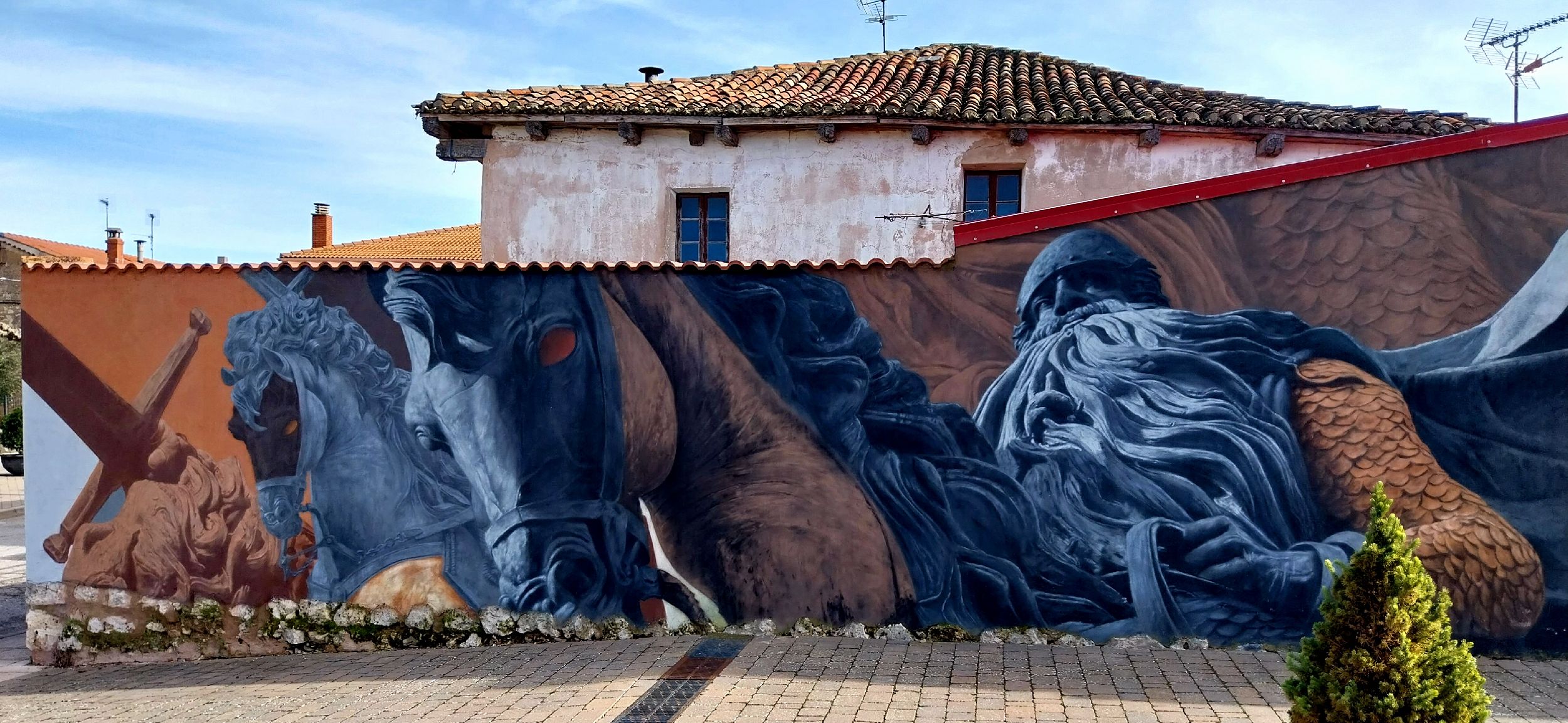
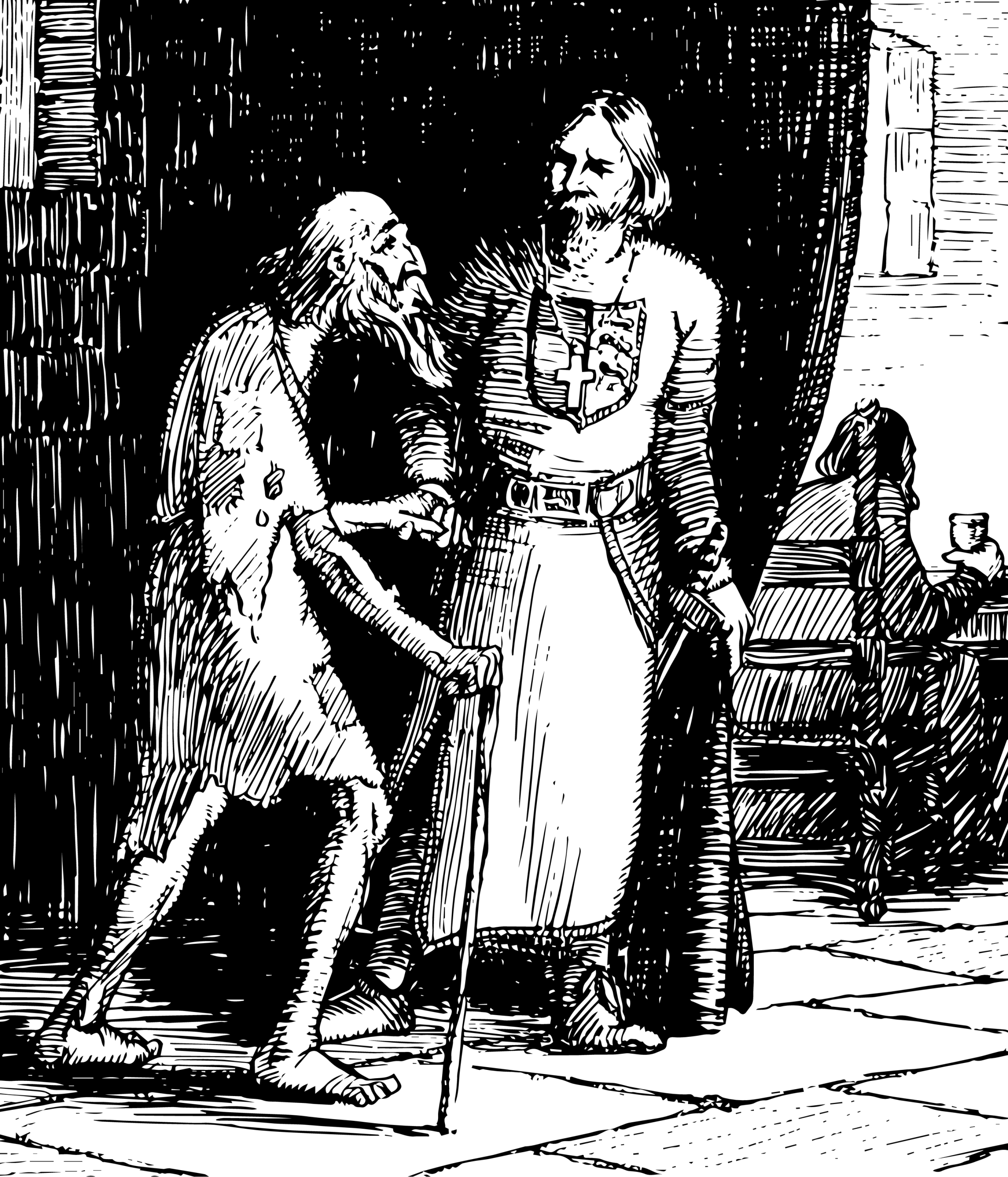
On a muddy road heading west, a knight dismounts to help a leper who has fallen into a bog. He lifts him up, hoists him into the saddle, shares his bowl with him, and when night falls, his blanket too. At dawn the sick man has vanished. A voice reveals that the man was Saint Lazarus, and predicts a destiny of victories that will outlast death itself.
He is on pilgrimage to the tomb of the Apostle James, at Compostela. The knight is Rodrigo Díaz de Vivar — El Cid, the great Spanish medieval hero who deserved to be brought to the cinema in 1961 played by Charlton Heston. The scene is famous. It is also, almost certainly, something that never happened. Which is precisely what makes it interesting.
The historical man
It is worth starting with the historical record, because it is less edifying and considerably more modern than the mask that was built over it. Rodrigo Díaz was born in Vivar, a village some ten kilometers from Burgos, around 1045. He grew up at the court of Ferdinand I, served as royal standard-bearer — armiger regis — to the king’s son Sancho II, and when Alfonso VI sent him into exile in 1081, he did what a lordless frontier warrior did: he sold his sword to whoever would pay. He fought for Christian kings and for Muslim emirs in Zaragoza. He conquered Valencia in 1094 and remained there until his death in 1099.
Even his name reveals this double allegiance. Cid comes from the Arabic sayyid, meaning “lord” — it was given to him by his Muslim adversaries. Campeador, “victor in battle,” was the recognition he received from Christians. His documentary existence is notarial in character: he appears as a witness in various texts, and in one of them his signature survives — ego Ruderico, “I, Rodrigo.” The historical Cid is a talented mercenary who survived in an Iberia where the line between cross and crescent was a frontier to be conquered, not a fixed boundary to be defended.
From this opaque and pragmatic man, Castilian culture fashioned a lay saint. The pilgrimage to Santiago is part of that polishing work.

Three figures, one name
Philology has long distinguished three figures who share the same name: the historical Cid, the literary Cid, and the legendary Cid. The first belongs to the archives. The second inhabits the Cantar de mio Cid, the epic poem whose sole poetic manuscript — the Códice de Vivar, now held at the Biblioteca Nacional de España — bears the copyist’s colophon of Per Abbat, dated May 1207 (the surviving copy is in fact a fourteenth-century transcription). The third Cid, the legendary one, lives in the Romancero, the great ballad tradition that continued inventing episodes for centuries.
It matters enormously to understand where our opening scene comes from. The Cantar narrates the years of exile and the reconquest of Valencia: there is no pilgrimage to Compostela anywhere in it. The encounter with the leper belongs instead to the cycle of the Cid’s “youth” narratives and to a celebrated ballad, Ya se parte don Rodrigo, que de Vivar se apellida. There, Rodrigo — on his way to Santiago — shares food and shelter with a gafo, a leper, out of pure Christian charity; the leper reveals himself as Saint Lazarus, prophet of the hero’s future glory. This is a hagiographic graft: an operation that transforms a warlord into something approaching a saint, retrofitting him with devotion, humility, and celestial blessing.
Specialist Camino sources are candid on the point: the placement of El Cid on the Jacobean route “is not confirmed” and is “the fruit of numerous Jacobean legends that arose after his death,” in which the hero defends pilgrims from Muslim attacks. The pilgrim Cid, in other words, did not precede his fame. He followed it.
Why the fiction worked
The question remains: why construct a pilgrim Cid, and why did the fiction take hold so effectively? The answer lies not in his biography but in geography and communication.
The Camino de Santiago, in the eleventh and twelfth centuries, was far more than a devotional road. It was the most heavily traveled artery of cultural transmission in Christian Europe: people, coins, relics, and above all stories moved along it. The Chanson de Roland traveled that road; the chivalric imagination that would shape the very idea of the hero spread along it. Marcelino Menéndez Pelayo noted as much: the pilgrimage to Compostela was decisive in disseminating epic legends. The Camino was not only a route — it was a mass medium, centuries before the printing press.
Operating within that same ideological circuit was Santiago Matamoros — the apostle transformed into a celestial knight who, according to the historically unsustainable legend of the Battle of Clavijo, descended from the sky to fight the Muslims. The holy warrior and the heroic warrior belonged to the same apparatus: that of the Reconquista, which required figures capable of fusing faith with the sword. To stitch El Cid to Santiago was to bring the most formidable Castilian fighter into the great sacred narrative of peninsular Christianity.
And then there is the geographical detail that closes the circle with almost suspicious elegance. Vivar, Rodrigo’s birthplace, sits beside the route of the Camino Francés as it passes through Burgos. He was buried at San Pedro de Cardeña, also within the orbit of the great road. The legend, in other words, traveled exactly the road that ran past his cradle. There was no need to imagine Rodrigo walking west: it was his story that walked — from pilgrim to pilgrim, from stage to stage. His tomb, in the Burgos Cathedral on the way to Santiago, can be also visited.

A road as infrastructure of meaning
A road determines which stories spread and which ones die, in precisely the way an algorithm today decides which news reaches us. El Cid did not need to make the pilgrimage: it was enough that the pilgrimage existed, and that his memory had been deposited beside it. The medium here literally manufactured the message. The legend of the leper is not evidence of Rodrigo’s sanctity — it is evidence of the power of a transmission network that converted warriors into saints as it carried them toward Compostela.
There is a lesson in this for anyone who builds narratives around places. The strongest destinations are those traveled by the greatest number of people willing to repeat the story. The Camino del Cid exists today as a real thing: over thirteen hundred kilometers of cultural itinerary retracing the territories of the exile. The pilgrim who walks it moves through a fiction that no document supports and that has nonetheless become more real than the archival truth.
Perhaps that is the question to carry on the road to Santiago. Does one become a pilgrim by walking, or because someone, centuries later, sets you walking inside a story? Rodrigo Díaz de Vivar never reached the tomb of the Apostle. And yet, along that road, he keeps arriving every day — carried not by his own feet, but by the road itself.
Sources: Cantar de mio Cid, Per Abbat manuscript, 1207 (Códice de Vivar, Biblioteca Nacional de España); Ramón Menéndez Pidal, La España del Cid; ballad “Ya se parte don Rodrigo, que de Vivar se apellida” (Romancero del Cid); historical documentation on Rodrigo Díaz de Vivar (c. 1045–1099); M. Menéndez Pelayo on the Camino’s role in disseminating epic legends; the tradition of Santiago Matamoros and the legend of Clavijo.
AI Transparency Notice
PilgriMaps uses artificial intelligence tools to assist in the research, drafting and translation of editorial content. All AI-assisted content is reviewed, edited and verified by our editorial team before publication. We contrast information against primary sources, specialist literature and on-the-ground knowledge to ensure accuracy, cultural sensitivity and editorial integrity.
AI is one tool among many in our workflow. The judgement, curation and responsibility for everything published on this platform remain entirely human.
Viator Media S.L. — in compliance with the EU Artificial Intelligence Act (Regulation EU 2024/1689).
This post is also available in: