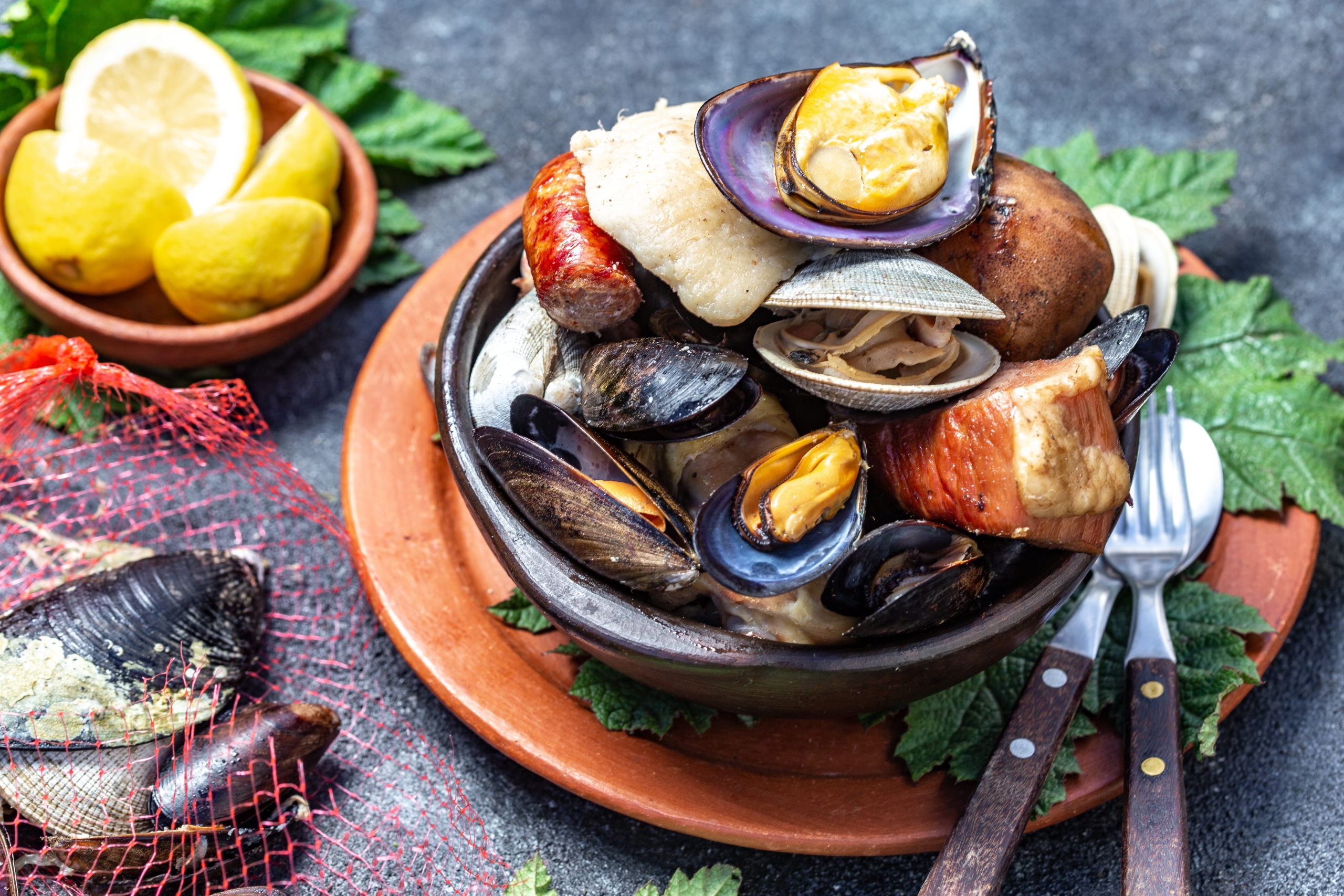
In Chiloé, the oldest cooking technique in Chile requires a pit, red-hot stones, giant leaves — and at least five people. That last ingredient is the one that matters.
The moment everyone waits for comes after two or three hours, and it lasts about ten seconds.
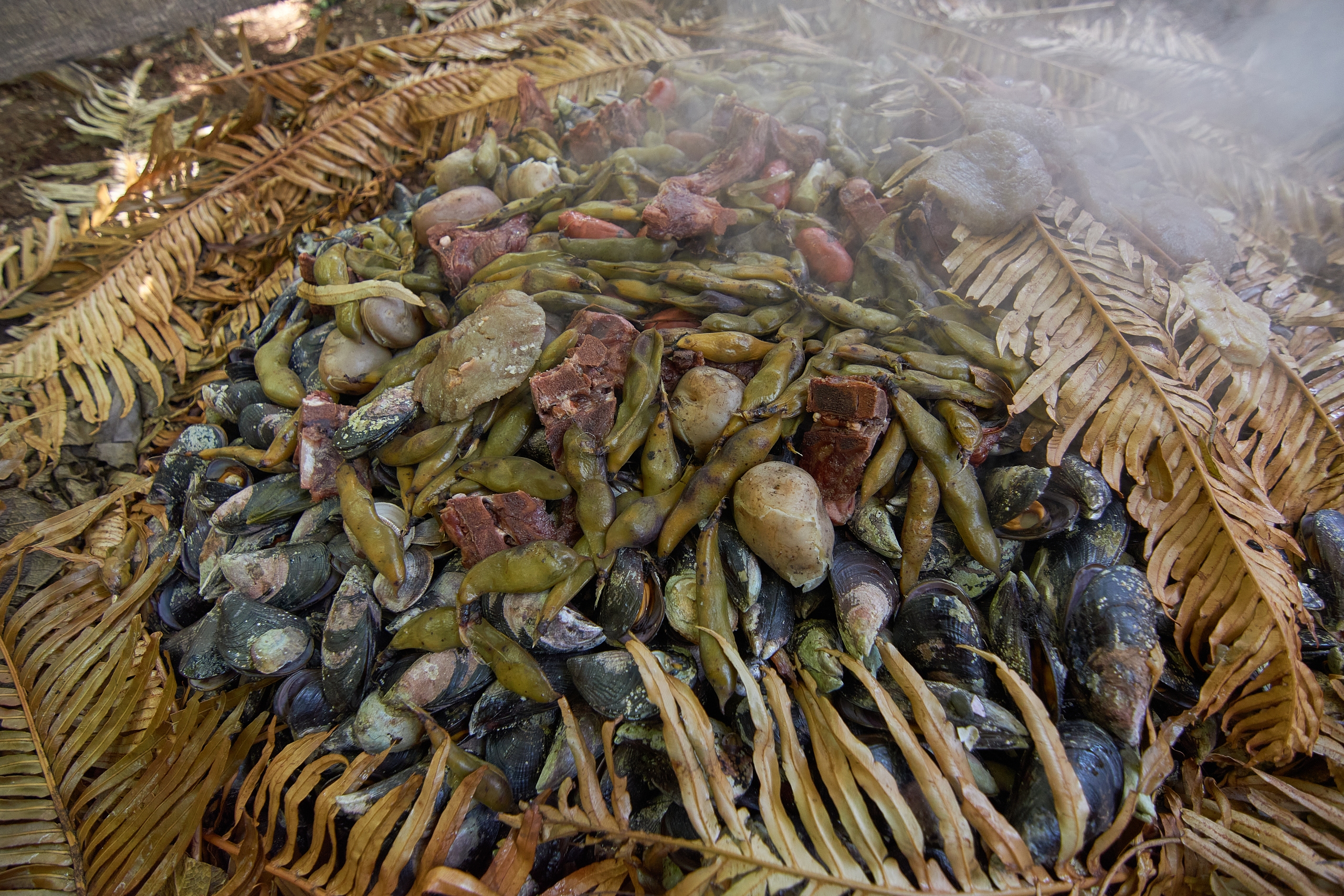
Someone lifts the turf. Then the layer of earth, then the great ribbed leaves beneath it — and a column of steam goes up with a force that makes people step back, carrying the smell of shellfish, smoked pork and wet vegetation. For a few seconds nothing is visible at all.
When it clears, there is a pit in the ground filled with food. This is curanto al hoyo, the signature dish of the Chiloé archipelago in southern Chile, and it is among the oldest continuously practised cooking techniques anywhere in the Americas.
Stones, Leaves and Layers
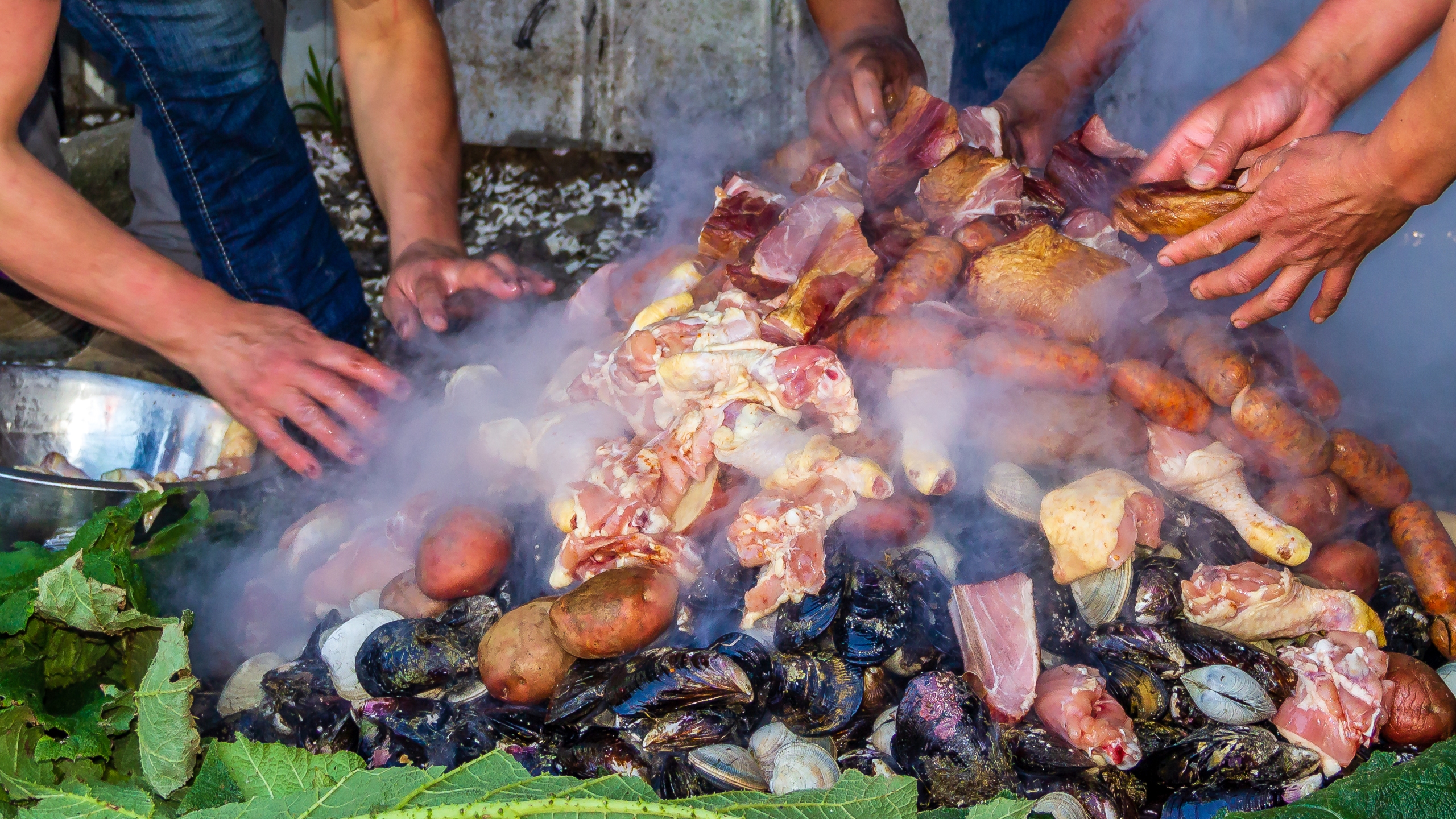
The method is unchanged in its essentials. A pit is dug, roughly half a metre deep and over a metre across. Firewood goes in, and on top of it stones of a regular size. The fire is lit and burns until the stones are nearly red, at which point the charred wood and the remains of the embers are carefully removed. Then the layering begins, and the order matters.
The shellfish go directly onto the stones: picorocos — the giant Chilean barnacles that look like something from a cave wall — then dried mussels, fresh mussels, clams. Over them a layer of nalca or pangue leaves, the enormous leaves of Chilean rhubarb, which seal in the steam.
On top of the leaves go the meats: pork ribs, longanizas, smoked sausages, chicken, potatoes, broad bean pods. Another layer of nalca. And finally, on the uppermost level where the heat is gentlest, the milcaos and chapaleles.
Everything is covered with more leaves and sealed with tepes — turf cut from the ground — or simply with the earth from the pit, so that no steam escapes. What happens underneath is neither boiling nor roasting. The shellfish open and release their liquor; that liquor becomes steam; the steam cooks everything above it. The archipelago has been running a pressure cooker made of earth for a very long time.
The Word and the Age
The name comes from Mapudungun. Kurantu means a stony place, a place of stones — and the word now does triple duty, naming the technique, the pit itself and the finished dish. The age is where it becomes genuinely remarkable, and where a careful writer has to slow down.
The figure most often cited comes from the archaeological site of Puente Quilo, on the northern coast of Chiloé, which confirms the practice at around 6,000 years ago. Other sources push the claim much further, to more than 11,000 years, on the Lacuy Peninsula near Ancud.
A sensible Chilean source puts the matter well: these are estimates from archaeology, not an invention date. The higher figures may be reaching toward the very early occupation of southern Chile — Monte Verde, on the mainland, is one of the oldest human sites in the Americas — rather than toward curanto specifically.
What is not in dispute is that the Puente Quilo evidence is solid, and that archaeologists of the region read the curanto as the strongest demonstration that pre-Hispanic Chiloé and present-day Chiloé share the same kitchen.
Six thousand years is enough. You do not need to inflate it. The ingredients tell their own history of the islands. The technique is generally attributed to the Chono people, with new ingredients added as the Huilliche and then the Spanish arrived — until it became the curanto known today. The shellfish and the technique are indigenous. The pork and sausages are European. The potato, of course, is Chilote to its core: the archipelago is one of the world centres of potato diversity.
The Minga
Here is the part that matters, and it is the reason curanto is more than a recipe. You cannot make one by yourself. The work required demands the participation of around five people or more: digging the pit, gathering firewood, selecting the stones, collecting the nalca leaves, cleaning kilos of shellfish, grating potatoes for the milcaos. Then two or three hours of waiting, which is itself the social event.
In Chiloé, this connects to an institution: the minga. The minga is collective reciprocal labour — the community turning out to help one household with a task too big for a family, in the expectation that the household will turn out in its turn. Its most famous form is the tiradura de casa, in which an entire wooden house is lifted onto skids and dragged by teams of oxen to a new site, or floated across the water to another island.
And the payment is the curanto.
The family whose house has just been moved feeds everyone who moved it. Which is why the dish is scaled the way it is: the quantities make no sense for a household and perfect sense for a workforce.
Readers of our piece on the wooden churches of Chiloé will recognise the pattern immediately. Those sixteen UNESCO-listed churches were built, and after the 1919 fire at Caguach rebuilt, by exactly this kind of collective labour. The same social machinery that produced the churches produced the dish that fed the people who built them.
Milcao and Chapalele
Two preparations deserve naming, because visitors routinely confuse them. Milcao is made from raw grated potato combined with cooked potato, pressed into flat cakes by hand, and very often enriched with chicharrones — pork crackling worked into the dough. It is dense, slightly elastic, and it is the thing people argue about. Chapalele is made from cooked potato and flour, formed into a thicker dumpling. Milder, softer, less contentious.
Both steam in the upper layer of the curanto. Both also exist independently of it, fried or baked, throughout the archipelago.
The Pot Version, and What It Costs
There is a practical variant. Curanto en olla, known in central Chile as pulmay, assembles the same ingredients in a large pot over a stove. It is good. Restaurants across southern Chile serve it, and it is what you will usually be offered outside the archipelago.
But something specific is lost, and it is worth being clear about what. Not just the smoke and the earth, though those are real. What goes is the pit, the waiting, and the number of hands. Curanto en olla can be made by one person in a kitchen. The original cannot be made by one person at all.
That is the whole point of the dish, and it is the part a pot cannot reproduce.
A Parallel Across the Pacific
Anyone who has read about the Māori hāngī will have been reading this article with a growing sense of recognition. A pit, stones heated in a fire, food in layers, leaves to seal the steam, hours of waiting, a community doing the work and then eating together.
The resemblance is real and the temptation to link them should be resisted. Earth ovens appear independently across the Pacific, in Polynesia, in Melanesia, among Indigenous peoples of North America, and in the far south of the Americas. They are a convergent solution — what you build when you have stones, fuel, large leaves and more food than a household fire can handle.
What travels between Chiloé and Aotearoa is not a technique but a conclusion: that the best way to cook for many people is to put the fire in the ground, and that the hours it takes are not a cost but the reason to do it.
Where to Eat It
Curanto al hoyo is not restaurant food in the ordinary sense, because the pit has to be dug and the stones heated for a group. In the archipelago, the surest routes are village festivals and the fiestas costumbristas that run through the southern summer, from roughly January to March, in communities across the Isla Grande and the smaller islands. Several places — Dalcahue, Chonchi, Quemchi, Ancud and the islands of Quinchao and Mechuque among them — hold events where curanto is prepared for visitors and locals together.
Some rural operators and island households will also prepare one for a group with notice, typically a day or more. Ask locally rather than booking in advance from abroad; in Chiloé this is still arranged through people rather than platforms.
Outside the archipelago, expect pulmay, and enjoy it for what it is.
Under the Turf
When the steam clears and the food is lifted out onto platters, the thing that strikes you is not the quantity, though the quantity is considerable. It is that everyone standing around the pit helped make it. The person who dug, the person who chose the stones, the woman who grated potatoes for two hours, the child sent to cut nalca leaves. Nobody arrived to a prepared meal.
Six thousand years ago, on these same shores, somebody worked out that hot stones under wet leaves will cook anything you put between them. What they also worked out, and what Chiloé has not forgotten, is that a method requiring many hands produces something more durable than dinner. The churches of Chiloé were raised by the same arrangement. So, for that matter, were the islands’ communities. To really enjoy this dish, you just have to help.
AI Transparency Notice
PilgriMaps uses artificial intelligence tools to assist in the research, drafting and translation of editorial content. All AI-assisted content is reviewed, edited and verified by our editorial team before publication. We contrast information against primary sources, specialist literature and on-the-ground knowledge to ensure accuracy, cultural sensitivity and editorial integrity.
AI is one tool among many in our workflow. The judgement, curation and responsibility for everything published on this platform remain entirely human.
Viator Media S.L. — in compliance with the EU Artificial Intelligence Act (Regulation EU 2024/1689).
This post is also available in: