Try to remember the last time you felt truly free. In all likelihood you were not still. You were moving, somewhere, and something unusual was happening in your head: the usual hum of worries had quieted, and for a stretch you were thinking with a clarity that never comes at home or at the office, in front of a desk. This is a phenomenon that can now be observed inside the skull — and it explains why so many people return from a pilgrimage repeating the most overused and most sincere phrase in the pilgrim’s vocabulary: “I found myself.”
The key word, surprisingly, is not freedom. It is rumination: that circular, stubborn mode of thinking in which the mind returns endlessly to the same negative thoughts, the same grievance, the same mistake, without ever untying the knot. It is one of the primary risk factors for depression and anxiety. And walking in nature, it turns out, is one of its most effective antidotes.
Ninety minutes that switch off a circuit
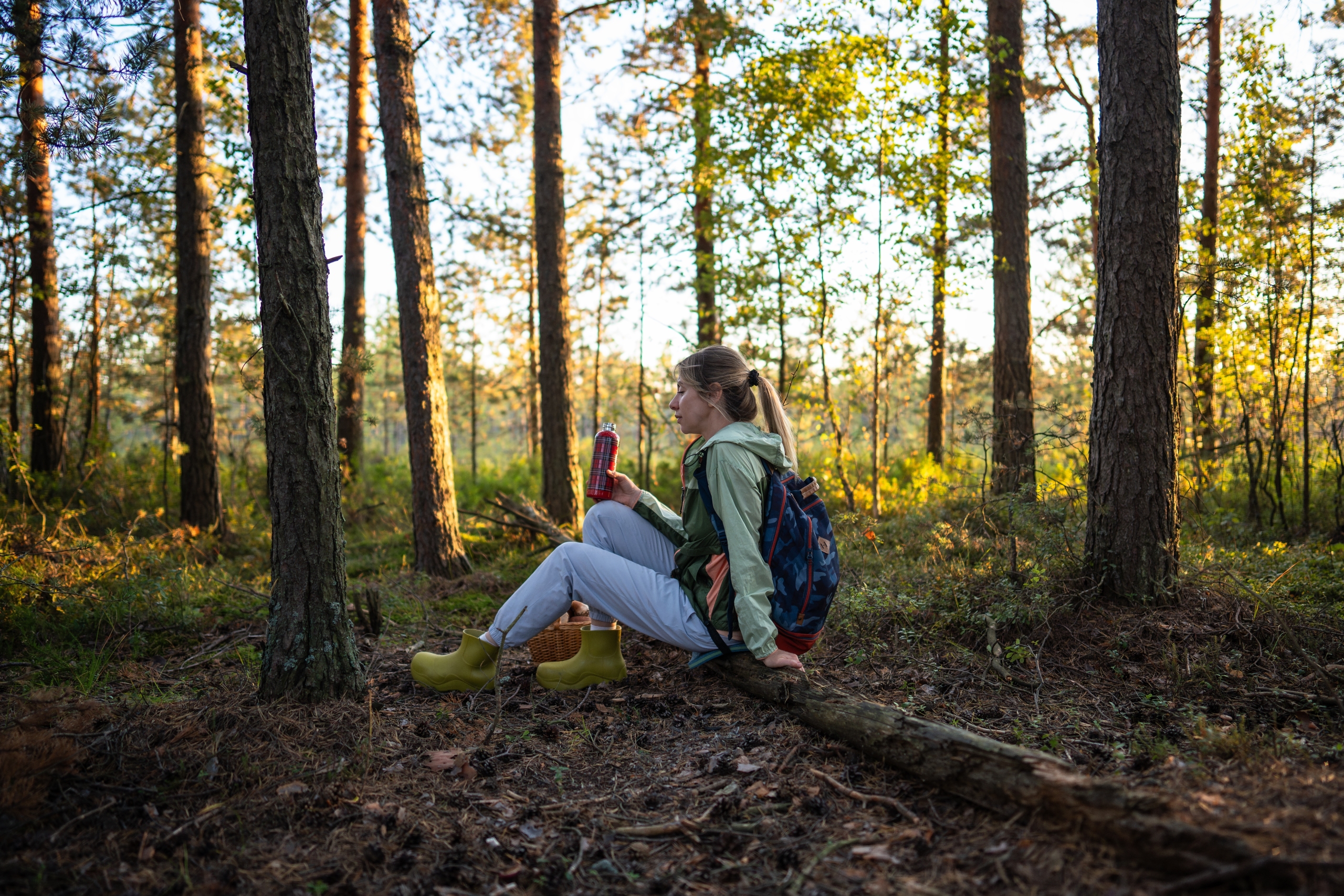
In 2015, a team of Stanford researchers led by Gregory Bratman conducted an elegant experiment. They took healthy individuals and sent them walking for ninety minutes: half through a natural environment, half along a busy urban road. Before and after, they measured two things: how much participants were ruminating, via questionnaire, and the activity of a specific brain region — the subgenual prefrontal cortex, an area that activates when we turn painfully inward. Those who had walked in nature returned with less rumination and lower activity in that region. Those who had walked in the city showed no change (Bratman et al., PNAS, 2015).
The nature and duration of the physical exercise was identical for both groups. What made the difference was a single element: those who walked among greenery were able to genuinely relax, to loosen the grip of rumination, to put it on pause. And that is precisely the condition into which a country path immerses the pilgrim for hours, day after day. The Camino is not a metaphor for liberation. It is, literally, a prolonged neurological intervention on a brain that has been tormenting itself.
The attention that recharges
There is a second, complementary mechanism. The psychologists Rachel and Stephen Kaplan described in the 1980s what they called Attention Restoration Theory. Urban and professional life imposes on us a “directed” attention — effortful, demanding continuous effort to ignore distractions and remain focused: a resource that depletes, like a muscle. Nature calls forth a different kind of attention — “soft,” effortlessly captured by a river, the wind through trees, the profile of a hill. While that soft attention is at work, the faculty of directed attention rests and recharges. After hours of walking, the mind is not emptied. It is cleared.
These two processes together explain an experience that almost every pilgrim describes. In the first days the head is still full: deadlines, unfinished conversations, resentments. Then, around the third or fourth day, something gives. The internal noise drops, and in the space that opens, deeper thoughts surface — decisions postponed for years, a clarity about oneself that ordinary life was suppressing. It is not the path that brings answers. It is that the path — by lowering rumination and recharging attention — frees the mind sufficiently for the answers that were already there to finally emerge.
Forest bathing and pilgrimage: When the forest becomes a sanctuary
The distance that returns us to ourselves
There is even a form of freedom that has to do with point of view. Psychology speaks of self-distancing: when we manage to look at our problems from a certain distance, as though they were happening to someone else, we process them better and suffer from them less. Walking physically puts distance between us and our lives: every kilometer moves us further from the house, the office, the people with whom the conflict became stuck. And that spatial distance becomes, internally, psychological distance. From far away, the issue that seemed enormous at home regains its proportions — not through any magic of place, but through the geometry of the mind.
The Romans expressed it in two words: solvitur ambulando — it is solved by walking — and they meant it in the most literal sense: certain things are only understood while the body is in motion. They were right without being able to prove it. Today we can. And it is worth noting that none of this requires the Camino de Santiago: ninety minutes in a park, according to Bratman’s data, are already sufficient to move the needle. Pilgrimage does not invent the mechanism. It concentrates and prolongs it until it becomes transformative.
The oldest technology of the mind
It is no coincidence that philosophy has always walked. Aristotle taught while strolling, and his students were called “Peripatetics” — those who go around — for that reason. Jean-Jacques Rousseau confessed that he could not think while standing still, and entrusted his last writings to the Reveries of a Solitary Walker. Friedrich Nietzsche, who walked for hours on the heights of Sils-Maria, came to distrust every idea conceived sitting down.
For centuries this was the intuition of artists and thinkers — a productive superstition without explanation. Neuroscience has done nothing more than give names to the circuits those people felt igniting: what they called the inspiration of the step, we now measure as rumination decreasing and attention recharging. The freedom of walking is not a discovery of contemporary wellness. It is one of the oldest technologies of the mind, rediscovered each time by those who have the fortune — or the necessity — to set out again.
One subtlety, however, deserves honesty. “Finding oneself” does not mean becoming someone else. It means, more often, temporarily ceasing to be the harried version of oneself that rumination produces, and returning to the one that was underneath. The freedom of the path adds nothing. It subtracts. It subtracts the noise — and what remains was already us.
One question remains, and I leave it to those who walk and to those who do not walk yet. If finding ourselves requires only that we lower the volume of our thoughts, and lowering that volume requires only that we move our bodies through greenery — why have we built lives in which we sit more and more, still, indoors, in front of screens that turn that volume up instead of off?
Sources: G. N. Bratman, J. P. Hamilton, K. S. Hahn, G. C. Daily, and J. J. Gross, “Nature Experience Reduces Rumination and Subgenual Prefrontal Cortex Activation,” PNAS 112(28), 2015; R. Kaplan and S. Kaplan, The Experience of Nature: A Psychological Perspective, 1989 (Attention Restoration Theory); literature on self-distancing and emotional regulation (E. Kross and O. Ayduk).
AI Transparency Notice
PilgriMaps uses artificial intelligence tools to assist in the research, drafting and translation of editorial content. All AI-assisted content is reviewed, edited and verified by our editorial team before publication. We contrast information against primary sources, specialist literature and on-the-ground knowledge to ensure accuracy, cultural sensitivity and editorial integrity.
AI is one tool among many in our workflow. The judgement, curation and responsibility for everything published on this platform remain entirely human.
Viator Media S.L. — in compliance with the EU Artificial Intelligence Act (Regulation EU 2024/1689).
This post is also available in: