Japanese shinrin-yoku meets older traditions of sacred woods: a new form of pilgrimage is taking shape in forests around the world
In the Akasawa Forest, in the mountains of Nagano Prefecture, century-old cypresses rise toward the sky like the columns of a green cathedral. The air is scented with resin. The silence is broken only by the sound of wind moving through the branches. It was here, in 1982, that Japan’s Ministry of Agriculture, Forestry and Fisheries officially recognized an older practice and gave it a new name: shinrin-yoku, literally “forest bathing.”
It is not a walk. It is not a hike. It is a sensory pilgrimage in which the destination is not a sanctuary built by human hands, but the forest itself.
The science of trees as agents of restoration
Dr. Qing Li, an immunologist at Nippon Medical School in Tokyo and author of Forest Bathing: How Trees Can Help You Find Health and Happiness, has devoted decades to the scientific study of the effects of forests on human health. The findings are consistent: two hours in a forest can significantly reduce cortisol, lower blood pressure, and increase the activity of natural killer cells, which help the body respond to infection and disease. These effects are not a matter of suggestion. They are documented physiological changes.
Part of the explanation lies in phytoncides, volatile compounds released by trees as part of their natural defense systems. When inhaled, they appear to produce measurable effects in the human body. As Li has argued, forest bathing lowers stress hormones such as cortisol and adrenaline, suppresses the sympathetic “fight or flight” response, and supports the parasympathetic system associated with rest and recovery.
A 2024 scoping review published in Global Advances in Integrative Medicine and Health surveyed international research from the previous five years and confirmed beneficial effects on stress, anxiety, depression, sleep quality, and immune function. In some countries, time in nature is increasingly treated as a legitimate therapeutic recommendation, with doctors prescribing specific durations of exposure much as they prescribe medication.
Walking barefoot: Well-being and the rediscovery of an ancient practice
Sacred woods: sanctuaries without walls
The Japanese formulation is relatively recent, but the underlying intuition is far older. In India, there are between 100,000 and 150,000 sacred groves—known by names such as devrai in Maharashtra, kavu in Kerala, and sarna in Adivasi regions—where cutting even a branch has long been taboo. In Japan, chinju no mori, the guardian forests associated with Shinto shrines, surround more than 100,000 sacred sites and protect over 100,000 hectares of woodland. In Ethiopia, the forests surrounding Orthodox churches are now among the last remaining tree cover in parts of Amhara, green islands in heavily deforested landscapes.
These sacred forests form what some researchers have described as a shadow network of conservation, protecting ecosystems in ways that legal structures alone often could not. In many cases, cultural restriction proved more effective than formal enforcement. Today, as the therapeutic value of forests is being reexamined, these older traditions acquire renewed ecological and cultural relevance.
How forest pilgrimage is practiced
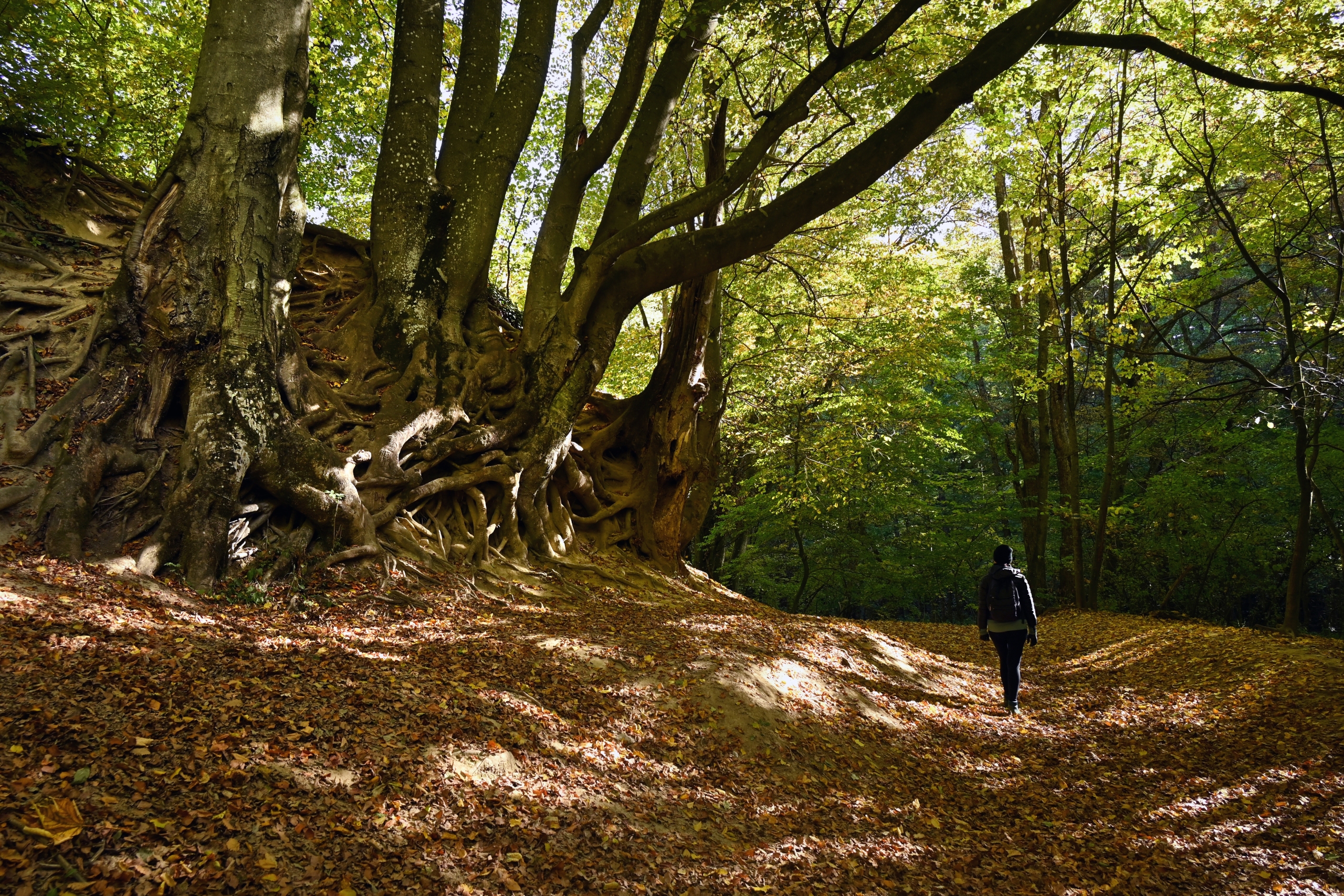
Shinrin-yoku is not a form of endurance walking. Its purpose is neither distance nor elevation. It asks for a slower mode of attention, almost to the point of stillness, and invites the forest to be perceived through all five senses: the green of leaves in filtered light, the scent of resin and moss, the sound of wind through branches, the roughness of bark under the hand, the taste of cool, damp air.
The Association of Nature and Forest Therapy, founded in the United States in dialogue with Japanese practice, trains certified guides who lead forest walks lasting two to three hours. Conversation is limited. Movement is slow. There are frequent pauses. Participants may be invited to touch trees, lie on the ground, or attend to details usually ignored. At the end, it is common to share tea prepared with local plants. The ritual is simple, but for many, its effect is substantial.
Destinations for forest pilgrimage
In Japan, Akasawa remains the symbolic birthplace of the movement, with trails designed specifically for forest therapy and hinoki cypresses more than three centuries old. The Kumano Kodo, a UNESCO-listed pilgrimage route, passes through forests of ancient cedar long regarded as sacred in Shinto contexts. Some of these trees provide timber for the cyclical rebuilding of the Ise Shrine, a ritual repeated every twenty years for more than 1,300 years.
In Germany, the Black Forest includes routes designated for Waldbaden, the German adaptation of forest bathing. In California, the ancient redwoods of Muir Woods hold deep cultural significance for Indigenous communities of the region. In India, the kavu of Kerala preserve fragments of rainforest amid plantation landscapes. In Scotland, the Caledonian Forest shelters Scots pines whose lineage stretches back to the end of the last Ice Age.
Yet no single geography has a monopoly on this experience. Any forest can become a sanctuary. Even urban parks, where trees are younger and more constrained, can support a form of forest pilgrimage if approached with intention.
Sacred trees and the presence held in bark and age
In Shinto traditions, trees that have lived beyond a century may be understood as inhabited by a spirit known as kodama. They are sometimes marked with sacred ropes, or shimenawa, and treated as the dwelling places of kami, the spiritual presences associated with the natural world. Such practices are not reducible to superstition. They express recognition: when a tree has stood longer than any individual life, when its roots have held the same ground for centuries, it calls forth a particular kind of attention.
That reverence appears across cultures. The Bodhi tree at Bodh Gaya, under which Siddhartha Gautama is said to have attained awakening, remains a major site of pilgrimage. In Celtic traditions, oaks held ceremonial and symbolic importance. In parts of North America, giant sequoias were regarded with reverence by Indigenous communities. In Nigeria, the Osun Sacred Grove, now a UNESCO World Heritage Site, has long been associated with ritual life and pilgrimage.
What emerges across these examples is a form of the sacred that does not depend on doctrine. It is rooted instead in duration, scale, and relationship.
Returning to the first cathedral
Before stone temples, there were sacred woods. Before built altars, there were trees. Forest pilgrimage is not a recent spiritual trend so much as a return to older patterns in human experience. As scholars have noted, the idea behind shinrin-yoku—that time among trees is life-giving—would have been immediately recognizable in earlier societies, even if expressed in different terms.
At a time when forests continue to disappear at a rate of millions of hectares each year, walking among trees as pilgrims may be one of the most quietly radical acts available to us. It offers restoration not only for those who enter the forest, but also a renewed sense of responsibility toward the living systems that sustain human life.
AI Transparency Notice
PilgriMaps uses artificial intelligence tools to assist in the research, drafting and translation of editorial content. All AI-assisted content is reviewed, edited and verified by our editorial team before publication. We contrast information against primary sources, specialist literature and on-the-ground knowledge to ensure accuracy, cultural sensitivity and editorial integrity.
AI is one tool among many in our workflow. The judgement, curation and responsibility for everything published on this platform remain entirely human.
Viator Media S.L. — in compliance with the EU Artificial Intelligence Act (Regulation EU 2024/1689).
This post is also available in: