


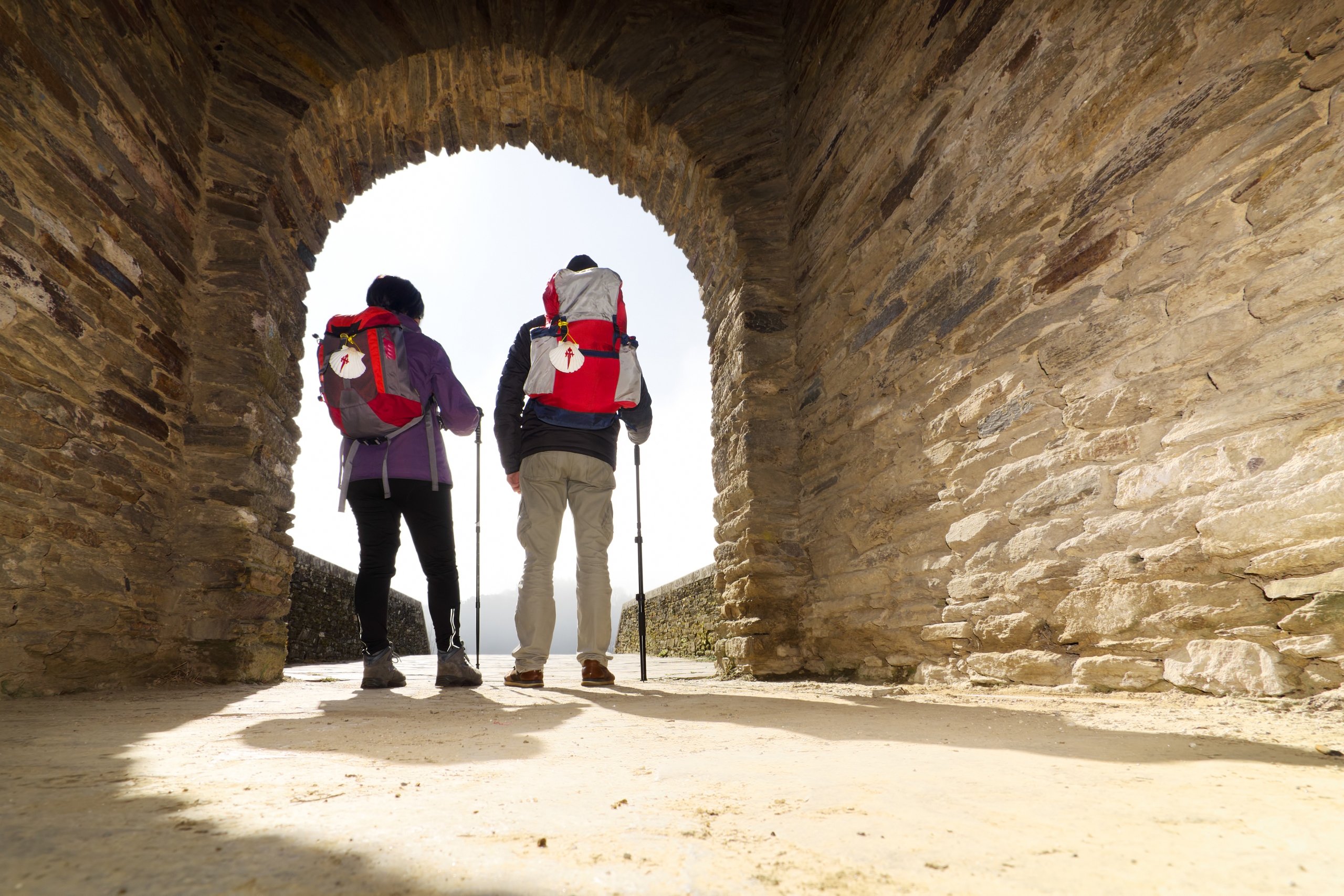
There comes a moment, somewhere along the world’s winding paths, when a pilgrim realizes the journey will never truly end. Not upon reaching the long-awaited destination, nor when the worn backpack is finally hung in a closet—but when that familiar threshold at home, crossed a thousand times without notice, suddenly reveals the same mystery as the cathedral or temple reached after days of walking.
The question that haunts those who return from pilgrimage is not “What did I see?” but “Who have I become?”—and above all, “How can I keep this from fading?” For anthropologists and psychologists alike, the return is the most delicate phase of the journey. It is the moment when transformation risks evaporating like morning mist, consumed by the routine of everyday life.
The threshold syndrome
Scholars of pilgrimage describe this passage as one of separation and subsequent reintegration. Along the way, the pilgrim temporarily leaves behind social roles and daily habits, adopting a new identity—that of the wanderer. The anthropologist Victor Turner called this state liminality, from the Latin limen, meaning “threshold”: an in-between condition where a person no longer belongs to the world they left but has not yet entered the one ahead.
During pilgrimage, this liminal zone becomes a place of extraordinary creativity. Turner wrote that “the essence of liminality lies in the breakdown of culture into its basic components, followed by their free or playful recombination.” In that space, the deepest insights often arise. Days of walking strip away certainties and reveal new angles from which to see both the world and oneself.
Pilgrimage becomes a kind of silent therapy, a mental reset where problems that once seemed insurmountable gradually lose weight with every step. Psychologists describe this as a symbolic yet real act: everyday space dissolves, allowing hidden potentials to surface, much like in psychotherapy.
But what happens when we cross the threshold home again?
The alchemy of the everyday
Neuroscience has shown that long-distance walking physically reshapes the brain: it increases white matter in regions most vulnerable to aging, improves episodic memory, and strengthens cognitive function. The brain that returns from the road is not only more efficient—it’s more flexible, more open to change.
Psychologist Mihály Csíkszentmihályi defined flow as that state of complete absorption when one is fully immersed in an activity, losing all sense of time and self. Pilgrimage is one of the most powerful gateways to that state. The challenge is learning to carry that flow into everyday life.
This doesn’t mean replicating the pilgrimage itself—it would be impossible to live perpetually in liminality—but integrating its lessons into ordinary existence. Pilgrimage suspends normal space and time, allowing the sacred to emerge. The task, then, is to bring that sacredness home through small, living symbols that let the spirit of the journey permeate daily routines.
Rituals of reconnection
How does this translate in practice? The examples come from those who’ve managed to do it. Some who walked the Camino de Santiago now treat their commute to work as a brief walking meditation. Others approach the simple act of making morning coffee as a sacred ritual, worthy of the same care once given to lighting a candle in a country chapel.
The detachment learned on the road—the discovery that one can live without so many “necessities”—becomes a practice of daily awareness. One doesn’t need to walk barefoot, but can choose each day to let go of something superfluous, creating spaces of fertile emptiness where new thoughts can grow.
The companionship found along the way—that rare sense of shared humanity and interdependence—can be cultivated in urban life through small gestures of openness: greeting a stranger, chatting with the barista, choosing to see the unfamiliar not as a threat but as a potential fellow traveler.
The map of return
Csíkszentmihályi taught that mastery of one’s consciousness begins with deliberate intention: those who can focus their attention, filter distractions, and stay engaged long enough will find satisfaction even in life’s simplest tasks.
The key is to build a map of return—not a geographical one, but an existential one. This map is drawn with questions: Which moments on the road made me feel most alive? When did I experience that unique balance of challenge and grace that creates flow? How can I recreate those conditions in my everyday routine?
Wonder itself—the attentive pace that turns the pilgrim from a consumer into a contemplative—can become a daily practice. Slow down. Look closely at the architecture of your neighborhood, the faces on the subway, the sky above the city. The world doesn’t change—our gaze does.
The body remembers
The body’s involvement is essential to awaken those flashes of vitality that make life richer. Pilgrimage teaches this through fatigue: blisters, sore muscles, exhaustion that turns, finally, into lightness. The body becomes the teacher—and this is a lesson worth preserving.
Integrating the path into daily life means making room for movement. Not necessarily more pilgrimages, but mindful walking. Research suggests that moderate aerobic exercise twice a week—such as brisk walking—helps keep the mind sharp and supports memory, especially for those at risk of cognitive decline. It’s not just physical health—it’s soul maintenance.
Some pilgrims keep walking every morning before dawn, seeking the same contemplative silence they knew on the road. Others spend Saturdays exploring their own cities on foot, discovering unknown corners as if each were a sacred stop along an invisible route.
The permanent threshold
Here lies the paradox: returning home should not mark an ending, but the beginning of a deeper pilgrimage. In Christian tradition, pilgrimage mirrors human life itself—a reminder that we are travelers made of earth and sky, journeying toward an ultimate dwelling. Yet even for those without religious faith, the metaphor still holds.
When the journey ends, the real transformation is not in the stronger body or the miles walked, but in the gaze—a new way of seeing the world, and above all, of seeing oneself. The challenge is to live in a permanent state of inner pilgrimage. This doesn’t mean abandoning responsibilities or escaping reality, but moving through it with the same mindfulness, the same wonder, the same openness to change experienced on the road.
The journey never ends
In the end, pilgrimage teaches a simple, revolutionary truth: every moment can be sacred. Every step can be a prayer, every encounter a revelation. You don’t need to walk for weeks toward a distant shrine to live this way—you only need the will to move through your life with that same depth of presence.
Life itself becomes restructured when the extraordinary seeps into the ordinary. The trick is to reverse the perspective. The threshold of your home, crossed upon returning, no longer marks the end of the journey but its transformation. From that moment on, every threshold—the office door, the bedroom, the space between sleep and waking—becomes an invitation to remember who you became along the way.
And perhaps, just perhaps, that’s the secret: the pilgrimage never really ends. It simply changes form—growing lighter, weaving itself into ordinary life until it transforms it into something extraordinary.
Home becomes a hostel. The city becomes a path. The stranger becomes a companion on the road. Everything depends on the gaze. And that gaze—we learned to change it along the way.
AI Transparency Notice
PilgriMaps uses artificial intelligence tools to assist in the research, drafting and translation of editorial content. All AI-assisted content is reviewed, edited and verified by our editorial team before publication. We contrast information against primary sources, specialist literature and on-the-ground knowledge to ensure accuracy, cultural sensitivity and editorial integrity.
AI is one tool among many in our workflow. The judgement, curation and responsibility for everything published on this platform remain entirely human.
Viator Media S.L. — in compliance with the EU Artificial Intelligence Act (Regulation EU 2024/1689).
This post is also available in:

1 Comment
Golan Rice
Hola Silvia, un artículo muy interesante.
Ayer terminé una peregrinación larga de 49 días, durante los cuales recorrí el Camino a Jerusalén y lo junte con el Camino Levante, en total 1411 km.
Quisiera compartir contigo uno de los pensamientos que me surgieron ayer:
No hace falta un camino largo para llegar lejos.
No hace falta un monasterio al fin del mundo para guardar silencio.
No hace falta silencio para saber escuchar.
Y no hace falta un viaje para encontrar el camino.
Solo se requiere tu disposición verdadera para estar ahí para ti mismo,
con una intención pura, una gran humildad y una sencillez auténtica.
Porque entonces entiendes que las cosas pequeñas y simples,
las que te tocan en los lugares más sensibles,
se encuentran en la rutina diaria.
Y si sabes buscarlas en tus lugares más profundos,
y te permites sentir y emocionarte con ellas sin vergüenza,
entonces quizás te sientas en paz contigo mismo para decir con gran orgullo:
“Esto es mío, y es hermoso.”
Y ahora,
ahora empieza a caminar.