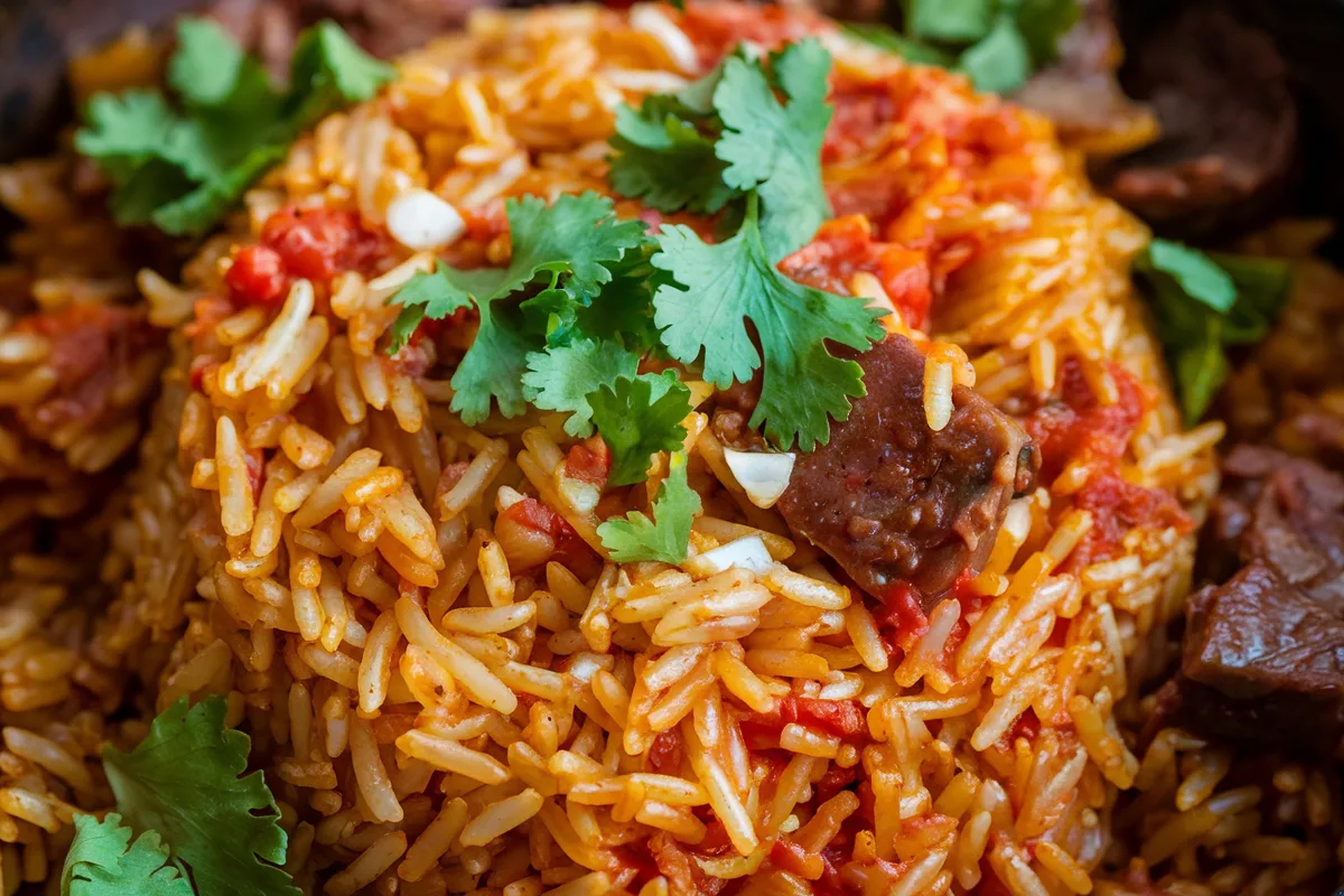
There is a dish that has started more arguments than almost any other food on earth. It has its own wars — fought not with weapons but with recipes, hashtags, and the absolute conviction of every grandmother who has ever stood over a pot of it. It has been eaten at funerals and weddings, at street parties and state dinners. It crossed the Atlantic Ocean in the worst possible circumstances, survived, and emerged on the other side as something new without ever ceasing to be itself.
It is jollof rice. And its story is one of the most remarkable journeys in the history of human food.
An Empire in a grain
Jollof rice was probably first cooked during the 14th century in the Wolof empire, which had risen in the previous century in what is now inland Senegal. Rice cultivation thrived in the Wolof empire and formed the basis of many dishes
The Jolof Empire — the spelling varies between Jolof and Wolof depending on the source — was one of the major political formations of pre-colonial West Africa, controlling territory across what is now Senegal, the Gambia and parts of Mauritania. It was a trading empire, a Muslim empire, a sophisticated political structure with its own systems of governance, diplomacy and culture. And it was, fundamentally, a rice culture.
One of those dishes was thiéboudienne or thiebou dieun, a dish made by cooking rice with fish, shellfish, and vegetables; the word thiéboudienne comes from the Wolof words for rice, ceeb or thiebb, and fish, jën. This is the great ancestor: a one-pot meal of rice cooked in a richly flavoured base, absorbing everything around it until the grain itself becomes the carrier of the dish’s whole character.
The name jollof is itself the name of the empire, worn down by centuries of use into the word we know. In the Wolof language, jollof means “a single pot” or “one-pot,” highlighting the cooking method as all the ingredients are combined in a single pot. The pot, the empire and the dish share the same name. That is not a coincidence. It is a statement about what the Wolof people considered central to their civilisation.
The Colonial ingredient
The jollof we know today is not identical to the thiéboudienne of the 14th century, and one reason for this is colonialism. Between 1860 and 1940 the French colonisers replaced existing food crops with broken rice imported from Indochina. Oral tradition credits the modern form of thiéboudienne to a specific woman: Penda Mbaye from St. Louis, Senegal, a cook who lived and worked in the colonial governor’s palace, said to have utilised broken rice as an alternative to barley, which was in short supply at the time.
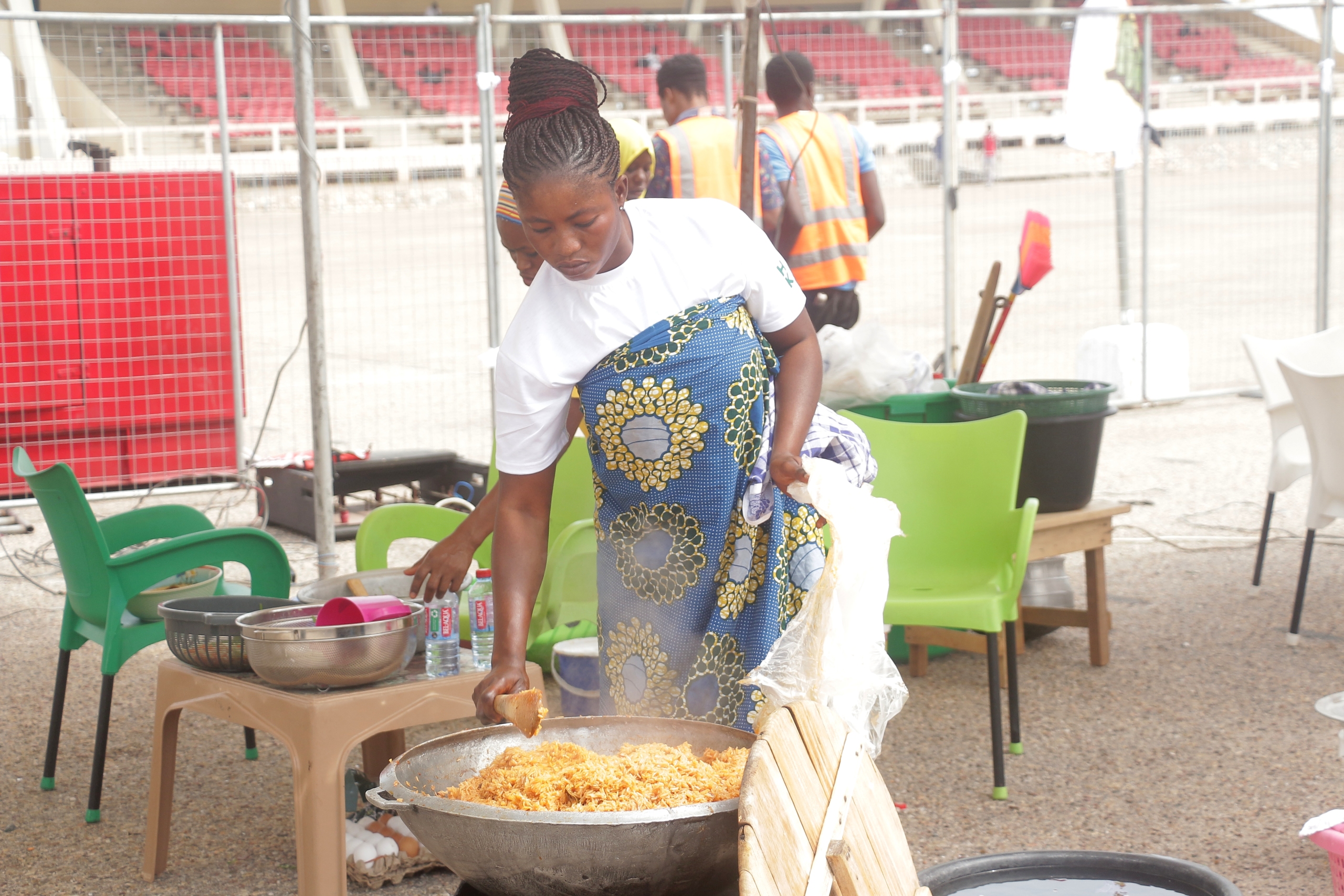
This is the characteristic double movement of colonial food history: the coloniser disrupts the food system, and the colonised transform the disruption into something extraordinary. Broken rice — cheaper, lower quality, imported — becomes the medium for one of the great dishes of world cuisine. The tomato, itself a New World ingredient that arrived in West Africa via Portuguese traders, becomes the base of the sauce. The dish is ancient in its structure and modern in its ingredients. It belongs entirely to neither period.
Across West Africa
From the Senegambian heartland, jollof spread across the region through trade, migration and the simple magnetism of a good dish. Today, jollof rice is known by different names such as benachin in The Gambia, thiéboudienne in Senegal, riz gras in French-speaking countries like Burkina Faso, Côte d’Ivoire, and Guinea, and nsamé or zaame in Mali.
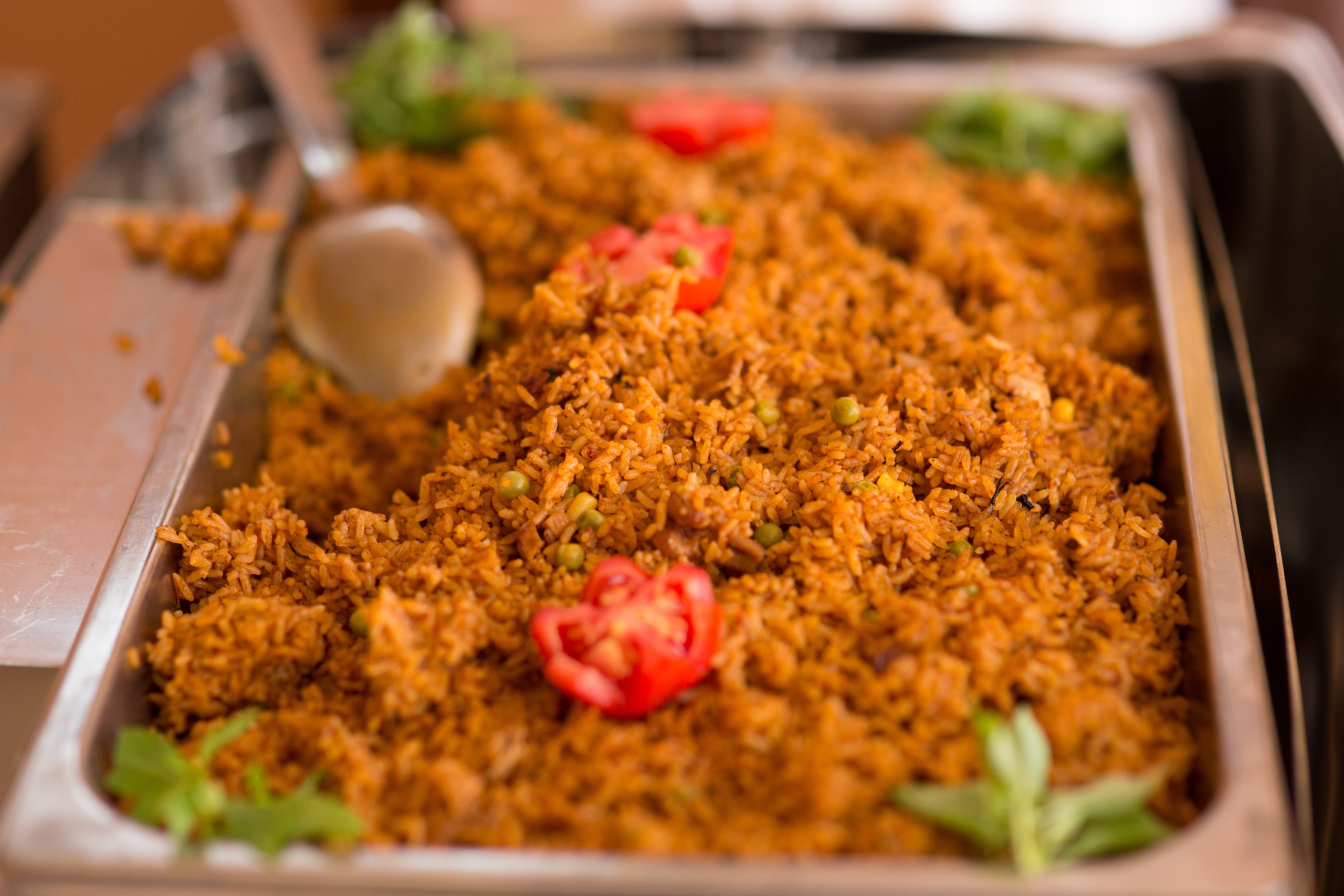
Each country made it their own. Nigerian jollof rice uses long grain rice while Ghanaians use Basmati. Nigerian jollof is spicier, using a blend of chilies and scotch bonnet peppers alongside tomatoes, while Ghanaian jollof is more warm and savory, using a lot more aromatic spices. Nigerian party jollof, cooked over open fire until the bottom of the pot blackens into what devotees call the party crust — that smoky layer of slightly charred rice that is the most contested prize at any gathering — is something distinct from anything Senegal would recognise as its own. Both claim ancestry. Both are right.
The jollof wars, fought with passionate intensity across social media between Nigerians, Ghanaians, Senegalese and everyone else, are superficially about national pride. But they encode something deeper: the question of who gets to define a shared inheritance. Jollof carries the role of celebration food, the dish that feeds a crowd and signals hospitality. When a pot of jollof appears, people assume an occasion is happening.
The middle passage
The dish crossed the Atlantic in the worst possible circumstances. Millions of people were taken from West Africa in the transatlantic slave trade, the majority from precisely the Senegambian and broader West African regions where rice was not merely a food but a civilisation. They did not travel as free people carrying recipes. They travelled in the holds of ships, in conditions of extreme brutality, stripped of almost everything.
Almost everything. What survived — what no amount of violence could entirely extract — was knowledge. Knowledge of how to grow rice, how to manage water and soil, how to cook a grain until it absorbed and transformed everything around it.
Enslaved Africans from Senegambia were brought to the Lowcountry of South Carolina specifically for their mastery in cultivating the grain and establishing irrigation systems. South Carolina made its preindustrial wealth off of the rice Black people grew, harvested, and milled, the outcome of which contributed to a global economy. The rice economy of colonial Carolina was not a European invention. It was African expertise, coerced into service.
Red rice and the Gullah Geechee
The Gullah Geechee people, who primarily reside in the coastal regions of South Carolina, Georgia, and Florida, are descendants of enslaved West Africans whose culinary practices are deeply rooted in the traditions of their ancestors. Among those practices is a dish called Charleston red rice: tomato-based rice cooked in a single pot with pork or sausage, coloured deep orange-red by the tomato base, rich with the flavours of the broth it absorbs.
“We prefer the red rice, which is the daughter or child of African jollof, which is tomato-based,” explains one Gullah cultural bearer from Charleston. “We love making Hoppin’ John, which is the Sea Island red field pea and rice cooked all together. It’s one of the perloos of the Gullah culture.” The word perloo — a Gullah term for one-pot rice dishes — is itself a linguistic trace of the same tradition. Pull the threads and you find yourself back in Senegambia.
From Charleston red rice came jambalaya, the Creole and Cajun evolution that added French, Spanish and Native American elements to the same fundamental structure. The one pot. The rice absorbing a spiced broth. The colour of the tomato base. The logic is unbroken.
The Caribbean and Latin America
The same process played out across the Caribbean and Latin America wherever enslaved Africans arrived with their knowledge and their palates intact.
In Trinidad and Tobago, the dish is called pelau: rice cooked with meat and pigeon peas, the meat first caramelised in burnt sugar — a technique with clear African roots — before the liquid and grain are added. Baidawi Bhagi, a Trinidadian cook and writer, notes that jollof‘s cousin pelau will feel familiar to those who love jollof, Charleston red rice, or jambalaya. The family resemblance is audible in the structure: one pot, infused grain, layered flavour.
In Cuba, congrí and arroz moro cook rice with beans and aromatics into a dish that carries the same one-pot logic. In Puerto Rico and across the Dominican Republic, arroz con pollo and arroz con gandules place seasoned rice at the heart of celebration cooking in a way that would be immediately recognisable to anyone who has eaten jollof. In Haiti, diri kole ak pwa — rice cooked with beans and aromatics — follows the same grammar. In Brazil, baião de dois combines rice and beans with chunks of pork in a manner that echoes Hoppin’ John and, behind it, the West African traditions that Hoppin’ John carries.
None of these dishes are identical to jollof. That is precisely the point. The diaspora did not import a finished product. It carried a principle: that rice, cooked in a flavoured base in a single pot, could be the centre of a meal and the centre of a culture. Each place it arrived, that principle was reinterpreted through local ingredients, local histories and local identities. The tomato stayed. The one pot stayed. The communal occasion stayed. The rest changed.
What the pot carries
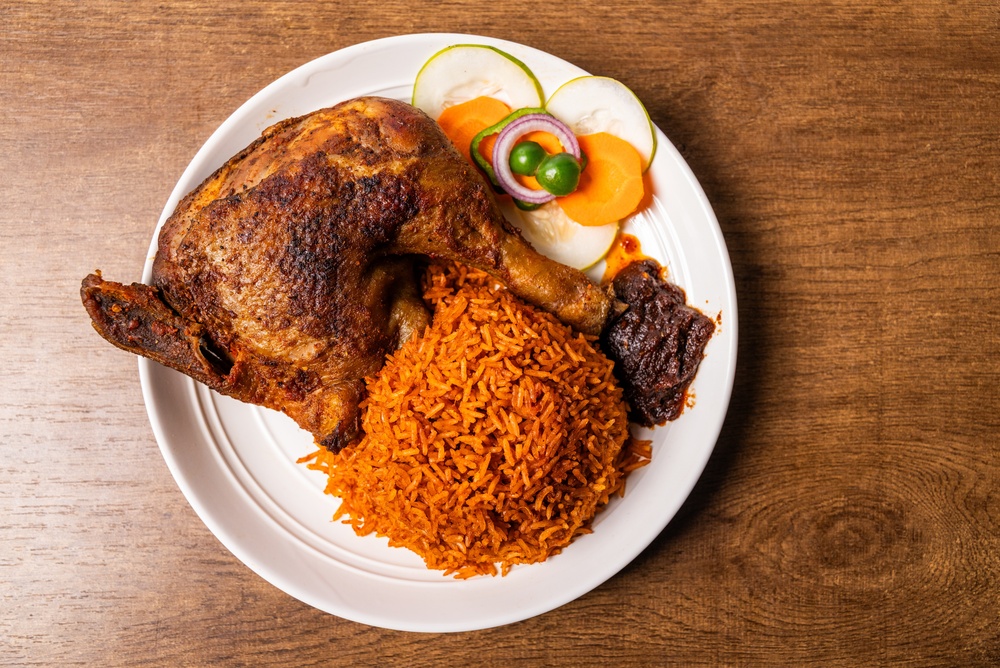
Jollof rice is history you can taste. The dish carries traces of the Wolof world, Senegal’s fishing communities, regional trade and migration, changing rice economies, and modern cultural identity.
It carries something else too: the evidence that the people who were enslaved and transported across the ocean were not passive. They were skilled, knowledgeable, and culturally rich. They did not simply receive the food cultures of the Americas and the Caribbean. They shaped them, from the ground up, in ways that are still being traced and named.
When a pot of jollof appears at a party in Lagos, when Charleston red rice is served at a family reunion in South Carolina, when pelau is made for Carnival in Port of Spain, when arroz con gandules anchors a holiday table in Puerto Rico — all of these moments are connected. Not by a recipe passing intact from hand to hand across five centuries, but by the deeper transmission of a way of understanding what rice can be and what a shared meal means.
The pot crossed the ocean. The knowledge survived the crossing. What grew from it feeds hundreds of millions of people today.
AI Transparency Notice
PilgriMaps uses artificial intelligence tools to assist in the research, drafting and translation of editorial content. All AI-assisted content is reviewed, edited and verified by our editorial team before publication. We contrast information against primary sources, specialist literature and on-the-ground knowledge to ensure accuracy, cultural sensitivity and editorial integrity.
AI is one tool among many in our workflow. The judgement, curation and responsibility for everything published on this platform remain entirely human.
Viator Media S.L. — in compliance with the EU Artificial Intelligence Act (Regulation EU 2024/1689).
This post is also available in: