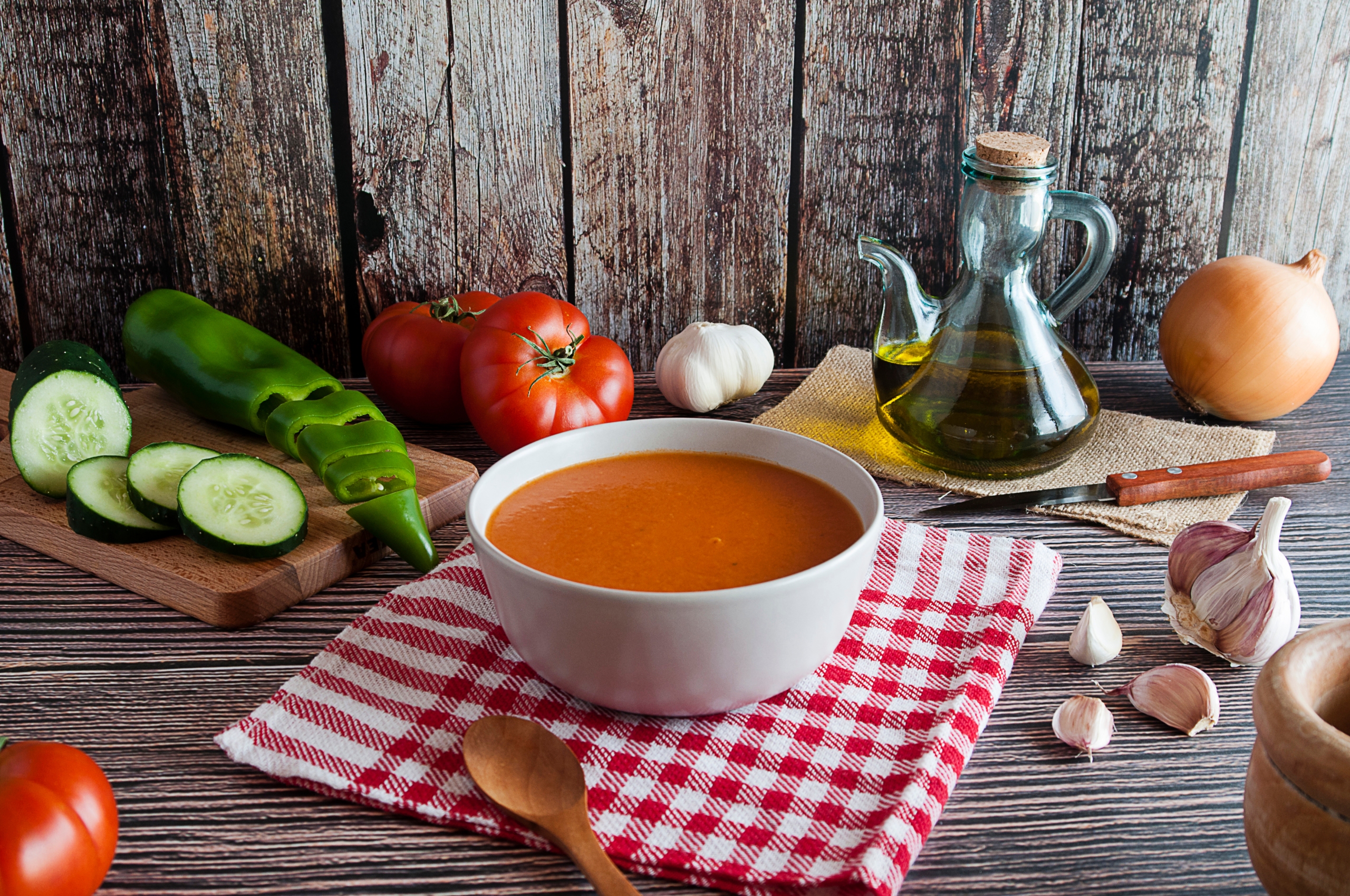
In the heat of an Andalusian summer, few foods are more welcome than a chilled bowl of gazpacho. Light, refreshing, and deceptively simple, it feels timeless—always there on the table beside bread and olive oil. Yet the story of this dish is anything but straightforward.
Today’s bright red version, centered on ripe tomatoes, is the result of a journey across centuries, shaped by Roman soldiers, Andalusi farmers, and nineteenth-century kitchens. To drink gazpacho is, in many ways, to drink history.
Roman Soldiers and Early Traces
Long before it was called gazpacho, mixtures resembling it sustained Roman legionaries in Hispania. Their drink of choice, posca, was a humble blend of water and vinegar that provided relief during summer campaigns. Sometimes they added crumbled bread, garlic, and oil—an improvised cold soup not far removed from the base of gazpacho.
Literary echoes survive as well. Virgil’s verses describe moretum, a rustic paste of bread, garlic, herbs, and vinegar prepared at dawn by farmers. Even the etymology carries hints of antiquity: “gazpacho” may derive from caccabaceus, referring to bread soaked in a cooking pot (caccabus). By the age of Caesar, the foundations of the dish were already present, though unnamed.
Al-Andalus and the White Gazpacho
When Islamic rule reshaped the Iberian Peninsula from the eighth century onward, the recipe endured in a different form. Bread, garlic, oil, vinegar, and water—modest, halal, and cooling—were staples for farmers working through long summers. These early Andalusi versions resembled what is today called ajoblanco, still prepared in Málaga and Granada with bread and almonds. Tomatoes and peppers had not yet arrived from the Americas, but the dish fulfilled the same function: to hydrate, nourish, and refresh.
This was not unique to Iberia. Across the Mediterranean, similar foods evolved from the same need. Tuscany had panzanella, a bread salad dressed with oil and vinegar. Ancient Greece had kykeon, a grain-and-water mixture with occasional herbs. All reflected a shared response to heat and scarcity: softening bread in liquid to create sustenance.

The Dish of Harvesters
For centuries, gazpacho remained associated with rural laborers. Sebastián de Covarrubias, in his 1611 dictionary, dismissed it as “food of reapers and coarse people.” Literary sources echo this view. In the picaresque tale of Estebanillo González (17th century), the protagonist remarks how a cold gazpacho chilled his stomach during his travels through Andalusia.
In maritime contexts, variations also appeared. Juan de la Mata, cook to Spanish ships, recorded a “marine gazpacho” in 1747 made of hard bread, garlic, oil, and salted anchovies. Tomatoes were still absent; the essence was bread, vinegar, and resourcefulness.
The Arrival of the Tomato
The transformation came during the nineteenth century. Although tomatoes had reached Europe from the Americas in the sixteenth century, they were long regarded with suspicion. By the 1800s, they were abundant in Andalusian gardens and gradually entered the gazpacho recipe. The result was striking: a vivid red soup, refreshing and flavorful.
Farm laborers enriched it with peppers, cucumbers, and onions—whatever the fields offered. Soon, the dish left the countryside and entered bourgeois homes. There it was sieved for smoothness and served with garnishes on the side, adapting rustic origins to refined tastes. Gazpacho began to symbolize Andalusian identity, even appearing in popular culture: in 1915, a Madrid theater staged the revue Gazpacho andaluz.
By the mid-twentieth century, gazpacho had become emblematic of Spanish cuisine. Tourism in the 1960s carried it abroad, where it became linked with the Mediterranean diet, praised as wholesome, light, and natural. Today it is bottled for export worldwide and appears on menus from New York to Tokyo—a far cry from its reputation as food for the poor.
Regional and Culinary Variants
Andalusian gazpacho is only one branch of a diverse family of cold soups and bread-based preparations. Several regional variants illustrate how a shared foundation can yield distinct culinary identities:
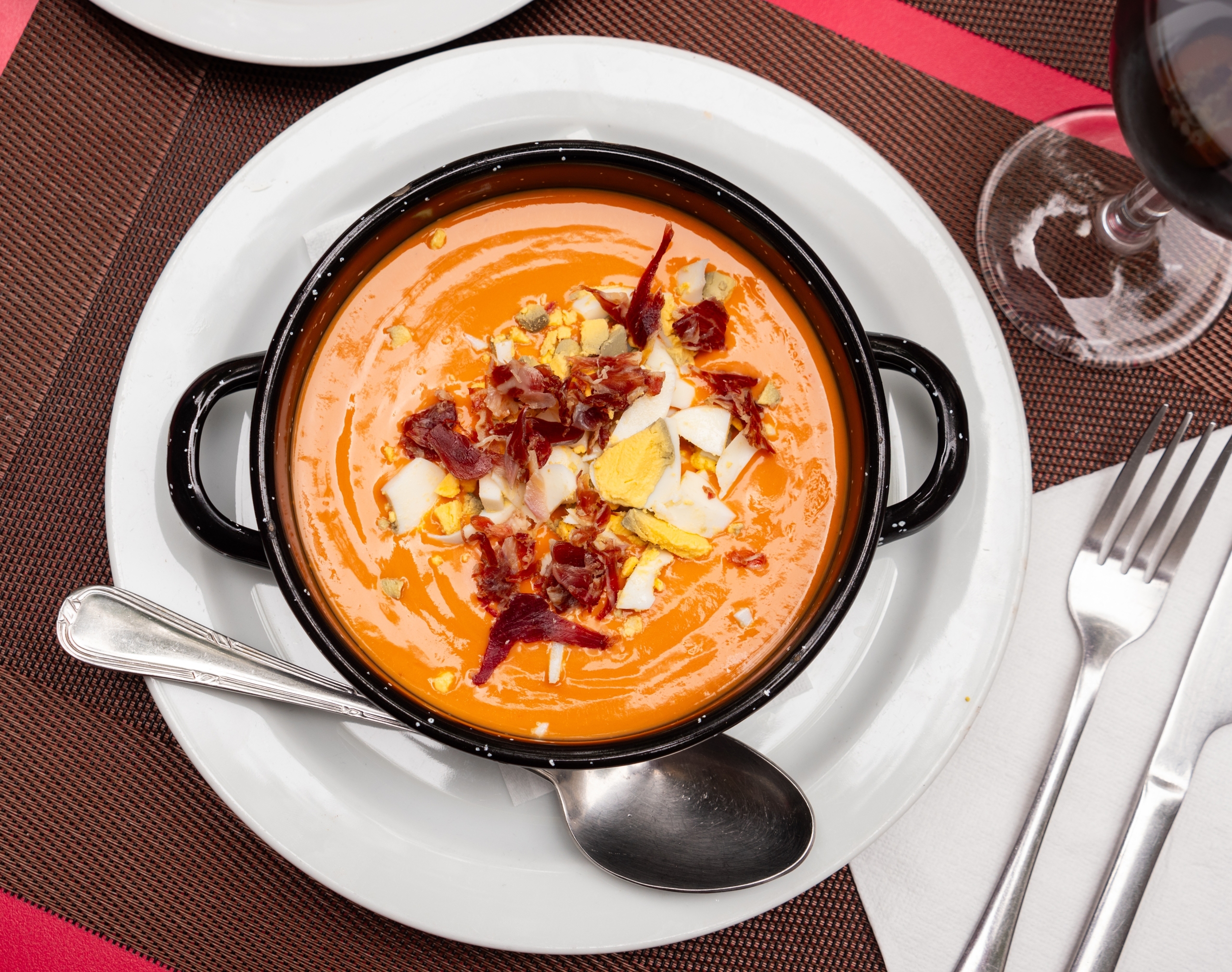
- Porra Antequerana (Málaga): Thicker than gazpacho, eaten with a spoon rather than drunk. Made with tomato, bread, garlic, oil, and vinegar, it is traditionally topped with diced ham and hard-boiled egg.
- Salmorejo Cordobés (Córdoba): Even denser, bordering on a purée, owing to more bread and oil. Served cold and crowned with ham and egg, it has become one of the most widely exported Andalusian dishes.
- Arranque Roteño (Cádiz): Considered one of the earliest forms, it involves pounding tomatoes, peppers, garlic, and hard bread in a wooden mortar, often with little or no water. The result is a thick paste eaten with bread in the fields.
- Ajoblanco Malagueño (Málaga and Granada): A “white gazpacho” without tomato or pepper, prepared from bread, almonds, garlic, oil, vinegar, and water. Its ivory color contrasts with its accompaniments—grapes or melon—making it both refreshing and refined.
- Gazpacho Manchego (La Mancha): A distant cousin in name only. This is a hot shepherd’s stew of unleavened bread and game meats such as rabbit or partridge, unrelated to the Andalusian cold soup but sharing the bread-based origin.
- Modern Variants: Contemporary cuisine has experimented with gazpachos of watermelon, cherry, or beetroot, exploring new flavors and colors while preserving the essential balance of bread, oil, vinegar, and fresh produce.
Together, these variations reflect the adaptability of a simple culinary idea to local landscapes, crops, and tastes.
Drinking History
Andalusian gazpacho is a cultural synthesis. Roman improvisations gave it a foundation, Andalusi traditions carried it forward, American crops transformed it, and modern kitchens projected it internationally. Each sip recalls legionaries, field workers, and harvesters who relied on it for sustenance under the sun.
To enjoy a glass of gazpacho in summer is to encounter a living record of two millennia of Mediterranean history—served cold, in a bowl.
AI Transparency Notice
PilgriMaps uses artificial intelligence tools to assist in the research, drafting and translation of editorial content. All AI-assisted content is reviewed, edited and verified by our editorial team before publication. We contrast information against primary sources, specialist literature and on-the-ground knowledge to ensure accuracy, cultural sensitivity and editorial integrity.
AI is one tool among many in our workflow. The judgement, curation and responsibility for everything published on this platform remain entirely human.
Viator Media S.L. — in compliance with the EU Artificial Intelligence Act (Regulation EU 2024/1689).
This post is also available in: