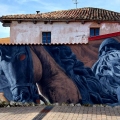
Every November, the Basilica of Our Lady of Montligeon, in France’s Perche region, welcomes pilgrims carrying the names of loved ones who have died. Some have recently lost someone close to them; others come to remember people who passed away many years ago. They attend religious services, pray for the departed, and entrust them to a spiritual fraternity that brings together the living and the dead from around the world.
But at Montligeon, prayers are also offered for people whom no one ever knew, for those whose names have disappeared over generations, or who no longer have family members to remember them. This is one of the defining features of a sanctuary that describes itself as an international center of prayer for the dead and Christian hope.
The enormous Neo-Gothic basilica rising among the forests and fields of Normandy can come as a surprise to first-time visitors to La Chapelle-Montligeon, a small village in the Orne department. Its two towers seem out of proportion to the size of the village, but their presence is explained by an extraordinary story.
Unlike other major Marian shrines, Montligeon did not originate in an apparition of the Virgin Mary or a miraculous event. Its beginnings lie in a priest’s concern for the souls of the forgotten dead and his determination to turn that concern into a mission that would also help the living.
The priest who wanted to help the Dead and find work for the living
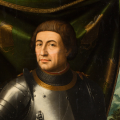
Paul-Joseph Buguet was born in 1843 in Bellavilliers, a village in Normandy. The son of a clog maker and a spinner, he grew up familiar with rural life and the hardships faced by working families. Ordained a priest in 1866, he served in several parishes before arriving in La Chapelle-Montligeon in 1878.
Two years earlier, he had suffered a loss that would profoundly shape his life. His brother Auguste had died in a workplace accident on November 1, 1876, All Saints’ Day. His brother’s death, together with his concern for the fate of departed souls, helped inspire an initiative he would begin developing several years later.
When Buguet arrived in Montligeon, he found an impoverished parish with few employment opportunities. Changes in the rural economy and migration to the cities were affecting communities throughout France. He wanted to improve the living conditions of his parishioners, but he was also increasingly troubled by the thought of people who had died with no one left to pray for them.
In 1884, with the approval of the Bishop of Séez, he founded an association dedicated to the deliverance of souls in purgatory, particularly those he considered most abandoned. His aim was to create a community of prayer that would preserve the spiritual memory of the dead, even after they had faded from the memories of their descendants.
The initiative grew and soon began attracting pilgrims. In 1887, Buguet organized the first pilgrimage dedicated to the souls in purgatory and established a printing press to provide employment for local residents.
The printing press became an essential part of his project. It produced publications and other materials promoting the association, which was beginning to spread beyond France. The publishing operation created jobs while helping finance an increasingly ambitious religious mission.
To gather support, the priest traveled extensively throughout France and other European countries, promoting his association and seeking donations. His tireless activity earned him the unusual nickname commis voyageur des âmes du purgatoire — roughly, “the traveling salesman for the souls in purgatory.”
As the organization expanded, the small parish church could no longer accommodate its pilgrims. Buguet therefore decided to build a large church that could welcome visitors and serve as the center of his international spiritual fraternity.
The foundation stone of the future basilica was blessed in 1896, and the building was consecrated in 1911. Buguet died in Rome in 1918, having devoted much of his life to a mission that had grown far beyond the boundaries of his small parish. His remains now rest in the crypt at Montligeon.
A basilica for those who have no grave to visit
The Basilica of Our Lady of Montligeon preserves many features that reflect its founder’s spirituality. Its Neo-Gothic architecture, stained-glass windows, and spacious interior were designed to create a major pilgrimage center dedicated to prayer for the dead.
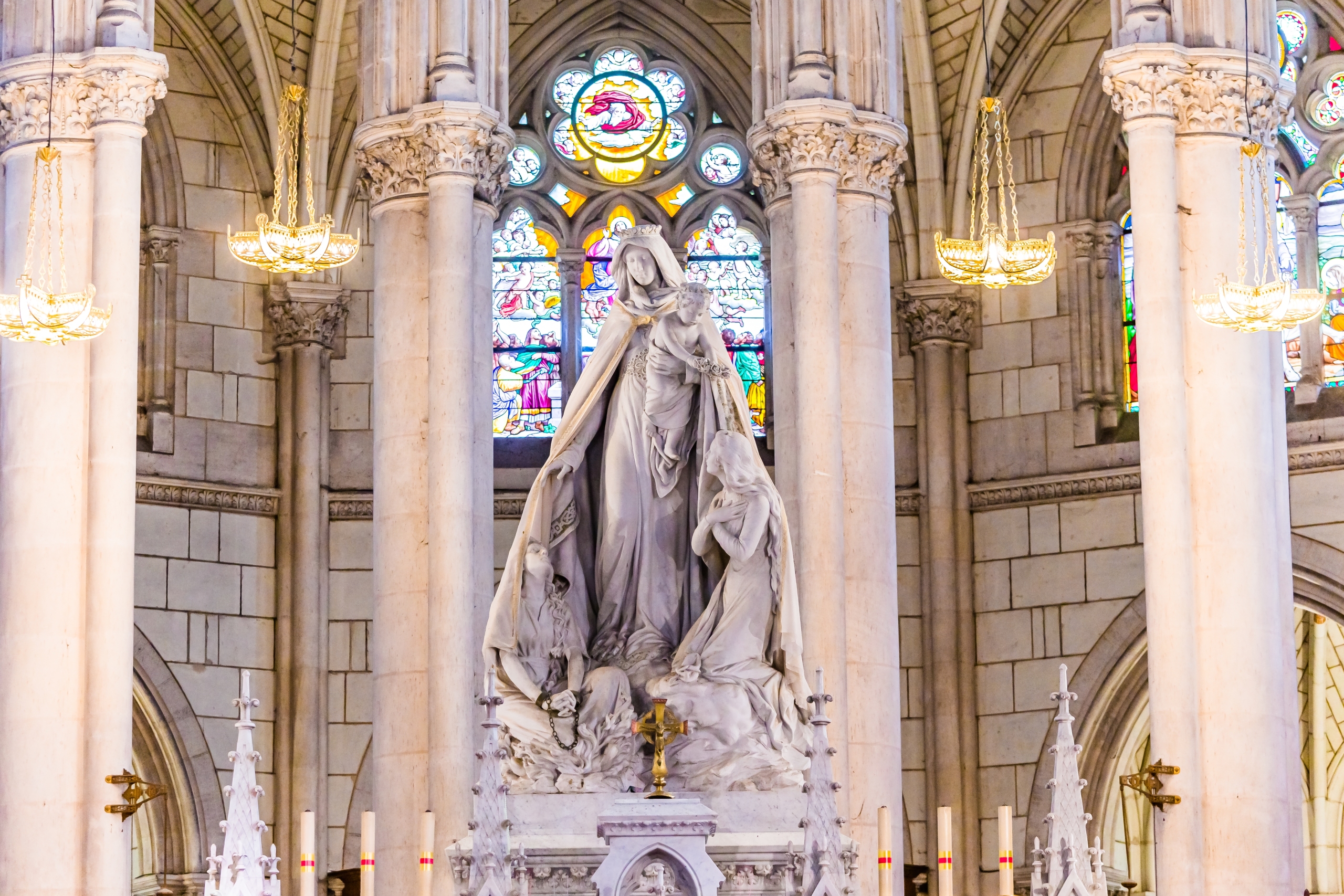
One of its most significant features is the monumental statue of Our Lady the Liberator, created in Rome by the Italian sculptor Giulio Tadolini. The Virgin Mary holds the Christ Child, while two female figures at her feet symbolically represent two states of the same soul.
On one side, a chained figure represents the purification of purgatory. On the other, the same soul appears liberated and receives the crown of glory from the Christ Child. The sculpture gives visual expression to the hope at the heart of the sanctuary: according to Catholic doctrine, souls undergoing purification are destined to enter into full communion with God.
The tradition of praying for the dead has deep roots in Christianity. In the Catholic Church, it is linked to the doctrine of the communion of saints, which teaches that a spiritual bond unites believers living on earth, those undergoing purification after death, and those already sharing in heavenly glory.
Prayer for the souls in purgatory expresses the belief that the living can intercede for the dead. For this reason, the most important act at Montligeon is not visiting a grave but participating in communal prayer.
Since 1884, the sanctuary has maintained what is known as the Perpetual Mass: a daily celebration of the Eucharist for everyone, living or deceased, enrolled in its spiritual fraternity. Enrollment is permanent, allowing people to entrust a relative, a friend, or anyone else to this ongoing prayer.
Over the years, the Montligeon Fraternity has grown to include several million members. Their names are preserved in registers kept inside the basilica, in an enormous cabinet known as the obituaire, standing nearly 26 feet (eight meters) tall. Every year, at the end of November, the register of new enrollments is solemnly added to the collection.
This vast archive is one of the sanctuary’s most distinctive features. It preserves the memory of people who died generations ago, alongside the names of living members who wish to entrust themselves to the fraternity’s prayers. Montligeon also explicitly maintains its commitment to praying for the dead whose names no one remembers.
November: The month of the pilgrimages of Heaven
Montligeon’s spiritual life continues throughout the year, but November is its most important month. Around All Saints’ Day and All Souls’ Day, the sanctuary organizes the Pèlerinages du Ciel, or Pilgrimages of Heaven. In 2026, six pilgrimage days are scheduled for November 1, 2, 8, 15, 22, and 29. Each includes Mass, prayers, opportunities for spiritual teaching, and the sacrament of reconciliation. The main ceremonies can also be followed online.
One distinctive practice during these gatherings is the prayer commitment made by some members of the fraternity during Vespers. Through this promise, they undertake to offer their prayers and actions for the souls in purgatory, continuing a tradition that dates back to the organization’s foundation.
But the Pilgrimages of Heaven also provide a form of human companionship and support. Many visitors to Montligeon are grieving, and the celebrations offer them a place to remember loved ones and share an experience that, under other circumstances, is often endured privately.
The sanctuary also organizes retreats and gatherings focused on death, grief, and Christian hope. Its spiritual programs welcome people of different ages and circumstances, from practicing Catholics to those searching for answers after a loss.
Montligeon’s international reach now extends far beyond France. Prayer groups affiliated with its fraternity meet in countries across Europe, the Americas, Africa, and Asia, sustaining the spiritual network begun by Buguet in the nineteenth century.
How to visit Our Lady of Montligeon today
The Sanctuary of Our Lady of Montligeon is located in the Orne department of Normandy, within the Perche Regional Natural Park, approximately 93 miles (150 kilometers) west of Paris as the crow flies.
The basilica is open year-round and welcomes visitors interested in both its religious significance and its history and architecture. Along with the statue of Our Lady the Liberator and the stained-glass windows, visitors can see the crypt where the founder is buried. The key must be requested at reception.
The sanctuary also offers prayer walks through its gardens, including a Way of Light dedicated to the Resurrection and a Way of Consolation associated with the remembrance of children who died before birth. For those wishing to stay several days, accommodations are available in rooms and houses for individual pilgrims, families, and groups.
The November Pilgrimages of Heaven are open to visitors, and participation in religious services is free. Reservations are not required to attend Mass, although visitors are advised to contact the sanctuary in advance to arrange accommodations, meals, or group visits.
Information about opening hours, services, and accommodations is available on the sanctuary’s official website. Visitors planning to attend the November 2026 pilgrimages can also consult the Pilgrimages of Heaven program.
More than 140 years after its foundation, Montligeon continues to respond to the concern that inspired Father Buguet. The basilica he built among the fields of Normandy retains a calling unusual among pilgrimage destinations: to sustain a permanent prayer that does not depend on the existence of a grave, the presence of surviving relatives, or even the preservation of a name, but on the Christian conviction that human forgetfulness need not have the final word on a person’s existence.
AI Transparency Notice
PilgriMaps uses artificial intelligence tools to assist in the research, drafting and translation of editorial content. All AI-assisted content is reviewed, edited and verified by our editorial team before publication. We contrast information against primary sources, specialist literature and on-the-ground knowledge to ensure accuracy, cultural sensitivity and editorial integrity.
AI is one tool among many in our workflow. The judgement, curation and responsibility for everything published on this platform remain entirely human.
Viator Media S.L. — in compliance with the EU Artificial Intelligence Act (Regulation EU 2024/1689).
This post is also available in: