A league from Santiago, when the church finally appeared on the horizon on a summer morning in 1325, Isabel of Portugal dismounted. She had travelled hundreds of kilometres, accompanied by a retinue and with the means of someone who had been queen for more than forty years. But that last stretch she wanted to walk.
The medieval source that records the pilgrimage does not name the place. Tradition generally identifies it with O Milladoiro, one of the points from which travellers could catch their first sight of Compostela. There, according to the account, Isabel dismounted and advanced toward the shrine “with great devotion.” The geographical identification is plausible, though not provable; the gesture, however, belongs to the oldest core of the story.
The scene becomes still more significant when one knows who the woman dismounting was. Isabel was not a decorative figure at Court: for decades she had negotiated between kings, intervened in dynastic conflicts and sought to reconcile family members turned adversaries. Later memory would end by making her an almost emblematic figure of international diplomacy.
A princess destined to unite kingdoms
Isabel had been born in 1271 into the Aragonese royal family. Tradition places her birth in Zaragoza, though early authors already disputed whether it might have occurred in Barcelona. She was the daughter of Peter III of Aragon and belonged to a dynastic network that connected her to some of the principal monarchies of Europe.
In 1282, still a child, her marriage by proxy to Dom Dinis, King of Portugal, was celebrated in Barcelona. Shortly afterwards she set out for her new kingdom. The marriage brought Isabel into a complex geography of alliances between Portugal, Castile and Aragon — precisely the settings in which she would later conduct much of her mediating activity.
It would be a mistake to imagine that mediation as a kind of contemporary diplomacy. Medieval queens acted through family networks, correspondence, personal encounters, patronage, moral authority and the capacity to access the men who formally wielded power. Kinship was a political tool, and Isabel knew how to use it.
In 1298 she accompanied Dom Dinis to the Castilian border, where he was to meet their daughter Constance, married to Ferdinand IV of Castile. She also took part in a negotiating context that involved the Castilian king and Ferdinand de la Cerda, who were in conflict over the succession.
A few years later she reappeared in a negotiation of greater scope. In 1304, relations between Castile and Aragon required a delicate territorial agreement. James II of Aragon, Isabel’s brother, insisted on her presence before any accord could be reached. She belonged to both sides of that negotiation: she had been born an Aragonese infanta and was queen of Portugal.
That capacity to move between royal houses explains part of the reputation that would accompany Isabel for centuries. But the most dramatic proof of her mediating role did not unfold between different kingdoms. It happened within her own family.
Between husband and son
The final years of Dom Dinis’s reign were marked by conflict with his heir, the future Alfonso IV. The dispute had personal and political ingredients. The prince distrusted the influence acquired by his half-brother Alfonso Sanches, the king’s illegitimate son and the beneficiary of his favour. Around both men gathered interests, partisans and resentments until a family tension became a civil war.

For Isabel, both sides had a face. One was her husband. The other was her son. Her position was inevitably uncomfortable. The queen tried to keep channels open between the two, helped the prince on occasion, and at the same time sought to prevent the conflict from ending by destroying the king’s authority — despite the fact that her husband had not treated her well.
But the situation reached its most dangerous point at the end of 1323. Prince Alfonso advanced with his supporters toward Lisbon. The two armies came close to engagement. Historical tradition preserves the image that would end by defining Isabel: the queen placed physically between father and son, moving from one to the other, reproaching the prince for breaking earlier agreements and trying to contain the king’s fury.
Posterity inevitably magnified the scene. Around Isabel a hagiographic tradition developed that turned many of her interventions into ideal exemplars of concord. Barely eleven months after that peace, Dom Dinis died. It was 7 January 1325.
The Camino after the war
Some modern biographies state that Isabel set out for Santiago in June 1325. The earliest medieval source does not allow the moment of departure to be established with such precision. What it does establish is that the journey took place before a year had passed since the death of Dom Dinis, and that the queen arrived in Compostela in July, a few days before the feast of Saint James.
The pilgrimage had a purpose expressly bound to his memory. Isabel came to pray for her husband. But the journey also coincided with the reorganisation of her own existence. She was leaving behind her role as queen consort and drawing ever closer to the community of Santa Clara in Coimbra, where she would adopt a form of life inspired by Clarissan spirituality without formally becoming a nun.
The road can therefore also be read as a biographical transition. The woman who had crossed borders to meet with kings was travelling again. But this time she carried no peace proposal for others — only for herself.
A destination she chose not to reveal
The medieval biography introduces a surprising detail: Isabel initially kept her destination secret. For several days, her companions did not know where she was leading them.
It is impossible to determine how much of the scene is historical memory and how much literary construction. The principal source for the journey, the Livro que fala da boa vida que fez a Rainha de Portugal, Dona Isabel, belongs to the hagiographic genre. Its aim was not to describe roads or count stages. It wanted to explain who Isabel had been.

Hence, perhaps, the silence about the itinerary. We have no documentary list of stages. The most plausible route would have followed the corridor of the present-day central Portuguese Way: from Coimbra toward Porto and then Barcelos, Ponte de Lima, Valença, Tui, Pontevedra, Padrón and Santiago. It was an appropriate road for a retinue that needed passable routes, bridges, lodgings, religious centres and places of supply.
Renouncing like a Queen
Walking the last league carried an obvious symbolic weight. To leave the mount was to lower oneself physically, to renounce for a few kilometres one of the most visible signs of social distinction.
But on arriving in Compostela another scene unfolded that reveals to what degree medieval humility could express itself through the language of power: Isabel made an extraordinary offering. Among the gifts presented was one of her finest crowns. The sources also mention rich fabrics, vestments and other alms. One biographical tradition adds a particularly eloquent object: a cloth decorated with the symbols of Portugal and Aragon.
Few offerings could have summarised her life more aptly. Isabel was seeking the humility of the pilgrim, but even her act of relinquishing was made of a queen’s materials.
The staff that remained
At the end of the pilgrimage, tradition attributes to Archbishop Berenguel de Landoria the presentation of a staff and a scrip — the attributes that allowed Isabel to be recognised visually as a pilgrim of Santiago.
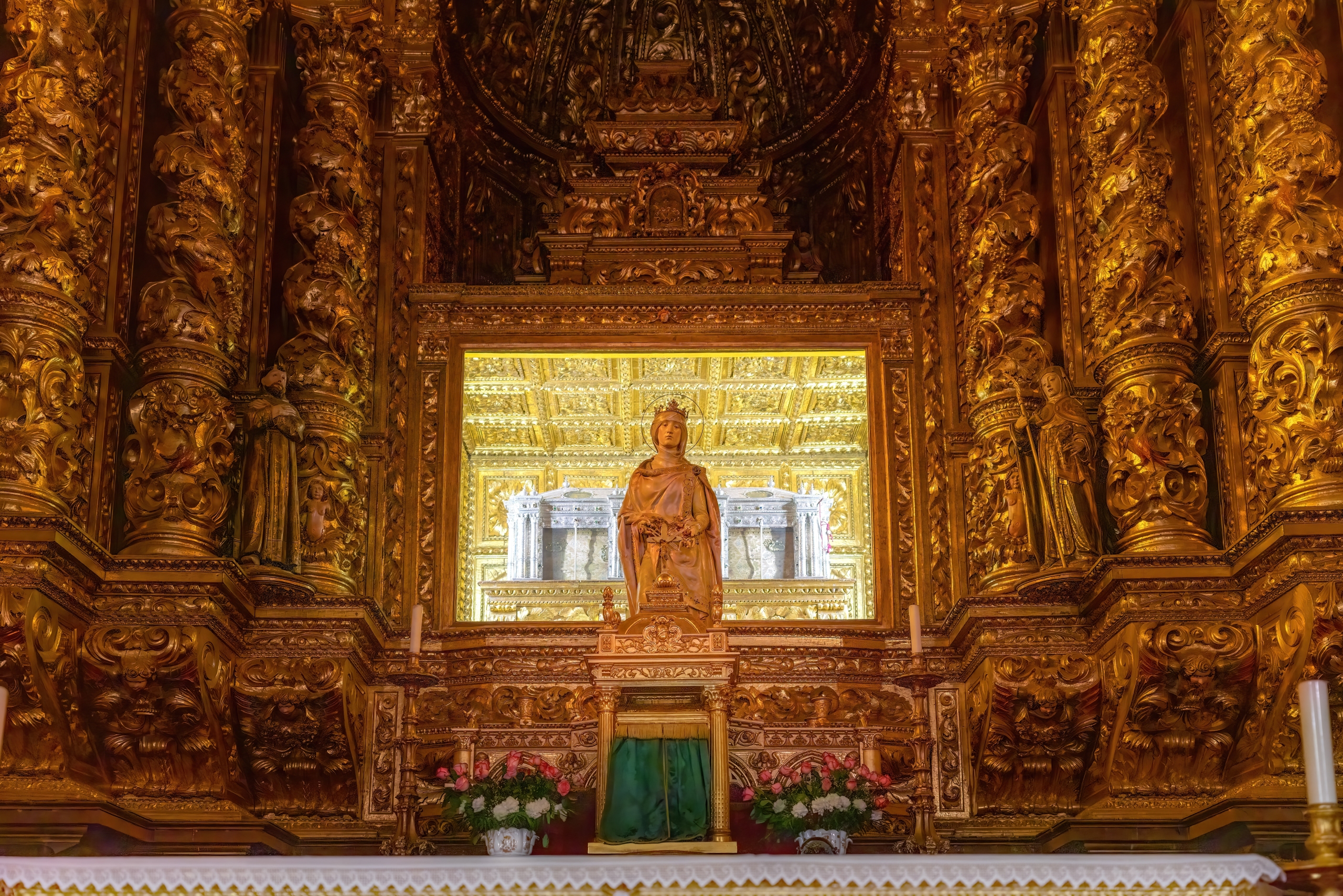
Caution is warranted here: the queen’s visit does not appear in the Deeds of Berenguel, a striking silence. Nevertheless, Isabel’s pilgrim identity was fixed very early in her funerary representation, where she appears with Jacobean attributes.
There is another detail. When Isabel’s tomb was opened in Coimbra on 26 March 1612, during the process related to her canonisation, a staff and a scrip were found resting on the coffin. The staff, of wood partially clad in silver, is decorated with fourteen scallop shells and topped by a tau-shaped handle set with reddish jasper. It would originally have measured around 143 centimetres.
Shortly afterwards a reliquary was made for it. It remains to this day associated with the Confraria da Rainha Santa Isabel at Santa Clara-a-Nova in Coimbra. The object extended the pilgrimage physically long after the queen’s death.
Between two worlds
A second pilgrimage is attributed to Isabel, supposedly made in 1335. Tradition presents her travelling almost anonymously on that occasion, on foot and in the guise of a poor pilgrim. It is a suggestive story, but documentarily far more fragile: it appears in later sources and does not feature in the oldest biography. It should therefore be treated as a plausible tradition rather than a fact as solid as the 1325 journey.
Isabel died the following year, on 4 July 1336, in Estremoz. Her reputation as a mediator helps explain why the pilgrimage to Santiago carries such symbolic force. For years, Isabel had traversed the space that separated people in conflict: between Portugal and Castile, between Castile and Aragon, between her husband and her son. Her power had often consisted in placing herself in the middle.
And perhaps that is why that league walked on foot still defines her seven centuries later: Isabel did not cease to be a queen when she dismounted. But she began to be remembered, forever, as a pilgrim.
AI Transparency Notice
PilgriMaps uses artificial intelligence tools to assist in the research, drafting and translation of editorial content. All AI-assisted content is reviewed, edited and verified by our editorial team before publication. We contrast information against primary sources, specialist literature and on-the-ground knowledge to ensure accuracy, cultural sensitivity and editorial integrity.
AI is one tool among many in our workflow. The judgement, curation and responsibility for everything published on this platform remain entirely human.
Viator Media S.L. — in compliance with the EU Artificial Intelligence Act (Regulation EU 2024/1689).
This post is also available in: