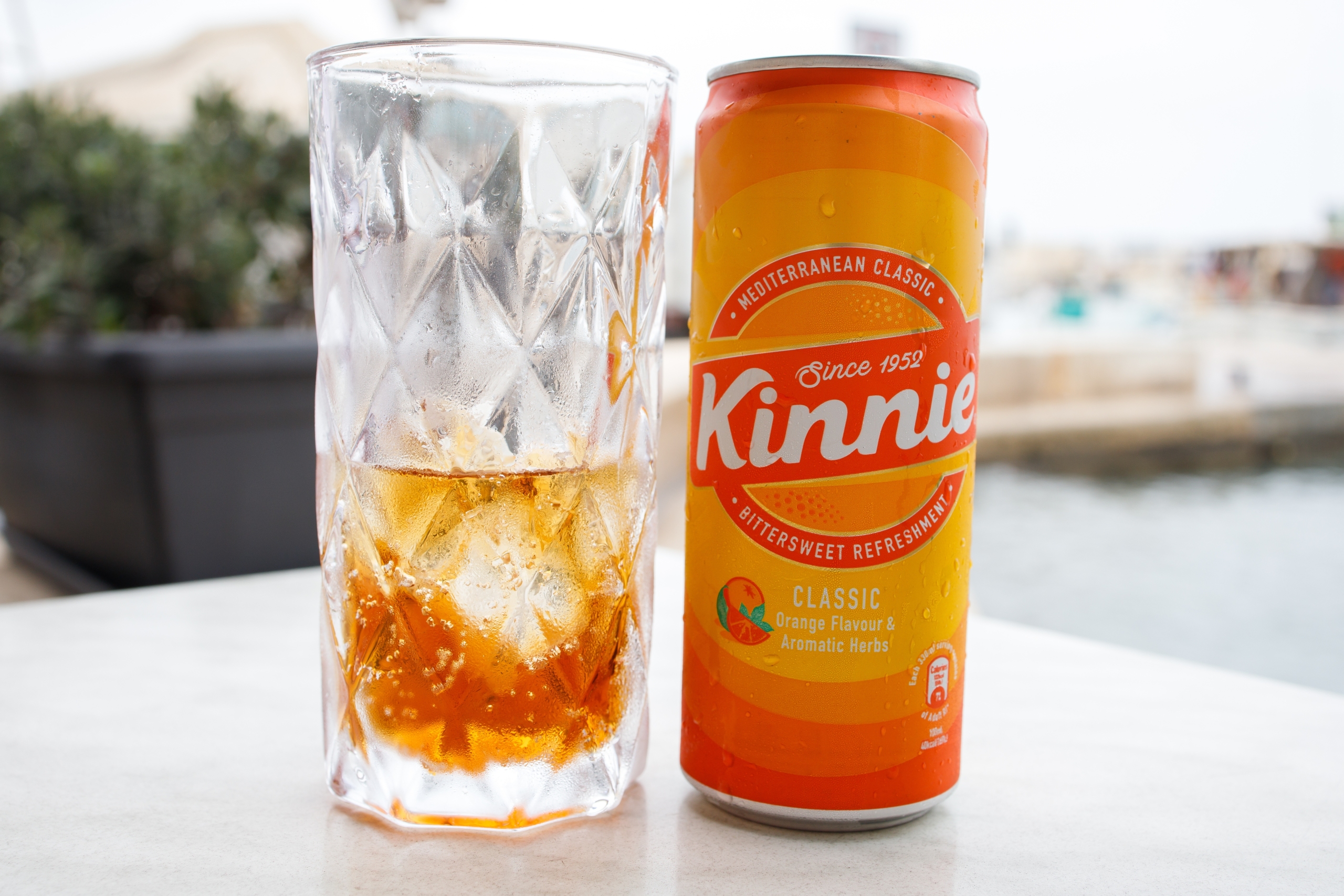
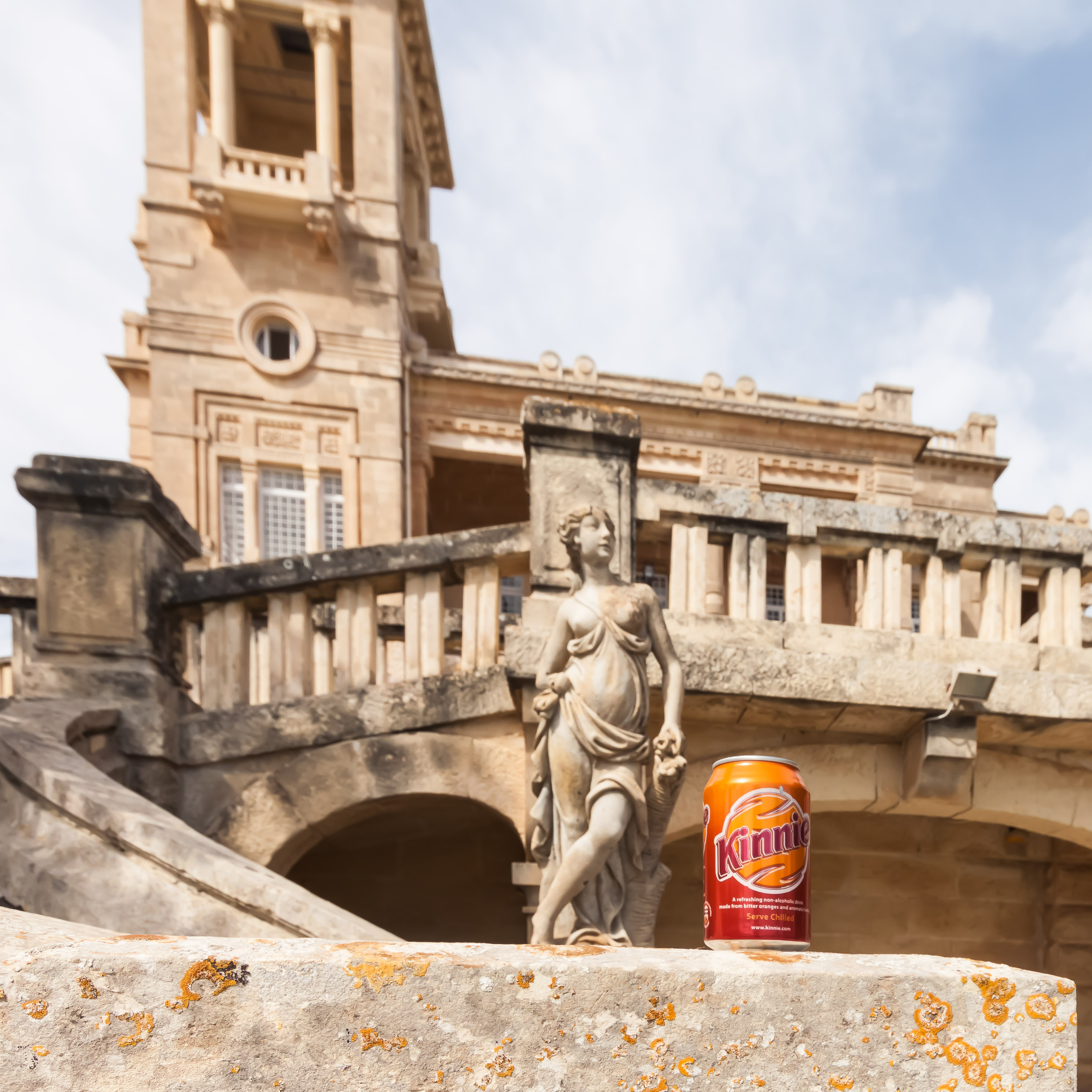
There is a drink you will be handed in Malta before anyone thinks to ask what you want. At a festa table, in a Valletta bar, on a Gozitan terrace with the afternoon heat still coming off the stone — someone will produce a glass, amber and fizzing, and place it in front of you. This is Kinnie. And in August, during the long week that builds towards Santa Marija, it is as much a part of the landscape as the brass bands and the fireworks.
A Maltese answer to an American question
Kinnie was introduced in June 1952 by Simonds Farsons Cisk, the brewery that had been producing Cisk lager since the 1920s, as a deliberate alternative to the cola drinks proliferating in post-war Europe. The man behind it was Anthony Miceli Farrugia, known as Ġiġi, the company’s managing director — half Sicilian and a devoted fan of chinotto, the bitter orange soft drink popular in the south of Italy. He wanted to make a distinctly Maltese version, and travelled to an artisanal essence house in Milan to develop what would ultimately become Kinnie.
Back in Malta with three samples, it was the essence of Paolo Salamina that formed the base of the new drink. Pharmacist Augustus Gandini developed the bitter, orange-flavoured carbonated beverage — lighter and fruitier than Italian chinotto, with a dark amber colour. The name was chosen for its simplicity: easily pronounceable in Maltese, Italian and English. Within two years of launch it commanded a third of the Maltese soft drink market, displacing rival brands. In 1975 it was named soft drink of the year by the French Comité International d’Action Gastronomique et Touristique.
What’s in the glass
Kinnie’s recipe is kept secret, but the official description points to a blend of Mediterranean chinotto bitter oranges combined with an infusion of a dozen different aromatic herbs and spices — anise, ginseng, vanilla, rhubarb, liquorice among them. Only natural ingredients are used. The result is bittersweet, faintly woody, with a citrus brightness that keeps it from being heavy. It is, in other words, exactly what you want in 35-degree August heat.
Chinotto, its Italian parent, belongs to a very old tradition. The drink was known in antiquity as a dark-hued, bitter-tasting variant of orange juice, considered a refreshment, though industrial production of chinotto soda dates to the 1950s. Kinnie arrived at precisely that moment — and promptly went its own way, becoming something distinct enough that Maltese drinkers do not think of it as a local chinotto at all. They think of it as Kinnie, full stop.
“It’s part of our national identity,” says Peter Mercieca, Head of International Business at Farsons, in the same breath as Cisk lager. “Grow up with Kinnie, grow old with Cisk.” The line captures something real: Kinnie belongs to childhood in a way that few national drinks do. It is what you drank at the festa as a child while the adults had beer, and the taste of it — that particular bitter-sweet-aromatic opening — carries an entire Maltese summer in it.
The Spritz
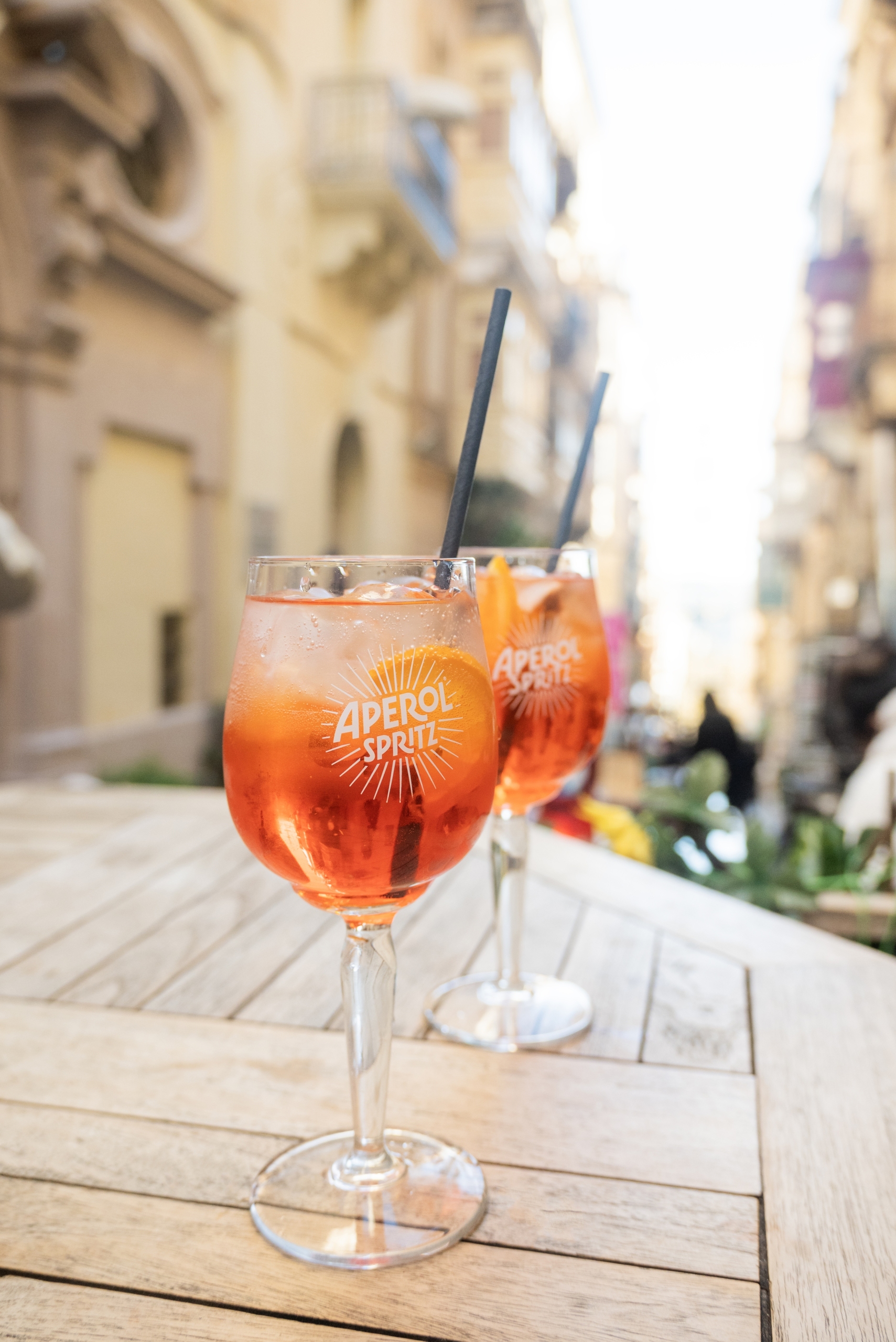
The Kinnie Spritz is not a complicated drink. It does not need to be. Equal parts Kinnie and prosecco, or Kinnie with Aperol and a splash of soda, over ice, with a slice of orange — the variations are minor. What matters is the combination of Kinnie’s bitterness with the lightness of sparkling wine, which produces something genuinely refreshing in a way that neither component achieves alone.
It has become the default aperitivo of the Maltese summer, appearing on menus from Valletta’s waterfront bars to the outdoor tables that appear in village squares during festa week. During the days leading up to Santa Marija, when seven parishes simultaneously celebrate the Assumption and the entire country takes the week as the midpoint of summer, the Kinnie Spritz occupies the same cultural role that the Aperol Spritz plays in the Veneto or the tinto de verano in Andalusia. It is what you drink while the decorations go up and the band club rehearses and the smell of gunpowder from the afternoon petards drifts through the streets.
Festa hospitality
Maltese festa culture has its own grammar of hospitality. Traditions go back to the late 18th century and involve street parades, marching bands and fireworks that last all day. Within that grammar, food and drink are not incidental. Tables appear outside front doors. Neighbours who have not spoken since last August reappear. The band club bar opens earlier than usual and closes later.
The Kinnie Spritz fits this context because it is, crucially, not too strong. A festa runs from early afternoon through to well past midnight, and the hospitality is continuous. You need a drink that can pace itself. Kinnie’s bitterness also acts as a natural palate cleanser alongside the fried rabbit, the pastizzi, the ftira loaded with tuna and capers that emerge from kitchens throughout the week.
For pilgrims arriving in Malta during August — whether to walk the opening stages of the Camino Maltés from St Paul’s Grotto, or to explore the Marian shrines with XirCammini — the Kinnie Spritz is the most immediate and honest introduction to the island’s character. It is Mediterranean and slightly bitter and deceptively light. It tastes like somewhere that has been doing this for a very long time and sees no reason to change.
“If you love it, you love it passionately,” says Michael Farrugia at Farsons, “because there’s nothing really like it to replace it.”
That is, precisely, the point. Malta does not produce a Kinnie Spritz because the world needed another aperitivo. It produces one because Kinnie exists, and Kinnie exists because in 1952 a man from a small island in the middle of the sea decided that his country deserved its own drink — and he was right.
Santa Marija: Malta’s greatest feast and the island’s Marian soul
AI Transparency Notice
PilgriMaps uses artificial intelligence tools to assist in the research, drafting and translation of editorial content. All AI-assisted content is reviewed, edited and verified by our editorial team before publication. We contrast information against primary sources, specialist literature and on-the-ground knowledge to ensure accuracy, cultural sensitivity and editorial integrity.
AI is one tool among many in our workflow. The judgement, curation and responsibility for everything published on this platform remain entirely human.
Viator Media S.L. — in compliance with the EU Artificial Intelligence Act (Regulation EU 2024/1689).
This post is also available in: