There is a small church on Victory Street in Valletta that almost nobody notices. Tourists pass it on their way to the Co-Cathedral, glance at its modest limestone façade and continue walking. It has no towering dome, no gilded interior competing with St John’s, no queue of visitors waiting to enter. What it has is something rarer: it is the oldest building in the city, and the reason the city exists at all.
The Church of Our Lady of Victory was the first building completed in Valletta. It was built on the site where, on 28 March 1566, Grand Master Jean Parisot de Valette laid the foundation stone of the new fortress city that would later bear his name. A church was chosen as the first building deliberately. Before there were streets, auberges, palaces or fortifications, before Valletta was anything more than a bare limestone peninsula, there was an act of thanksgiving — and that act took the form of a small church dedicated to the Virgin Mary.
The story of why begins the previous September.
The summer that changed the Mediterranean
In the spring of 1565, the forces of Ottoman Sultan Suleiman the Magnificent surrounded the Maltese archipelago with an army numbering more than 50,000 men, including 6,000 elite Janissaries. The Knights of St John, under Grand Master de Valette, had perhaps 6,000 soldiers and the Maltese population behind a chain of fortifications centred on Birgu, Senglea and Fort St Angelo. What followed was one of the most ferocious sieges in the history of the Mediterranean.
It lasted five months. The Ottomans took Fort St Elmo after weeks of assault, at enormous cost. They bombarded Birgu and Senglea continuously. Disease and heat killed men on both sides. The Knights and the Maltese held out through a summer that should have destroyed them, and on the eve of 8 September — the Feast of the Nativity of Mary — the Ottoman forces unexpectedly abandoned the siege.
De Valette’s response was immediate and physical. Overwhelmed with gratitude, he laid his sword and hat at the altar steps, dedicating the victory to the Blessed Virgin. The date — 8 September, the feast of the Birth of Our Lady — became inseparable from the victory. The holiday that had previously been known simply as Il-Bambina — Baby Mary — began to be called Il-Madonna tal-Vitorja: Our Lady of Victories.
The Great Siege of Malta: A collective pilgrimage of Faith and Resistance
The following spring, when de Valette drove the first stone of his new city into the limestone of Mount Sceberras, the site chosen for the inaugural Mass was the site that would become Our Lady of Victory Church. It is said that the valiant Grand Master would spend many hours in prayer here during the building of Valletta. When he died in 1568, his remains were temporarily buried here before being moved to St John’s Co-Cathedral. The inscription on his tomb — composed by his Latin Secretary, Sir Oliver Starkey, the last English knight at the time of the Siege — reads: Here lies La Valette, worthy of eternal honour, he who was once the scourge of Africa and Asia, and the shield of Europe, whence he expelled the barbarians by his Holy Arms, is the first to be buried in this beloved city, whose founder he was.
A date that keeps accumulating
What makes 8 September so extraordinary in Malta is that history did not stop adding to it in 1565.
Victory Day commemorates not one but three historical sieges: the Great Siege of 1565, the Siege of Valletta by the French ending in 1800, and the Siege of Malta during the Second World War ending in 1943. In 1800, the French — who had seized the islands from the Knights in 1798 — were finally expelled after a two-year blockade, and that too fell on 8 September. Then came the most devastating siege of all.
During the Second World War, Malta endured over three thousand air raids — more bombs per square mile than any place on earth during the conflict. The islands were awarded the George Cross in April 1942. On 8 September 1943, the Italian fleet surrendered to the Allied Forces outside Malta’s Grand Harbour. The war was not over, but the immediate mortal threat had passed. Once again, 8 September.
Malta in World War II: The Siege, the Faith, and the Fire that did not break
The Church of Our Lady of Victory was not spared the war’s violence. On 23 April 1942, the church ceiling was damaged as a consequence of an air raid that destroyed the nearby Royal Opera House. The building that had stood since 1566 was left exposed to the elements. Its subsequent decline was slow and painful; restoration, begun by the National Trust of Malta, Din l-Art Ħelwa, was ongoing as recently as 2011, when the government entrusted the church to Din l-Art Ħelwa as its guardian.
The coincidence — if coincidence is the right word — of three defining moments of Maltese survival clustering on the same feast day has produced something unusual: a date that is simultaneously a Marian feast, a national holiday and a day of collective memory unlike any other in the Catholic calendar. The feast originally celebrates the Virgin Mary’s nativity, and local parishes go all out — altars dressed in lavish garlands, red damask hung everywhere, the most beautiful ornaments put on display, towns decorated and local bands filling the streets with joyous marches. But beneath the celebration runs a current of something more serious: the Maltese awareness that this date has been tested, more than once, and has held.
The Birgu layer
The church on Victory Street is not the only place where this devotion lives. Before there was a Valletta, the Knights held out in Birgu — the fortified peninsula across the Grand Harbour now known as Vittoriosa, the Victorious City, a name it received in thanksgiving for 1565. The Church of the Annunciation in Birgu was renamed Our Lady of Victories after the Siege, and Fort St Angelo in Birgu, where the Siege was centred, continues to carry the weight of that memory.
Birgu, Senglea and Cospicua — the Three Cities — were the places that actually survived the Ottoman assault. Walking their streets on 8 September, with the Grand Harbour below and the fortifications rising on every side, gives a different texture to the feast than the more processional celebrations elsewhere on the island. Here the devotion has a topography: these are the specific streets and bastions where the outcome was decided.
Il-Vitorja on the water
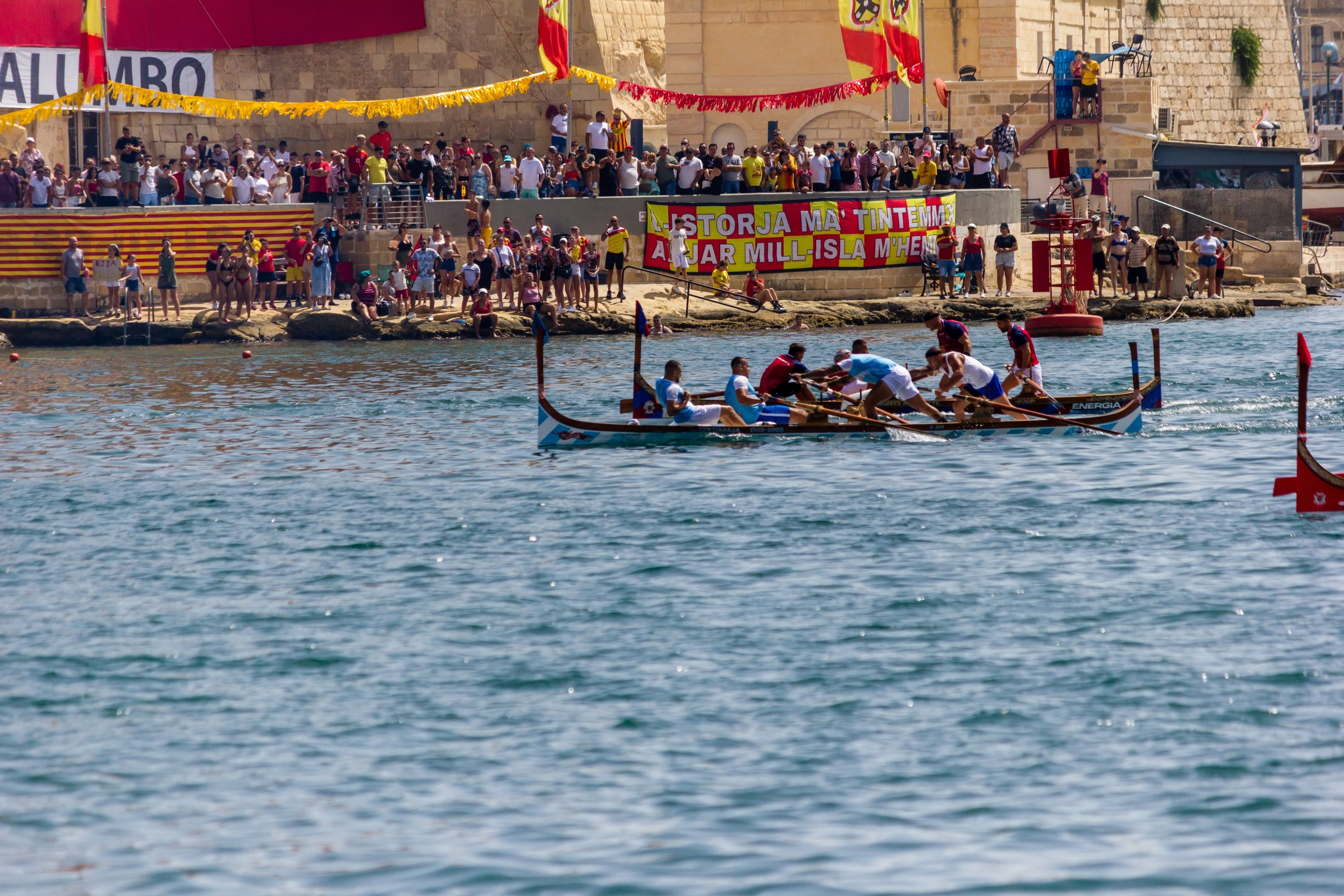
One of the most distinctively Maltese expressions of the feast takes place not in a church at all but on the Grand Harbour itself. The famous regatta — one of the oldest sporting traditions in the islands — is held in the Grand Harbour on Victory Day, with boat races observed from the bastions above.
The competing teams represent Valletta, Senglea, Cospicua, Vittoriosa and other villages, and the rivalry between them is ancient and intensely felt. The regatta is not an entertainment grafted onto the feast. It is an expression of the same civic pride, the same sense of collective survival, that built the church on Victory Street in the first place.
The small church and what it means
There is a detail worth sitting with. When Jean Parisot de Valette decided that the first building in his new city would be a church, and that the church would be dedicated to the Virgin of Victory, he was making a statement about the relationship between faith and survival that the Maltese have been living ever since.
The city itself — Valletta, the fortified capital, the place the Knights built to make sure what happened in 1565 could never happen again — begins with an act of gratitude rather than an act of power. The first stone is a church, not a fortress. The city is named after the Grand Master, but it begins with the Virgin.
Walk up Victory Street on any morning, away from the crowds at St John’s and the Upper Barrakka, and you will find the small church at the corner of Merchants Street. It is open, usually quiet, and easy to miss. The titular painting behind the main altar depicts the Nativity of the Virgin. A bronze bust of a pope looks out from the façade. Inside, the accumulated weight of four and a half centuries is present in the proportions of the space — small enough that you feel the walls, old enough that the limestone has darkened to the colour of the city itself.
This is where Valletta began. This is where de Valette prayed while his city rose around him. This is where his body was laid before the greater church was ready to receive it. And this is the place whose feast day — 8 September, Il-Vitorja — the Maltese have been marking, in one form or another, for four hundred and sixty years.
This content comes to you in collaboration with VisitMalta
AI Transparency Notice
PilgriMaps uses artificial intelligence tools to assist in the research, drafting and translation of editorial content. All AI-assisted content is reviewed, edited and verified by our editorial team before publication. We contrast information against primary sources, specialist literature and on-the-ground knowledge to ensure accuracy, cultural sensitivity and editorial integrity.
AI is one tool among many in our workflow. The judgement, curation and responsibility for everything published on this platform remain entirely human.
Viator Media S.L. — in compliance with the EU Artificial Intelligence Act (Regulation EU 2024/1689).
This post is also available in: