There is a widespread image of the Camino del Norte: a pilgrim always advancing beside the Cantabrian Sea, between cliffs, beaches and fishing villages, on the road to Santiago. The reality is considerably more interesting.
The Norte does not follow the coast continuously, nor does it reproduce metre by metre a medieval route. It is not the oldest Camino de Santiago either. Its distinctiveness lies elsewhere: for centuries it functioned as a great overland corridor connected to the ports of the Cantabrian coast and, at the same time, to other pilgrimage destinations. From it you could continue toward Compostela, turn aside toward Santo Toribio de Liébana, or head to Oviedo and join the Camino Primitivo.
Today the Camino del Norte typically departs from Irún or Hondarribia, crosses the Basque Country, Cantabria and Asturias, and enters Galicia — usually via Ribadeo — before converging with the Camino Francés at Arzúa. The total distance depends on variants and measurement criteria, but can be estimated at around 820 kilometres, generally requiring approximately 30 to 35 days on foot.
An ancient road, but not the first
The pilgrimage to Compostela began to develop following the discovery, in the 9th century, of a tomb identified as that of the Apostle James. Tradition connects the earliest years of the shrine with Alfonso II, King of Asturias, who promoted the original church built over the tomb.
The itinerary associated with that journey from Oviedo toward Galicia is at the origin of the present-day Camino Primitivo. For that reason it is more accurate to reserve for this route the distinction of being the first traditionally documented Jacobean Camino.
The Camino del Norte arose differently. Pilgrims coming from territories to the east, and others arriving by sea, made use of roads already existing between settlements, valleys, bridges, monasteries, markets and ports.
Nobody designed in the Middle Ages a single route from Irún to Santiago. What existed was a communication network that gradually acquired a Jacobean function. The Camino we see today is therefore a living historical route.
The Camino del Norte is not the Camino Inglés
The Norte’s relationship with the sea can produce another common confusion: with what is known as the Camino Inglés, or the English Way.
The Camino Inglés is also deeply connected to pilgrims arriving from northern Europe, but the two routes functioned differently.
On the Camino Inglés, the sea crossing led to Galicia. Pilgrims from England, Flanders and other territories disembarked at ports such as A Coruña or Ferrol and from there undertook the overland section of their journey to Santiago.
On the Camino del Norte something different occurred. There was a long overland corridor running along the Cantabrian coast. The ports were gateways into that corridor.
A traveller might arrive overland from the east, but could equally disembark at Bermeo, Bilbao, Santander or another port and continue westward from there.
The difference can be stated simply: the Camino Inglés extended a sea journey by land; the Camino del Norte was an overland road open to the sea.
And there is a further distinction: whereas the Inglés leads essentially toward Santiago, the Norte offers historical connections to other major pilgrimage centres.
A road from which other roads depart
This is probably its most singular characteristic. The first great crossroads appears in Cantabria. After passing through Castro Urdiales, Laredo, Santander, Santillana del Mar, Comillas and San Vicente de la Barquera, the pilgrim reaches the area around Muñorrodero. From there the road can continue toward Santiago or turn inland toward the Picos de Europa along the Camino Lebaniego, which leads to the monastery of Santo Toribio de Liébana.
The second great fork lies in Asturias. After covering Llanes, Ribadesella and Villaviciosa, the walker arrives at Casquita. There the routes divide: toward Gijón the Camino del Norte continues; toward the interior the road to Oviedo opens. Those who choose this second option can reach the cathedral of San Salvador and then continue toward Compostela along the Camino Primitivo.
The connection is not accidental. For centuries, the relics preserved in Oviedo exerted a strong pull on pilgrims. From that tradition comes the well-known medieval saying that recalled the importance of visiting the Saviour before continuing to Santiago.
In this way, over just a few hundred kilometres, the Camino del Norte connects three great pilgrimage geographies: Compostela, Liébana and Oviedo.
The Basque Country: A demanding beginning
The Camino opens with a warning for anyone who imagines it as a gentle coastal stroll. From Irún or Hondarribia, the Basque terrain introduces frequent climbs and descents. The crossing of Jaizkibel, the arrival at Pasaia, San Sebastián, Zarautz and Deba already show the characteristic mixture of the Norte: sea, forest, farmhouses, urban centres and inland stretches.
Afterwards the itinerary moves away from the coast to cross Markina-Xemein, the area around Ziortza, Gernika and Bilbao. This is one of the stretches where it is worth calculating stages not only by kilometres but also by elevation gain. A relatively short stage can prove more demanding than expected.
Cantabria: Bays, coastal towns and a decision
On entering Cantabria the landscape opens up. Castro Urdiales and Laredo retain the character of old port towns; Santoña introduces marshes and estuaries; Santander confronts the walker again with the scale of a large city. Further on come Santillana del Mar, Comillas and San Vicente de la Barquera.
The crossings of bays and river mouths also explain why this section of the Camino has historically had various alternatives. Where roads and bridges exist today, for centuries there may have been ferryboats or overland detours.
This is also the territory in which the pilgrim must decide whether to continue directly toward Asturias or to add the Liébana diversion to the journey.
Asturias: Between the Cantabrian Sea and the Primitive Way
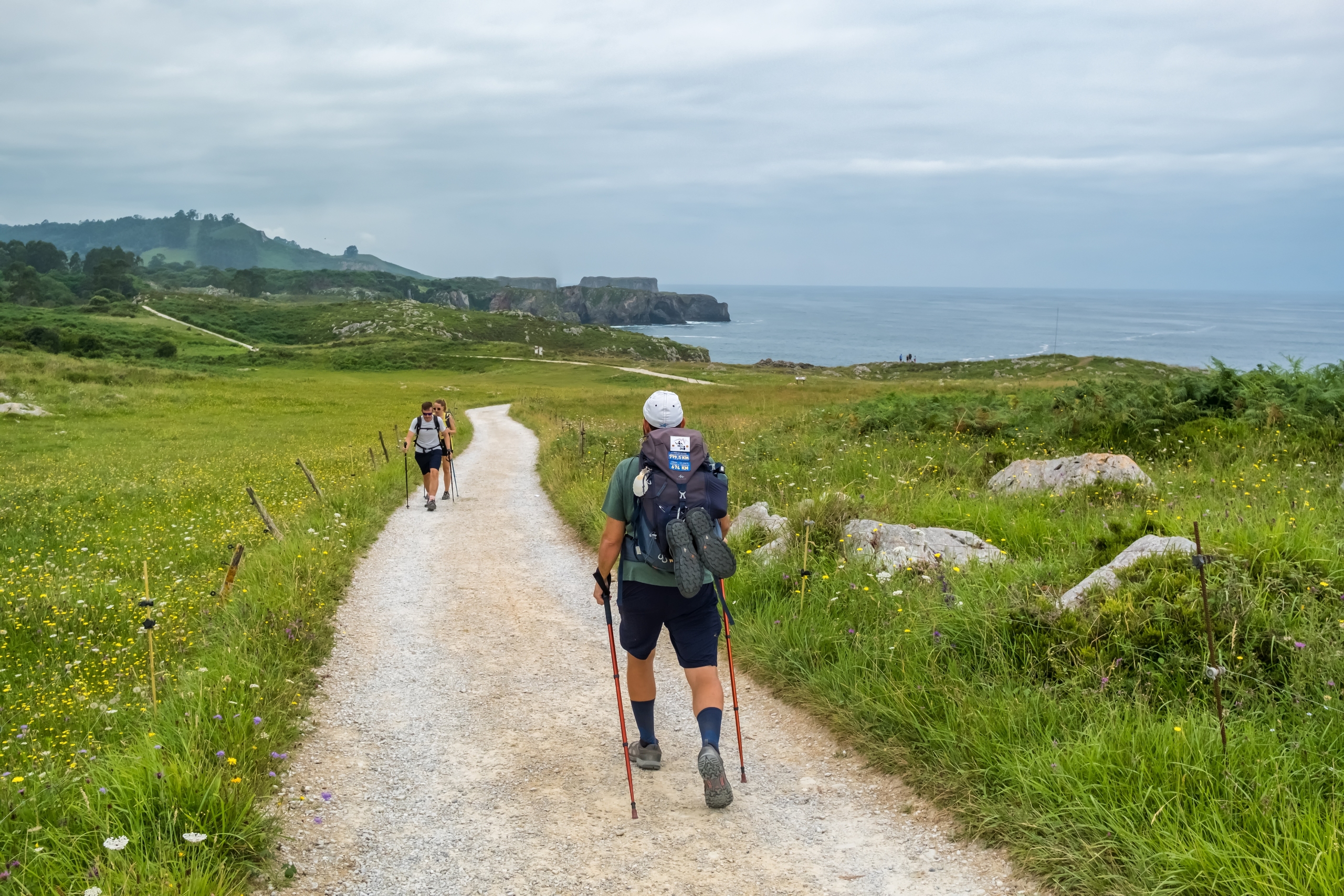
The entry into Asturias takes place in a landscape where the proximity of sea and mountain shapes the route once again. Llanes and Ribadesella lead toward Villaviciosa and Casquita, the key junction for those wishing to connect with Oviedo.
Those who remain on the Norte continue toward Gijón and Avilés and then pass through a succession of smaller settlements in western Asturias: Muros de Nalón, Soto de Luiña, Luarca, Navia and A Caridá.
As the Eo estuary approaches, another decision presents itself. Today many pilgrims cross directly toward Ribadeo via the Ponte dos Santos. There is also the inland variant that continues via Vegadeo and Santiago de Abres before entering Galicia.
Galicia: The sea falls behind
Ribadeo marks a clear change. The pilgrim quickly leaves the maritime landscape behind and moves into Galicia via Vilanova de Lourenzá before reaching Mondoñedo, one of the historically most important towns on the Galician stretch.
Its cathedral, its status as a former episcopal see and the very configuration of the town recall that the Camino was not organised solely around distances, but also around places capable of receiving, guiding and sheltering travellers.
From Mondoñedo the climb toward Abadín begins. Then come Vilalba, Baamonde and the monastery of Sobrado dos Monxes. Finally, at Arzúa, the Camino del Norte joins the Camino Francés.
How to walk it today
Those with the time to complete the full route should allow approximately five weeks, though the number of stages depends greatly on physical condition and daily distances chosen.
A reasonable distribution would be around eight or nine stages for the Basque Country, seven or eight for Cantabria, eleven to thirteen for Asturias and around eight for Galicia. The official stage divisions should not be treated as obligations: some administrative stages exceed 30 kilometres considerably and are worth subdividing.
An additional basic precaution applies: on the Norte, difficulty does not depend solely on distance. The terrain, particularly in the Basque Country and certain Asturian sections, can significantly alter the feel of a stage.
A network still visible
The great appeal of the Camino del Norte does not consist solely in views of the Cantabrian Sea.
Its history explains something deeper about medieval pilgrimage. Routes did not function like modern roads with a fixed start, a fixed end and an invariable course. They were networks formed by ports, bridges, hospitals, monasteries, cities, secondary roads and shrines.
The pilgrim could disembark at a port, join an existing route, turn aside toward Liébana, enter Oviedo and then continue by another Camino.
That is why the Norte remains, perhaps more than any other great Jacobean itinerary, the Camino that allows us to understand that in former times roads did not end where another began: they met.
AI Transparency Notice
PilgriMaps uses artificial intelligence tools to assist in the research, drafting and translation of editorial content. All AI-assisted content is reviewed, edited and verified by our editorial team before publication. We contrast information against primary sources, specialist literature and on-the-ground knowledge to ensure accuracy, cultural sensitivity and editorial integrity.
AI is one tool among many in our workflow. The judgement, curation and responsibility for everything published on this platform remain entirely human.
Viator Media S.L. — in compliance with the EU Artificial Intelligence Act (Regulation EU 2024/1689).
This post is also available in: