In New Zealand there is a pilgrimage road that is not measured in kilometres and is not recognised by arrows guiding travellers. Its history began almost two centuries ago beside the waters of the Hokianga, but it took an unexpected form in 2021, when an image of Mary set out on a journey across the whole country. It crossed rural communities, churches, schools and Māori meeting places, carrying with it a singular combination of European and indigenous symbols.
In most pilgrimages it is people who travel toward a venerated image. Here something different happened: for roughly a year, it was the image that travelled to meet the communities.
So began the contemporary stage of Te Ara a Maria, an initiative that recovers an old Catholic tradition and turns it into an invitation to discover the various memories of Aotearoa, the Māori name for New Zealand.
A story that began in 1838
To understand this pilgrimage one must travel to the far north of the North Island, where the green landscapes of the Hokianga meet the waters of a wide harbour. It was there that the French bishop Jean-Baptiste François Pompallier, of the Society of Mary, arrived on 10 January 1838. Three days later he celebrated Mass at Totara Point and dedicated the New Zealand Catholic mission to Mary Assumed into Heaven.
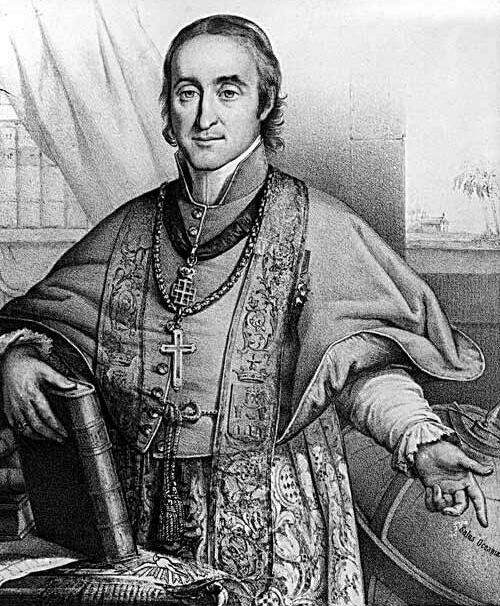
That event marked the beginning of a stably organised Catholic missionary presence in the country, although there had been earlier contacts with Catholicism. Pompallier’s arrival formed part of a much broader historical process. During those decades, European Christian missions were extending across territories inhabited for centuries by Māori peoples, whose traditions, systems of organisation and spiritual conceptions long predated colonisation.
In February 1840, Pompallier took part in the discussions surrounding the Treaty of Waitangi, one of the foundational documents of New Zealand history. His intervention is particularly remembered for his defence of religious freedom. The history of those first missionaries, however, cannot be separated from colonial tensions, disputes over land and the profound transformations experienced by indigenous communities. That complexity remains part of the country’s religious and cultural memory.
A tradition reborn during the pandemic
Almost two centuries later, an unexpected health crisis brought that old dedication back into the present. During the lockdown of 2020, various sectors of the New Zealand Catholic community asked their bishops for a consecration of the country to Mary, as an expression of hope and protection in uncertain times.
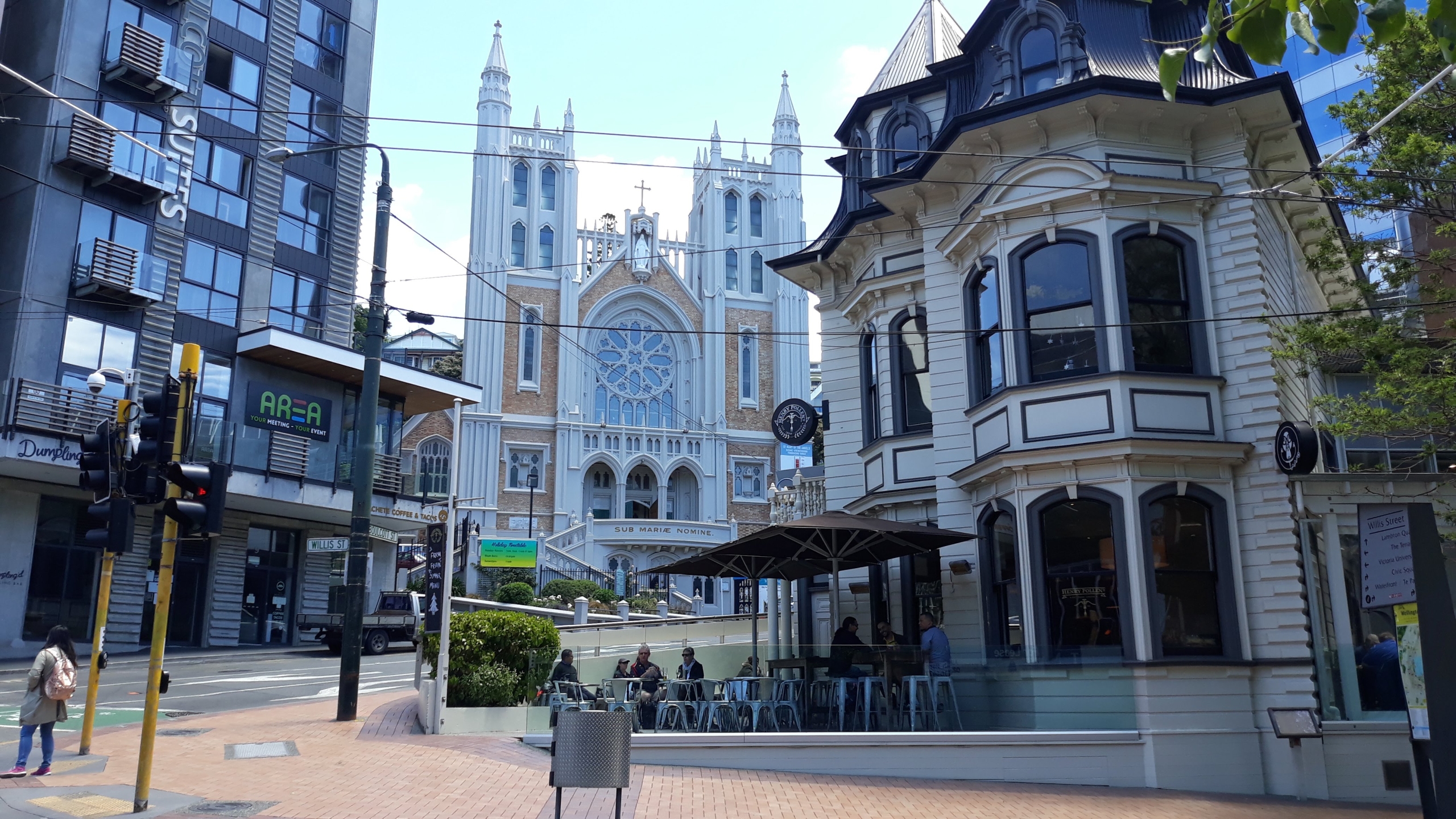
Church leaders then recalled that this gesture had already been made in 1838. They decided, therefore, to renew it. The initiative was given the name Te Ara a Maria — Mary’s Way. On 15 August 2021, the feast of the Assumption, the principal act of renewal was celebrated at the church of St Mary of the Angels in Wellington.
But the most original part was yet to begin. To accompany the project, a work of Marian art was commissioned that would travel through New Zealand’s six Catholic dioceses. The journey, called a hīkoi wairua — spiritual pilgrimage — carried the image through parishes, schools and local communities, including some Māori ones.
Health restrictions temporarily interrupted the route, but the work continued its journey until it returned to Wellington in August 2022. On the 14th of that month, St Mary of the Angels was formally dedicated as the National Shrine of Mary, Mother of God, Assumed into Heaven.
A Mary clothed in Māori symbols
The visual protagonist of Te Ara a Maria is a work by the New Zealand artist Damien Walker, titled Ko Hāta Maria, te Matua Wahine o te Atua, depicting Mary with the Child. At first glance it preserves recognisable features of Christian iconography. But closer observation reveals an artistic language deeply connected to Aotearoa.
Mary appears wrapped in a korowai, a traditional Māori cloak. The composition incorporates motifs such as the koru, a spiral form inspired by the unfurling fern frond and frequently associated with ideas of growth and renewal. There are also references to the kaitiaki, figures linked to protection and guardianship, and to elements of indigenous material culture.
The Child wears a cloak of kiwi feathers and holds a book symbolically connected to the history of the first Catholic mission. The work thus constitutes a contemporary interpretation seeking to establish a dialogue between two cultural traditions. Its creation was informed by Māori advice, though this does not mean it represents a view shared by all the country’s indigenous communities.
Part of its interest lies precisely there. Beyond its devotional function, the image raises questions about the relationship between religion, cultural identity and colonial memory. How is a tradition transformed when it encounters a new territory? What happens when symbols from different worlds share a single representation? These are questions that make this painting something more than the centrepiece of a pilgrimage.
A road with no single route
Unlike the Camino de Santiago or other great international itineraries, Te Ara a Maria has no continuous waymarked course, no official distance, no obligatory sequence of stages. The national journey of 2021 and 2022 was the travelling of an image carried between communities, not a walk on foot from one end of the country to the other.
The present-day pilgrimage works differently. Its centre is Wellington, where the work now remains, and it proposes the discovery of various religious, historical and cultural sites in the region.
The natural starting point is St Mary of the Angels, a neo-Gothic church in the heart of the city. Among contemporary buildings and commercial streets, its interior offers a marked contrast with the everyday rhythm of the capital. From there, the traveller can visit the monument dedicated to the Polish children who arrived as refugees during the Second World War. Their memory brings into the itinerary a history of exile, welcome and personal reconstruction.
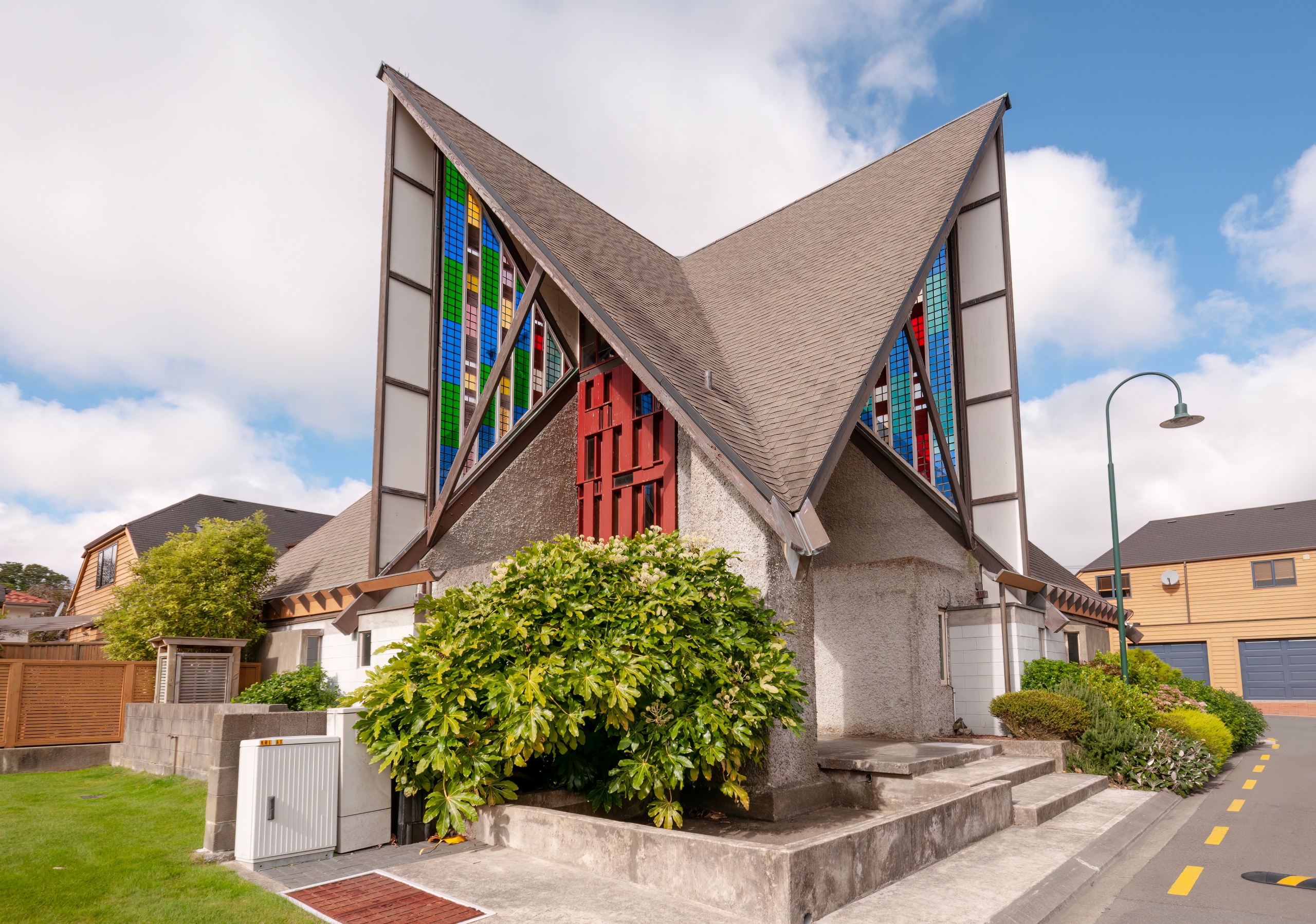
Another site is the old Catholic cemetery on Mount Street, a testimony to the first generations of European inhabitants of Wellington. In Karori stands the extraordinary Futuna Chapel, designed by the architect John Scott and opened in 1961. Considered one of the outstanding works of New Zealand modernism, it integrates European and Māori architectural references. Its value extends well beyond its religious function.
Toward Island Bay, the route leads to Our Lady’s Home of Compassion, a place particularly bound to Suzanne Aubert, the French religious sister who carried out extensive social and charitable work in New Zealand. Her life recalls another dimension of the country’s Christian history: care for the sick, the vulnerable and the marginalised.
The itinerary can be extended northward to the historic church of St Joseph’s at Pāuatahanui, and to the great Marian monument at Paraparaumu, set on high ground overlooking part of the coastal landscape.
Taken together, these places show that Te Ara a Maria is not solely a proposal of religious devotion. It also allows the exploration of architecture, migration, social history and heritage, in a territory where European and Māori memories coexist in complex ways.
A pilgrimage for seeing differently
Perhaps the most singular thing about Te Ara a Maria is that it does not propose conquering a distance or reaching a goal after days of walking. Its course depends on the questions and interests of each visitor. For some it will be a spiritual experience; for others, an opportunity to discover little-known episodes of New Zealand’s history or to contemplate works of art and architecture far from the usual tourist circuits.
The project also reflects a broader transformation in contemporary pilgrimage, increasingly open to those who approach it for cultural, historical or personal reasons.
The image that travelled the country now remains in Wellington. The journey it inspired, however, continues in another form: inviting people to discover the places, communities and stories that make up the memory of Aotearoa.
Not every pilgrimage needs a long path to become a meaningful journey. Some begin simply when we learn to look at a territory with different eyes.
How to Walk Te Ara a Maria Today
The principal characteristic of Te Ara a Maria is its flexibility. There is no official route with stages, fixed distances or pilgrim credential. The organisation proposes seven places of interest, which can be visited in whatever order each traveller chooses.
To see them without rushing, a reasonable approach is to allow two days for Wellington and one additional day for the Kāpiti coast.
Day one: central Wellington and Karori
Begin at St Mary of the Angels, 17 Boulcott Street, where the image of Mary is kept. Continue to the memorial to the Polish children in Frank Kitts Park, and climb up to the historic Mount Street cemetery in Kelburn. The day can end at Futuna Chapel in Karori, provided it coincides with opening hours.
The chapel usually opens on the first Sunday of each month, from 11:00 to 15:00, and accepts arranged visits.
Day two: Island Bay and the legacy of Suzanne Aubert
Devote the morning to Our Lady’s Home of Compassion, 2 Rhine Street. The complex offers a chapel, the resting place of Suzanne Aubert, and spaces dedicated to her story.
The chapel and resting place publish daily opening, usually from 8:00 to 16:00. It is worth checking the hours of the other spaces.
Optional day three: Pāuatahanui and Paraparaumu
The northern extension allows a visit to the church of St Joseph’s, built in 1878, and the monument of Our Lady of Lourdes at Paraparaumu.
This day is best done by car. St Joseph’s is private property with no general public access and requires prior authorisation to enter. The Paraparaumu monument, fourteen metres high, is reached by an uphill climb.
Tips for planning the trip
The best time for combining heritage with walking is usually late spring, summer or the beginning of the southern autumn. Those wishing to take part in the religious celebrations may choose August, around the feast of the Assumption, though they should expect the New Zealand winter.
Wellington is known for its strong winds and changeable weather, so waterproof clothing, comfortable footwear and sun protection are advisable. The city has public transport, including the number 2 bus, useful for reaching Karori.
There is no general registration fee for Te Ara a Maria. The main costs are the usual ones of travel, accommodation and transport; some sites accept voluntary donations, known as koha.
Before setting out, the most useful step is to consult the official Te Ara a Maria website, its selection of places to visit, and Wellington’s public transport planner.
The absence of a fixed route should not be read as a limitation. It is, in a sense, the feature that best defines this pilgrimage: every visitor can build their own way through the history and memory of New Zealand.
AI Transparency Notice
PilgriMaps uses artificial intelligence tools to assist in the research, drafting and translation of editorial content. All AI-assisted content is reviewed, edited and verified by our editorial team before publication. We contrast information against primary sources, specialist literature and on-the-ground knowledge to ensure accuracy, cultural sensitivity and editorial integrity.
AI is one tool among many in our workflow. The judgement, curation and responsibility for everything published on this platform remain entirely human.
Viator Media S.L. — in compliance with the EU Artificial Intelligence Act (Regulation EU 2024/1689).
This post is also available in: