When modern readers encounter Hildegard von Bingen’s Scivias, it is often through text. Yet for Hildegard’s contemporaries, the most immediate and powerful impression of her visions came through image. The Scivias manuscript produced at Rupertsberg—now lost but preserved in a 1920s facsimile—contains a cycle of full-page illuminations that translates twenty-six dense visionary episodes into diagrammatic, architectural, and cosmic forms. These images illustrate the text, but they are also integral to its meaning. The visions are spatialized. They invite the viewer to enter a world mapped in symbol, light, and structure.
Seeing as moving
The illustrations resemble maps, not in the sense of plotting terrestrial terrain, but in their visual logic. Many adopt concentric designs, layered geometries, or axial symmetry. One of the best-known illuminations—the so-called “Cosmic Egg” of Vision I.2—depicts the universe as an ovular enclosure bounded by fire, wind, and stars. Others portray the heavenly hierarchy, towers of virtues, or personified souls ascending toward a radiant source. Each image operates as a visual itinerary: a progression across moral, cosmic, or theological space.
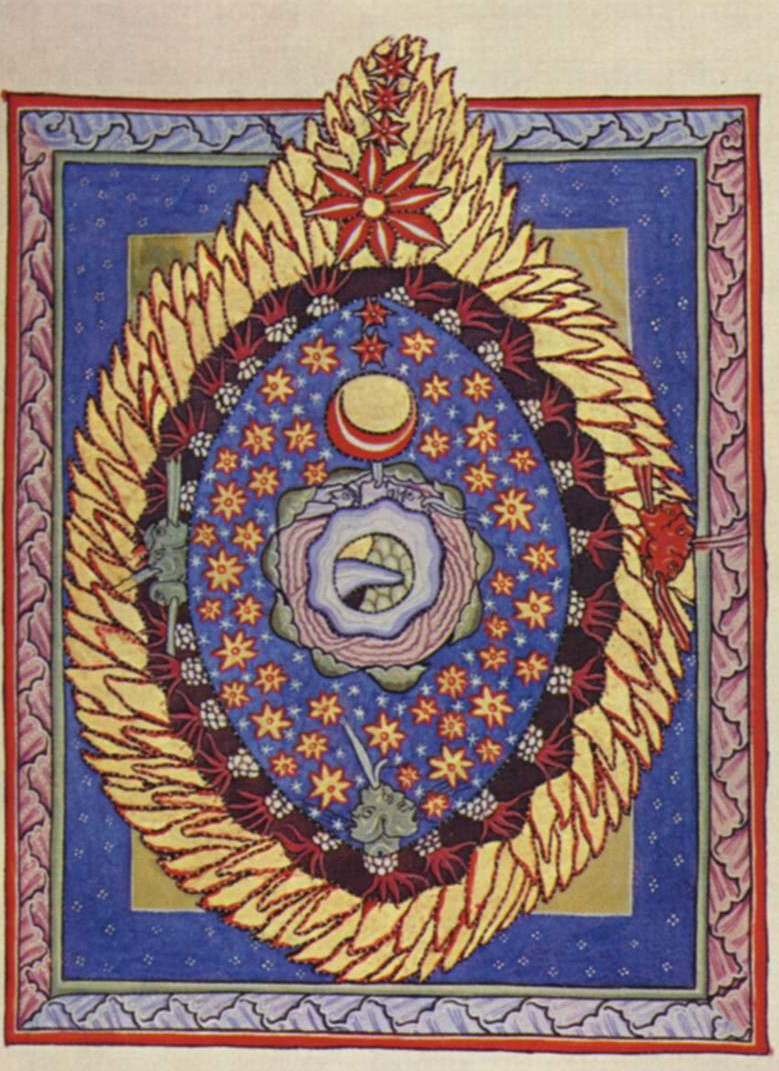
For the viewer, the act of looking becomes an act of moving—through layers of meaning, through allegorical architecture, and toward an envisioned goal. This mirrors the conceptual structure of pilgrimage, in which physical distance is paralleled by interior transformation. The illuminations served as cognitive tools for meditation and instruction, particularly within Hildegard’s monastic community. They were never passive images; they were active maps of meaning.
Image as pilgrimage map
The visual program of Scivias can be situated within the broader context of medieval devotional and pedagogical culture, where sacred knowledge was often transmitted through spatial metaphors. Manuscripts, especially those created for enclosed communities, were designed to be used—not simply read, but handled, shown, and discussed. Hildegard likely oversaw the production of the Rupertsberg Codex, and may have sketched or described the visual content herself. Her visionary language is often already pictorial, and the illuminations reflect a conscious effort to codify and stabilize what she experienced in states of heightened perception.
Within this visual system, the manuscript itself became a kind of portable sacred space. It offered a pilgrimage of the eyes and mind, a structured engagement with theological insight. This aligns with broader developments in 12th-century spiritual culture, where sacred topographies—both real and imagined—were increasingly mapped onto visual, liturgical, and textual forms. Pilgrimage was not always about physical movement toward relics. It could also be enacted through the guided contemplation of symbolic worlds.
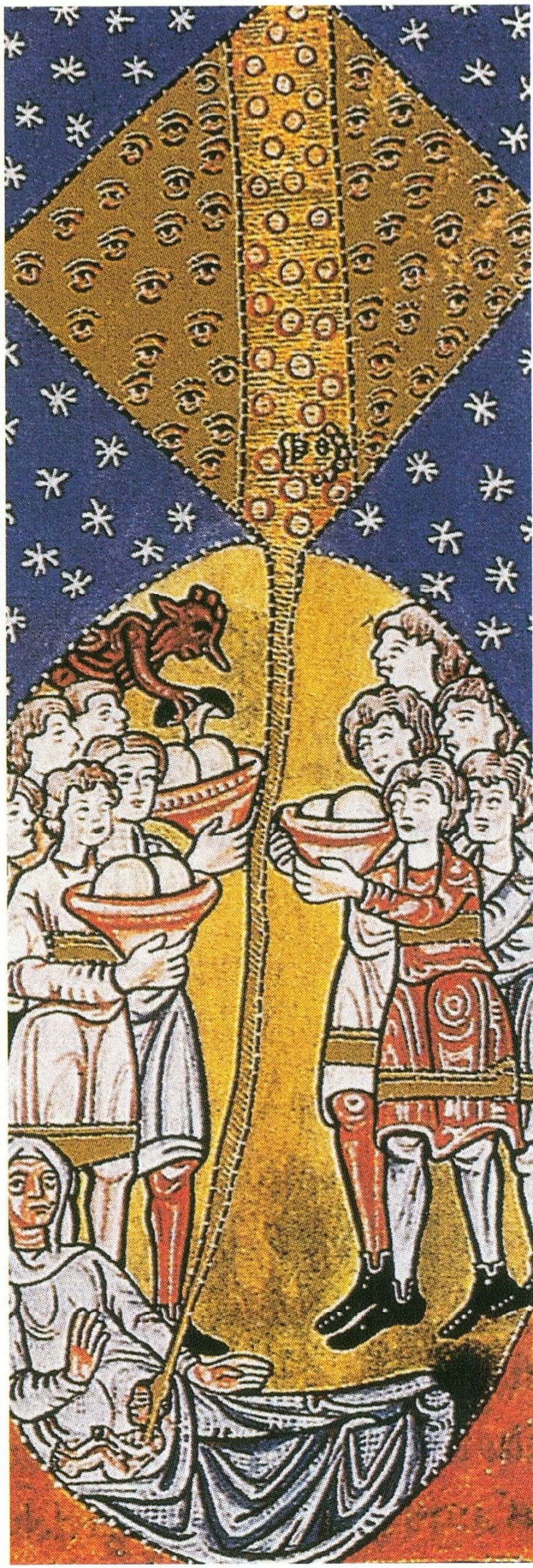
The Rupertsberg manuscript stood at the intersection of these practices. For the nuns at Hildegard’s monastery, and for visitors—abbots, scholars, noblewomen—the manuscript offered a structured cosmology to be contemplated, memorized, and internalized. Its images shared affinities with pilgrimage maps of the same period, such as schematic plans of the Holy Sepulchre or symbolic views of Jerusalem, which guided pilgrims spatially and spiritually. In both cases, the act of looking was itself a form of devotion.
Although the original codex was destroyed in the 20th century, the surviving facsimile captures its distinctive visual logic. Unlike later Gothic illumination, which often emphasized narrative scenes, the Scivias illustrations are diagrammatic and emblematic. They impose order on visionary experience, offering a stable architecture through which to navigate Hildegard’s often opaque language. The images don’t explain—they map.
In this sense, the Scivias illuminations occupy a unique place in the history of medieval visual culture. They are neither illustrations in the modern sense nor didactic images in the style of stained glass or sculpture. Instead, they are conceptual tools: devices for visual theology, for inner travel, for anchoring visionary experience in a form that others could follow.
Today, visitors to Hildegard’s sites—Disibodenberg, the hill above Bingen where Rupertsberg once stood, or the still-active convent in Eibingen—walk through landscapes shaped by centuries of cultural memory. But the most enduring map left by Hildegard is not on the ground. It is bound into vellum: an architecture of vision, designed for pilgrims of the mind.
AI Transparency Notice
PilgriMaps uses artificial intelligence tools to assist in the research, drafting and translation of editorial content. All AI-assisted content is reviewed, edited and verified by our editorial team before publication. We contrast information against primary sources, specialist literature and on-the-ground knowledge to ensure accuracy, cultural sensitivity and editorial integrity.
AI is one tool among many in our workflow. The judgement, curation and responsibility for everything published on this platform remain entirely human.
Viator Media S.L. — in compliance with the EU Artificial Intelligence Act (Regulation EU 2024/1689).
This post is also available in: