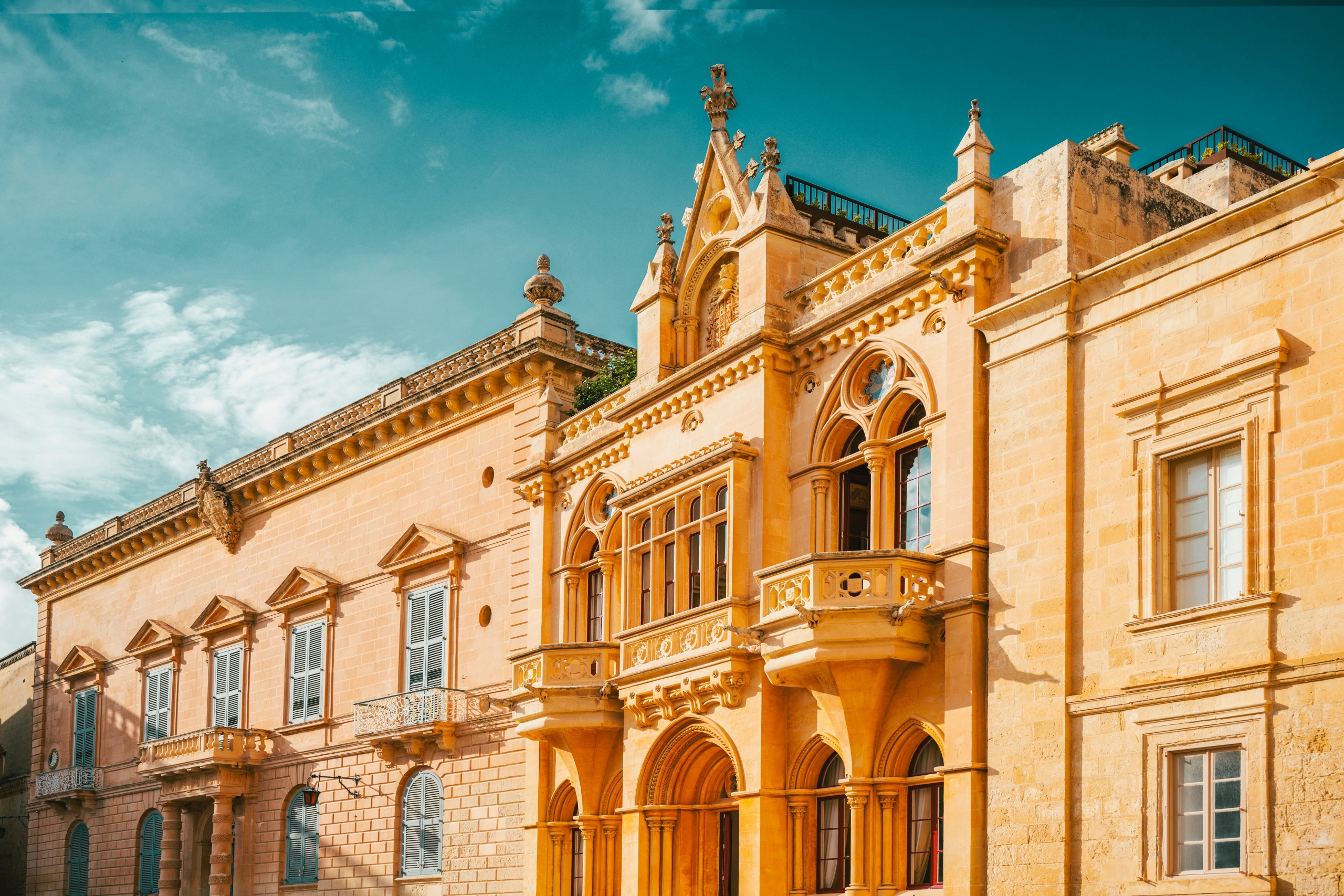
From the street, the Co-Cathedral of St John gives little sign of what it holds within. Its façade is severe, compact, almost military. Two bell towers flank it with a restraint that fits Valletta perfectly — a city born of war and designed as a fortress. Nothing, or almost nothing, prepares the visitor for what happens when they cross the door.
Then the space changes all at once.
The eye takes a few seconds to decide where to look. There is gold, coloured marbles, coats of arms, angels, flowers, funerary monuments, paintings, chapels, tombstones. The surfaces seem to compete with one another for attention. The floor is covered in images; the walls carved and gilded; above the nave stretches an enormous painted vault.
It is one of those interiors where the Baroque expression horror vacui — fear of the void — ceases to feel like an academic formula and becomes a physical experience.
A Building You Read from the Ground Up
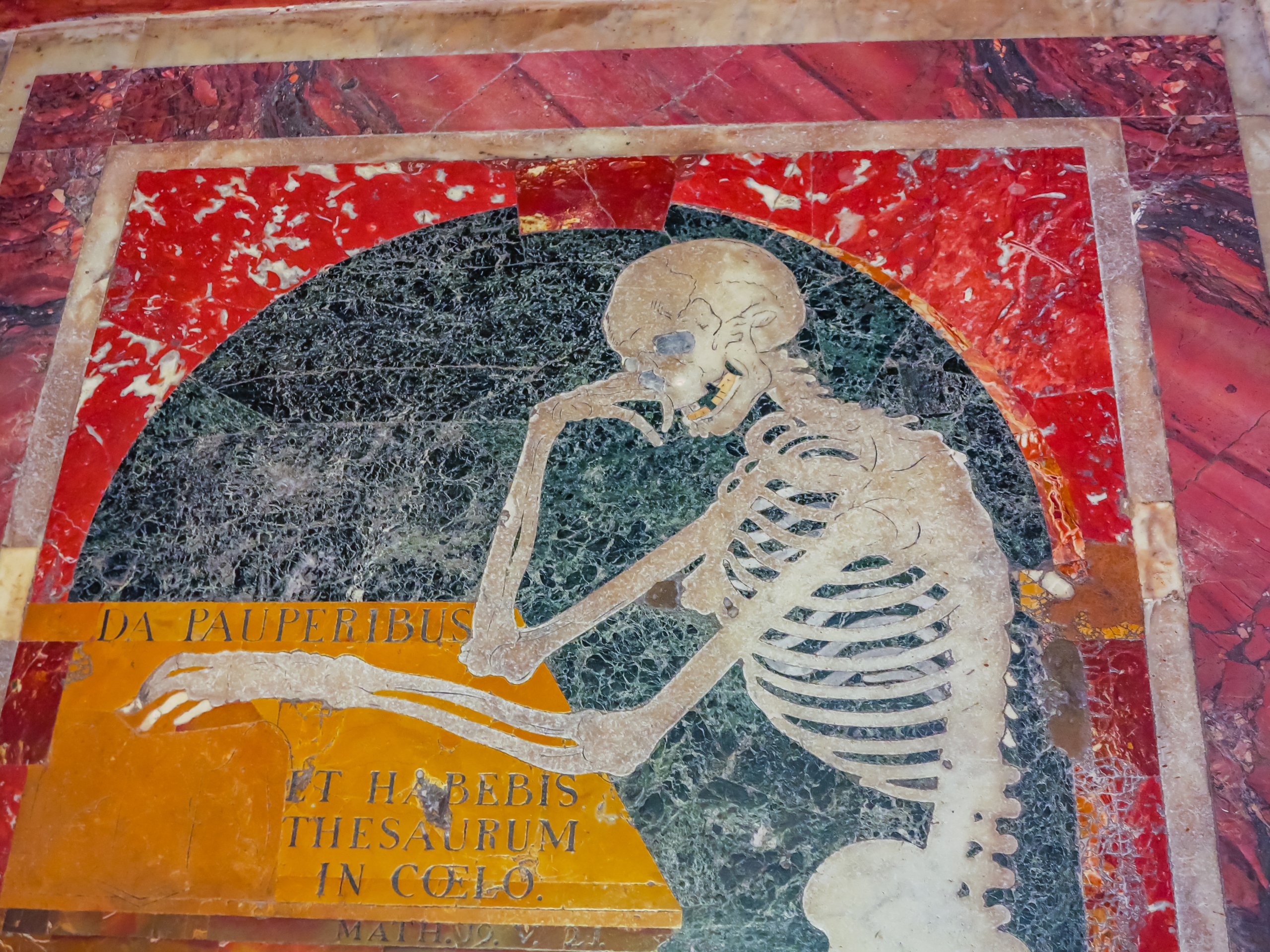
Perhaps the best way to understand St John’s is to begin with the floor.
The nave is covered by polychrome marble tombstones. Skeletons, scythes, hourglasses, suits of armour, flags, crowns, coats of arms and allegories of fame appear across it. They do not form a discreet pavement: they compel the visitor to walk literally over a vast funerary programme. The most elaborate pieces were made by cutting away the white marble and inlaying other marbles of different colours, in a technique close to stone marquetry.
The nave today preserves 154 sepulchral slabs, though approximately 407 inscriptions have been documented across the church as a whole. It is worth qualifying the tourist formula that “four hundred knights are buried beneath the floor”: many slabs were displaced and reorganised over time and do not always mark the intact original site of a burial.
Then there are the walls. Much of the ornamentation that at first glance appears to be stucco is, in fact, carved directly into the Maltese limestone and subsequently gilded. Foliage, flowers, figures, heraldic symbols and military motifs turn the architecture into an almost textile surface. The original building did not disappear beneath the decoration: the Baroque used the local stone itself to transform it.
On either side of the nave open nine chapels. Eight were associated with the langues — the “tongues” of the Order, groupings that organised the knights according to their European origins. Aragon, Italy, France, Provence, Germany, Auvergne, Castile, León and Portugal thus form a kind of political geography carved in stone and marble.
The ninth chapel is associated with the Virgin of Philermos and the Blessed Sacrament. More than simple devotional spaces, the chapels tell how an international institution represented itself within its own church.
And then, finally, you look up.
The great barrel vault was decorated by Mattia Preti, principally between 1661 and 1666, with episodes from the life of St John the Baptist. One detail tends to surprise: they are not frescoes. Preti painted in oil directly onto the stone. Fictive frames, perspectives, foreshortened figures and effects of depth make the painting appear to extend the real architecture, and certain figures seem about to leave the vault and enter the nave.
From the Church of a Military Order to an Aristocratic Setting
The history of St John’s begins after one of the decisive episodes in Maltese history. Following the Great Siege of 1565, the Order of St John decided to build a new fortified capital: Valletta. The conventual church was to occupy a central place in that city and become the great institutional space of the knights.
In 1572, Grand Master Jean de la Cassière commissioned the church from Girolamo Cassar, Maltese architect and military engineer. The main works were carried out between 1573 and 1577, and the church was consecrated on 20 February 1578. Its initial appearance belonged to the late Renaissance and Maltese Mannerism: solid, austere, contained.
The spectacular interior we know today belongs primarily to the following century. Under Grand Masters Raphael and Nicolas Cotoner, the church began to be transformed. Mattia Preti, who arrived in Malta at the end of the 1650s, became the great visual architect of that metamorphosis.
Successive generations added new layers. In the late 17th century, Grand Master Ramon Perellos commissioned in Brussels an extraordinary series of 29 tapestries. In 1726 the Cappella Ardente was added — a spectacular dismountable funerary structure designed by Romano Carapecchia that could reach around ten metres in height and accommodate some 230 candles.
The arrival of the French in 1798 ended the Order’s rule and opened a process that would eventually transform St John’s into a co-cathedral. The transition did not occur on a single unequivocal date, but gradually across the first decades of the 19th century. It was also a period of significant losses: a portion of the gold, silver and other precious objects was requisitioned during the French occupation.
Caravaggio, a room and an execution
But there is one place in St John’s where the Baroque almost disappears to make room for a different kind of intensity. It is the Oratory of St John.
Caravaggio arrived in Malta in 1607 after fleeing Rome following the death of Ranuccio Tomassoni in a brawl. He found the protection of Grand Master Alof de Wignacourt and, in July 1608, was admitted as a Knight of Magisterial Obedience. His stay was brief. A few weeks later he was involved in another fight, imprisoned in Fort St Angelo, escaped from Malta and was eventually expelled from the Order in absentia.
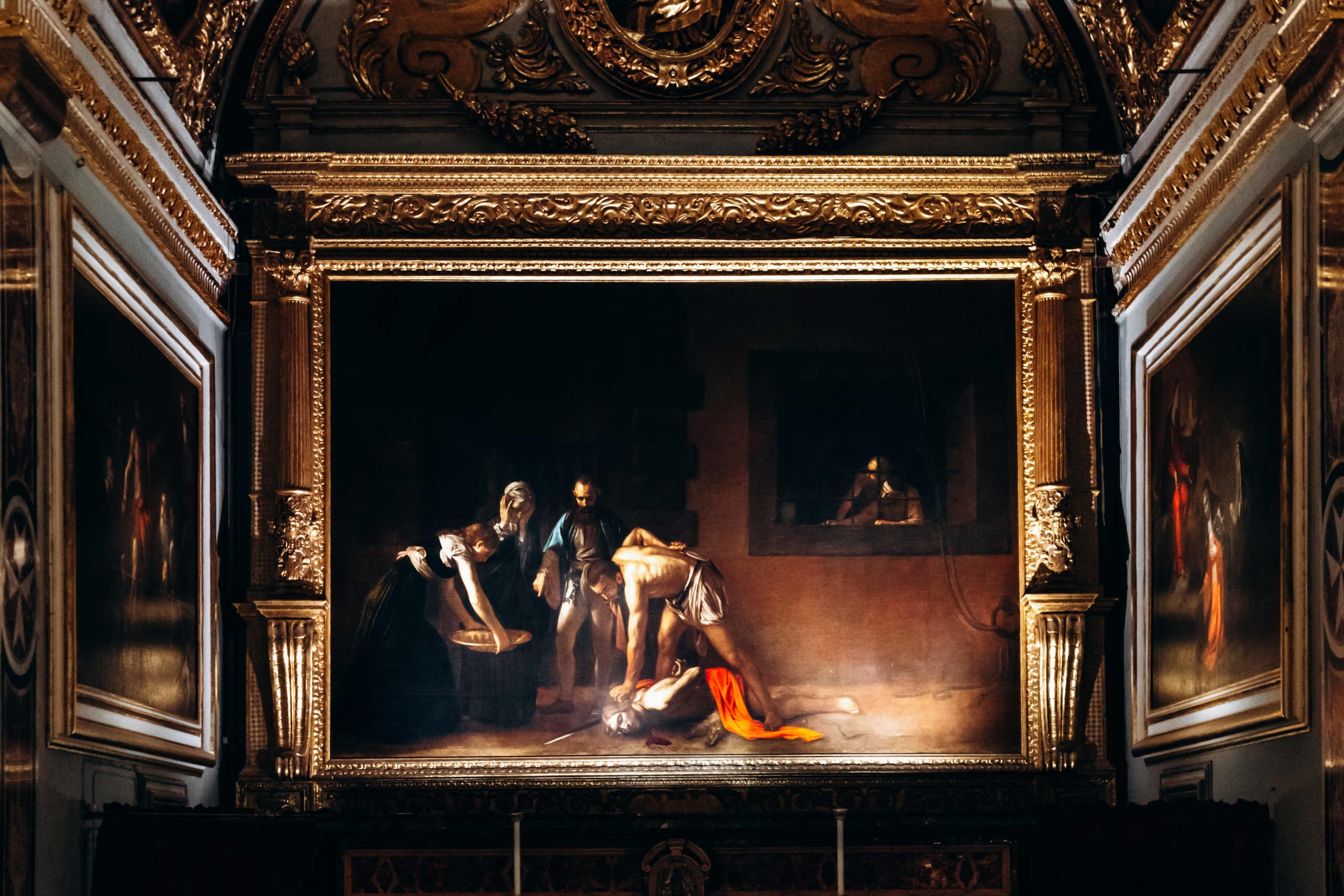
The Beheading of St John the Baptist, painted in 1608, measures approximately 360 by 520 centimetres. It is the largest work by Caravaggio and the only one generally accepted as signed by him. It was conceived for the Oratory itself and remains there still.
The scene does not depict a glorious martyrdom. The initial blow has already fallen. The Baptist lies on the ground while the executioner bends to complete the act. A young woman holds a platter; an older woman reacts with horror; two prisoners watch from an opening in the wall.
The scale of the canvas makes the represented space appear to continue the real space of the Oratory. Seeing it there is therefore not the same as viewing a painting transferred to a museum gallery. The architecture, the altar, the position of the viewer and the painting were conceived as parts of a single experience.
St John’s also preserves another Caravaggio, St Jerome Writing, painted around 1607. Far more intimate, it shows an elderly man absorbed in writing. The work originally belonged to Fra Ippolito Malaspina, was later bequeathed to the Chapel of Italy, stolen from the co-cathedral in 1984 and recovered in 1987. Since 2021 it has been displayed in the Caravaggio Wing.
How to visit today
The tourist visit to the Co-Cathedral of St John is open Monday to Saturday from 09:00 to 16:45, with last entry at 16:00. On Sundays and public holidays it is closed to tourist visits.
For those with Caravaggio as a priority, the best option is to arrive at opening time. An effective itinerary might begin with the nave and the floor, continue through Preti’s vault and the principal chapels, and conclude in the Oratory and the Caravaggio Wing. Personal photography is permitted without flash, and appropriate dress is required; stiletto heels are prohibited to protect the marble pavement.
When the visitor steps back out into the streets of Valletta, the sobriety of the façade takes on a different meaning. St John’s is not simply an austere church concealing a spectacular interior. It is the result of several centuries of transformation: a church born in a military city that ended by becoming an aristocratic setting, a mausoleum, a painting gallery and a great visual archive of the Order.
Perhaps that is why its most enduring image lies not only in the gilding of the vault or in the darkness of Caravaggio. It lies also in the floor. After almost two hours of walking among symbols of power, victories, coats of arms and monuments, the visitor discovers that much of the history of those knights was written from the very beginning beneath their own feet.
This content comes to you in collaboration with VisitMalta
AI Transparency Notice
PilgriMaps uses artificial intelligence tools to assist in the research, drafting and translation of editorial content. All AI-assisted content is reviewed, edited and verified by our editorial team before publication. We contrast information against primary sources, specialist literature and on-the-ground knowledge to ensure accuracy, cultural sensitivity and editorial integrity.
AI is one tool among many in our workflow. The judgement, curation and responsibility for everything published on this platform remain entirely human.
Viator Media S.L. — in compliance with the EU Artificial Intelligence Act (Regulation EU 2024/1689).
This post is also available in: