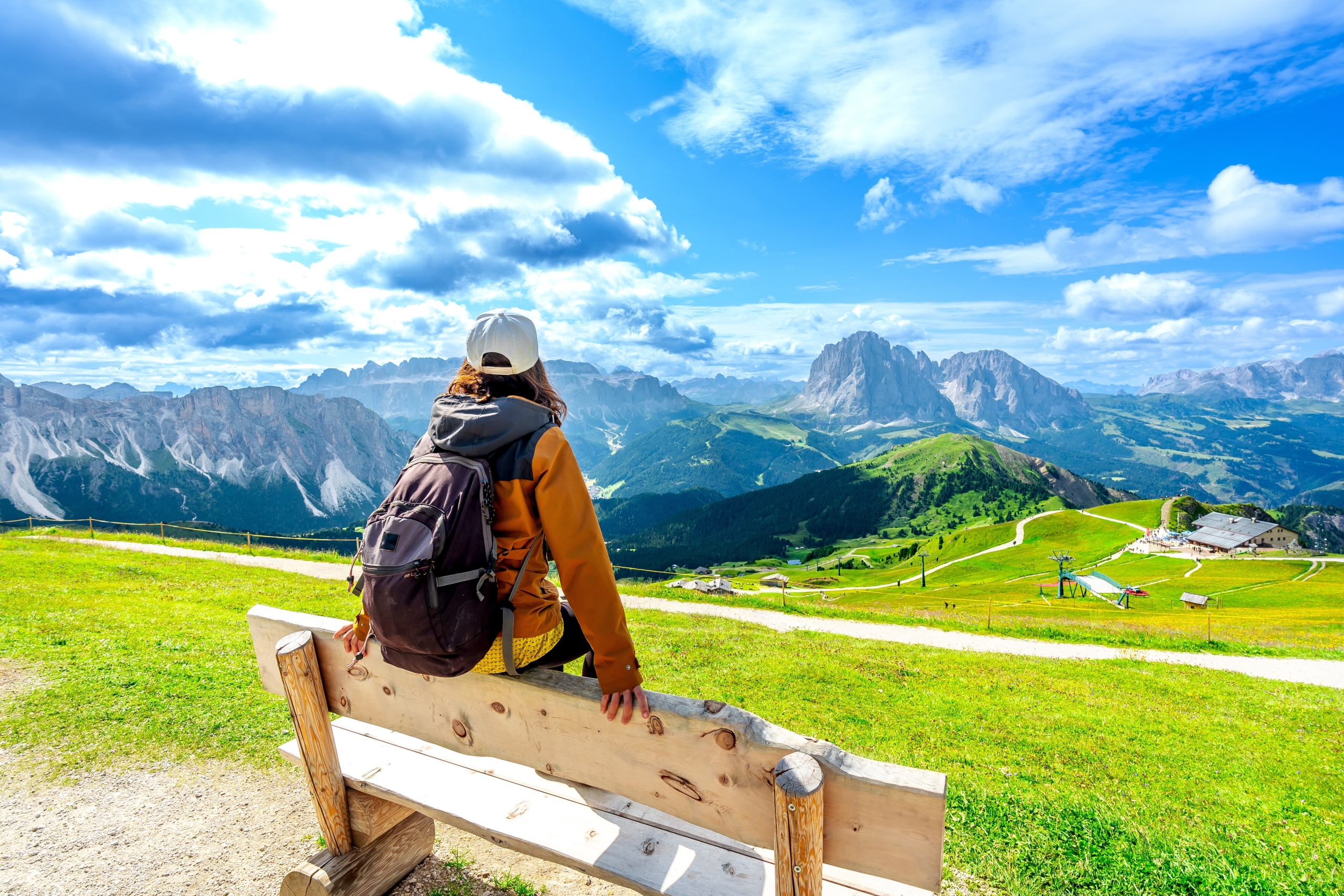
How many times, on a long walk, have you stopped to take in a view — a valley opening suddenly after hours of forest, a Romanesque bell tower against the light, a sky full of stars with not a single lamp in sight? Images that catch us off guard and make us feel, for just a moment, like tiny points in the universe.
English has a single word for that sensation: awe. Italian needs several — stupore, meraviglia, soggezione — wonder, amazement, reverence. For centuries it was the territory of poets and mystics. For the past twenty years it has also been the territory of the laboratory, and the results are compelling enough to suggest that wonder may be one of the deep reasons we flourish.
The “small self,” photographed
In 2020, a team led by Virginia Sturm at the University of California San Francisco, working with emotion psychologist Dacher Keltner, recruited sixty older adults and sent them on a fifteen-minute walk once a week for eight weeks. Half of them were given one additional instruction: during the walk, actively seek moments of awe. Look at the world through the eyes of a child seeing everything for the first time. The others simply walked.
At the end of each outing, participants took a selfie. When the researchers analyzed the photos, they found something nobody had anticipated: week by week, those who had been seeking wonder made themselves smaller and smaller in the frame, letting the landscape in, and their smiles grew broader (Sturm et al., Emotion, 2020). It was the “small self” made visible — literally photographed.
The awe group reported more prosocial emotions, more gratitude and compassion, and less everyday distress. The decisive detail is that the control group had actually walked more. It was not the exercise. It was the orientation toward wonder. A single instruction had been enough to change the chemistry of the experience — and therefore the experience itself.
A medicine that expands time and reduces inflammation
The “small self” is at the heart of the mechanism. Awe works by shifting attention away from one’s own ego toward something vast that contains it: a mountain range, a cathedral, a starlit night, even a crowd at prayer. In that decentering, personal problems shrink along with us, and this opens space for others. In a series of experiments, Paul Piff showed that people induced to feel awe become more generous and more willing to help (Piff et al., 2015). Wonder, counterintuitively, does not close us in on ourselves. It opens us.
Awe also acts on the perception of time. Several studies suggest that people who experience awe feel they have more time available — they become less impatient, prefer experiences over objects, and report greater life satisfaction (Rudd, Vohs and Aaker, Psychological Science, 2012). The reason: awe pins us to the present, and in the present, time stops slipping away. It is exactly the sensation the pilgrim knows — the one that makes a week on the road feel worth months of ordinary life.
There is even a trace of this in the blood. Positive emotions have been found to correlate with lower levels of an inflammatory marker linked to numerous chronic diseases. And among all the positive emotions measured, awe was the strongest predictor of those reduced levels (Stellar et al., Emotion, 2015). Said plainly: wonder, beyond making us feel better, appears to correlate with a less inflamed body.
Why slow walking is a factory of awe
If awe does all of this, then walking pilgrimage is one of the most effective devices humanity has ever invented for producing it — and for a reason that has everything to do with slowness. Awe arises from two ingredients, according to the model proposed by Keltner and Jonathan Haidt: vastness, something that exceeds our habitual scale, and the need for accommodation, something that does not fit our existing frameworks and forces us to enlarge them.
Speed is the enemy of both. By car, by plane, behind a screen, vastness slides past before it can touch us. On foot, at five kilometers an hour, the landscape has time to enter. A climb earned with short breath makes the valley below, once you reach the top, immeasurably vaster than the same view from a window. Slowness is not incidental to pilgrimage. It is the condition that allows awe to happen.
And here is something that democratizes the whole picture. Sturm’s study asked for fifteen minutes a week and an intention: to look while seeking wonder. Awe does not depend only on the grandeur of what we look at, but on the disposition with which we look. It can be trained like a muscle, and it can be found in a shaft of sunlight through leaves just as surely as before a cathedral. Pilgrimage holds no monopoly on wonder. What it teaches, better than any other experience, is how to recognize it — because it removes the hurry that at home makes wonder invisible.
One question remains, and I leave it with those who walk and those who have no time to. If feeling small before something vast makes us healthier, more generous, and richer in time, perhaps our malaise does not come from having felt too unimportant — but from having built lives in which we never stop long enough, before anything, to finally feel small.
Principal sources: V. E. Sturm et al., “Big Smile, Small Self: Awe Walks Promote Prosocial Positive Emotions in Older Adults,” Emotion, 2020; M. Rudd, K. D. Vohs and J. Aaker, “Awe Expands People’s Perception of Time, Alters Decision Making, and Enhances Well-Being,” Psychological Science 23(10), 2012; J. E. Stellar et al., “Positive Affect and Markers of Inflammation: Discrete Positive Emotions Predict Lower Levels of Inflammatory Cytokines,” Emotion 15(2), 2015; P. Piff et al., “Awe, the Small Self, and Prosocial Behavior,” Journal of Personality and Social Psychology, 2015; D. Keltner and J. Haidt, “Approaching Awe, a Moral, Spiritual, and Aesthetic Emotion,” Cognition & Emotion, 2003.
AI Transparency Notice
PilgriMaps uses artificial intelligence tools to assist in the research, drafting and translation of editorial content. All AI-assisted content is reviewed, edited and verified by our editorial team before publication. We contrast information against primary sources, specialist literature and on-the-ground knowledge to ensure accuracy, cultural sensitivity and editorial integrity.
AI is one tool among many in our workflow. The judgement, curation and responsibility for everything published on this platform remain entirely human.
Viator Media S.L. — in compliance with the EU Artificial Intelligence Act (Regulation EU 2024/1689).
This post is also available in: