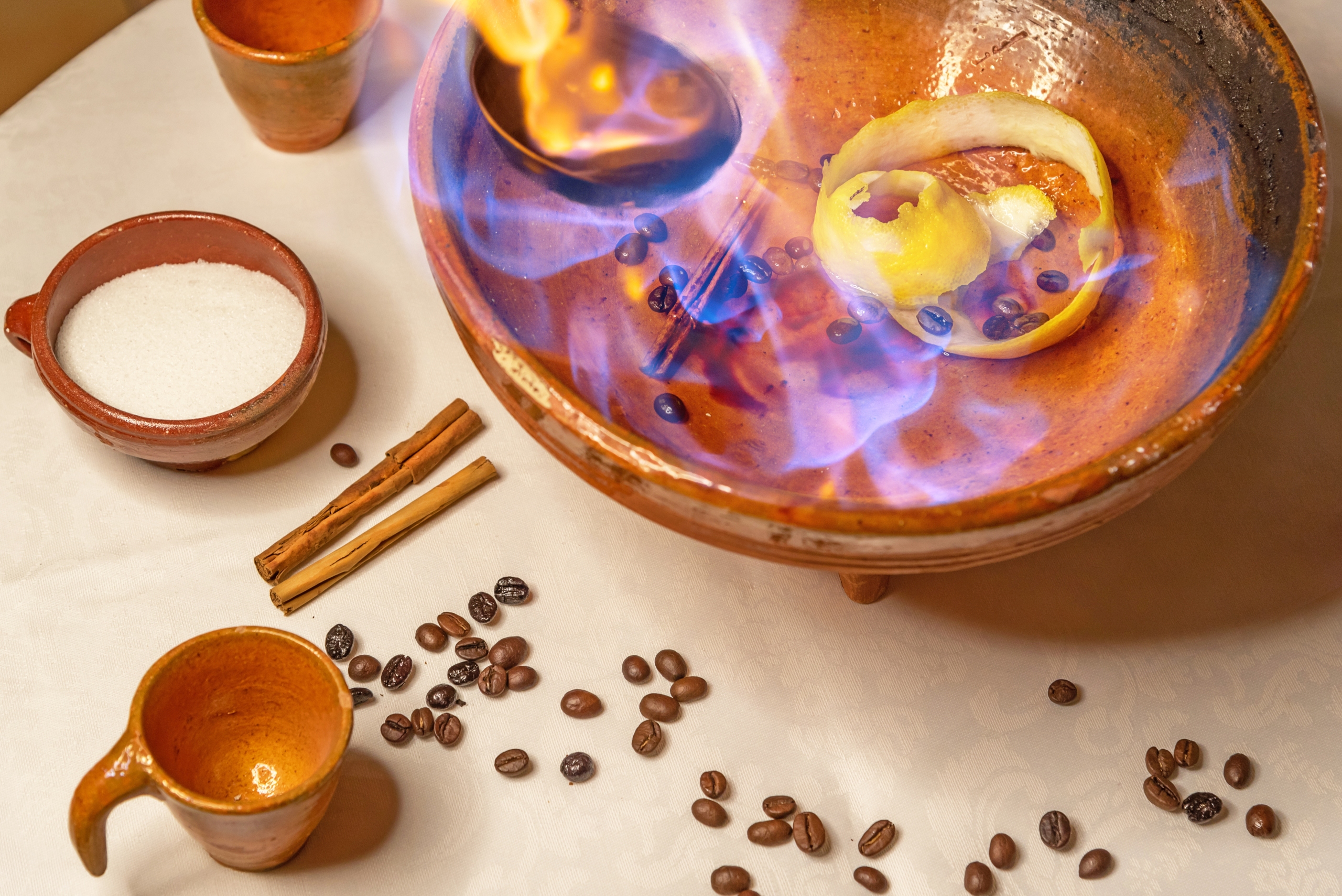
The first thing that strikes you is the colour. A blue flame, almost electric, dancing on the surface of a dark liquid inside a terracotta bowl. Someone switches off the lights in the tavern. The ladle rises, the fire pours like running water, and for an instant the room stops breathing. Then a voice, deep and slightly theatrical, begins to list owls, toads, witches and spirits of the mists. Everyone smiles; nobody quite laughs. This is the queimada, and anyone seeing it for the first time would swear they were witnessing a Celtic rite that had survived the centuries.
The truth is more interesting.
A bank clerk, an impounded ship, a myth
The text recited today in every corner of Galicia, from the Camino de Santiago to the tourist restaurants of Vigo, has an author, a place and a date. It was written in Vigo in 1967 by a clerk at the Banco Pastor, Mariano Marcos Abalo, who died in 2022 pleased to have given life to a myth.
The scene of its birth could have come from a novel by Álvaro Cunqueiro: Marcos Abalo and his friends used to meet aboard an old impounded ship entrusted to its chief engineer, where from time to time they would organise queimadas and dances.
The conxuro, the spell, grew over the years. In 1974 the author added the references to Satan and Beelzebub and began performing it on stage at the Fausto nightclub in Vigo. Then something happened that every scholar of communication ought to study. A local printing house began selling copies of the text, first without authorisation and later paying him a peseta a copy. Other companies imitated it without mentioning his name, and this is precisely what helped create the belief that the author was anonymous. His name disappeared, and its place was taken by the most powerful word in cultural marketing: tradition. Only in 2001 did Marcos Abalo register the intellectual property of the conxuro.
His comment, reported in the Galician press, is the finest manifesto of retranca, the subtle irony typical of Galicia: for him it was a matter of pride that the text should travel the world even without earning him a euro.
The invention of tradition, Atlantic edition
In 1983 the historian Eric Hobsbawm, together with Terence Ranger, published The Invention of Tradition (Cambridge University Press), demonstrating that many rites perceived as ancestral — from Scottish kilts to the ceremonies of the British monarchy — were nineteenth-century creations born to answer a need for identity. The queimada is a textbook case, with one peculiarity: its invention took place in full view of everyone, in the age of mass tourism, and it worked all the same.
Why? The answer lies in the ground the seed fell on. Galicia was already a country inhabited in the imagination by meigas, the benevolent and malevolent witches of folklore, and by the Santa Compaña, the nocturnal procession of souls that wanders the paths. The conxuro gathered up this widely held imagery and gave it a recitable, rhythmic, collective form. The variants circulating today all invoke the Santa Compaña, the meigas, Satan and Beelzebub as presences to be kept away from those present and from the souls of relatives and friends, through the purifying power of the flames.
The drink, older than its spell
If the spell has a recent date of birth, the drink has deeper roots. The base is aguardiente, Galician pomace brandy, worked with sugar, lemon peel and coffee beans, sometimes apples or raisins. The Celtic origin, however, remains a suggestion. The distillation of aguardiente in Galicia does not predate the arrival of the alembic, placed between the twelfth and thirteenth centuries, and the most likely origin of the drink is therefore medieval. The Celts knew beer and mead; the alembic came much later, through Arab chemistry and the monasteries.
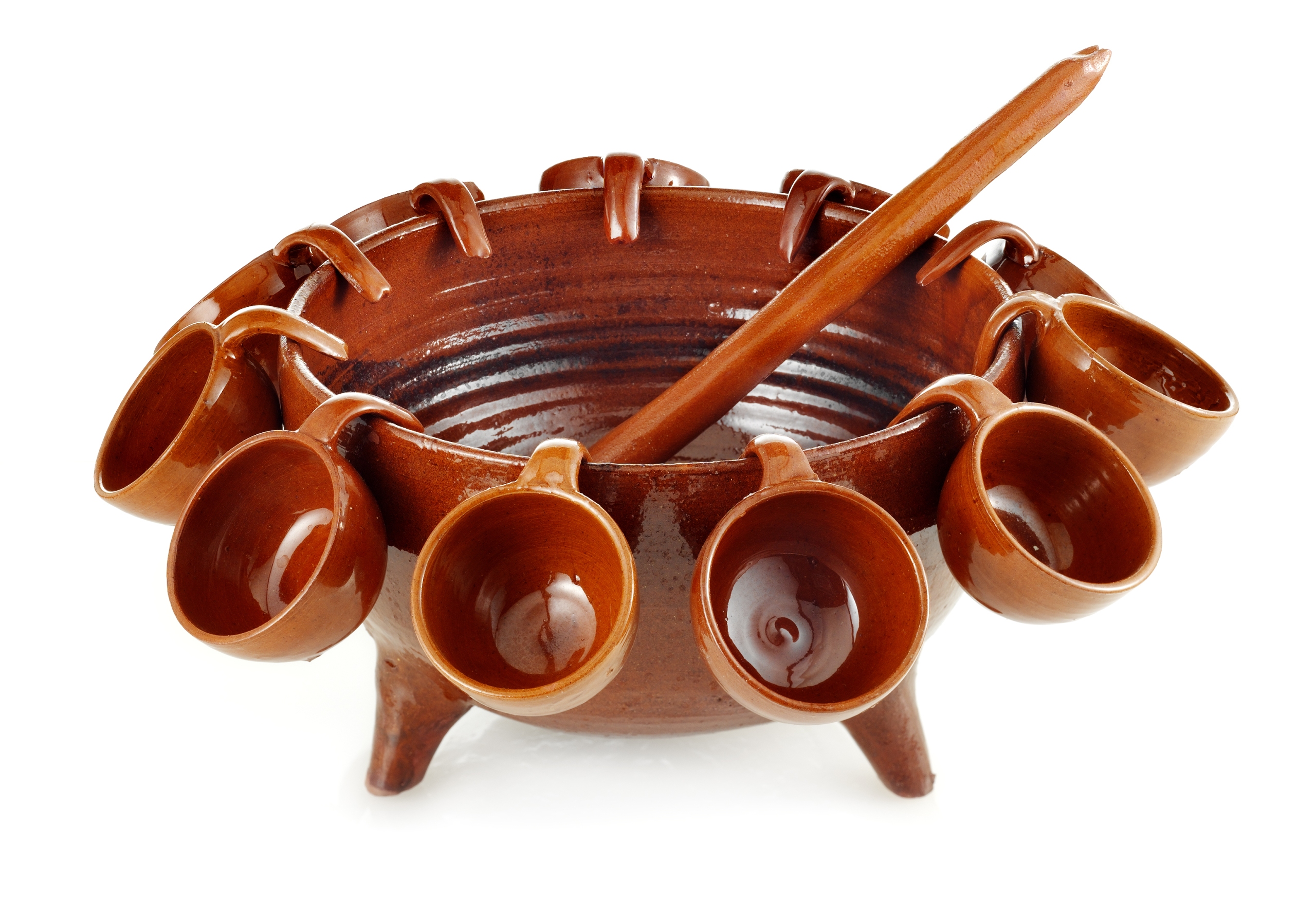
Then there is the vessel, which is the altar of the rite. The traditional bowl is terracotta, and the mind turns to Buño, on the Costa da Morte, where the activity of potters is documented from the sixteenth century in the parish archive. Even today the workshops of the village list queimada bowls among their signature pieces. Matter, fire, word: the elements of every rite in the world, from the Vedic fire to the censer of the Easter Vigil.
There is also a chemical reason behind the spectacle. The flame consumes part of the alcohol and caramelises the sugar; the longer it burns, the sweeter and lighter the drink becomes. The rite, in short, has a practical function: the time of the spell is the cooking time. Whoever recites too quickly drinks something stronger. Whoever recites calmly drinks better.
From the Camino to the table: the rite as experience
For the pilgrim arriving in Santiago after weeks of walking, the queimada has a precise flavour: that of the threshold. It is drunk to close a day, a friendship born on the Camino, an entire journey. Today it is part of Galician cultural DNA: it is prepared at the autumn magostos, on the night of San Juan, at family celebrations, in tourist restaurants and in gatherings scattered around the world.
Here cultural tourism meets an uncomfortable question. Is an invented rite less authentic? The Galician experience suggests the opposite. Authenticity lives in participation, in a gesture’s capacity to generate belonging, rather than in the age of a text.
The last flame
Let us return to the tavern. The voice falls silent, the ladle is set down, someone covers the bowl and the blue flame goes out with a breath. The lights come back on, the small terracotta cups pass from hand to hand. The liquid is warm, sweet, bitter with coffee, fragrant with lemon. The person at the next seat, a stranger until half an hour ago, raises their cup.
Marcos Abalo wrote his spell to drive witches away. Perhaps, without knowing it, he had written one to bring people closer. And a question remains open that holds for every tradition in the world: how many of the things we call ancient are simply stories we have decided, together, to keep telling?
AI Transparency Notice
PilgriMaps uses artificial intelligence tools to assist in the research, drafting and translation of editorial content. All AI-assisted content is reviewed, edited and verified by our editorial team before publication. We contrast information against primary sources, specialist literature and on-the-ground knowledge to ensure accuracy, cultural sensitivity and editorial integrity.
AI is one tool among many in our workflow. The judgement, curation and responsibility for everything published on this platform remain entirely human.
Viator Media S.L. — in compliance with the EU Artificial Intelligence Act (Regulation EU 2024/1689).
This post is also available in: