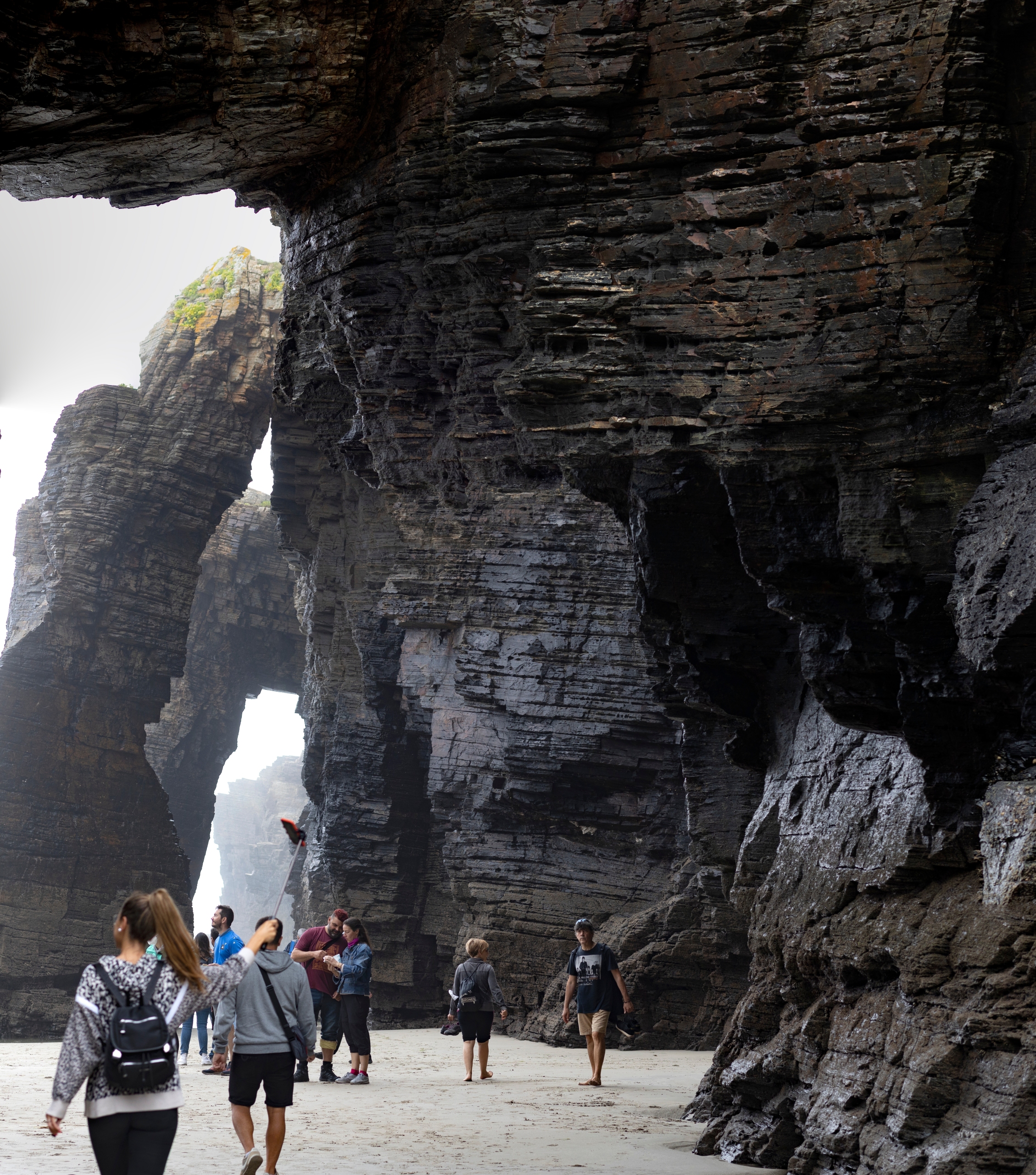
The walker descends the last steps and, suddenly, the landscape changes scale. A few minutes ago he was moving along the top of the cliff; now he is treading white, damp sand between dark rock walls that seem to grow with every step. Before him a corridor opens. Beyond it, a gigantic arch lets light through and frames the sea. To cross it feels strange: for a moment it seems as though he has entered a stone temple.
The tide has just gone out, exposing one of the most singular landscapes on the Galician coast. At the Praia das Catedrais in Ribadeo, the waves have been working for centuries on slate and quartzite, following fractures, widening cavities and opening tunnels and arches that at some points reach around thirty metres in height.
Perhaps that is why the name by which this place is now internationally known feels so easy to grasp. When low tide allows you to walk among the great arches, the comparison with a cathedral arises almost spontaneously.
That image has also given rise to a tourism slogan. The Concello de Ribadeo invites the pilgrim to experience a journey “from cathedral to cathedral”: beginning before this natural cathedral of the Cantabrian Sea and ending, many kilometres later, before the cathedral of Santiago de Compostela.
The formula seems perfect. A cathedral shaped by the sea at the Galician gateway of the Camino del Norte; another raised by human hands at the end of the pilgrimage. Between them, the Camino.
There is only one problem: the Camino del Norte does not officially pass through As Catedrais.
The “from cathedral to cathedral” campaign does not, therefore, describe a real stage of the Camino. But nor does it establish a purely artificial connection. Between the beach, Ribadeo and the pilgrimage there exist tourist, walking and historical links that allow a rather more interesting story to be told than that of a simple detour.
The metaphor of the two Cathedrals
The first connection lies in the landscape itself and in the force of the metaphor.
As Catedrais — historically also known as Praia de Augas Santas — occupies a stretch of the Ribadeo coastline, at the eastern end of the Lugo coast. The Natural Monument covers 28.94 hectares and forms part of both the Natura 2000 network and the Río Eo, Oscos e Terras de Burón Biosphere Reserve.
Its monumental appearance might suggest stable architecture, but geologically the opposite is true. The sea opens cavities in the cliff; some end by piercing the headlands to form tunnels and arches; others collapse and leave isolated stacks or islets.
The “cathedral” is unfinished. And it never will be.
The comparison with a cathedral, then, is born not only from the shape of the arches, but also from a particular experience: entering for a few hours a stone space that the sea opens and then closes again. At high tide, much of the beach is covered. At low tide the surface emerges that allows you to walk among the rock formations. The Xunta recommends organising the visit within approximately two hours either side of low tide.
But the true Jacobean connection must be sought a few kilometres further on, in Ribadeo.
Ribadeo, gateway of the Camino
The Camino del Norte enters Galicia from Asturias today by crossing the estuary on the Ponte dos Santos. For centuries, however, many travellers made that crossing by boat. Ribadeo was thus a genuine arrival and transit point for those continuing their journey toward Santiago.
The town also preserves a history closely tied to the reception of pilgrims. Municipal records recall the founding, in 1206, of the Hospital da Barca, linked to the free transport of travellers between the two banks.
In the town itself there was also the Hospital de San Sebastián, intended for the poor, the sick, those passing through and pilgrims. In 1550 it is documented as having twenty beds. Further along the route, the itinerary passed through San Lázaro and A Ponte de Arante, where another hospital for the poor and for pilgrims operated from the 16th century.
Ribadeo’s Jacobean dimension is therefore not a recent tourist addition. It is part of its history. But on leaving the town, the Camino stops following the Cantabrian coastline and heads inland toward Lourenzá. As Catedrais, as we have said, is not an official stage of the Camino.
The road that does reach As Catedrais
From Ribadeo the beach can be reached on foot along a waymarked itinerary. This is the Camino Natural de la Ruta del Cantábrico, a route distinct from the Camino de Santiago.
Its first stage links the centre of Ribadeo with As Catedrais over just over 18 kilometres. The route passes through Porcillán, O Cargadoiro, the Fort of San Damián, Illa Pancha, several hillforts, Rinlo and its old fish tanks, Os Castros, As Illas and Esteiro before finally reaching the beach.
Here the slogan “from cathedral to cathedral” acquires a first tangible dimension: a pilgrim can temporarily leave the Jacobean route at Ribadeo, keep walking along the Cantabrian coast and reach the beach under their own steam.
An ancient road beside the sea
The connection between pilgrimage and the coast does not end with the current paths. Historical documentation introduces a third itinerary, far harder to follow on the ground: the so-called Camiño do Mar.
In a study published in 2011 in the academic journal Ad Limina, researcher Xosé Ramón Fernández Pacios analysed medieval and modern sources that allow the reconstruction of an ancient coastal corridor.
According to that research, in the area around Ribadeo travellers could find two directions. One led toward Lourenzá and Mondoñedo, close to the current official route of the Camino del Norte. Another continued closer to the sea, passing through the area of Santiago and San Miguel de Reinante, Barreiros, A Espiñeira and, later, Viveiro. The author interprets this second route as a historical fork of the Camino del Norte.
Even so, the study does not expressly mention As Catedrais or Augas Santas as a Jacobean stopping point. We cannot say that medieval pilgrims walked beneath the current arches of the beach, nor that the modern Camino Natural reproduces exactly that ancient route.
A prologue before Santiago
For the contemporary pilgrim, that distinction also has practical consequences.
Walking the Camino Natural from Ribadeo to As Catedrais covers just over 18 kilometres. At walking pace it can take around five hours, not counting stops at Illa Pancha, Rinlo or the beaches.
The official stage from Ribadeo to Lourenzá adds a further 28.2 kilometres. Attempting to combine both routes in a single day would turn the visit into a disproportionate effort for most walkers.
The most reasonable option is to treat As Catedrais as an excursion from Ribadeo. Those with time can walk the coast and return afterwards by public transport. Those who prefer to save their energy for the pilgrimage can visit the beach more directly and continue the following day toward Lourenzá.
Understood in this way, As Catedrais does not need to be artificially turned into a Jacobean stage. It can play a more evocative role: that of a kind of prologue to the Galician Camino.
The visitor who descends to the beach at low tide can walk for a few minutes among those enormous rock formations and feel that they are passing through a cathedral without a roof, without an altar and without an architect. Afterwards they will return to Ribadeo and, if they are a pilgrim, take up another road: the one that leaves the sea behind and advances, step by step, toward Compostela.
The second cathedral will come many kilometres later. Between the two there is no continuous line of yellow arrows. There is something more interesting: a landscape of overlapping roads, historical memory and pilgrimage, in which the coast and Santiago meet without any need to confuse their routes.
AI Transparency Notice
PilgriMaps uses artificial intelligence tools to assist in the research, drafting and translation of editorial content. All AI-assisted content is reviewed, edited and verified by our editorial team before publication. We contrast information against primary sources, specialist literature and on-the-ground knowledge to ensure accuracy, cultural sensitivity and editorial integrity.
AI is one tool among many in our workflow. The judgement, curation and responsibility for everything published on this platform remain entirely human.
Viator Media S.L. — in compliance with the EU Artificial Intelligence Act (Regulation EU 2024/1689).
This post is also available in: